Recent Articles
Tuesday, July 31, 2012
Tuesday, July 31, 2012
- 1 Comment
I'm getting out of London for a few weeks. For a holiday I plan to walk from Calais to Amsterdam.

If you are so inclined, you can follow my journey here:
Normal service will resume in a fortnight or so.
Monday, July 30, 2012
Monday, July 30, 2012
- 0 Comments

One of the nicer London experiences it's possible to have is happening upon a sign with 'Gallery' and an arrow pointing somewhere on it. You can end up in the strangest places, often places so interesting that the art can take a bit of a back foot to the location. 'Points of Contact' is art exhibited in such an atmospheric space that the gallery itself can seem like the most interesting piece of all. This isn't to say that I didn't enjoy the art at 'Points of Contact', more that heading into a dark, old and cobwebby space underground in central London is one of my favourite things.
 |
| Entrance to the crypt. |
I mean, look at that entrance! Who wouldn't want to head for a look around down there? Hosting art exhibitions in a crypt gives proceedings a rather solemn affair, the air is cool and still, and as it was fairly empty when I attended, it was also very quiet. The walls and floor were unadorned brick, and corridors lead to small, dark and slightly claustrophobic rooms. In a space like this you begin to wonder where all the bodies are, there is the occasional tomb marker here and there, but on the whole the place seems to have been stripped of much mention of its inhabitants. There is a pile of tombstones in the centre, which I assume would have once occupied the walls of the space.
 |
| Tombstone Blues |
Fortunately, the art exhibited within tended to complement the atmosphere of its surroundings rather than be overpowered by it. The artists exhibited here all studied at the Working Men's College in Camden for a Foundation Degree in fine art, presumably they have learnt at the same rate therefore meaning that the art on show has some familial relationship to each other. The pieces might be from a variety of different artists with widely varying things to say, but they all spring from approximately the same source. The work is multi-disciplinary, encompassing sculpture, found objects, paintings and audio-visual work.
 |
| Halo of Eggshells |
Among the highlights that I particularly enjoyed was Phoebe Smiths's 'Place of Safety', a halo of crushed eggshells on the floor of the gallery. It's a neat little visual joke that rewards you for 'getting it'. I like the fact that it's laid out in a kind of halo, I suppose if you're exhibiting under a church then it feels quite appropriate. It made me wonder if the church puts any restrictions on what can be shown in its gallery or not. The sometimes uneasy relationship between religion and art could neatly be described as walking on eggshells - and visitors to the gallery literally get to do that here. As we are directly underneath the church, the congregation walking above also gets to do it, albeit unwittingly.

Another piece I liked was Jane Musgrove's 'The Timbre of Your Voice' a collection of books sealed in wax. They belonged to the artist's father, who took possession of them after he died. The books were in another language, and unreadable to the artist so they've were sealed in wax. It's a quite striking effect, effectively freezing the text written inside them. This, like the eggshells above is nicely tactile - we're invited to pick up and handle them. I generally enjoy art like this that seeks to stimulate more senses than just sight. Here, being able to hold the book seems to create a paradox - if I really wanted to it would have been possible for me to crack the wax shell open, but the text within themselves would still have been impenetrable to me. The only really valid way for me to interact with them is as objects, and them being sealed in wax underlines that fact.

Walking further down the corridors of the crypt we come to Andy Charalambous' ultraviolet starburst creation. This is accessible from a two different places in the gallery, one close to the epicentre of the 'burst', and one at the outer ends of it. Both are interesting viewpoints, although I preferred getting up closer to the centre. The taut strings that compromise the bursts of light look like laser beams from a distance, and it is only upon getting closer that you notice them gently swaying in the light breeze. This is a piece that can only work properly in a lightless area - without the ultraviolet glow it would be pretty dull. Even in the dark of the crypt some light intrudes upon it at the far end, ever so slightly spoiling the effect. Even so, the scale of the piece is great, and as an effort to physically capture the action of light in motion in a static object it succeeds.

In this exhibition, more than many I've seen in London lately, the art seems to live or die by how well it fit into the aesthetic of the crypt. I'm not sure I would have enjoyed Celine Samson's piece, 'The Ghost Diner' (the white, plaster pieces in the picture above) if they didn't bring to mind a row of gravestones and complement the slightly morbid surroundings. Having a space like this to display in allows you to be dramatic with your lighting, the artist has almost complete control of how things look without having to be concerned with daylight or street light pollution. The whiteness of the material above gets picked out by the light, looking clean and fresh against the grimy Victorian walls of the crypt. It serves them well - in a modern gallery where the walls are invariably pure white they would run the risk of 'melting' into the background.

Jane Musgrove's collection of hanging feet - 'Still' - are another example of the location complementing the art. The positioning of these casts of feet, using clingfilm and sticky tape injects an element of humanity into a place notable by its absence of representations of people. There were numerous casts hanging in front of the one pictured above, but this one in particular stood out due to its position. We can presume that directly below them are a collection mouldering Victorian skeletons, the last physical remnants of individuals, so it seems fitting that surrounding them are the physical impressions that the artist has left of herself. Whereas in that stone box are the inner framework of what's left of people long passed, the art surrounding it shows the outer impression of someone that's still alive. Maybe as a juxtaposition it's a little on the nose, but it's still pretty neat and manages to make a point while showing some reverence for the dead whose homes the artists have temporarily occupied.

There were a few pieces that I don't think worked particularly well down here. The majority of the two dimensional paintings and photographs were overpowered by the architecture they were placed in. Aside from that, some of the subject matter and form seemed at odds with the sepulchral atmosphere, especially Andy Charambolous' photographs representing physical representations of Feynmann diagrams. While a very neat idea, and well executed, theoretical science just didn't seem to work in the context of a crypt. I'm all for an exploration of the conflict between hard science and contemplative mysticism, but in this location it's an all or nothing proposition - you either devote the entire place to it or don't. It's for this same reason that I didn't think Maureen Klingels-Pruss' sculpture pictured above worked - despite being a beautiful and finely executed object - here it tends to meld with the walls of the crypt and the hard, cold, clinical lines are too much at odds with its dirty, dusty, mildewy surroundings.
For something randomly wandered into from off the street this was a very nice exhibition, and upon writing this article I wished I had taken more photos. I very much enjoyed the blocks of soap, the book of buttons and the 'lightbox' off in one of the rooms, but unfortunately forgot to photograph them. What this exhibition underlined for me is the importance of making sure art is complemented by the space its placed into and vice versa. St Pancras' church crypt has such a unique atmosphere that it becomes almost immediately apparent when a piece seems is working against it. I'm sure that my opinion of much of the art I didn't think so highly of would be changed having seen them in a more sterile gallery environment, or that some of the things I very much enjoyed were largely because of where they were, not what they were.
Edit: Thanks to Celine Samson for updating me as to the names of the pieces and the artists that made them.
Edit: Thanks to Celine Samson for updating me as to the names of the pieces and the artists that made them.
'Points of Contact' is at the Crypt Gallery, St Pancras church until the 1st of August 2012, 11am to 7pm

Very soon a momentous event in sporting history is about to take place. At the London Olympics, double amputee Oscar Pistorius will compete in the able-bodied 400m and 4x400m relay races. If he wins these events, something will change forever in athletics - a man relying on an external prosthesis, his 'blades', will have beaten the able-bodied athletes on a world stage. The notion of a physically augmented athlete being the most efficient and quickest contender will take firm hold, inevitably raising a number of ethical arguments about the relationship between the human body and technology.
 |
| Oscar Pistorius competing with able-bodied athletes. |
It all sounds like cutting edge scientific debate - a conversation that previously would have been relegated to science fiction - but the Wellcome Collection's new 'Superhuman' exhibition outlines the long history of how men and women have replaced or extended their bodies capabilities and senses, as well trying to explore where we may be heading.
The first exhibit we encounter in the exhibition is a small statue of Icarus dating from ancient Greece. This is not exactly a cheery start to the exhibition, but it does seem appropriate. The notion of a millennia old story about the dangers of relying too much on technology shows us that these are issues that humanity has grappled with in some form or another for millennia.
 |
| Icarus - 1st-3rd century CE, bronze |
One of the things that the exhibition is keen for us to understand is that human augmentation and prosthesis can take many forms. It's not all robot limbs and glowing red eyes - even something as innocuous as a pair of spectacles or a watch can be considered an augmentation. In the first display case we see items as disparate as a pair of Vivienne Westwood shoes, an iPhone and a blister pack of Viagra. We take many items like this for granted, but in a very real sense they can respectively be considered as augmenting beauty, memory and sexuality - three pretty essential components for humanity.
 |
| Viagra (sildenafil citrate) |
Near this is another demonstration of a socially acceptable form of human modification - plastic surgery. In 'Cut Through the Line' a short film by Venezuelan artist Regina José Galindo, we see the artist standing naked (link NWS), with a plastic surgeon drawing marker pen lines across her body to show the changes he would make to her body. The loops and lines he draws across her look beautiful and faintly primal - as if she's being prepared for sacrifice. It's only when you remember that these lines of ink are guides for the scalpel to cut along that you understand the true import. The impact of the film, and the message it sends are quite clear. Galindo clearly has nothing wrong with her physically, yet to judgmental eyes there will always be a nip or a tuck somewhere that'll somehow bring her closer to an imagined universal standard of beauty. Her passivity as she stands naked with bystanders surrounding her, some filming her seems to both show her as a submissive canvas on which the plastic surgeon artist can realise his vision, while also showing her as an individual who is comfortable with her body as it is, and has no qualms about standing naked in front of people. This video outlines a compelling argument against the race for enhancement- would humanity be better off as a race of conventionally beautiful, technologically enhanced superpeople? If you can afford to recreate yourself like this, then where does individuality lie? And what about the people who're left behind?
 |
| Pair of artificial legs for a child (red shoes), Roehampton, 1966 |
The next section of the exhibition that caught my attention was a display about the prosthetics developed in the 1960s to help victims of the Thalidomide tragedy. Pregnant women who'd taken a drug to prevent morning sickness found that their children were born with underdeveloped limbs, and well-meaning experts on prosthesis stepped in to offer their assistance on giving the children a 'normal' life. Displayed at the exhibition are a collection of these prostheses. Decoupled from their owners they look faintly disturbing, limbs constructed of leather, gas-cylinders powering movement with shoes incongruously placed on the feet. What this display highlights is that prostheses like these seem to be more for the benefit of everyone who has to interact with the person using them, rather than to help them. The people creating them doubtless had the best of motives, but the victims of the Thalidomide tragedy seemed to find it far easier to learn to cope with their limitations of their own limbs rather than learn to use these somewhat clumsy replacements. There is an interesting contrast between a video of a child delicately and neatly eating lunch in school using his foot to hold a spon, and of someone in a prosthetic 'suit' awkwardly trying to control arms constructed of hooks and springs. Manipulating one of these devices is described as like "being in a dream, where you can manipulate things, but can't feel them".
My perspective on this seems to be that doctors were in too much of a hurry to 'normalise' these children. The de facto position seems to have been that the conventional human body shape was what should be aimed for above all else. Their mistake was assuming that if a person looks normal, then the assumption must be that they feel normal - a position that conveniently allows able-bodied people to avoid dealing with the disabled person's condition. If someone can learn to utilise their bodies effectively in a way that works for them, irregardless of whether it might appear a little weird to onlookers, then that is something that should be aimed for.
 |
| Thomas Hicks, Marathon Olympic Champion and his supporters at the marathon, St Louis Olympic Games, 1904 |
The next arena we examine is the world of sports. There are two areas to focus on - athletes using drugs to enhance performance, and physical aids. I was amazed to learn that in the early C20th, athletes would use strychnine to improve performance during marathons. The athlete, Thomas Hicks won the 1904 Olympic marathon after taking two doses of strychnine and brandy to ward off exhaustion. Not surprisingly, he collapsed and nearly died after crossing the finish line. A slightly more recent, and more disturbing example is the death of Tom Simpson in 1967. He was competing in the Tour de France on a bakingly hot day, and race rules at the time restricted athletes to about two litres of water per day. On a steep mountain climb he began weaving across the road before collapsing. While a medical team attempted to save his life he urged them to let him continue the race, shouting "Go on! Go on!". Three tubes of amphetamines were later found in his pocket - the drugs prevented Simpson from knowing he was dehydrated: he didn't realise he was dying.
The last minutes of Tom Simpson
Thankfully, deaths like Tom Simpson's are now extremely rare due to advances in anti-doping detection and an awareness of the dangers of doping. Yet athletes still seek to enhance their bodies with banned substances. One exhibit in this section is a fake penis called a 'Whizzinator' that allows athletes to fake urine tests. In a 2012 study by Leeds Metropolitan University it was discovered that athlete's attitudes towards banned substances was generally negative, although many of them understand the temptation. Athletes believe that 37% of their fellow athletes would use a drug if it was undetectable and guaranteed winning - 9% believe that their fellow athletes would use the drug even it led to guaranteed death within 5 years!
This intense desire to win lies at the heart of all professional athletes - arguably they wouldn't be professionals if they didn't have that burning desire for victory within them. It's easy to understand how they can come to rely on the crutch of a banned substance - especially in circumstances where a coach or instructor is advising the use something as safe, morally acceptable or undetectable.
 |
| Pair of blue and yellow Nike waffle trainers, Nike 1977 |
The other, more uplifting side to human augmentation in athletics is physical prosthesis. This ranges from something as simple as running shoes. On display at the exhibition is an early C20th running shoe - it's a fearsome and uncomfortable looking thing made of hard leather and with a flat sole. Apparently athletes used to soak their feet in brine to toughen themselves up to wear it! So it was somewhat of a revolution when Bill Bowerman, coach of track sports at the University of Oregon developed a 'honeycomb' sole and new running shoe design - many of these innovations are still in evidence in running shoe design to this day.
The displays within the exhibitions are in rough chronological order, and as we get to the final rooms we begin to consider the future of human enhancement. There are a variety of theories, ranging from wearable computers, to internal organic implants, to gene therapy and even more science fiction applications of nanotechnology to the human body. One thing that is agreed is the future of humanity almost certainly lies with further augmentation of our bodies and senses.
There are two short films on display here that more than adequately demonstrate the dangers of this. The first tells us a fictional story of an injured US Marine who wins a contest to turn him into a superhero through prosthesis. The film takes the form of his video diary over a number of months - and we see his progression from a handsome and well-adjusted person to a monstrous and disorientated Frankenstein. Initially he starts out happy, enjoying the look of his new 'blade' legs, but as more and more is subtracted from him he begins to lose his humanity. There is one distressing sequence where his arm has been amputated and replaced with a prosthetic "that'll let me punch through walls", but as impressive as this might be, "it isn't so good at the small stuff" like fine motor manipulations. By the end, after he's had radical brain surgery and his eyes replaced by bleeding mechanics there is almost no trace of the excited and charming man at the start of the documentary - he's been replaced by a scarred and disorientated machine.
The other is a 'documentary' about the fictional condition Metalosis Meligna. The report shows us how people's metal implants have begun to take over their body. It's an extremely effective bit of body horror - reminding me of Shin'ya Tsukamoto's Tetsuo: the Iron Man (1989), with pieces of metal invading and taking over people's bodies. While Tetsuo treats this as surreal and frantic, this takes an almost perversely sober look at the 'metalosis' of sufferer's bodies. It's a nice allegory for our relationship with technology, and the dangers of immersion and reliance upon it.
 |
| 'Metalosis Meligna' Floris Kaayk, 2006 |
The final piece of the exhibition is an autonomous wheelchair 'Psalms'. This piece was created by Donald Rodney, a sufferer of sickle-cell anaemia. He was too ill to attend his gallery openings, and a wheelchair was designed to take his place. The piece incorporates a neural network, and it wanders through the exhibition negotiating paths around us using various sensors affixed to it. Rodney died in 1998, and yet his wheelchair still roams the exhibition without him: a prosthesis making a lonely journey without its owner. This none too subtly points towards a possible future for humanity - that we will dissolve into or be replaced by what we have created to aid ourselves.
There is a theory popularised by futurists like Ray Kurzweil known as the 'singularity'. Here is the basic outline of how it may come about:
"Let an ultraintelligent machine be defined as a machine that can far surpass all the intellectual activities of any man however clever. Since the design of machines is one of these intellectual activities, an ultraintelligent machine could design even better machines; there would then unquestionably be an ‘intelligence explosion,’ and the intelligence of man would be left far behind. Thus the first ultraintelligent machine is the last invention that man need ever make." - I.J. Good - 1965
This is sound thinking, but adherents commonly posit the singularity as a quasi-religious enlightenment of the human race. That it'll be a jump towards post-humanism, the end to all of our woes, that we will soon after become immortal, godlike digital intelligences. Thinking like this is one of my major issues with the notion of augmentation as inherently a good thing for the future of humanity. It seems that something like this would inevitably widen the gap between the haves and have nots - sure some people may jump forward, but at the expense of those left behind.
If a person is likely to experience a vast increase in awareness and intelligence due to an application of technology they are far more likely to be an extremely affluent person than, say a subsistence farmer in a Third World country. The gap between life at the lowest end of the poverty scale is wide enough already, and it is worrying to think of a world where the rich can afford to make themselves physically and mentally superior to us. How will these superhumans consider their interactions with us? The wealthy will have perfect photographic memories, be able to survive without sleep or run for miles - can we expect to be able to compete against them with our clumsy and imprecise organic brains and easily worn out and tiring bodies?
These are issues that we are beginning to have to face in the current day. Elderly people who are not connected to the internet risk losing out on essential interactions with their families - separated from them by an intimidating digital wall. As time progresses, we will find ourselves in their position, faced with a society plugged into each other in ways we might not be able to comprehend, or more likely, won't be able to afford.
There is a good argument that while there may be an initial stratification of society it will eventually even out. Look at mobile phones - once a trademark of wealthy financiers in the 1980s, and now a worldwide technology hugely popular and useful in African countries. The spread of the internet, possibly humanity's first global prosthesis is another way in which technology that was once the preserve of the wealthy eventually becomes accessible to all. I consider there be to be obvious silver linings to this cloud, but for a while it may be a pretty dark and forbidding cloud as we race to catch up with those who can afford to make themselves 'superhuman'.
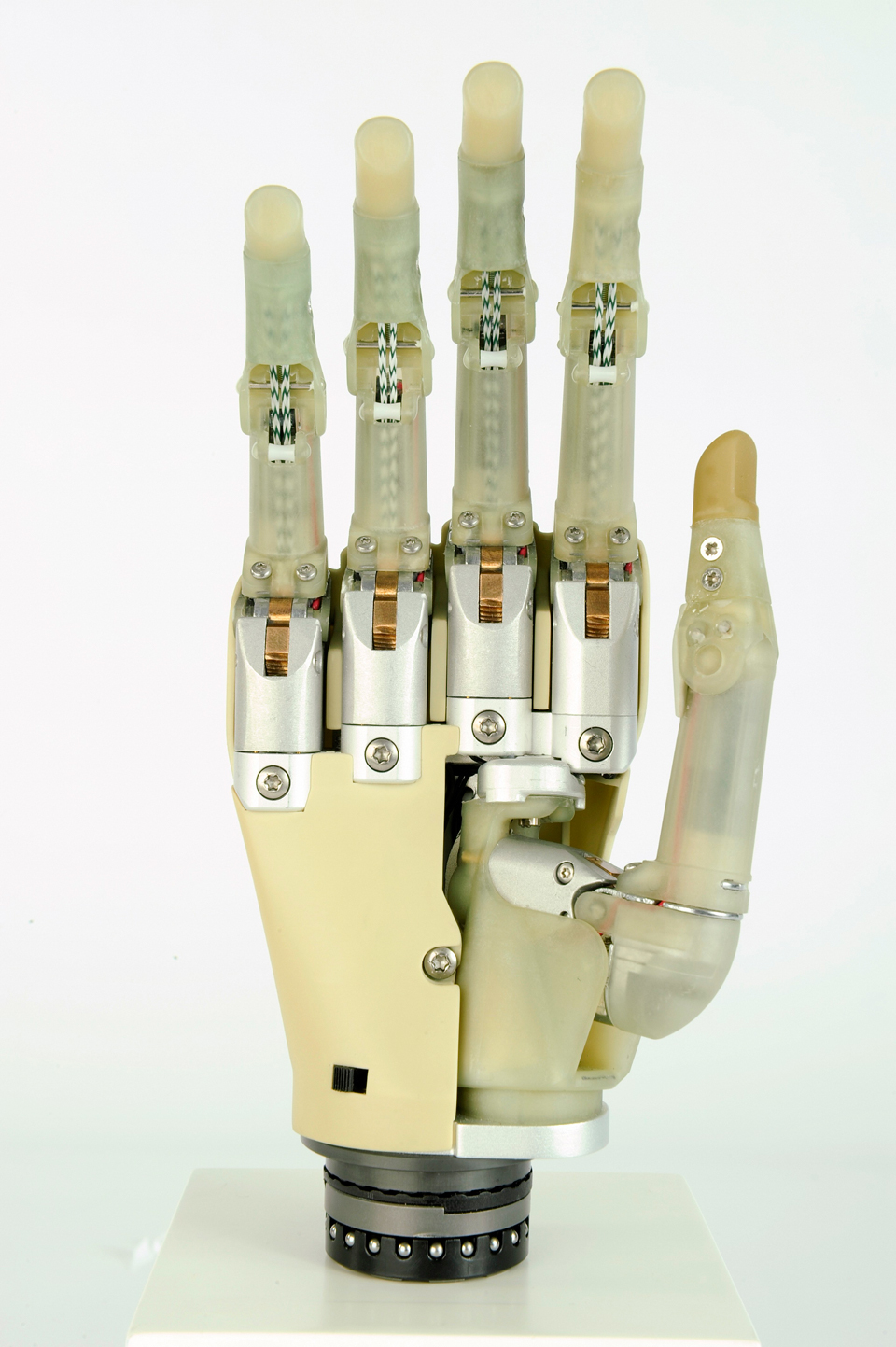 |
| 'i-Limb ultra prosthetic hand', Touch Bionics |
This is a typically excellent, and highly thought provoking exhibition from the Wellcome Collection - a place which really should be more popular among London attractions. It's well laid out, gives us just the right amount of information and most importantly lets us come to our own conclusions about what we see. There is a wry sense of humour to some aspects of the exhibition, and some interestingly provocative choices in what to exhibit. I particularly liked the way that the information cards were pinned to the wall in a stretched, slightly surgical manner. My only criticism is that this is an exhibition that relies very heavily on video and the volume of them varies enormously. There are some that are so quietthat it is very hard to make out what is being said, while conversely a few are so loud that you can hear them across the entire exhibition. But in a summer where people are pushing their bodies to the limits of athleticism in the Olympics and Paralympics it's very timely and any visitors to this should find themselves watching some events in a different light. Highly recommended - and anyone attending should be sure to see the rest of the Wellcome Collections fascinating galleries.
If anyone visited this and wants to add their thoughts I'd be very interested to hear them, post in the comments below!
'Superhuman' is at the Wellcome Collection from the 19th of July until the 16th of October 2012.
Wednesday, July 25, 2012
Wednesday, July 25, 2012
- 0 Comments
 |
| The River of Music |
When I saw that the Kronos Quartet, possibly the most critically praised string quartet in the world, were performing at the ‘River of Music’, and that tickets were free, I was filled with excitement. I figured that this would be booked up almost immediately and frantically refreshed the website as the tickets became available. Having got them, I inwardly congratulated myself on getting what I assumed was the hot ticket of the summer. My friends didn't seem quite as enthused as I was. Maybe I overestimated the appetite of Londoners for cool string quartets. My suspicious were confirmed later, and I was dismayed to find out that even the day before the concert there were free tickets still available. C'mon London, it's Kronos, get with it.
I’m a big fan of the director Darren Aronofsky, especially The Fountain, which I consider to be a hugely under-rated gem. One of the primary reasons the film works so well is the epic score by composer Clint Mansell, and played by the Kronos Quartet. My knowledge of classical and world music is pretty limited, but I know what I like – and I was sorely tempted to fork out money to see them play at the Barbican earlier in the year.
And so I found myself on a beautifully baking day in Battersea, lying on the grass and enjoying some deeply weird yet melodic music. The River of Music took place on the weekend of the 21st and 22nd of July, and consisted of six stages up and down the Thames playing music from different corners of the world. These were: the Africa Stage at the London Pleasure Gardens, the Americas Stage at the Tower of London, the Europe stages at Trafalgar Square and Somerset House, the Oceania Stage down in Greenwich and the Asia Stage, which I was at, in Battersea Park.
This was a very well-organised event, although possibly one that was not exactly over-subscribed. Even turning up a few hours after it opened on a gorgeous day, there didn’t seem to be that many people there. Right near the stage there were large empty green patches of grass to lie upon, there was no queue for the bar and there were enough Portaloos for five times the amount of people around. I can hardly complain about this, from a punters perspective it’s nice to be able to wander around and not have to wait for anything, but after taking a wander past innumerable food vans filled with bored looking staff while unwanted burgers sizzled beyond edibility you couldn’t help but get the feeling they were expecting bigger crowds. Hopefully the place filled up after I’d left, and the event was judged as worthwhile.
 |
| Arun Ghosh |
I arrived in the middle of Arun Ghosh’s set. His Arkestra Makara was in full swing, and it was a pretty damn pounding swing. He danced around at the front of stage, playing wildly on what I assume was a clarinet. Looking across the stage, with its panoply of members from around the world it’s a fun game to try and work out how many instruments you can identify – and the answer was not much. Looking at the lineup afterwards, you realise just how eclectic this orchestra is, containing bizarre sounding instruments like the kulintang, the sarunay, the drangyen, the morsing and (my favourite) the geomungo. Reading lists like this makes you realise that the label of world music is so mind-boggling diverse that putting it all under the same umbrella seems like a childish oversimplification. Still, the park seemed to contain a large proportion of London’s world music fans who were presumably buzzing in anticipation of a blistering geomungo solo.
 |
| A geomungo |
Also on stage with Ghosh’s orchestra was the Morpeth School big band, ‘Urban Playground’ from Tower Hamlets, further adding to the huge amount of people playing this dizzying variety of instruments. This music is very hard to categorise, sounding like a cross between really intense jazz and big, dance music style beats, among other styles. All of this was a bit of a (not unpleasant) sensory overload as the sun raged overhead.
Before I talk about Kronos Quartet, I have to briefly mention Hardeep Singh Kohli, who, with Nikki Bedi was acting as host of the event. Being told to improvise jokes about different types of world music is a tough proposition for anyone, but Kolhi rose to the occasion with aplomb, and was very, very funny. I particularly liked his joke about zithers:
“Vân-Ánh Võ is up next, and she’s brought along her big zither for this performance! She’s left her baby zither looking after the kids.”
Cheesy? Yes. But you try thinking of a joke about zithers on the spot.
 |
| Kronos Quartet |
What was I expecting from the Kronos Quartet? I’d pre-emptively listened to some of their contemporary work online before I came, so I didn’t have expectations that they’d be doing a Clint Mansell greatest hits session. This being an Asia themed music event I expected a set of modern classical music, and considering this was billed as a collaboration with Vân-Ánh Võ, that it’d be mainly Vietnamese in origin. I was quite pleased that they began on stage as just the quartet, playing songs with quite scary sounding names like ‘Oh Mother, the Handsome Man Tortures Me’, and even playing some of the epic and ominous sounding music that had put them on my radar in the first place. Their methodical and almost mathematically precise style seems to automatically imbue everything they do with a sense of importance, if you had to choose a string quartet to play out the end of the world, I think you could do a lot worse than the Kronos Quartet. Much of their music is melodic and fairly calming, but conversely they’re not afraid to make a bonkers sounding, dissonant racket at times. One song was so loud and crazily over the top I couldn’t help but wonder if the families sitting around eating picnics were starting to wonder if they’d made a terrible mistake.
They were so enjoyable that I was almost wishing that Vân-Ánh Võ would be unavoidably delayed, and we’d get a set of pure Kronos. In retrospect, this wouldn’t have been half as good as what we got. Vân-Ánh Võ is a mesmerisingly awesome, and Emmy award winning zither player (among other instruments), and someone who is not only fascinating to hear, but fun to watch. My entire exposure to zithers up to this point was the soundtrack to The Third Man, so I associated zithers with laid-back cool. Vân-Ánh takes it to a whole other level. She moves about that zither with the crazy self-confidence of someone who’s completely mastered an instrument, it’s pretty inspiring stuff.
 |
| Van-Anh Vo with zither |
She later moves onto various other instruments, at one point banging a huge drum with big sticks while a pot of change dances crazily on top. Kronos, being a string quartet are somewhat static on stage, it’s hard to dance while playing a cello after all. Vân-Ánh, on the other hand is energetic, striking poses behind them, focussed, iconic looking and always giving it her all. The music has a strange psychedelic trancey quality to it, and dotted around the field were hippie looking girls showing off some blissed out loose limbed dancing. The lovely weather and the tripped out music had a cool ‘Summer of Love’ style sixties feel to it. People were meandering around in kaftans, Vân-Ánh was going mental on a zither, someone was blowing bubbles that glinted in the clear sunlight! These are the kinds of times that you want to remember – I lay back, closed my eyes and soaked up the sun, deeply enjoying myself.
They closed, somewhat unexpectedly, with a Bob Dylan cover, ‘Don’t Think Twice It’s Alright’. This was a little confusing, what they played sounded nothing like any version of that song I’d ever heard. Vân-Ánh was playing what appeared to be some exotic variety of Theremin to the gently modulating Phillip Glass sounding strings of Kronos. It was a little distracting trying to figure out exactly what part of the song they were playing, and how it bore any resemblance to the original. I eventually gave up trying to identify it as a Dylan piece and just enjoyed the music gently drifting my way.
I had a prior commitment on the South Bank that I had to zoom off for after this, so I didn’t get to see how the rest of the night panned out. I would have liked to have seen Zakir Hussein (the best tabla player in the world!), but I can live without it. Well done the organisers for putting such a nice, free and varied concert on. A perfect way to spend a sunny Sunday afternoon in London.
Tuesday, July 24, 2012
Tuesday, July 24, 2012
- 0 Comments

While one of my favourite things about writing this blog is getting to travel to new places in London, there is something to be said for culture coming to me. To my literal doorstep in fact. I moved to Whitecross Street three years ago, and every year I find new reasons to love it. There’s a smattering of excellent restaurants, including the wonderfully friendly Iskele and Cozzo, the very friendly Two Brewers pub , a bustling street food market on weekdays and a recent crop of new art galleries. It’s a wonderful place to live. Indeed, in 2011, it was voted ‘The Hippest Street in London”.
I’ve attended the Whitecross Street Party every year it’s been held, and every year it seems to become more popular, more elaborate and more enjoyable. This year was the best one yet. The concept is to transform the street into an open-air art gallery, with sculpture, paintings and performances “from pavement to rooftop”. The stalls of the foodie street market also stay open for the weekend and this year a large stage was erected at the southern end of the street to allow a wider variety of musicians to play with a good sound system.
Every Whitecross Street Party held has managed to be sunny and pleasant. I wasn’t holding my breath this time last week. The perpetual gloom that smothered London for much of July seemed unshiftable. If there was to be a street party, then I figured at best it’d be one held between bouts of drizzle and under thick grey clouds. So I when I awoke on Saturday morning to the sounds of what I assume were bagpipes through my bedroom window, I feared the worst. Ordinarily being woken to bagpipes would rank among my least favourite starts to the day, but on opening my window the sun blazed in. And who can be grumpy then? As if blessed by the street party gods, the sun was out in full force, instantly filling the street with a much-needed positive atmosphere.
 |
| Sun! (photo by Anais Gallego) |
Even when there’s not a cultural festival being held here the street usually has a few pieces of well-designed and clever street art. It helps brighten up the place no end. One of the aims of the Whitecross Street Party is to give street artists a place to showcase their art without being criminalised. Indeed, Islington Council refers to graffiti as having:
“a negative effect on the lives of those whose neighbourhoods, parks, property and public transport are blighted by this type of vandalism.”
In the case of crude spraypainted tags I can see their point, but Whitecross Street would be a much grimmer place without the street artists that use it as their canvas to work on. Recently we’ve been treated to a charming picture of Wenlock the Olympic mascot having his leg humped by a wayward dog. In the run up to the street party we saw pictures of Marlon Brando, Al Pacino, Christian Bale’s Batman and so on pop up all over the street. I’d much rather look at an interesting piece of design by a talented artist than some blank brick wall.
As “hip” as Whitecross Street is supposed to be, it’s not exactly the prettiest street in the world. Don’t get me wrong, it’s far from ugly, but as things stand in 2012 there’s a row of 6 or 7 shops that have been boarded up and gutted for over a year now. It looks like there’s some work being done behind the barricade, but I never see workmen going in or out of them, and they haven’t changed externally in a very long time. Artist Malarky's mural, that's been painted onto the flat, officious white of the chipboard is a testament to how much a nice bit of a street art can improve the tone and mood of a street.
 |
| Take THAT 'the Man' (photo by Anais Gallego) |
Peppered up and down the wall of the Peabody Estate are a number of other excellent pieces of graphical art, with a stand out being a typically striking billboard by Shepard Fairey. This party is billed as the ‘Rise of the Non-Conformists’ (a reference to the non-conformist religious past of the street), and much of the art exhibited is satirical in nature. There’s a few very funny and occasionally scary Olympic satires, as well as some nicely executed and witty observations on the surveillance state. Without this touch of politics to the work, the party could fall into the trap of being a mere celebration of aesthetics. That’s not necessarily a ruinous thing, but the fact that some of the art has some political meat and anger gives a tinge of authenticity to the rest of the art upon display. The underlying philosophy behind much of street art is anti-establishment and rebellion, perhaps naturally given that the very act of making it often breaks the law, and even though this is a festival sanctioned and promoted by the council for a moment you can fool yourself into believing all of this is underground and rebellious.
 |
| Shepard Fairey (below) (photo by Anais Gallego) |
The most impressive painted piece on the street is undoubtedly Conor Harington’s brilliant painting of a man in period gear. When I first saw it, I’d assumed the paint had begun to run in the rain, but it’s clear that it’s supposed to be like this. I’ve seen similar paintings that I assume are by Harington in Hackney, and they stand out as particularly surreal and strangely soft and textural pieces of art. Street art is generally (by necessity) bold, thick lines, immediate and quickly comprehensible graphical imagery, but Harington’s work is soft and almost liquid, seeming to not only be blurred, but to blur the surroundings. You have to stop and examine it to fully appreciate it.
 |
| Conor Harington's piece (photo by Anais Gallego) |
It was a typically good year for sculpture, with the cast iron skull sitting between two buildings a definite highlight. The exhibition goes on until the beginning of September, and the art is left in place until then – you find yourself wishing they’d never take certain pieces down. The black iron skull is one of them, I’d be overjoyed if that was permanently installed there. One of the small downsides of a street festival like this is that it can be quite difficult to work out who's responsible for it, but they deserve no small amount of praise. Other notable sculptures are the man-size femur propped against a wall, a set of robots helping each other onto a rooftop, and a robotic homeless man, constructed from consumer goods. The only piece that falls a bit flat for me is a pile of boxes perched on the edge of a rooftop. It looks a bit out of place in its austerity perched on the side of a building. All of the art, even the more delicately executed pieces rely on a strong visual ‘punch’, and this is a little bit bland for my tastes.
 |
| The Skull (photo by 'surreyblonde') |
But this is a minor complaint, wandering down the street you notice more and more pieces of art that you’d previously missed. A fake window high up on a wall has a police sniper hidden behind it, and a nondescript door on the wall opens up to reveal an idyllic beach scene, blue plaques for 'English Hedonists' detail the ‘hidden’ history of the street and flying eyeball mosaics dot the spare patches of wall. It’s a visual feast, and one of the many reasons why I was praying for sun. All of this art loses a lot of immediacy and vitality when it’s viewed under an overcast sky. When the sun is blazing onto the street the whole place pops with colour and life!
 |
| Happy crowds (photo by Anais Gallego) |
It was also an impressive year for music, although I didn’t get to see half as much as I wanted to. The music stage was much more impressive than previous years, taking up the width of the street. I enjoyed the variety of the Key Changes Musicians, a therapeutic music service for patients in acute psychiatric care in Islington. It was pretty wild stuff, with the musicians ranging from gently acoustic covers of Bob Marley’s One Love, to wild, screamed crunk duets. I think my favourite was an extremely animated performance from a man singing about how he wanted to be allowed to be himself. A lot of the performers were quite static and a little nervous looking, but this guy really threw himself into it, jumping around the stage and loudly asserting his individuality.. As he left, the compere noted that this man (whose name I unfortunately can’t remember) had never and could never be anything but himself.
 |
| Key Changes (photo by Key Changes) |
The next act I saw in full was Jenny Hallam, a singer/songwriter playing light, summery indie sounding tunes. Many of them had a bit of a Regina Spector feel to them, and in a line up that was a bit skewed towards loud and fast music she was a breath of calm, cool air. There were maybe 40 to 50 people watching her on a small stage, and she seemed quite sweetly overwhelmed by the crowd, repeatedly saying what a wonderful place the street was, and how much she was enjoying being there. Her good mood was infectious, and contributed no end to the happy, friendly atmosphere around the stage.
Next up was a small child, (I think she was called Esme) who sang a song. I don’t need to say much more about this than that it was very beautiful and honest in the same way that a small child singing a song generally is. There wasn’t a dry eye in the house. What a lovely, lovely voice.
Next up, and in complete tonal opposition to the sweet young girl singer was two rappers. They were really bad, so I left to check out the dub reggae stage at the other end of the street.
 |
| Bike poking out of wall (photo by Anais Gallego) |
The ‘Solution Soundsystem’ is a new addition to the street party, and (together with the smoke of the jerk chicken stand next to it) turned a small part of the street into the Notting Hill Carnival. If there’d been someone selling coconuts filled with rum the illusion would have been complete! I don’t really know that much about dub reggae to make any assessment of whether it was good or not, but I do know it certainly was loud. I suspect that loudness and bone-shaking bass are pretty much the primary factors on whether dub works well, and it certainly had that.
All of the art and music, coupled with the great food and very affordable art and fashion makes for a great day. My only regret is that I didn’t have enough time to see it all. I managed to miss the giant mechanical fire-horse and the huge pink robot, due to being elsewhere in London on the Sunday. Even so, it’s a wonderful, unique event in London, and I feel extremely lucky to have it all taking place right outside my house. It's such a strange experience to be walking through throngs of people, surrounded by talented artists and gorgeous art, and being able to step into my house for 5 minutes. It's been a highlight of my summer for three years now, and I expect it to be one next year. Roll on 2013!
Photos courtesy of Anais Gallego at http://thisisthebananaline.blogspot.co.uk/
Subscribe to:
Posts (Atom)


