Recent Articles
Sunday, December 30, 2012
Sunday, December 30, 2012
- 0 Comments

'Jack Reacher' isn't just a bad film, it's a poisonous one. The film deifies dead-eyed, masculine narcissism, showing us a portrait of a monster and expecting us to wank ourselves silly in admiration and respect. What 'Jack Reacher' asks us to admire and emulate is the hateful and negative: emotional auto-castration, superiority complexes, alpha male posturing, casual sadism and the paternalistic shaming of sexuality. Among shitty films it's a rarity, being not only boring and offensive but one that will make the world outside the theatre an imperceptibly worse one.
The film revolves entirely around Tom Cruise's Jack Reacher, a character so utterly ridiculous and preening that only someone with Cruise's grotesquely overdeveloped ego would even consider playing him. This is the kind of film where when our hero is not on screen, the characters are talking about how amazing he is. When he is on screen he smirks and slimes his way through scenes, every action calculated to show up exactly how incompetent every other character in the film is compared to the inestimable Jack Reacher.
 |
| Rosumund Pike as she realises she needs to get a better agent. |
He's the kind of man who can do everything a little better than you. You know that prick friend-of-a-friend who's always desperate to one-up everything you do? If you tell him that you've done a bungee jump, he's done a skydive. If you went out for a nice dinner, he's just got back from a Michelin starred private tasting. That kind of dick. Well, that's Reacher. If a character in the film has any kind of talent, then Reacher effortlessly outclasses them. He's not just a soldier, he's a policeman of soldiers! He's an expert driver! He's got a photographic memory! He can fight five men at once! He's a crack shot! He can see the links in the case that no-one else can see! Women collapse into shuddering piles of pleasure at his presence! Men cower in fear at the sight of him!
If this character were written by a five year old I might be able to understand it. He's the parody action movie character played straight, the kind of person so ridiculous that the audience should be giggling at his vanity. The cherry on top of this shit sandwich is that this supposed titan is played by a saggy looking Tom Cruise. He is a ridiculous little man, and none more so than when he expects us to take him seriously as the paragon of masculinity.
 |
| Inflicting pain is so 'in', darling. |
If you want to see the real-life Jack Reachers in action just spend five minutes reading a Men's Rights forum (or see them on this tumblr). These towering examples of manhood equate success with an emotional numbness, a smug denial of affection and kindness towards others and a certainty at their own rightful place as the centre of the moral universe. 'Jack Reacher' validates this warped philosophy, giving these damaged people a peek into a world where their twisted self righteousness causes them to be revered as gods.
This is a dangerous film, it actively encourages a conservative, pettily violent, vindictive small-mindedness and ignores any negative consequences. Jack Reacher has no friends, no passions except violence and lives on the margins of society. The film romanticises this lone wolf lifestyle, characters that do develop interpersonal relationships in the film are invariably betrayed or abandoned. It's a conscious rejection of the rest of humanity: taking solace in the knowledge that if you can't love your fellow man, you can at least break his fingers one by one as he screams in terror.
 |
| a real hero a real human being a real hero a real human being a real hero a real human being |
I was reminded repeatedly during this film of Nicholas Winding Refn's 'Drive', which might be my favourite film of 2011. Why do I find Ryan Gosling's 'Driver' more interesting and acceptable than Jack Reacher? Driver is a very similar character to Reacher, both live solitary lifestyles, both are emotionally stunted and both are capable of extreme, reflexive violence. 'Drive' is a success because it shows us the recognisable human reaction to the extreme violence meted out by its hero. There is a scene where Driver realises that he and the women he has grown to love are in immediate danger, he kisses her, then turns and beats a man to death, stamping on his face over and over again. He looks up see her shocked face as she realises his real nature. It's this look of fear from her that's key. As much as we might take a thrill in the violence of the 'Drive', it's leavened with the message that actions like these lead to isolation, a lonely, aimless emptiness.
'Jack Reacher' takes the opposite tack; violence and antisocial behaviour leading to isolation is a good thing. What's important is proving that you're more of a man than anyone else around you by either inflicting pain or demonstrating how you're effortlessly 'better' than them. How else can you explain the scene where Reacher begins to explain to Helen (played in a kind of numb stupor by Rosamund Pike) what really happened in the case the plot explores? He refuses to actually tell her what's happened, but writes down the solution on a post-it note and hands it to her, telling her to work it out for herself and then check the note. You want to yell at the screen "just fucking TELL her you dick!", but we're forced to sit through another scene of Reacher posing smugly waiting for everyone to catch up with him.
 |
| Women are sluts am I rite? |
Every single second of the film is repugnant to various degrees, but there are a few moments that define this nihilistic apocalypse of a human being that we're supposed to be cheering on. He tortures a man by systematically breaking his fingers, a wry smile on his face as he gets the information out of him. He bullies a terrified teenage girl into giving him her car. He sexually intimidates the female lead. He executes a defenceless man. He calls a woman a "slut" for coming onto him in a bar.
Perhaps the defence for all this is that he's not supposed to be a hero, after all, he does say "You think I'm a hero? I am not a hero. And if you're smart, that scares you. Because I have nothing to lose.". But despite saying this, he clearly is the hero, at least as far the narrative is concerned. He beats the bad guy, saves the day and rescues the girl. Perhaps another actor could have injected the role with a certain knowing attitude, someone who could play an egotistical 'Mr Perfect' like Reacher and get away with it purely through a natural charisma. Tom Cruise is not that person, there's not an ironic bone in his body, every mannerism here is that of the well-fed, self satisfied star who is absolutely sure they're the most important person in the film, and probably on the planet. The entire exercise reeks of stroking the Cruise ego, especially an excruciating scene where he lounges around without his shirt on.
 |
| .... christ man, why.. |
So there's that. But there's worse. The villain in this piece of shit is played by none other than Werner Herzog. Oh Werner. Whatever they've got on you wasn't worth this humiliation. There's nothing more painful than watching someone you respect debase themselves. Herzog is probably my favourite director, and I always enjoy his acting performances whenever he pops up in random films (he was primarily why I saw this film). But not this time. His arch, doomy persona is prostituted to the fullest, pimped out in service of a z-grade Bond villain gimmick. He makes the best of some atrocious dialogue, but there's a sense of shame behind his eyes that I've never seen in him before. The jungle couldn't defeat him. 'Insignificant' bullets barely faze him. He even survived the towering rants of Klaus Kinski. He looks lost, confused as to how he's ended up in what he must know is a terrible film. I hope to god whatever he got paid for this was worth it.
A defender of this film might point out the realistic nature of the action sequences, the clever sound design of the car chase sequence, the tactical realism of the final bullet-strewn action sequence or the visually enticing introduction scenes. But these are nothing more than blossoms haphazardly poking out of a freshly laid turd. Film is a powerful medium, and films like this fuel violent, solipsistic power fantasies in stupid, frustrated people. It's a dangerous piece of propaganda for stunted emotional growth, and everyone involved with it should be utterly ashamed of themselves.
Saturday, December 29, 2012
Saturday, December 29, 2012
- 2 Comments

You'll know the cloth from which 'Quartet' is cut pretty fast. The film is almost entirely set in a friendly retirement home full of opera singers and classical musicians that are past their prime. But it's in financial trouble! The only way it can be saved is for four once world famous opera singers is to band together and perform their signature piece, thus raising enough money to keep the place going. But they've all got problems and little bits of personal development that they have to get through before they can get back on stage, prove that age is no barrier to success and give the best damn performance of their lives.
'Quartet' winds a familiar path through a setup that's as creaky as its characters, who are played by the cream of British establishment acting. Our quartet is composed of Jean (Maggie Smith), Wilf (Billy Connolly), Reginald (Tom Courtenay) and Cissy (Pauline Collins). In supporting roles are a mixture of established theatrical performers, notably Michael Gambon and Andrew Sachs and a smattering of actual retired classical performers, none of whom I recognised, but all of whom get a nice shout-out to their careers in the credits.
 |
| Left to Right: Billy Connolly, Tom Courtenay, Andrew Sachs and Pauline Collins |
These leads are about as safe a set of hands you could hope to hire for a film like this. There is no conceivable way that Billy Connolly is going to misfire in a role that primarily requires him to say quasi-sexual inneundos to pretty young nurses. Likewise, Maggie Smith plays the role of a slightly depressed elderly opera singer struggling to regain her confidence brilliantly. In one sorrowful stare through a pane of glass she conveys everything you need to know about her misery at ageing and having to move into a retirement home. it's impressive, but then, it's Maggie Smith. Of course she's going to be good. The highlight for me is Michael Gambon as 'Cedric', the overbearing bumbling musical director. As a minor character he's not burdened with the serious, sad scenes that the central quartet are, and gets to cut free a bit, overacting in what seems to be his Dumbledore costume minus the beard.
 |
| Maybe this is just Gambon's style now? |
You very quickly realise here that the film is set on an course, and is inexorably plodding towards a big concert finale. As soon as they mention this, it's just a matter of when, not how we're going to get there. Whether a conscious choice or not, this drains a lot of dynamism from a film that is content to spend the majority of its run time meandering through low-stakes emotional conflict.
I guess you have to work out who exactly the film is aimed at: the elderly. This seems primed to ride the wave that stuff like 'The Best Exotic Marigold Hotel' (which I haven't seen) have generated. 'Quartet' is a film that plays it safe at every opportunity, and treats its target audience with a faint, unconscious contempt for their critical faculties. Humourwise there's nothing original here; all the jokes in here are straight out of the 'old age' cliche book; ha, they have to piss a lot! Ha-ha look he's old and still horny! Hey look, she's a bit dotty and forgetful! Hilarious. It seems a bit insulting to assume that older audiences want the film equivalent of a cup of weak tea.
 |
| Maggie Smith as Jean, and Sheridan Smith as Dr Lucy Cogan |
Worse, the world of the retirement home is sinisterly sugar-coated. Beecham House is more of a luxury spa than a retirement home, staffed full of cheeky and cheery empathetic characters who are more than happy to indulge their elderly patients. This is a fairly light-hearted comedy and I didn't exactly want the film go all Haneke on me, but maybe a few quick acknowledgements life in an extremely plush hospital isn't all happy fun times wouldn't have gone amiss. A prime example is a light-hearted scene where Wilf (Connolly) negotiates with the Doctor that runs the place about going out to a restaurant for dinner. It's presented in a fun, flirty and friendly way, but there's a sinister undertone of enforced confinement.
'Quartet's message is inarguably a noble one: old age shouldn't be a barrier to achievement and that a new chapter in our lives can come along right when you least expect it. But all of the personal growth that happens in the film is the result of our leads surrendering their independence and trotting off to live in seclusion in the countryside with other old people. Beecham House may be kind, opulent and friendly, but it is a cage. The film feels like the kind of thing that a cold hearted son or daughter with their eye on their old Mum's house might show her to try and convince to her move out of the place. "Oh look all your friends will be there! And the nurses are so friendly! There's even zumba!"

But 'Quartet' doesn't only stumble in delivering its uplifting message, it's a structurally flawed film and, like an ill-made souffle, completely collapses towards the end. Dustin Hoffman, in his directorial debut, has made a film that's sickly sweet in it's imagery. It's hard to gauge just how much time passes between scenes as it feels like damn near every outside shot is taken on a hazy summer evening as the sun is about to set. I get it Hoffman. The sun is setting but it is still beautiful. Perhaps this isn't quite as clever and subtle as you think. The film shamelessly exploits an overly twee rural England aesthetic, characters traipse through compositions that look like they've been ripped from the front of a tin of shortbread. These aren't the fastest moving characters in film either, so you're going to drink in this cloying countryside postcardiness whether you like it or not.
Despite all this, I am still a bit of a sucker for films that end in a big concert scene. You know deep down that everything's going to work out alright, but there's behind the scenes trouble, last minute panics, sudden losses of confidence and so on. It's manipulative and cliched, but does a workman like job of ratcheting up the tension. But then two things happen in quick sequence that sucked out whatever goodwill I had left remaining for the film. They're spoiled below, but frankly it's better you know about them now rather than waste your money.

The central pressure on our leads is to raise enough money by putting on a concert to save the luxurious, friendly retirement community that they live in. This means there is a certain pressure of responsibility on our leads, they must each risk their own dignity for the community that supports them. This gives them a heroic nobility that is vital in getting us to sympathise with them. But this structure means that the real triumph isn't them actually performing, it's just that they will appear on the bill. The film actually calls attention to this, saying "we've saved the home!" before the climax. Doing this pulls the plug on the wider drama going on around the characters.
That's a problem, but there is a far, far worse one that dawns on you in the closing seconds. This is a film about opera singers discovering that they've still got it. We hear all about how our leads were amazing in their time, but we never actually get to hear them sing prior to the finale. We see a montage set to music of them rehearsing, showing their frustrations and joy as they obviously begin to get the hang on it. The tension builds as their spot at the top of the bill draws closer, and by the time they step on stage we're as racked with nerves as they are. Will Wilf keep his balance? Will Jean hit those high notes like she used to? Will Cissy's dress stay in one piece? It's the final round in 'Rocky'. It's the choir performing for the Pope in 'Sister Act'. Hell, it's the battle of the bands in 'Bill and Ted's Bogus Journey'. The band starts up, we lean forward and...
Fade to black. Credits.
WHAT?! All that and we don't even get to hear them sing? Hey 'Quartet', in the words of Maggie Smith's Jean I'm about to say a very rude thing:
"Fuck you!"
 |
| This doesn't happen. Boooooooooo! |
Thursday, December 20, 2012
Thursday, December 20, 2012
- 0 Comments

'Safety Not Guaranteed' is a mean little tease of a film. It tempts you with all kinds of time travel based shenanigans, for most of the film you feel pretty sure about where this is all going, but then the film takes repeated turns away from what you expect it to be, but ends up in an equally familiar place.
We live in a time where almost anything can be adapted into a film: theme park rides, board games and seemingly every comic-book property under the sun. But the genesis of 'Safety Not Guaranteed' is even more unlikely than these, a classified ad placed in 'Backwoods Home Magazine' in 1997.

This advert eventually took on a life of its own, being the subject of a skit on the Jay Leno Show, and becoming an internet meme in its own right. The concept here is, what if this advert was serious? Darius (Audrey Plaza) is the hero of our story, an unpaid intern working for an upmarket Vice-esque magazine. She, and the geeky Arnau (Karan Soni) are chosen by writer Jeff (Jake Johnson) to come with him on a field trip to investigate the advert and write an article about the guy behind it, who they naturally assume is a crackpot.
Our would-be time traveller is Kenneth (Mark Duplass), and fortunately for Darius, who is told to get to know him, he's not a total psychopath. He's an intense, depressed man who wants to travel back in time to re-unite with his childhood ex-girlfriend. He initially comes across as a harmless nut, but as Darius gets closer to him she's drawn into his world and starts to believe that maybe, just maybe there's a slight chance he could actually travel in time.
 |
| Darius (Audrey Plaza) - btw those glasses tell you much of what you need to know about this film |
Audrey Plaza does a decent job of showing her gradual thawing out. She begins the film suffering from an undefined and irritatingly vague depressive state, taking a kind of masochistic pleasure in being one of life's punching bags. Plaza is great at this, just one blank, big-eyed incredulous stare from her is enough to tell you all you need to know about her character. She spends much of the first half of the film hunched over in a hoodie, self-defensive to a tee and ready with a barbed comment for anyone that crosses her path. She isn't that likeable, but smartly, the two people she's paired with on this investigation are both annoying in their own ways. The writer, Jeff is a shallow, sex obsessed jock who is using this assignment as an excuse to track down his high school girlfriend and Arnau is a socially crippled, bordlerline autistic nerd. Faced with these unappetising social prospects, Darius' smart-ass, cynical demeanour becomes quickly relatable.
But this Darius' iceberg quickly melts when she meets up with fellow social outsider Kenneth. I've only seen Duplass in one film before this, the so-so 'Your Sister's Sister', and is playing a variation on what seems to be his 'type', namely the slightly rumpled, somewhat slobby but ultimately loveable bachelor. It's not exactly a stretch for him, although to his credit he believably inserts a certain manic layer underneath much of Kenneth's actions. He's paranoid, at times worryingly so, most obviously when he suspects he's being followed and begins threatening an innocent couple with a shotgun. Despite that there are these elements of dangerousness in Duplass' performance, they're quickly glossed over by the film. It is a little odd how quickly Darius falls for a man who lives in a shack in the woods with a large collection of firearms and a predilection for burgling medical facilities.
 |
| Kenneth (Mark Duplass) |
After these two 'meet cute', they begin to open up to each other and learn that maybe you don't need to go back in time to find happiness, maybe you can find it right here right now. Bleeurgh, vomit-inducingly sweet stuff. And here my problems with the film begin. These characters begin their arcs as broken, just barely functioning people: in other words, they're interesting. As their relationship develops they start to become slightly better adjusted and open up to each other, and the more they do the less interesting they become. Sure, it's uplifting to watch these two lift themselves out of their depressive states, but uplifting in an increasingly dull way.
The film settles into following a well-worn indie romantic comedy groove, with our two oddballs getting to know each other through Kenneth's wacky time travel guerilla training. We see them geekily practicing martial arts on a beach, running through the wood smiling dreamily and (a bit off-puttingly) practising shooting stuff. In the opening act of the film, it seems like it could head into some untrodden ground, even if it was 'just' a mashup of indie romcom and time travel shenanigans, but quickly it settles into following a well-trodden formula pretty rigidly.
 |
| Darius, Arnau (Karan Sohi) and Jeff (Jake Johnson) |
'Safety Not Guaranteed' never quite lost me, but it came pretty damn close during an excruciating scene where, on a camping trip out in the woods, Kenneth plays Darius a heartfelt song he's written for his lost love. You really want to go here film, fine, I'll tough it out. I braced myself for the inevitable appearance of the beaten up indie romcom acoustic guitar. But what was to come was even worse, Kenneth is too kooky to settle for a guitar, no, he pulls out a fucking zither. As Darius dreamily looks on, her big eyes lit up by the campfire, he proceeds to plink out a horrible, morose, sub-sub-Coldplay zither song.
My eyes widened in horror during this scene at what I was seeing. Not only was the song rubbish, not only was it played on a stupidly pretentious dumb-looking instrument, but the film actually expects to nod our heads sagely and come to the conclusion that under all his oddness and paranoia lies the softly beating heart of a sensitive artist (one whose passion can only really be expressed with a fucking zither*).

I've always held that when you're writing about a film, it's important to write about the film you've seen, rather than the film you wanted to see. But taking that amazing classified advert as a starting point and then making a by-the-numbers quirky indie romcom is a waste of a great concept. Throughout the film they repeatedly set up plot points to be resolved using time travel that just hang in the air as if left over from a previous (and more entertaining) draft of the script. Characters will bemoan their actions from 10 years ago and wish they'd done things differently, with the obvious solution being crazy time travel. It's clumsy exposition, but you can comfort yourself with the idea that the payoff will be worth it. Ultimately there is no payoff. The film even wastes Jeff Garlin on a one scene blink and you'll miss it cameo!
Even more annoyingly, the film ends at the point you feel it should have gotten to at least an hour ago. We watch our characters head off into a far more interesting film leaving us staring at the credits feeling vaguely let down. Perhaps it's a question of personal taste. I've seen a hell of a lot of indie romcoms where two eccentric outsiders connect, and I've also seen a lot of films with bonkers time travel paradox conundrums. I know the general beats of both of these genres, but I'd much rather the film have been more 'Back to the Future' than 'Garden State'.

I find it difficult to disagree with the overall message of 'Safety Not Guaranteed'; namely that travelling back in time to solve your personal problems isn't a mature way to go about things. But the execution is something I've seen many times before with very few surprises. It's nice to finally see Audrey Plaza in a leading role, she's a great actor and makes a difficult character work. Likewise I've got few complaints about Duplass' performance. My problem is that the film wants to subvert audience expectations, which is all well and good, but its idea of subversion is to adopt another equally predictable set of conventions that are pretty dull and played out in 2012.
'Safety Not Guaranteed' is on general release in the UK from 26th December.
'Safety Not Guaranteed' is on general release in the UK from 26th December.
*I
want to point out here that I have nothing against zithers per se,
the soundtrack to 'The Third Man' is awesome, and I'm sure in the right hands
zithers are a fine, fine instrument, but still, an acoustic camping zither
player is a special kind of tosser. To make things worse I just read this goofs
entry on IMDB: "When Kenneth and Darius are at the camp and Darius asks
what kind of musical instrument Kenneth has, he responds that the instrument is
a zither. The instrument they are using is a mountain, or Appalachian,
dulcimer. Mountain dulcimers do fall into the general zither category, but
typically when people refer to zithers they mean instruments that have shorter
scale lengths and many more strings, or courses, than mountain dulcimers.
Calling a dulcimer a zither is like calling a viola or cello a violin simply
because they fall into the general "violin family" category."
IT’S NOT EVEN A PROPER ZITHER!
GAH!
Wednesday, December 19, 2012
Wednesday, December 19, 2012
- 0 Comments

The last time I saw Chekhov's 'Uncle Vanya' I screwed up. I'd been sent some tickets to a production in the Camden People's Theatre, and didn't do any research beforehand. I turned up and sat in the centre of the front row, the play started, and everyone began speaking in Russian. I'd inadvertently wandered into a foreign language version of the play. I made it through the thing, doing my best to work out what was going on just from who was crying and who was shouting at whom. That version: 'Uncle Vanya in Languages' was very small-scale, so when I snapped up some tickets to a full, swanky, star-studded production in the West End I was eager to find out exactly what the hell happens.
'Uncle Vanya' has a reputation as one of those plays where 'nothing happens', but this is unfair, this is a play that's got a lot bubbling beneath the surface. We meet a cast of characters struggling to carve themselves a space to live on their own terms in a hostile world. These people are a miserable bunch of losers, trapped in a static, twilight world. But, crucially, they're also recognisable and sympathetic losers.
 |
| Vanya (Ken Stott) and Sonya (Laura Carmichael) |
The setting is the Russian countryside where we find the titular Vanya (Ken Stott), living with the plain Sonya (Laura Carmichael) in a staid, rural existence at a country estate owned by Professor Serebryakov (Paul Freeman). The Professor and his young wife Yelena (Anna Friel) have come to visit, causing much friction between all parties. Everyone is in love with one another, but none of the affection is returned. Vanya lusts after Yelena, Sonya is in love with a young Doctor Astrov (Samuel West) that visits the elderly Professor, Yelena ostensibly faithful, but obviously sexually frustrated and also pining for the doctor.
Basically, it's complicated. All of this simmers under the surface for much of the play, with characters sniping and bitching about each other and making Morrissey-esque monologues that spell out exactly how heaven knows they're miserable now.
This production has an weighty sense of permanence. The sets are huge and wooden, seemingly carved out of one enormous tree. This envelopes the characters in the world; it's like the stage has put down roots. As the production goes on we move between different rooms in the house, all with the same heavy wooden furniture, huge brick ovens and tiny windows that lit in a perpetual sunset. It's a fine bit of stage design, and is wonderfully lit, the characters posing like something out of an old daguerrotype of a bygone age.
 |
| Yelena (Anna Friel) |
The performances range from the brilliant down to, I'm afraid to say, the cringe-worthy. The measure of success here is the ability of the actor to say two things at the same time. Chekhov's characters, especially here, rarely say exactly what they mean. They constantly mask their true feelings and deep passions, bottling things up inside until an eventual eruption.
It's Ken Stott's Vanya who's does this best, showing us a man who is having the worst kind of mid-life crisis. In a time without penis extension sports cars he desperately attempts to assert his masculinity by ineffectually lusting after Yelena. Vanya is a miserable shell of a man, mocking the Professor for producing nothing of worth while frittering away his (apparent) talents and intelligence maintaining the man's estate. Stott constructs a portrait of a man who's realised that he's reached the age where he's officially 'old'. There is no escaping it. He bemoans the opportunities he's passed up, and fears the future heading his way. It's easy to laugh at Stott's Vanya; he's a vain, silly, jumped up little man, but after a certain point we feel a bit guilty laughing at him.

Towards the mid-way point of the play he, besotted and puppy-like, heads out to pick some autumn roses for Yelena, and returns to find her passionately kissing Doctor Astrov. He freezes, his heart breaking and Stott immediately makes us guilty of mocking this poor man earlier in the play. For all his insecurities and unattractive self-pity Vanya is still a man clutching onto some dignity, a man living with a faint flicker of hope in his heart. We watch this flicker being extinguished before our eyes, the character's increasingly melodramatic actions throughout the rest of the play are grounded upon this moment; a wonderful bit of acting.
Anna Friel's Yelena is another great performance. Yelena stands apart from everyone else in the house, placed on a pedestal and exalted. She's admired by most of the male characters more for what she represents than what she is. She's metropolitan, beautiful and probably most importantly, relatively young. Vanya bemoans what he perceives has her 'throwing away her youth' on remaining faithful to the aging professor. Friel's porcelain features are her best weapon, a composed, buttoned up demeanour which is so calculatedly placid that it's obviously artificial. Her faithfulness to the Professor could seem artificial too, but this shines through as actually being genuine, in the way she's obviously a good person trying to do the right thing.
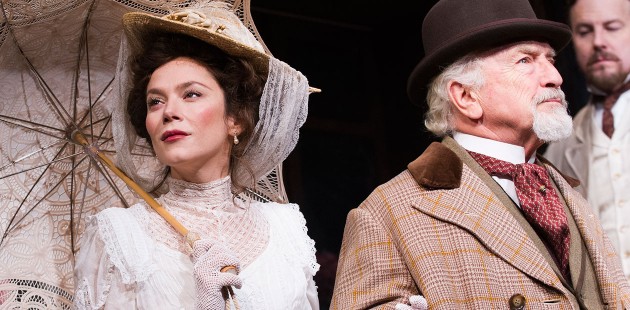 |
| Yelena (Anne Friel) and the Professor (Paul Freeman) |
Most of the rest of the cast is successful to varying degrees. Samuel West's Doctor Astrov has a pleasant dreaminess to him as he talks of conserving forests, and imagining the effects of his work on societies 1,000 years in the future. He's a bit of a fool, throwing himself at Yelena and (wilfully?) misinterpreting her reactions to his advances. His dialogue about the climate change and vegetarianism feels awfully prescient given that this play is about 110 years old.
Unfortunately there is a dodgy cog in this mostly functioning machine, and that's Laura Carmichael's Sonya. Her performance has already taken on semi-legendary status, purely for her being interrupted on opening night by a drunken Sir Peter Hall, founder of the Royal Shakespeare Company and former director of the National Theatre. During Carmichael's closing speech, when she repeatedly says "Life must go on", he responded by shouting "No! Please stop now!".
I disagree with the time and the place in which the criticism was made, but I have to say I find it perfectly accurate. I feel a bit sorry for Carmichael, who is clearly trying very, very hard to do a great job. But it's impossible not to notice that practically every line reading she gives is intoned in the exact same way. She starts out speaking relatively normally, and then by the end of the sentence the pitch of her voice gets higher. It's like everything she says can be read as a question, and it drove me bananas.

Stage and television and film acting require a different set of skills, you can't afford to be as subtle as you can with a camera with a theatre audience and things necessarily must be played a bit bigger. This has translated to Carmichael changing up her facial expression every single second. It's like someone's plugged the muscles of her face into a wall socket! Here eyebrows are maniacally working themselves up and down, her lips moving around, her eyes flaring and narrowing. It's distractingly bizarre.
Sonya is a character lacking in confidence, someone fully aware of their lack of beauty and experiencing cruel pangs of unrequited love. Carmichael isn't really plain, but it's easy to see why you'd think she might be a good choice for the role. She's got a bird-like flighty physicality, and her eyes seem well-suited to wistfully gazing across a room at someone. But for all this, the performance just doesn't add up. The now notorious final speech is a total disaster, something that's supposed to sum up the themes of the play, but here just sounds incredibly insincere and utterly over-rehearsed.
This production is a good one, it's got some of the most intricate and clever staging I've seen recently, and nearly all of the cast acquits themselves well, some magnificently. Chekhov's themes still ring relevant to audiences in the modern day; these are recognisable and comprehensible emotions and actions. You'd have to be a pretty strange human being not to recognise facets of yourself in these characters, they function both as a mirror and as a warning of a future to avoid. It's just a pity about Carmichael's performance. I feel the deepest sympathy for her. Getting heckled on your opening night has got to suck, big time. But it's got to suck even worse when the heckle was completely accurate.
Tuesday, December 18, 2012
Tuesday, December 18, 2012
- 0 Comments

If you were to ponder who to cast as a middle-aged slightly eccentric, loveable and Welsh local theatre director, I suspect one of the top names on your list would be Rob Brydon. He sits squarely in the middle of this production of Alan Ayckbourn's multi-layered comedic jab at Little England. Brydon's character Dafydd, is a solicitor who directs the local light operatic society, a job which seems to occupy nearly all of his time and thought. He's sick of the same old light opera cliches, and wants to push the boat out a bit and put on a production of John Gay's 'The Beggar's Opera'. Unfortunately he has to contend with a swirling maelstrom of petty rivalries among his cast of amateurs. Into this tricky situation comes Guy (Nigel Harmon), a lonely, introverted widower who begins to climb up to the top of the bill, initially being cast as the one line character 'Crook Fingered Jack' but eventually becoming the lead, 'Macheath'. But while he conquers the world of the stage, he's also conquering the wives of the men in the village.
This setup allows Ayckbourn to cleverly mirror the dashing and theatrical highwaymen n' whores world of Macheath and 'The Beggar's Opera' with the dowdy, kitchen sink world of village life in England. The play begins with the climax of the play, throwing us into the deep waters of 18th century operatics with the attendant petticoats and tricorn hats. I wasn't familiar with Ayckbourn's play before this, and frankly, my heart sank a little bit when I saw this. For a moment I wondered whether I'd walked into the wrong play. The posters had Rob Brydon with a cardigan on them, and he was, apparently nowhere to be seen. But soon, he walked on stage and began making that slightly cheesy "thank-you to everyone" speech. Weirdly, structuring the play like this means that we begin the play with a big round of applause for everyone, which is at least novel.
 |
| Our cast |
But then the stage lights go down, and Guy is left on stage. He changes out of his glamourous scarlet costume, and into a dowdy M&S beige outfit, and time rewinds to three months earlier when Guy first walked through the door to audition for a part. This device neatly sidesteps some of the cliche inherent in a drama about a small-scale drama production. For one, we know from the beginning that it's going to be a roaring success, and that Guy will eventually play a damn good Macheath. So we're primed to ignore any on-stage tension about whether the play will go ahead or not. What generates the drama is the journey rather than the destination, the evolving interactions and relationships between this group of characters, with a focus on how they orbit around the central character of Guy.
Guy might be the protagonist, but in this production the audience's attention and affection is entirely with Rob Brydon's Dafydd. The role doesn't see Brydon stretching himself particularly far, and if I hadn't have known better I might have assumed it'd been written for him (I suspect that Brydon wanted to make a West End stage debut, and they found a play suitable for him). If there ever was a man to deliver slightly exasperated dialogue in a strong Welsh accent it'd be Brydon. The tragedy of the character is the lack of respect he has from those around him. Nominally he's in charge of this company and appears to be a perfectly competent director. The problems arise when it quickly becomes apparent that while this is a passion for him, it's far less serious for the cast, who use the production as an excuse to either relieve boredom, gossip or play mind games with each other.
 |
| Matthew Cottle as Ted, and Rob Brydon as Dafydd |
There is an essential sadness to Dafydd, shown through the occasional self aware flickers he has of the ridiculousness of his situation. In perhaps his most melancholy moment, he tells Guy that he spends all his time worrying about the problems of the production, which are irrelevant outside the theatre and no time worrying about the very real and serious problems that face him "out there, in the real world". This faint strain of misery hidden underneath an upbeat and friendly mask is visible in all Brydon's best dramatic work, seen most easily in 'Gavin and Stacey', and subtly but effectively in 'The Trip'.
While Brydon's characters may be masking an underlying sadness, the mask is at least a hilarious one. He's by far the funniest thing on stage here, whether he's interrupting Guy's audition to sing loudly in Welsh, fussing about with the lighting manager while unbeknownst to him his marriage disintegrates under the very spotlight he's testing or simply rolling around on the floor moaning after being kicked in the bollocks. Brydon is the selling point of the show, and all eyes are quite rightfully on him when he's on stage.
 |
| Nigel Harmon's Guy |
This is an ensemble piece though and Brydon is just a cog in a larger machine, one geared around Nigel Harmon's Guy. Guy is an extremely peculiarly played character, a lothario who appears to have no real interest in women or sleeping with them, yet begins screwing his way through most of the female cast. He's a softly spoken sphinx, a depressed enigma in beige slacks and inexplicably the women go crazy for him. I can only guess that the fact that these women so readily drop their knickers for him is an indictment of the boredom of small-town marriage life, and the hunger for something, anything new.
Of course, there is also the less charitable interpretation that Harmon's performance is missing the mark entirely. I'm not sure how the role is played in other productions, but it is almost impossible to sympathise or even to like Guy, who is exasperating in his naivety and nebbishness. With this black hole of a personality squatting in the centre, the structure of the play feels deformed and we're alienated from everyone on stage except Brydon.
 |
| Georgia Brown as Bridget |
The rest of the cast puts in some spirited performances, especially Georgia Brown as the vaguely punky, sullen stage manager Bridget. All of the other characters slot easily into this small world, happily occupying societal roles that seem decided in advance. Bridget is the only one that seems to bristle under the petty gossip and small-minded misogynistic Conservativism that flows through the town. Ashley Jensen, as Dafydd's frustrated and miserable wife Hannah would like to rebel against this life of repairing socks and general housewifery, but tragically lacks the imagination to truly break free, and settles for attaching herself, limpetlike, to the boring Guy. You find yourself wondering exactly how she sees a life with Guy as an improvement over life with Dafydd, who at least seems like a kind man.
The other characters don't have quite such a strong focus, and while everyone on stage is a competent performer there is only so much you can do characters who seem to be wandering archetypes, the same old stereotypes you'd find cropping up in every small-town English comedic drama from here to eternity.

Rob Brydon just about keeps the production's head above water, and supplies the vast majority of the laughs. Even so, this is a comedy that's ponderous and melancholy rather than fast-paced and quick witted. No-one seems to move with any kind of urgency and it's difficult to detect that anyone particularly cares about their fate. At times it feels like these characters have been sedated, that this English life has sapped them of any capacity for true passion and any we do detect is merely them going through the motions, a cast playing not very good actors who are rubbish off as well as on stage. As a cynical indictment of the vanity, pettiness, greed and mindless lust of Little England it's viciously successful. As an entertaining way to spend nearly three hours, not so much.
Monday, December 17, 2012
Monday, December 17, 2012
- 0 Comments
 |
| Taken during the show, Philip Glass is seated on keyboard near the bottom right. |
I've been looking forward to this concert/screening for what seems like forever. 'Koyaanisqatsi' is my favourite film of all time, and ever since I first watched it in 2006 I've been desperate to see one of the rare orchestral performances of the score performed in sync with the film. So when I found out last February that Philip Glass himself would be performing it 5 minutes from my front door I snapped up a ticket right away. Since then the ticket has been gently yellowing from age, tucked safely up on a high shelf for 10 months, the concert always too far off in the future to let myself get truly excited for it. But on Friday the day finally arrived.
I hate the idea of having a singular 'favourite' film that sits above all others, but if I did have to pick one 'Koyaanisqatsi' would probably be it. It's a piece of 'pure cinema', minimalist in construction, composed entirely of beautiful images and music. There is no plot, no characters and no dialogue. The only problem with it is that the general response when you say it's your favourite film is for people to go "Koyana-what?" It's almost impossible to describe the film without coming across as a pretentious arsehole, especially if you begin using (perfectly accurate) phrases like 'visual tone poem' or, for that matter, 'pure cinema'.

Ironically, even though a description can make the film sound utterly inaccessible, 'Koyaanisqatsi' is a film that any human being can appreciate on some level. By eliminating language the director, Godfrey Reggio, created something that can be appreciated anywhere in the world. Similarly, culturally specific elements like plot and characters can be enormous barriers, invisible to audiences accustomed to Western story-telling, but potentially alienating to anyone outside of that sphere. I genuinely believe that every single human being on the planet, can get at least something out of this film. Sure, they might be bored or confused by it, but 'Koyaanisqatsi' is constructed in a way that highlights certain universal human experiences and emotions.
So, if the film is pared down so much, how does it communicate? The division is split 50/50, between the beautiful cinematography of Ron Fricke and the score composed by Philip Glass. The score is famous in its own right, being appropriated for video game trailers or superhero films but for my money it's so intrinsically connected with the images in this film that it doesn't properly work anywhere else.

Walking into the Barbican auditorium to a stage full of empty seats immediately impresses upon me how many people it takes to bring this music to life. We have the Britten Sinfonia, the Philip Glass Ensemble and the Trinity Laban Chamber Choir, all in all meaning there's about 60 or so people on stage at any one time. We also have Philip Glass in attendance on keyboards, although as far as I can see he doesn't do a huge amount himself, leaving the complex arpeggios to Mick Ross. Still, I think he's earned the right to sit back a bit and take the co-pilot's seat tonight.
I've seen this film many times, and I know pretty much every shot in it by heart, but I was anticipating what the live musical accompaniment would add to the experience. From the moment Jeremy Birchall stepped up and began singing the word 'Koyaanisqatsi' in an impossibly deep bass tone I knew we were in safe hands. Throughout this performance, the sheer abundance of incredibly talented musicians on stage breathed new life into the film.

'Koyaanisqatsi' begins very slowly, with majestic shots of deserts, lakes and mountains. The pacing here is deliberate and stately, underlining the permanence of this geography. Some of the shots of the desert seem deliberately framed to be reminiscent of shots of Mars; alien landscapes utterly indifferent to human life. This tactic of transforming the familiar into something abstract runs throughout the film. As we progress through the film we see the first signs of human life, miners carving their way through this pristine landscape. The final progression is an extended examination of a city, the processes that support it and the lives of the people living within it.
There are a number of clever and subtle contrasts in this film, and the impressing upon us of the timelessness of the natural world is inversely mirrored in the impermanence of our man-made world. The human equivalent of these majestic landscapes are our skyscrapers and urban environments. 'Koyaanisqatsi' shows up these as something transitory. We're shown the Pruitt Igoe housing project being demolished, row after row of huge blocks collapsing into dust. Skyscrapes bloom grey clouds from their bases as the TNT explodes, and then seem to be sucked into the earth. Again and again the film urges us to consider our environments and behaviour from different perspectives.

The film uses various artistic tools to shift our viewpoint, forcing us to view a familiar world with an outsider's eyes. Probably the most famous is the time shifted photography. In the most intense sequence, 'The Grid', we see the processes of a city hugely sped up. Traffic becomes abstract red lines, electronic dots chasing each other around a maze. People become frantic blurs, jittering their way through mechanised turnstiles and office doors. Here, the crowd becomes dehumanised, notions of individuality are squashed. There is a an inescapable futility here, thousands of people rushing around madly to no apparent end, running as fast as they can to stay in the same place.
During 'The Grid' we examine the life support systems that keep this crazy system running smoothly. We see food mass production, conveyor belts teeming with food sorted by robotic, emotionless workers, television after television being bolted together or computers being assembled. These shots echo the machines we've seen people travelling through. One shot of sausage production directly quotes footage of commuters pouring off escalators. You inescapably begin to feel like a piece of meat yourself, a tiny pointless cog in a bigger machine.
 |
| You're somewhere in that crowd! |
As this sequence ends the music drops away and we cut to high above the city. The camera floats serenely, reminiscent of an out-of-body experience. This is a transition from the small-scale to the large and the silence allows us a moment of contemplation and decompression after all the thundering noise and energy. After maybe 40 seconds of this, there's a series of spectacular match cuts which show us the city from above as circuit board, manufactured and logical, humans mere electrons blustering around components.
Throughout 'The Grid' the music builds and builds to a frantic pace. The rhythmic chanting of the choir seems to match the arpeggios of the keyboards. As it gets faster and more frantic so do the visuals, as if they're racing each other and matching speeds. This onslaught of imagery and sound had a profound physical effect on me. I found myself pressed back into my seat, my muscles tense, my jaw locked in a grimace. I felt a bit like David Bowman in 2001 being passed through the star gate. Seeing the film projected large, with an orchestra thundering beneath it elicits an actual physical response, suddenly 'Koyaanisqatsi' is not a nearly 30 year old film, it is something happening here and now.

Though this is a film that gets a clearer view than most of the bigger picture, there are repeated smaller and personal moments that always affect me. One shot shows an faintly simian looking man sitting, smoking in the bowels of a power station. He looks competent and in control, emanating some kind of confidence in his role, as if he's shouldering the responsibility of keeping the city running. Another is an old homeless man who, as the choir starts singing, turns his head to look directly at the camera, staring dully and faintly accusingly at us, his sunken eyelids seamy and red.
By far the most affecting, for me is simply a shot of an elderly withered hand weakly searching for human contact in a hospital. Film is ultimately a manipulative medium, exploiting a basic human love of melodrama to make us feel emotions. But when a nurse walks over out of shot and takes that person's hand and comforts them, it feels genuine; a true glimpse of kindness. The contrast between seeing tightly regimented humanity moving marching robotically through the city, and dazed, wandering, injured people of this sequence couldn't be greater. We're seeing the people who've been spat out of the machine, broken gears that society has no further need for.
 |
| Watching this woman trying to light her cigarette showcases the misery of the mundane. |
'Koyaanisqati' is a wonderful film, something that achieves what few films ever can: a positive change in the viewer. Rather than preach a message it trusts us to reach our own conclusions and to actually think about the images and sound before us. The film allows us to explore the perspective of the outsider, to see the world with new eyes. It's the kind of film that stays with you for the rest of your life. Heading onto the tube in London in rush hour you inescapably begin to consider yourself as a mere electron, just another insignificant face in the crowd. It's not a pleasant feeling, but it is, perhaps, the truth.
It was an absolutely wonderful concert, and I think maybe the best single screening of a film I've ever attended. 'Koyaanisqatsi' is an outstanding piece of cinema, and is only uplifted by hearing its score live and loud. An experience to treasure forever. If you ever get the chance to see this film with an orchestra behind it - jump at the chance!

Subscribe to:
Posts (Atom)


