Recent Articles
Showing posts with label Barbican. Show all posts
Showing posts with label Barbican. Show all posts
Wednesday, May 16, 2018
Wednesday, May 16, 2018
- 0 Comments
Reviewed by David James
Rating:

This probably outs me as a morbid weirdo, but I think about being nuked each and every day. I gobble up books, TV and films about the subject: Command and Control (about the many screwups that almost led to Armageddon); Neville Shute's On The Beach; the terrifyingly mundane Threads; and many movies like When The Wind Blows, the nuclear explosion scene in Terminator 2: Judgment Day and, of course, Dr Strangelove: Or How I Learned To Stop Worrying And Love The Bomb.
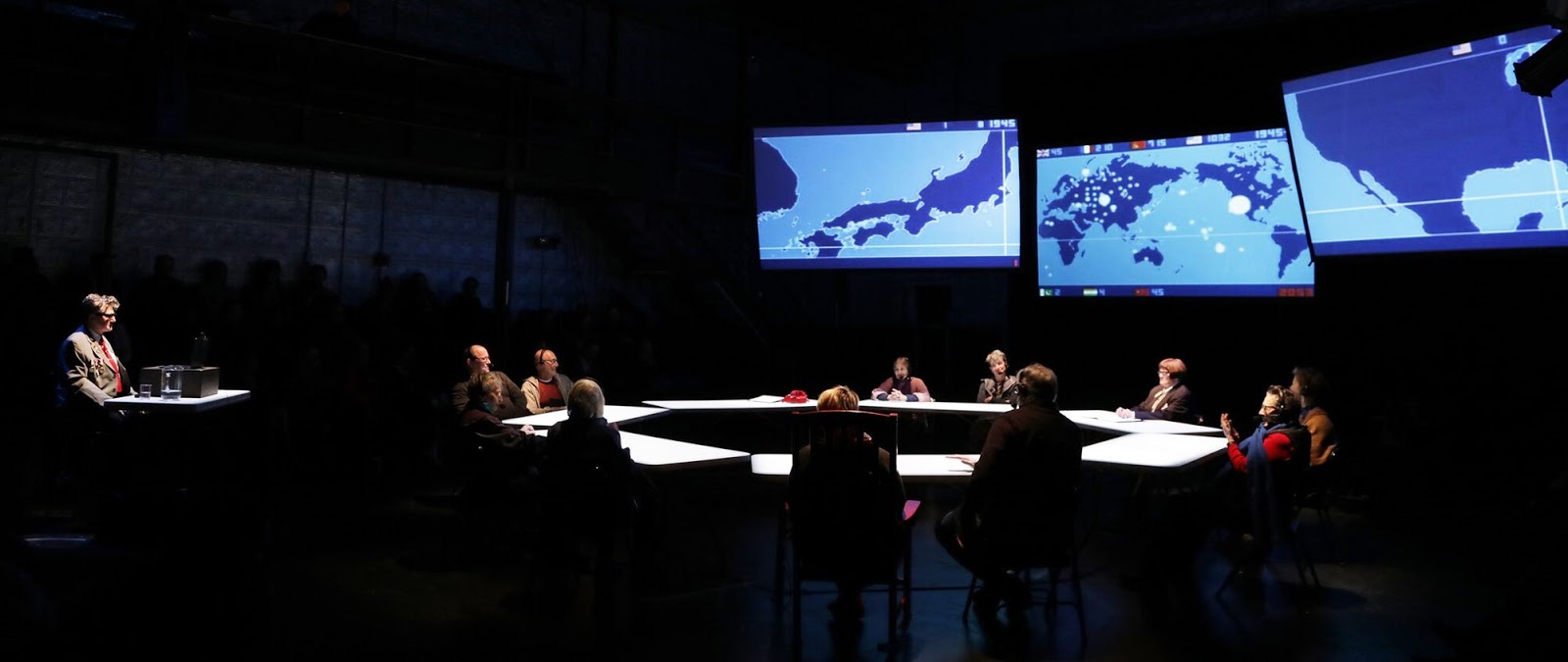
I haven't learned to stop worrying yet, and from the looks of things neither have queer comedy duo Split Britches (Peggy Shaw and Lois Weaver), whose Unexploded Ordnances (UXO) recreates the war room set from Kubrick's film and informs us that we have an hour until the bombs drop. With Shaw playing the US President and Weaver as a Jack D. Ripper-ish general, the apocalyptic deadline gives us time to ponder some important things about life, the universe and, y'know, everything.
The vehicle for said pondering is a 'Council of Elders' composed of the oldest members of the audience. After ascertaining who they are by asking people to raise their hands if they were alive during World War II, the Korean War or the Vietnam War, they're asked to sit around a circular war table. As the nuclear countdown ticks down they're quizzed about their fears, ambitions and thoughts on the state of the world.


Responses were somewhat depressing. The 'younger' old people all seemed terrified at the prospect of further aging, describing their fears of incontinence, their bodies continuing to fall apart and the sudden proximity of the Grim Reaper. On top of this, there was an unsettling pessimism of the state of the world in general, touching upon the Israeli slaughter of Palestinian civilians, plastic choking up the world's oceans, global warming and the incompetence and ineptitude in global political leadership. It's a bit worrying to hear people's misgivings at how they expect the world to be in 50 years, and how they will be unable to protect their children and grandchildren from whatever happens.
The one ray of light comes with the oldest member of the council, 82-year old Margaret. She seems to have pragmatically accepted ageing and declares herself to be a born optimist, explaining that she's sure things will work themselves out somehow. It's a pretty vague platitude, but hey, I'll take it.
The backdrop to this discussion is infographics showing every nuclear explosion from 1945-1998, with tallies by country in the top corner, B-52 bombers lazily trailing their way across the stage and 1950s stock footage of children practising 'Duck and Cover' (advice that is not as ridiculous as it might first appear). This stage dressing (together with reminders from Weaver's General that we're working to a deadline) help keep both the Council of Elders focused and ensure that things keep moving.
But it's in sustaining momentum that Unexploded Ordnances (UXO) often comes a bit unstuck. By design the show meanders between subjects according to the whims of its participants, and I suspect it lives and dies by who ends up on stage. Even though I suspect we got a pretty interesting batch, there were moments throughout the show where things got exasperatingly aimless - more than once I wondered what the point of this all was.


Fortunately, Split Britches isn't trying to be particularly enigmatic. The show's title refers to potentially lethal bombs (grenades, mines, shells etc) that remained buried long after the war they were used in was over. This explained as a metaphor for the unexploded ordnance within us - the fears we keep bottled up and the ambitions and desires we have not or cannot realise. Perhaps a tiny bit presumptuously the show posits itself as therapeutic for its participants, but they looked like they were engaged so hell, maybe it was.
It made me reconsider my preoccupation with being incinerated in a nuclear holocaust: is it a practical fear or just an irreligious way of thinking about my own death? Visualising buildings torn apart in a hail of shattering glass, combined with a raging wall of fire moving at the speed of sound is a bit Roland Emmerich especially when, statistically speaking at least, I'm more likely to pop it slipping in the shower. Then again these bombs really do exist, they really are aimed at London and the people currently in charge of them don't inspire much confidence. It's an unsettling train of thought, and the mundane fears and desires we see here reminded me of Stalin's famous quote that one death is a tragedy and a million is just a statistic.
Unexploded Ordnances (UXO) ends up as a tricky one to grade. The show often engages in self-critique, particularly when Weaver and Shaw explain that they never know how to end a show properly, after which they do indeed unceremoniously anticlimax themselves off-stage. Understanding and explaining your flaws doesn't excuse them, but it at least shows an honesty that few other shows have. But though this is a fuzzy and loose-limbed bit of theatre it's also a consistently thought-provoking one. And as always that goes a long way.
Unexploded Ordnances (UXO) is at the Barbican Arts Centre until 19 May. More info here.
Monday, May 9, 2016
Monday, May 9, 2016
- 0 Comments

Alan Moore is one of only a couple of people that have permanent spot in my personal pantheon. My adoration of musicians fades as they put out a couple of dodgy albums; I find myself growing out of writer's styles and promising directors' are forgotten when later film lack the spark of their early work. Alan Moore isn't like that - the man is a writing genius and I'll be a fan 'til the day I die.
Though primarily known for his comic books (which are light years beyond any of his contemporaries), Moore's also a musician, prose author, philosopher, magician, publisher, activist and now screenwriter. He's described in the programme for his event as "one of the most important postwar British authors"; an accolade he more than lives up to.
Over the last twenty years his focus has shifted to his hometown of Northampton, writing the brilliant Voice of the Fire, guiding readers through 4,000 years of Northampton history, Northampton centred alt-culture magazine Dodgem Logic and the upcoming epic novel Jerusalem, an intimidating one million word (!!!) magnum opus about a 1/2 mile stretch of, you guessed it, Northampton.
And now we get Show Pieces, Moore's first foray into screenwriting. Set, predictably, in Northampton, it comprises three short films baked into a single open-ended narrative. The first, Act of Faith, is a tense and stylish mini-narrative about the extremes of kink and sexual gratification. This bleeds into the double-hander Jimmy's End and His Heavy Heart, which follows James Mitchum (Darrel D'Silva)'s very bad night on the tiles.
I may be a diehard Alan Moore fanboy but I was a bit nervous about Show Pieces. I had no worries about the writing, but a script is only a component of cinema. What if it's badly shot? What if the acting is amateurish? What if it just looks cheap?


Pleasantly and cheerily, it clears all these hurdles. But that's probably the only context you can use "pleasant and cheerily" to describe Short Pieces, which proves to be a suffocatingly intense and disturbing trek through sexual humiliation and Egyptian afterlife by way of a fag-stained working men's club.
In Act of Faith, Jenkins pitches up somewhere between Nicholas Winding Refn and David Lynch; fetishising the rolling on of stockings, slugging back neat vodka and the slow, sticky application of blood red lipstick - all under washes of luminescent primary colour. In the 'main feature', the Lynch-cribbing ramps up a notch, with tattooed burlesque dancers, horrific circus performers and thick velvet red curtains.
I guess if you're doing a surreal horror short Lynch is a decent place to take tonal inspiration, but even I was a little dismayed when the evil and sinister clown archetype reared his head. Psychopathic clowns are - to say the least - a bit played out. Fortunately, Moore's clown (wonderfully played by Andrew Buckley) quickly proves to have a lot more going on than usual - namely being an avatar of the Egyptian god Anubis by way of the East Midlands.
Short Pieces develops into an excellent showcase for Moore's skill at making incomprehensible mystic processes and metaphysical beings as at home in your local pub as they are on millennia old papyrus. This fuzzy partnership between domestic/cosmic works gangbusters, heightening the horror by bringing it home for tea. In practical terms it's difficult to relate to the workings of the Ancient Egyptian Book of the Dead - but in Moore's hands Anubis, Set, Ra and all the rest might be loitering just around the corner...
After the show we were treated to a Q&A with Moore and Mitch Jenkins, compered by journalist Charles Shaar Murray. Moore was, as expected, a warm, polite and deadpan presence (his online reputation as a bitter and miserable grump continues to perplex), discussing his fascination with Northampton ("not just the centre of Britain, but the confluence of all time and space"), the processes of shooting in Northampton and his interest in Ancient Egypt eschatology ("great at makeup, but fucking morbid").
 |
| L-R, Alan Moore, Charles Shaar Murray and Mitch Jenkins |
I asked Moore if it was refreshing to get to show people how it's done, considering the famously iffy quality of Hollywood adaptations of his work. He explained that he has no desire to see any of those, but that working with Mitch Jenkins was an eye-opener in terms of translating his words to images. Moore's famous for his lengthy and precise comic scripts (once writing ten pages of notes to an artist for a single panel) but film is a different beast, the end product the work of many creative collaborators.
Despite this process, Show Pieces feels very much like an Alan Moore joint - he has a small role in it, wrote all the music (the bands credited are fictional) and designed every product in the film. The intent was to create a self-contained fictional universe that, like so much of Moore's work tends to, has begun to bleed into the 'real' world.
Short Pieces closes on the hellish image of Nighthampton "where Northampton goes when it dreams". This will be the setting of Show Pieces follow-up: where our unfortunate protagonists will journey further into Alan Moore's bottomless and terrifying imagination. I can't wait.
Show Pieces is available on DVD now.
Tuesday, March 22, 2016
Tuesday, March 22, 2016
- 0 Comments

I don't know much about ballet, but I know what I like. And I like Ballet Black. Founded by Cassa Pancho, the company's goal is to grant black and Asian dancers an opportunity to shine. Sadly, black and Asian dancers are overlooked for major roles, Carlos Acosta perhaps putting it best: "There is this mentality, especially with directors, that a black ballerina in the middle of a flock of white swans would somehow alter the harmony."
Ballet Black not only tours shows that showcase their extraordinarily talented dancers but run the popular Ballet Black Junior School and an Associate Programme (with 400 members), in the hope that they can inspire a new generation of dancers.
I know all this because I attended an open rehearsal for the show. There I got to know the dancers as human beings rather than as unapproachable epitomes of physical perfection, got to see the construction of the choreography and heard explanations of pretty much everything they was going on on stage. This is invaluable for a neophyte like me - ballet's always seemed like a world where everyone assumes you know your arrière from your sissonne fermée (thanks Google).
After very much enjoying the rehearsal I was eager how the sketch I'd seen would translate to a full picture. Divided into three separate pieces, two short/one long, the show is constructed on the basis of 'something for everyone'. Indeed, each segment was markedly different from the others, offering a mixture of populist theatre and the avant-garde.
First up was Arthur Pita's Cristaux. I'd thought that Ballet Black would ease us in with something warm and personable, but Cristaux quickly proves anything but. Soundtracked by the jangling glockenspiel loops of Steve Reich's Drumming Part III, this is a coolly minimalist, almost mechanically precise demonstration of what the company is capable of.
Dancer Cira Robinson emerges in a crystal festooned tutu and tiara, the spotlight casting rays of light from it that gently discoball their way across the awed audience. It's an impressively attention grabbing introduction, only equalled by the moment when a gigantic crystal pendulum dramatically whooshes across the stage, apparently threatening to decapitate the dancers below. Robinson eventually intertwines with Mthuthuzeli November, the two mesmerisingly falling in and out of synchronisation - their motions occasionally giving the illusion that the two somehow physically meld.

As it ends it feels as if the audience collectively exhales - there's a general sense of "wow". Christopher Marney's To Begin, Begin has big shoes to fill. This is anchored by two elements, a large sheet of cobalt silk that weightlessly flutters around the stage and the magnetic stage presence of Sayaka Ichikawa. The two work through a series of eye-catching configurations; ranging from a costume to bondage to scenery. Contrasting the loose chaos of the silk with the precision of the dancers is effective, but lacks some of the oomph of the preceding piece.
After the internal is the main course: Christopher Hampson's Storyville. It tells the story of Nola (Cira Robinson) a young girl lost in New Orleans. She's a talented and natural dancer, but falls under the sway of salubrious nightclub owners Lulu and Mack. Gradually she sinks into a life of vice, the only ray of light in her life the love of an honest sailor.
Using a variety of Kurt Weill songs, there's a Cabaret-esque seedy tinge throughout, with Nola's plunge into the metaphorical (and later literal) underworld ably conveyed by smart choreography and a carefully chosen group of symbolic props. Highlights are when Nola's childhood doll is used to puppeteer her, voodoo style. As it's dropped Robinson perfectly and dramatically collapses onto the stage. Also impressive is a later scene of drunken hedonism, in which we see the interesting juxtaposition of drunken clumsiness and ballet, the dancers obviously relishing the challenge.
That said, though Storyville is an excellent showcase for the company and oozes style, I didn't feel half the emotional heft that I felt from the earlier conceptual pieces. The sustained focus on narrative didn't quite pay off, and despite a downer ending I didn't particularly feel the tang of tragedy that I'd anticipated.
Nitpicking? Perhaps. It's difficult for me to criticise performers this skilled - they left me thoroughly gobsmacked from start to finish. As promised, there's something for everyone here, though for me it's the boldly experimental modernist thrills of Cristaux that will stay with me the longest.
★★★★
Ballet Black's Triple Bill is on tour throughout 2016. Tickets and info here.
Thursday, March 19, 2015
Thursday, March 19, 2015
- 0 Comments

Jesus fucking Christ. Where to begin? I've been a lot of bizarre concerts and heard a lot of weird music. But Squarepusher at the Barbican was (by some distance) the craziest, most aggressive electronic gig I've ever attended. Firmly putting the 'mental' in 'experimental music', this was about 90 minutes of ear-splitting, atonal noise accompanied by gigantic epilepsy-inducing abstract visuals.
Squarepusher (aka Tom Jenkinson) emerged from the electronica scene of the mid-90s and has subsequently been producing music that ranges from drum n' bass to soothing ambient electro (and almost everything in between). I got into him after seeing the Chris Cunningham directed video for Come On My Selector sometime in the late 90s, my teenage self highly impressed with the equally barmy audio and visuals. Now, after forays into jazz, solo bass guitar and last year's Music for Robots project, in which Jenkinson collaborated with a team of Japanese engineers to create robots capable of playing beyond the capabilities of puny flesh musicians, he's back in the studio for Damogen Furies, his fourteenth album.
2015 is an interesting time for Squarepusher's brand of electronica. With EDM surging in popularity, temptation has come knocking at the door. Cover yourself in LEDs, laser beams and billowing crowds of dry ice, play tracks constructed around gigantic bass drops and watch the money roll in. Though this gig firmly isn't appealing to the mainstream, elements of popular EDM have nonetheless crept in. Hidden amongst the clanging atonal madness are the odd build up and big drop, a couple of synth melodies and what almost sounds like a sample from The Cure's Just Like Heaven. That aside, this is fiercely aggressive, head-meltingly strange music - bizarre to the point that I'm perplexed that enough people like this stuff to fill the Barbican Hall.
As I sat there getting my face blasted off I looked around the seated crowd, wondering just who the hell these people were. I can only assume they're old school rave casualties: so accustomed to high BPM acid-techno that they can now stomach only the most corrosive of of corrosive music. Even among this sturdy lot reactions varied; one gangly man attempted to gain access to the stage, then proceeded to cavort, limbs flailing, around the auditorium, closely pursued by security. Conversely a steady stream of people left throughout the show, presumably having been bludgeoned into submission by what was blaring out of the speakers.
As for me? From minute one I didn't know which way was up. I felt like a prospective astronaut in high-G training, spun to dizzy unconsciousness in a giant centrifuge. At times it was like I was hearing five gigs at once, jagged shards of sound jumbling up together into something weird and alien. The brain doesn't quite know which angle to approach this from, the moment you identify what could plausibly be melodic progression things collapse into a hail of dissonant squeals and beeps. At it's peak I'm listening to music so fast that's one or two steps removed from static; a decent simulation of what it's like to be a superintelligent robot with a really bad migraine.
 |
| One of the visuals. |
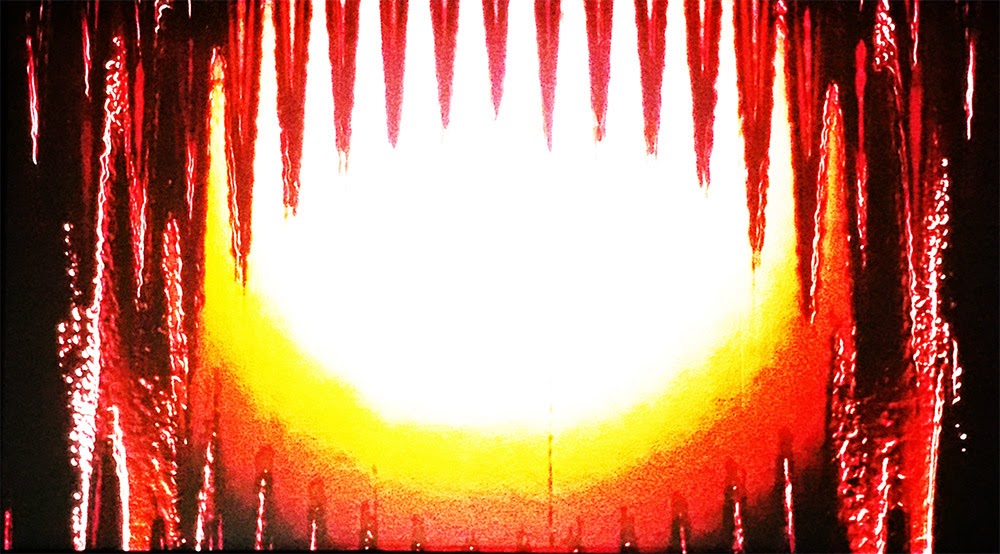
The visuals are similarly screwed. Endless tunnels of glitched out graphics and monochrome DOS smears pop up at a rate of two a second. Complex patterns, text and diagrams spin past, too rapid for the brain to process. The effect is as if Squarepusher is downloading something directly into our minds, beating the doors of perception tdown. There's a cyberpunk flavour throughout, the iconography of computing harnessed in an attempt to simulate silicon life. Eyes glued, ears ringing and mouth hanging slackly open it's as if you're living through William Gibson's wettest dream.
It ends with a hundred ears ringing in unison and shellshocked eyes blinking in confusion. I'm not sure I 'enjoyed' this gig per se, it was more as if something had happened to me over which I had no control, like being swept up in an tsunami of noise. On a visceral level I feel (even the next day) like a pneumatic drill has been taken to my head, but I also feel a strange calm, no matter what craziness the world throws at me I can probably deal with.
Squarepusher is really pushing the boat out here - casting his net towards the bonkers end of the musical spectrum in an avalanche of unfriendly abstract sound. It's hard to imagine how much further he could go than this. It's hard to imagine that audiences could take much more than this.
Thursday, January 22, 2015
Thursday, January 22, 2015
- 0 Comments
Dystopian cyberpunk mime theatre? Sign me the hell up. When I read about Light, described as "blending anime-style storytelling and a pulsating soundscape"" I couldn't get a ticket fast enough. I always enjoy science fiction theatre; it's difficult enough to realise a fantasy world in cinema, let alone on stage. So companies that take up the challenge tend to be of the ambitious, experimental and bold variety.
Those qualities apply in spades to Theatre Ad Infinitum's Light, but sadly they don't add up to a particularly enjoyable experience. Staged in the depths of The Pit - the Barbican's deepest theatre - we're utterly entombed in concrete. Down here nothing gets in, not the sounds of the traffic, not phone network signals and certainly not a ray of sunlight. As we begin we're plunged into pitch darkness and tossed forward in time to an Orwellian nightmare.
This is future of interconnectivity between humanity, where thoughts can be tossed between skulls as easily as sending a text message. These wonder implants might have once had the potential to unite us in empathy, but they're been appropriated by an authoritarian government to police the thoughts of the citizenry. It's now illegal not to be implanted; the memories, desires, dreams and ambitions of every person filtered through state surveillance.

Our hero is Agent Petrus, charged with hunting down those who've had their implants removed, torturing those he captures and working his way up the ladder to the terrorist's leader. It's a stressful job and adding to his woes is that he's the son of the Glorious Leader, who considers him a disappointment in failing to stamp out the resistance. But things are soon to change for Petrus as he discovers the true nature of his world, the past those in power would rather keep hidden and some dark family secrets.
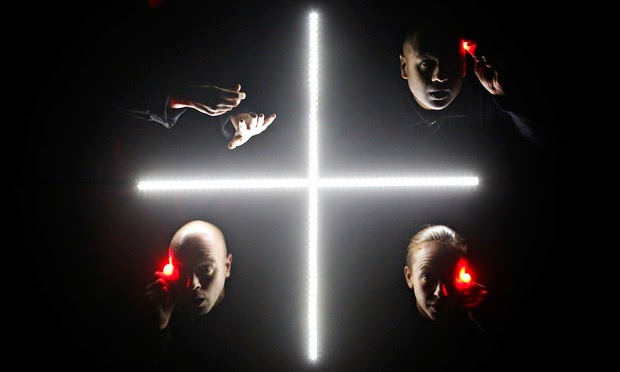
In every respect this is dark stuff; from the crushing misery of the futuristic surveillance state to the literal darkness we're enveloped in. Told entirely through mime (with dialogue on surtitles above) the primary methods of communication are motion and light. This is extremely minimalist theatre; what's on stage pared right back to the bone. Characters wear identical black jumpsuits and move between pools of torchlight, the scenery created through a couple of strips of LEDs held in different configurations.
It's undeniably visually striking, the lack of detail allowing us to imagine a future far more detailed than anything a production designer could cook up. There's a film-noir aesthetic to the hunts and interrogations; the cast's faces uplit to create a sinister chiaroscuro effects. A dry ice haze that hangs over the stage makes for a literally dense atmosphere, allowing the performers to remain invisible so long as they're not directly in the light. This means they can sinisterly loom from anywhere, fostering appropriate levels of paranoia. Perhaps most cleverly, this technique also allows the company to 'edit' their play like you would a film. In dream sequences we can 'cut' from the dreamer to seeing what's inside his mind, giving the piece an expansive, spontaneous quality that's difficult to capture 'live'.

So with all that going for it, how can Light not be that great? Well, once you've gotten over being thrilled by the novel aesthetics there's not much else to fixate on. The show lasts about an hour, but you'll have seen practically every trick it has to offer after about fifteen minutes. It quickly transpires that no matter how imaginatively you use two strips of LEDs, a couple of torches and some red gels you're limiting yourself.
This leaves the story to hold our attention. On paper it's a pretty straightforward sci-fi tale, but the lack of spoken dialogue makes it next to impossible to empathise with the characters and often makes it pretty tricky to even follow what's going on. Not to mention that the structure is a little wonky, the hero disappearing from the plot in favour of a lengthy flashback sequence. There's a tension between the symbology of the piece (having the characters communicating only by electronic text is entirely appropriate) and the actual enjoyment of watching it.
If this were half an hour long I'd be singing its praises to the heavens. But, as pretty as it frequently is, fatigue rapidly sets in. Light is technically and politically excellent, containing some wonderful imagery and imagination, but just can't quite sustain its aesthetic high-wire act, so I was disappointed when I realised I'd ever-so-gradually become a bit bored.
Light is at the Barbican Centre until 24th January. Returns only.
Wednesday, September 17, 2014
Wednesday, September 17, 2014
- 0 Comments

Commander Macbeth, leader of a bloodthirsty militia raping and pillaging its way through the Democratic Republic of Congo, strikes an imposing figure. Illuminated from behind by tessellating patterns of light his features slowly melt away into silhouette; reducing him from an individual into some sick ideal of an African warlord. AK47 clutched in hand, tyrannical physique swaddled in camouflage gear and surrounded by baubles of Western extravagance he could be any one in an infinite procession of brutal bastards, each rising up through blood and intimidation to wreak havoc with armies of drugged-out child soldiers.
Brett Bailey's adaptation of Verdi's opera goes for the jugular early and often, a slimmed down, muscular Macbeth shot through with angry, intelligent politics and realised with neon pop-concert staging. In an opening preamble we read that in 1935 an amateur opera company visited the city of Goma and staged Verdi's Macbeth. They disappeared, leaving behind a case filled with dusty old costumes and scoresheets. The conceit of this show is a modern company discovering this case and creating their own production influenced by the recent history of the DRC.
You don't need to be particularly clued up on recent African history to know that this region is drenched in blood and plagued by atrocity. This makes it fertile ground for a reimagining of Macbeth, the 11th century tangle of nobles, castle, dynasties and witches replaced by militia commanders, secure compounds and predatory multinational corporations. This cycle of rising warlords battling for control of regions, gaining power and being subsequently slaughtered by their rivals fits Macbeth like a glove.
 |
| Commander Macbeth (Owen Metsileng) |
Reimaginings of Shakespeare set in the present often feel crowbarred into shape to fit the circumstances. For example, a recent prison-set Hamlet worked well enough, but you could see the ragged edges where medieval Denmark didn't quite fit. So it's a little scary how perfectly Macbeth slots into this time and place. Perhaps this isn't so surprising though; after all Idi Amin did famously dub himself "the uncrowned King of Scotland".
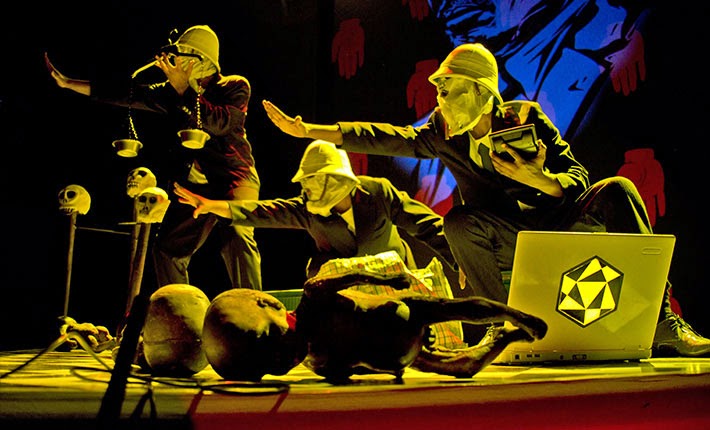
Central to Bailey's adaptation is the reimagining of the witches as besuited representatives of the Hexagon Mining Corporation. The DRC is rich in minerals, notably gold and tantalite, both crucial in keeping the West equipped with shiny new phones and tablets. Under the bloodsoaked soil lies a fortune for the canny investor, but one dependant on buttering up the local despots. Here, the witches aren't mystical dealers in prophecy but actively manipulating events to their own ends, using Macbeth's ambition as a means to gain control of these resources.
Commander Macbeth (Owen Metsileng) thus becomes the military arm of Western corporate interests, his militia doing the dirty work that the corporation officially washes its hands of. His transformation is soon made literal when Macbeth dons a ceremonial hat in the form of a bloody fist, turning his body into a limb. Though the character is venal, bloodthirsty and cruel this overt manipulation makes sympathetic. Bailey paints him as a puppet unable to see his strings, strings that tragically are all too visible to the audience.

Lady Macbeth (Nobulumko Mngxekeza), introduced washing clothes by hand tub undergoes a no less disturbing transformation. She becomes fatally infected by Western consumerism, swaddling herself in Harrods jewellery and dressing in haute couture. The cycle of murder she and her husband become locked in is twinned with their desire to lead a fantasy life of luxury dangled like a carrot on a string by the corporations seeking to exploit them. Key to this is that Shakespeare's Macbeth begins as a noble, whereas this couple start with nothing, clawing their way up from the dirt. In a dog eat dog world no wonder they cling to what they've gained with murderous jealousy.
Transferring ultimate responsibility for these events from Commander Macbeth to the Hexagon Corporation gives Bailey's opera a sharp political bite. Subtle links in staging and costuming connecting the colonial past to modern corporatist control. We gradually realise that Macbeth's rise and fall has been carefully orchestrated; the ultimate aim to keep the region unstable and ripe for exploitation. After all, a democratic, authoritative government might put in place labour laws, export taxes and consider nationalising industry - all anathema to corporations for whom profit is above all else.
That all sounds a bit heavy for a night out right? Fortunately this Macbeth is also riddled right through with a surprising amount of sly humour and wit for a show that features dead babies and photos of corpses. For example, Macbeth informs his wife about his initial encounter with the witches by text message: "Met witches in forest. Said I'd b King. L8r bbz X" The opera is also peppered with foul language, as Macbeth belts out Verdi's opera the surtitles inform us he's ranting about "motherfuckers!" and yelling "fuck them all!". Opera is usually pretty staid (or at least its usual audiences are), so it was refreshing to hear an audience laughing so hard.
 |
| Neocolonialist bastards, skulls and dead babies. |
I was initially faintly suspicious that an opera using the DRC conflicts as a backdrop was being a touch exploitative. There's a slight queasiness about a classy London opera audience being entertained by tales of African barbarism, nodding in understanding, then retreating to bourgeois suburbia. This is largely defused by a series of cards introducing us to the performers and their backgrounds: most are war orphans from the area and a few are former child soldiers. Their beautiful singing underlines the our unthinking complicity in their pasts - singing ironically (though I guess appropriately) interrupted a few times by chirping mobiles from the audience.
At just an hour and forty minutes this rockets along without pausing for breath, mixing together Verdi's music with glittering disco balls, back-projected animations and costuming with one foot in reality and the other in allegory. It's consistently entertaining and warmly performed - every couple of minutes there's a flourish of imaginative staging that keeps audiences engaged. Above all this is a fiercely intelligent dissection of the corporate forces that keep the DRC wading knee-deep through a river of gore - Macbeth turning out to be the perfect vehicle for this grim tale.
'Third World Bunfight / Brett Bailey Macbeth' is at the Barbican Centre until 20th September. Tickets here.
Wednesday, July 9, 2014
Wednesday, July 9, 2014
- 0 Comments
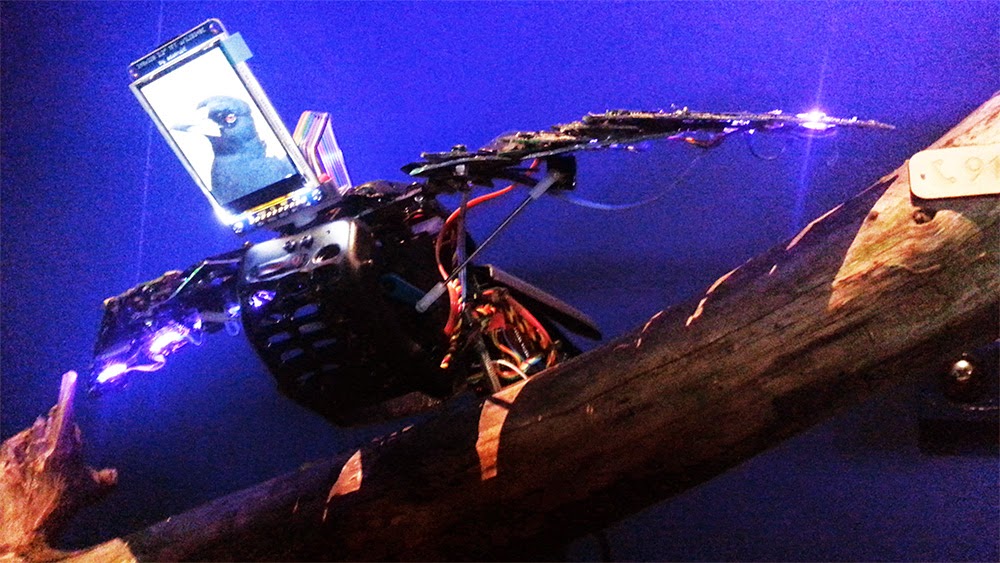
Digital Revolution is an unreasonably entertaining exhibition. Within the Curve Gallery at the Barbican centre they've crammed a crazy amount of eye-catching, imaginative and straight up fun technological trinkets. By the time you've come to the end of the exhibition you'll have had steam billowing from your eye-sockets, been transformed into a birdcreature and flown away and been sung at by the giant creepy Egyptian-styled head of will.i.am. But first a game of Pong.
At first it's like you've walked into a particularly busy branch of Virgin Megastore circa 1995. Bathed in futuristic blue light, monitors glow from steel racks and the air is filled with iconic synthesised videogame blips. Somewhere Sonic the Hedgehog has dropped his rings, Mario has gobbled a mushroom and the Russian folk song Korobeiniki (immortalised in gorgeous DMG-CPU-03 GameBoy synth) floats across the room. It's as if ten-year-old-me has died and gone to heaven. Projectors around the room show some of the greatest hits of 90s tech; the T-Rex from Jurassic Park, Lara Croft diving through flooded tombs - even beloved obscurities like Parappa the Rapper get their moment in the sun.
 |
| Someone enjoying Super Mario Bros. |
It's peculiarly touching to see all these childhood favourites immortalised in a gallery - what was once regarded to be trivialities now behind plexiglass with a little description alongside explaining its heritage and cultural import. As we move through the exhibition we quickly realise that these 8, 16 and 32 bit classics represent the testy first dabbles of culture's toes in the digital sea - the early years when it began to realise the joy of shifting pixels.
The rest of the exhibition is devoted to the potential of technology to elevate mankind, appreciate the world in new ways and explore our rapidly growing technological legacy. It's this last aspect that this exhibition really opened my eyes to. By its very nature the internet is transitory - a website changes its design and (aside from archived screenshots) it vanishes forever. As long-forgotten servers die, so to do the dusty bytes hidden away on them. Experiencing these early webpages feels somehow important to understanding the modern internet. I was particularly impressed by Hi-ReS!'s website for Requiem for a Dream which uses Flash 4 magnificently in recreating the style of the film as a page. You can experience the archive of this here - a vintage yet still lovely slice of internet art.
 |
| Requiem for a Dream website - Hi-Res |
The most impressive example of trawling through the lost internet is Richard Vijgen's The Deleted City. If you were online in the mid to late 90s you weren't anybody unless you had a GeoCities page crammed full of flaming skull gifs and "Under Construction" banners. As the internet evolved and social media began to grow, people quickly abandoned the site, first to MySpace and then Facebook, leaving behind an internet ghost town. In 2009 the death sentence was pronounced; the entire community was to be deleted. In a heroic effort, a team scoured the servers of data before deletion - amassing a 650 gigabyte file.
 |
| The Deleted City - Richard Vilgen |
In The Deleted City you can explore this archive, navigating through the cyberboulevards and zooming in to see what you can find. I unearthed an enormous cache of bitty, low-res pictures of Sporty Spice and a bizarrely comprehensive history of the haircuts of The Backstreet Boys. Vilgen describes his work as a "digital Pompeii", and much as we stare at ancient Roman graffiti and try to put ourselves in their sandals, perhaps future generations will ponder Bonzi Buddy and try to deduce why we despised him so.
As we move further through, there's a whole raft of exhibits that allow you to see yourself reflected back in the cold panel of a TV screen with effects applied. This stuff, novel and entertaining back in 2003 with launch of Sony's EyeToy is looking a little bit creaky in 2014 - though at least what's on display is visually compelling. The technology powering most of these appears to be Microsoft's Kinect, which makes up for its shortcomings as a game controller by working beautifully as an art delivery device.
 |
| The Treachery of Sanctuary - Chris Milk |
The undisputed highlight of this section (and maybe the whole exhibition) is Chris Milk's astonishing The Treachery of Sanctuary. In this the viewer stands in front of a series of white screens to see their silhouette. Above the screens a flock of birds spirals and loops around. In front of the first screen you see your body slowly dissolving into more birds. The second sees birds swooping down and snatching pieces of you away. The third, and most impressive, sees the subject raise their arms to find that they've been replaced by graceful feathers. As you move your arms you hear the sound of wind swooshing through them - flap your arms and you take off, flying through the air. Just watching it is fun, actually doing it is amazing.
This piece isn't breaking any new technological ground but it's a great example of an artist precisely understanding the limits of the devices they're using. This underlies much of what's on display here; it's less about marvelling at the gadgetry and more at the imagination of those using them. Perhaps the pinnacle of this comes with Dreamin' About the Future, a multimedia installation by will.i.am and Sean 'bare' Rodela.
 |
| Dreamin' About the Future - will.i.am and Sean 'bare' Rodela |
Working on the principles of the 'hollow face illusion', will.i.am's polygonal face tracks you across the room. In an exhibition full of illusions that rely on mountains of mathematics and circuit boards, this one works a straightforward optical illusion; albeit one augmented with a great projection. The gigantic godlike head made me feel oddly like a worshipper of technology, staring up at some gigantic omniscient CGI god whose eyes follow me wherever I go; a subtle criticism of an increasingly interconnected, privacy free world?
I've covered but a smidge of the stuff here, but everyone should check this place out - especially if you're the curious sort who likes to fiddle with all kinds of interesting little tech toys. Other than the above be sure to check out the excellent Assemblance by Umbrellium on sublevel -2 where you can dance with light. This whole thing stinks of excellence - it's an almost embarrassingly good time.
Digital Revolution is at the Barbican Centre until 14 September 2014 - 11-8pm daily. Standard ticket £12.50.
Sunday, March 9, 2014
Sunday, March 9, 2014
- 0 Comments

Last week the Met unceremoniously cancelled the Barbican Centre's Just Jam grime festival because they don't trust young black Londoners not to stab or shoot each other. Something had to be done. Someone had to step up to the plate. Someone had to take a stand and show everyone that the Barbican isn't just the preserve of middle-class, white Guardian readers. And that someone was.... Secret Cinema?!
Yes, Secret Cinema, purveyors of cinema 'events' that currently cost £53 a head to wander around a tarted up Central London ruin and pay over the odds for rubbish cocktails and suspicious smelling schnitzel. Oh well, I suppose you take your revolutionaries where you can find them. An email went out on Sunday evening from them promising their first 'Secret Gig' at, as is their wont, a location to be determined. Secret Cinema aren't exactly the most urban youth orientated organisation, so I expected some morose looking dude on a stool with an acoustic guitar, or perhaps a willowy pale girl straight out of Cambridge singing melancholy rubbish.
What they actually served us up with Ghetts, a young south London grime artist with a bevvy of tunes about fucking over various institutions, angrily rapped over a booming bass beat. The secret location? Right in the middle of the Barbican complex, sandwiched between the pond and St Giles-without-Cripplegate. I turned up early when there were more police than spectators, three cops engaged in a tense conversation with Secret Cinema's organiser, Fabian Riggal.

“You can't do this, it's going to be mayhem!” the officer sternly told Fabien. “You just can't turn up in a residential area and hold a concert without authorisation!" Fabien justified himself by saying that the London youth deserve an opportunity to hear their own music in what purports to be an inclusive cultural centre, and that this was a protest against the cancellation of the festival. The police, looking faintly dumbfounded that he was even trying to do this, demanded to know how many people were going to show up. To be fair it's a good question, stuff like this spreads like wildfire on social media, and Secret Cinema's things are usually popular. Fabien dodged the question, probably terrified that thousands might show up.
An Inspector was called and as the red-scarfed crowd trickled in so did more police in Land Rovers and on bicycles. The atmosphere was pretty tense. But with a promise that the sound would be kept low Ghetts took the stage. “Let's make some fucking noise!” he yelled, before launching into the first of the four-ish songs he managed to play. Although Ghetts is clearly on board with the maxim “fuck tha police”, I don't think he'd ever played a gig before where he might actually be dragged off stage by the burly, scowling men of the MET.
His eyes darted from the side to side as the police massed off to stage left, as did the Secret Cinema staff, who're probably more accustomed to serving twats in top hats champagne cocktails than getting a truncheon wrapped around their heads and eyes pumped full of pepper spray.
All that excitement added up to a nicely dangerous and rebellious atmosphere (which was slightly punctured whenever Ghetts' album was plugged). The bass thumped around the concrete courtyard, reverberating around this old, dignified Brutalist utopia. Residents, clearly not particular happy, began to poke their heads from windows, their Earl Grey teas vibrating like the T-Rex from Jurassic Park was about, their snoozy Sunday evening in front of The Musketeers unexpectedly disrupted by an angry rapper loudly spitting epithets in their general direction.
Soon behind the decks there was some very restrained commotion. A grey-haired man in sweatpants and a grey t-shirt was angrily remonstrating with the DJ, Phil (who really needs to work on his moniker if he's going to make it). The guy, presumably an upset Barbican resident, was making a face like someone had taken a shit in his favourite hat, and with a petulant flourish he yanked the power cable out, cutting Ghetts off in mid-flow.

To be honest, Ghetts looked a tiny bit relieved that someone who wasn't the police had ended the gig. It would have been one hell of a climax to end a show with the performer being bundled into the back of a police van, but in the long term probably for the best for Ghetts that this didn't happen.
As the crowd dispersed I saw the upset residents angrily remonstrating with the police. One of them urgently pressed a flyer into a cop's hand, - “nice work Sir, with this piece of evidence we can close the case” the cop didn't say. At what point in your life does the joy drain out of you to such an extent that you're eager for young musicians to be punished for expressing themselves, even if it does disturb a peaceful Sunday?
I chatted to one of these annoyed residents afterwards. He explained that it certainly wasn't that he disliked hip-hop, but there's a time and a place for concerts and protests, and a Sunday evening in the Barbican isn't it. He argued that they should have gotten permission, I pointed out that they wouldn't have gotten permission – and anyway the fact that the Barbican was prepared to host a grime festival in the first place means that they kinda sorta maybe tacitly approve of this kind of thing. Then he told me if I wanted to change the world I should join the Labour Party (lol).
I like the Barbican. It's a nice place to hang out, the staff are friendly, they hold interesting free events and their scones are second to none. But a cultural centre like this has got to cater for every Londoner, not just those who ask “ooh, could you put a bit of soya in that latte?”. To give them every credit they tried to put something on for the London youth and were stopped by the fuzz. But they couldn't stop this bandit gig tonight – and it was all the more fun for its illegality. Well done Secret Cinema, and well done Ghetts.
Nuts to those who had 20 minutes of their life marginally inconvenienced by a bit of music. I hope they take a long look in the mirror and realise that they've become everything they once despised.
Monday, December 17, 2012
Monday, December 17, 2012
- 0 Comments
 |
| Taken during the show, Philip Glass is seated on keyboard near the bottom right. |
I've been looking forward to this concert/screening for what seems like forever. 'Koyaanisqatsi' is my favourite film of all time, and ever since I first watched it in 2006 I've been desperate to see one of the rare orchestral performances of the score performed in sync with the film. So when I found out last February that Philip Glass himself would be performing it 5 minutes from my front door I snapped up a ticket right away. Since then the ticket has been gently yellowing from age, tucked safely up on a high shelf for 10 months, the concert always too far off in the future to let myself get truly excited for it. But on Friday the day finally arrived.
I hate the idea of having a singular 'favourite' film that sits above all others, but if I did have to pick one 'Koyaanisqatsi' would probably be it. It's a piece of 'pure cinema', minimalist in construction, composed entirely of beautiful images and music. There is no plot, no characters and no dialogue. The only problem with it is that the general response when you say it's your favourite film is for people to go "Koyana-what?" It's almost impossible to describe the film without coming across as a pretentious arsehole, especially if you begin using (perfectly accurate) phrases like 'visual tone poem' or, for that matter, 'pure cinema'.

Ironically, even though a description can make the film sound utterly inaccessible, 'Koyaanisqatsi' is a film that any human being can appreciate on some level. By eliminating language the director, Godfrey Reggio, created something that can be appreciated anywhere in the world. Similarly, culturally specific elements like plot and characters can be enormous barriers, invisible to audiences accustomed to Western story-telling, but potentially alienating to anyone outside of that sphere. I genuinely believe that every single human being on the planet, can get at least something out of this film. Sure, they might be bored or confused by it, but 'Koyaanisqatsi' is constructed in a way that highlights certain universal human experiences and emotions.
So, if the film is pared down so much, how does it communicate? The division is split 50/50, between the beautiful cinematography of Ron Fricke and the score composed by Philip Glass. The score is famous in its own right, being appropriated for video game trailers or superhero films but for my money it's so intrinsically connected with the images in this film that it doesn't properly work anywhere else.

Walking into the Barbican auditorium to a stage full of empty seats immediately impresses upon me how many people it takes to bring this music to life. We have the Britten Sinfonia, the Philip Glass Ensemble and the Trinity Laban Chamber Choir, all in all meaning there's about 60 or so people on stage at any one time. We also have Philip Glass in attendance on keyboards, although as far as I can see he doesn't do a huge amount himself, leaving the complex arpeggios to Mick Ross. Still, I think he's earned the right to sit back a bit and take the co-pilot's seat tonight.
I've seen this film many times, and I know pretty much every shot in it by heart, but I was anticipating what the live musical accompaniment would add to the experience. From the moment Jeremy Birchall stepped up and began singing the word 'Koyaanisqatsi' in an impossibly deep bass tone I knew we were in safe hands. Throughout this performance, the sheer abundance of incredibly talented musicians on stage breathed new life into the film.

'Koyaanisqatsi' begins very slowly, with majestic shots of deserts, lakes and mountains. The pacing here is deliberate and stately, underlining the permanence of this geography. Some of the shots of the desert seem deliberately framed to be reminiscent of shots of Mars; alien landscapes utterly indifferent to human life. This tactic of transforming the familiar into something abstract runs throughout the film. As we progress through the film we see the first signs of human life, miners carving their way through this pristine landscape. The final progression is an extended examination of a city, the processes that support it and the lives of the people living within it.
There are a number of clever and subtle contrasts in this film, and the impressing upon us of the timelessness of the natural world is inversely mirrored in the impermanence of our man-made world. The human equivalent of these majestic landscapes are our skyscrapers and urban environments. 'Koyaanisqatsi' shows up these as something transitory. We're shown the Pruitt Igoe housing project being demolished, row after row of huge blocks collapsing into dust. Skyscrapes bloom grey clouds from their bases as the TNT explodes, and then seem to be sucked into the earth. Again and again the film urges us to consider our environments and behaviour from different perspectives.

The film uses various artistic tools to shift our viewpoint, forcing us to view a familiar world with an outsider's eyes. Probably the most famous is the time shifted photography. In the most intense sequence, 'The Grid', we see the processes of a city hugely sped up. Traffic becomes abstract red lines, electronic dots chasing each other around a maze. People become frantic blurs, jittering their way through mechanised turnstiles and office doors. Here, the crowd becomes dehumanised, notions of individuality are squashed. There is a an inescapable futility here, thousands of people rushing around madly to no apparent end, running as fast as they can to stay in the same place.
During 'The Grid' we examine the life support systems that keep this crazy system running smoothly. We see food mass production, conveyor belts teeming with food sorted by robotic, emotionless workers, television after television being bolted together or computers being assembled. These shots echo the machines we've seen people travelling through. One shot of sausage production directly quotes footage of commuters pouring off escalators. You inescapably begin to feel like a piece of meat yourself, a tiny pointless cog in a bigger machine.
 |
| You're somewhere in that crowd! |
As this sequence ends the music drops away and we cut to high above the city. The camera floats serenely, reminiscent of an out-of-body experience. This is a transition from the small-scale to the large and the silence allows us a moment of contemplation and decompression after all the thundering noise and energy. After maybe 40 seconds of this, there's a series of spectacular match cuts which show us the city from above as circuit board, manufactured and logical, humans mere electrons blustering around components.
Throughout 'The Grid' the music builds and builds to a frantic pace. The rhythmic chanting of the choir seems to match the arpeggios of the keyboards. As it gets faster and more frantic so do the visuals, as if they're racing each other and matching speeds. This onslaught of imagery and sound had a profound physical effect on me. I found myself pressed back into my seat, my muscles tense, my jaw locked in a grimace. I felt a bit like David Bowman in 2001 being passed through the star gate. Seeing the film projected large, with an orchestra thundering beneath it elicits an actual physical response, suddenly 'Koyaanisqatsi' is not a nearly 30 year old film, it is something happening here and now.

Though this is a film that gets a clearer view than most of the bigger picture, there are repeated smaller and personal moments that always affect me. One shot shows an faintly simian looking man sitting, smoking in the bowels of a power station. He looks competent and in control, emanating some kind of confidence in his role, as if he's shouldering the responsibility of keeping the city running. Another is an old homeless man who, as the choir starts singing, turns his head to look directly at the camera, staring dully and faintly accusingly at us, his sunken eyelids seamy and red.
By far the most affecting, for me is simply a shot of an elderly withered hand weakly searching for human contact in a hospital. Film is ultimately a manipulative medium, exploiting a basic human love of melodrama to make us feel emotions. But when a nurse walks over out of shot and takes that person's hand and comforts them, it feels genuine; a true glimpse of kindness. The contrast between seeing tightly regimented humanity moving marching robotically through the city, and dazed, wandering, injured people of this sequence couldn't be greater. We're seeing the people who've been spat out of the machine, broken gears that society has no further need for.
 |
| Watching this woman trying to light her cigarette showcases the misery of the mundane. |
'Koyaanisqati' is a wonderful film, something that achieves what few films ever can: a positive change in the viewer. Rather than preach a message it trusts us to reach our own conclusions and to actually think about the images and sound before us. The film allows us to explore the perspective of the outsider, to see the world with new eyes. It's the kind of film that stays with you for the rest of your life. Heading onto the tube in London in rush hour you inescapably begin to consider yourself as a mere electron, just another insignificant face in the crowd. It's not a pleasant feeling, but it is, perhaps, the truth.
It was an absolutely wonderful concert, and I think maybe the best single screening of a film I've ever attended. 'Koyaanisqatsi' is an outstanding piece of cinema, and is only uplifted by hearing its score live and loud. An experience to treasure forever. If you ever get the chance to see this film with an orchestra behind it - jump at the chance!

Subscribe to:
Posts (Atom)