Recent Articles
Showing posts with label Brunel Shaft. Show all posts
Showing posts with label Brunel Shaft. Show all posts
Thursday, June 18, 2015
Thursday, June 18, 2015
- 0 Comments

When most people think of opera, they imagine a crowd of white-tied toffs watching a wailing woman who looks as if she's been dragged backwards through a make-up counter. Opera is an artform where emotion is accentuated beyond all reasonable bounds: sadness becomes a grief, anger becomes fury and jealousy is an untamable green-eyed monster. So it's refreshing to see something where, for all the skill and talent, the tone is loose, dumb goofiness.
Rossini's L'italiana in Algeri, here reinterpreted by Pop-Up Opera as a Vegas-set casino sleaze narrative, is jam-packed with silliness. Typically, the company puts on a short classic opera then pokes fun at the more outrageous bits. For example, a long, energetic and adventurous aria might be summarised in the surtitles as "I really miss my girlfriend!". This drains any pomposity, but, well in L'italiana in Algeri there doesn't seem like much pomposity to drain away.
Mostly set backstage at the Algiers Casino, the narrative revolves around battlin' egos and blind lust. Owner Mustafa (Bruno Loxton) is struggling to cope with his aging showgirl star (and wife) Elvira (Catrin Woodruff). In exasperation he decides to be rid of her, scheming to offload her onto luckless gambler Lindoro (Oliver Brignall). Complicating matters is Lindoro's devotion to his long lost girlfriend Isabella (Helen Stanley) and her new (temporary) squeeze Taddeo (Oskar McCarthy).
These larger than life characters are tossed together in all kinds of ways, shifting in status, falling in love, going mad and growing furious - eventually tangling up in one big farcical knot. But though feelings run high and hearts snap like twigs, every development is handled with dead-on comedy timing and a generally upbeat, irreverent atmosphere.
Pop-Up Opera are famed for their choice of performance locations. I've seen them stage operas inside cocktail bars and antique shops, though they're also ventured into castles, vineyards and garlic farms. This production found them ensconced in the stygian depths of The Brunel Museum's Thames Tunnel shaft. I've visited this venue before, when it deeply tickled my history-lover's bone.
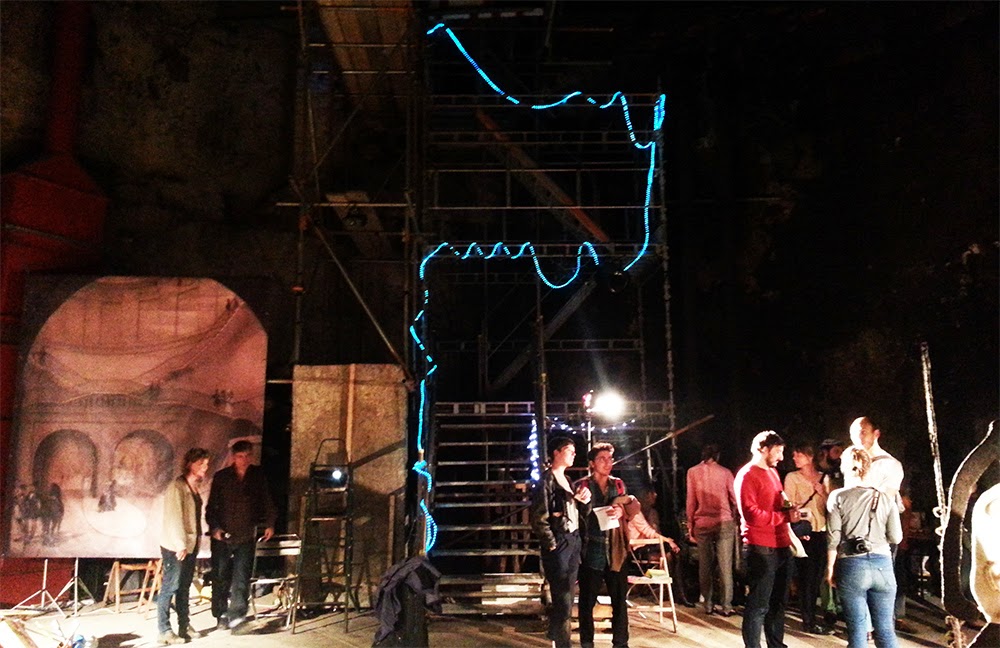
It's tricky to imagine a more dramatic entrance to a venue; from street level you climb down into a miniature concrete pit, then duck your head and shuffle forwards through a low concrete tunnel. You emerge about 40 feet in the air, perched atop a scaffold. Gingerly you make your way down to the floor, finding yourself in a huge cylindrical room below which the paradoxically named Overground periodically rumbles past.
Last time I was here it was packed with bizarre audiovisual art, the subterranean location making for an effectively grimy backdrop. So I was eagerly anticipating returning, especially for a company as consistently entertaining as Pop-Up Opera. Sadly, the venue didn't quite live to expectations. My primary problem is that while the shaft is an amazing place to explore, as a static backdrop it's essentially a large grey wall. This made it an austere viewing experience, somewhat at odds with the tasteless Vegas luxury in this adaptation.
But what the venue lacks in glitz it certainly makes up in acoustics. As the talented cast delicately, dynamically and expertly navigate Rossini's beautiful music. Each cast member carves their own niche in the material; be it the bitchy insecurity of Catrin Woodruff's Elvira, the suspicious primadonnaness of Helen Stanley's Isabella or, my favourite, the sheer bonkers eccentricity of Bruno Loxton's Mustafa. Everyone sounds amazing, the space reverberating and amplifying every note, leaving practically able to sense the soundwaves bouncing off the hard, curved walls.
It was about when Mustafa, caught up in the bizarre rhythms of 'pappatacci' fever, removes his trousers, dons a fluffy white fur coat and a Beatle wig, that I decided that this was the most loveably dopey thing I'd seen in a while. As Loxton marched up and down in his pants, uproariously booming his bass parts, I spotted a manic glint in his eye: performing this looks about as fun as it is to watch.
I said in my last review of Pop-Up Opera that it would be difficult to imagine anyone having a bad time at their shows. I stand by that; you could place this company in practically any location and a crowd would walk out smiling. That said, in this instance the location wasn't quite in harmony with the material. But hey, I can't deny that I enjoyed myself.
This much personality and talent assembled in one company means there's a bedrock of quality they cannot sink below. I always look forward to Pop-Up Opera: they haven't disappointed yet, and I don't anticipate them doing so any time soon.
★★★
Pop-Up Opera's L'italiana in Algeri is back at the Thames Tunnel Shaft on 2-3 July 2015, then at various locations around the country. Information and tickets here.
Friday, October 3, 2014
Friday, October 3, 2014
- 0 Comments

There's a pleasing harmony in venturing down a great big hole to view works by female artists – especially when you discover a gigantic sugary clit nestled within. Brunel's shaft, a hop, skip and jump from Rotherhithe overground station, throbs with a weirdly compelling electricity, as if you're uncovering secrets just by being there. Clambering down on hands and knees through a claustrophobic doorway, you emerge at the top of a neon-lit scaffolding staircase. Below you lies a perfect circle of stained brick and rough concrete, the walls bisected by 150 year old pipes that rise like veins to the ceiling, swollen with rust and blackened by time. As you gingerly make your way down to the floor level you feel the gentle vibration and *whoosh* of the Overground passing just below you.
All things considered it's a neat place to be – frankly I'd be having a good time down here even if there wasn't art about. But there is, and fortunately the artists exhibiting, Charlotte Wendy Law, Susan Beattie and Kristina Pulejkova, fit the space like a glove. All three are exhibiting work caught in moments of a transition, objects that look as if they've been startled during the process of their creation, frozen like a deer in the headlights.
Susan Beatties' Baba wants what Baba dreams sculptures rise from piles of soil on the floor, blossoming into life as if she's more gardener than artist. The roughly person-size sculptures combine biological material (fur, intestines and a familiar looking piece of cow gut) with compacted earth pressed onto wooden sculptures. These rough-hewn shapes remind me of neolithic sacrificial sculptures; I can imagine ancient artist coaxing objects like this into existence and tossing them underground to appease some kind of bog god.

The most eye-catching is a 5 foot tall vulva with lips rendered in hundreds and thousands and pink icing. There's a pleasingly frank sexuality at play, genitals divorced from prudish morality and presented as objects of delicious veneration. That they look as if they've spontaneously sprouted from the concrete floor only underlines the effect, like the very earth under our feet has thrown them up from our collective subconscious.
More artificial, yet no less organic are Charlotte Wendy Law's Experiments in E. These sculptures are chaotic tangles of detritus. Bits of burnt piano, distorted balloons and random trash collide to create weird, purposeless objects. It's as if a particularly artistically minded hurricane has swept through a junkyard, mashing stuff together in a kaleidoscopic tangle.

I had a chat to Charlotte at the beginning of the exhibition, who explained that the pieces were influenced by the early Victorian psychic Helene Smith, who had become a minor celebrity on the back of claiming to be from Mars. To back up her claim she spoke Martian as a party act (unfortunately no recordings survive). Slightly puzzled, I went back to the works and tried my best to frame them with this in mind.
What I came up with was that just as Helen Smith had invented her own grammar and syntax, so Charlotte has created a grammar and syntax of objects. These kludged together sculptures, reminiscent of s possess a weird cargo-cult logic, suffused with directionless purpose. Every little junky fragment appears to be in the 'right place', yet there is no 'right place'.

To close off the evening Charlotte gave us a demonstration of her creative process. To an avant-garde musical accompaniment by sound artist Artur Vidal she showed us creation and destruction. Throughout the night a space blanket has been lying in the centre of the room like some gigantic metal grub. Wearing a crimson boiler suit Charlotte peels it open to reveal a tangle of junk. She picks up burnt, smashed up bits of wood, planks with nails jutting out of them and a broken balloons and begins to assemble them into a sculpture. Though she's freewheelin', there's a sense of purposefulness, like she's putting together a jigsaw.
After about twenty minutes her creation towers above her, a teetering, ramshackle, nail-studded sort of thing that looks like a health and safety nightmare. A tension builds in the crowd as it wobbles with each additional piece like a particularly modish game of Buckaroo. Then, with a creak, a bit falls off, bashing the rest on the way down. The structure is suddenly imbalanced and collapses into a mashed up tangle of planks and nails – from objet d'art to yesterdays trash in about 3 seconds flat.
There's a punky sort of satire in this performance. We've spent the evening admiring Charlotte's sculptures, enjoying their complexity and trying to work out what they're trying to communicate. But here, like Helene Smiths's meaningless Martian gobbledegook the grammar behind it is revealed as pure nonsense, a blizzard of phonemes that functions at as a simulacrum of language.

Also on display was Kristina Pulejkova's O, a short, looped film projected high onto the curved wall of the shaft. This continuec the communication theme, the footage showing us mouths apparently moving in morse code, saying “hello”. Once more the art appears to emerge from deep within the earth, the projectioned image appearing as a ghostly apparition on top of the old bricks.
To the side of the scaffolding was an artist's impression of the shaft at the height of its popularity. In its day it was quite the tourist attraction; curious and elegantly dressed Victorians driven here to experience the novelty of being underneath the River Thames. This novelty was not to last and soon the dank, gas-lit tunnels became famed for their population of prostitutes and low-lives rather than for Brunel's architectural ingenuity – so were walled off and confined to industrial use.
It's interesting to compare their present, semi-decrepit state to their opulent opening. You can still see the marks on the walls where Brunel's spiral staircase was attached and imagine excited people processing down into the depths. Exhibitions like Hello Ape Eyes keep these amazing places alive, a sort of time travelling game of whispers between the was and the now.
So I had a great time. Honestly, drag me to any mysterious hole in the ground and I'm yours. All hail subterranea!
Hello Ape Eyes is at the Brunel Tunnel Shaft, next to the Brunel Museum, SE16 4LF from the 3-5 October. 12-6pm.
Subscribe to:
Posts (Atom)