Recent Articles
Friday, August 31, 2012
Friday, August 31, 2012
- 0 Comments

In the shadow of the Olympic stadium, a diverse and international group of artists from have been sequestered in an industrial warehouse owned by ]performancespace[. The artists have been living and working intensively throughout the summer in what look like fairly spartan conditions. The aim of this concentrated focus is to allow these artists to "practically and critically interrogate their personal practices". I've come to the conclusion of this process; an open performance event in the Hackney Wick warehouse.
The evening featured several installations and performances by some of the artists. Everyone was welcoming and friendly, but then I've come to expect this kind of friendliness from the performance art community. It's hard to consider anything going on here as elitist or aloof, especially as you're choosing which delicious cake you're about to have a piece of (I chose New York Cheesecake). Everyone's happy to discuss their work, to explain how the space works and what it's been like to live here.

 |
| Glow in the dark vodka jellies! |
Dotted around the room from the beginning were various pieces and ongoing performances that had begun sometime earlier in the day. The most immediately attention grabbing were Arianna Ferrari's 'Drum' and Lauren Brown's 'Untitled'.
Through the art space, I could hear a slow rhythmic booming of uncertain origin. Initially I thought this was mood music, something being piped in to put the people attending slightly on edge. As it turned out, this booming sound was coming from a small, dark space in the corner of the warehouse. As you enter the small room, which is draped entirely in black cloth you notice movement behind one of the sheets. Pulling back this curtain makes you feel like an intruder, a peeping-tom seeing something you're not supposed to. Behind this you see a woman with contact microphones taped all over her semi-naked body. A drummer standing next to her emotionlessly beats out a slow organic rhythm, striking the drumsticks against her ribcage. The action of pulling back the curtain makes you complicit somehow, and the soft curtains bring to mind Lynchian imagery, pulling back the curtains of reality and normality to reveal disturbing things you might not want to see beneath the surface.
 |
| A wider view of the warehouse. |
The conversion of the artist's body into instrument or machine is interesting stuff. As I've been made all too well aware of recently, the dividing line between the organic human body and machine is much more blurred than you'd expect. Ferrari has taken this to a logical conclusion, sacrificing all of her agency and humanity to become a pure tool. She doesn't even have the capability to suggest what rhythm is beaten from her body. It's neat stuff, and this surrendering of freedom leads me neatly on to the next ongoing performance.
 |
| Lauren Brown's 'Untitled' |
Lauren Brown's 'Untitled' is an exploration of sensory deprivation and overload. The artist is blind, naked and has headphones blasting noise strapped to her head. She's placed in a box in the centre of the gallery, and attendees move around her without her being conscious of them at all. This experience is explained as a recreation of a torture that detainees at Guantanamo Bay receive. The CIA have used sensory deprivation/overload as a torture method since the 1950s, often preferring it to physical torture as this doesn't leave marks upon the victims. The desired outcome is the destruction of the victim's personality which can then be reconstructed by the torturer. There was a clock on the outside of the box Brown was in, and I initially thought she'd been in there for nearly three days. Upon closer inspection it was three hours - even so, I imagine that time becomes a bit more elastic when you have no method of timekeeping.
 |
| Lauren Brown undergoing sensory overload/deprivation. |
It was interesting watching people interact with Brown as she was undergoing this process. Obviously communication is a one-way street here, she cannot see or hear you. The power is very much with us, numerous people reached out to stroke her hair. The extreme power imbalance between the artist and ourselves made for an interesting dynamic, without access to conventional human interactions people treated her as something animalistic and feral. Understandably, the artist would jump in surprise when people unexpectedly stroked her hair, and the person stroking would jump back in surprise as if expecting to be bitten. Much has been written about the effects of power imbalances between prisoners and guards and I saw a tiny bit of this here in microcosm. After all, if people are touching her without consent, how might they react when placed in prolonged contact and in a codified position of authority?
 |
| Lauren Brown being helped from the box. |
Later in the evening, and with over three hours having elapsed on the clock, Brown emerged, looking drained and disorientated. My initial reaction was that three hours didn't seem like a huge amount of time. I've read accounts from CIA backed isolation studies where patients would be placed in soundproofed underground pitch black rooms with white noise piped in. The patients would be fitted with dark goggles and rubber eardrums as well as cardboard tubing being placed over the arms and hands "thus interfering with his self image". These patients were kept in these conditions for extreme lengths of time, one for a terrifying 35 days. Compared to this, three hours in an art gallery seems like a cakewalk, but then I wasn't the one to go through so who am I to criticise? As far as opening our eyes to the methods our governments will use to break what they consider an enemy it was effective. It is one thing to read about this in the news, but quite another to see it happening to someone in front of our eyes.
 |
| Noëmi Lakmaier's ''This Is Just For You 1, 2 & 3' |
The first performance piece was Noëmi Lakmaier's 'This Is Just For You 1, 2 & 3'. These are self-described explorations of "control, anger and catharsis". The performance I saw was one of a series of three, and I am not sure where in the series it falls. The artist sat surrounded by shoes of various sizes and styles. In front of her was a sheet of perspex, and behind this a computer monitor with a webcam pointing back at the artist, showing a live mirror image. Lakmaier picked up the shoes, and hurled them angrily and in frustration at the digital image of herself. They'd bounce off the perspex with a loud banging sound, causing the image on screen to flex and distort with each hit.

I have no idea if Lakmaier self-identifies as disabled, but throughout the rest of the night she was using a wheelchair. Taking this into consideration, the choice of shoes as a weapon to attack an digital representation of herself seems particularly powerful. Her anger and frustration were palpable as she threw each shoe as hard as she could against the perspex. To my eyes she's attacking the way she's perceived, explicitly demonstrating her feelings towards the illusory screen-self construction. Upon the conclusion of the piece, she dragged herself across the room, and into her wheelchair.
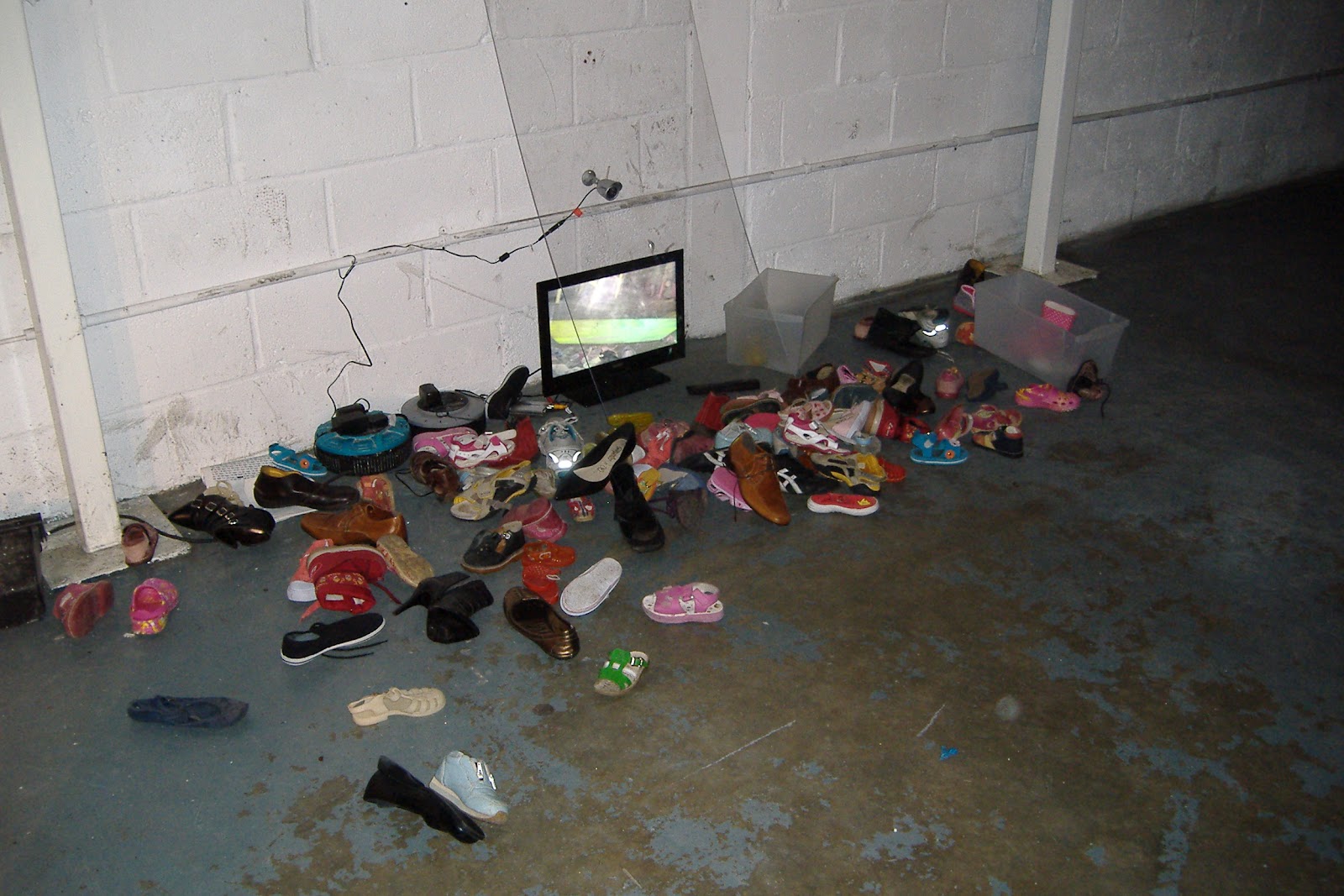
It's difficult to analyse this without taking note of the fact that a few hundred meters away the first day of the Paralympics was in full swing; presenting a very different vision of disability to Lakmaier's piece. The Paralympics tend to present a somewhat sanitised vision of disability. The participants are described in terms winning personal battles, of "overcoming" their conditions to reach success. It seems unlikely we would ever see a cathartic release of anger like Lakmaier's piece in any context in the Paralympics, although I imagine that most of the athletes participating have had their moments of intense frustration and loss of control of their own. In terms of frustration felt, it's notable that these Paralympics are sponsored by ATOS, the organisation tasked with certifying as many people as possible as 'fit for work' and to therefore cut their benefits. I've read accounts of people in final stage terminal illnesses, or those in constant excruciating pain being certified as 'fit for work', often against the advice of the patient's GP. With this as backdrop, Lakmaier's explosive anger against the televised image of herself seems timely, appropriate and incisive.
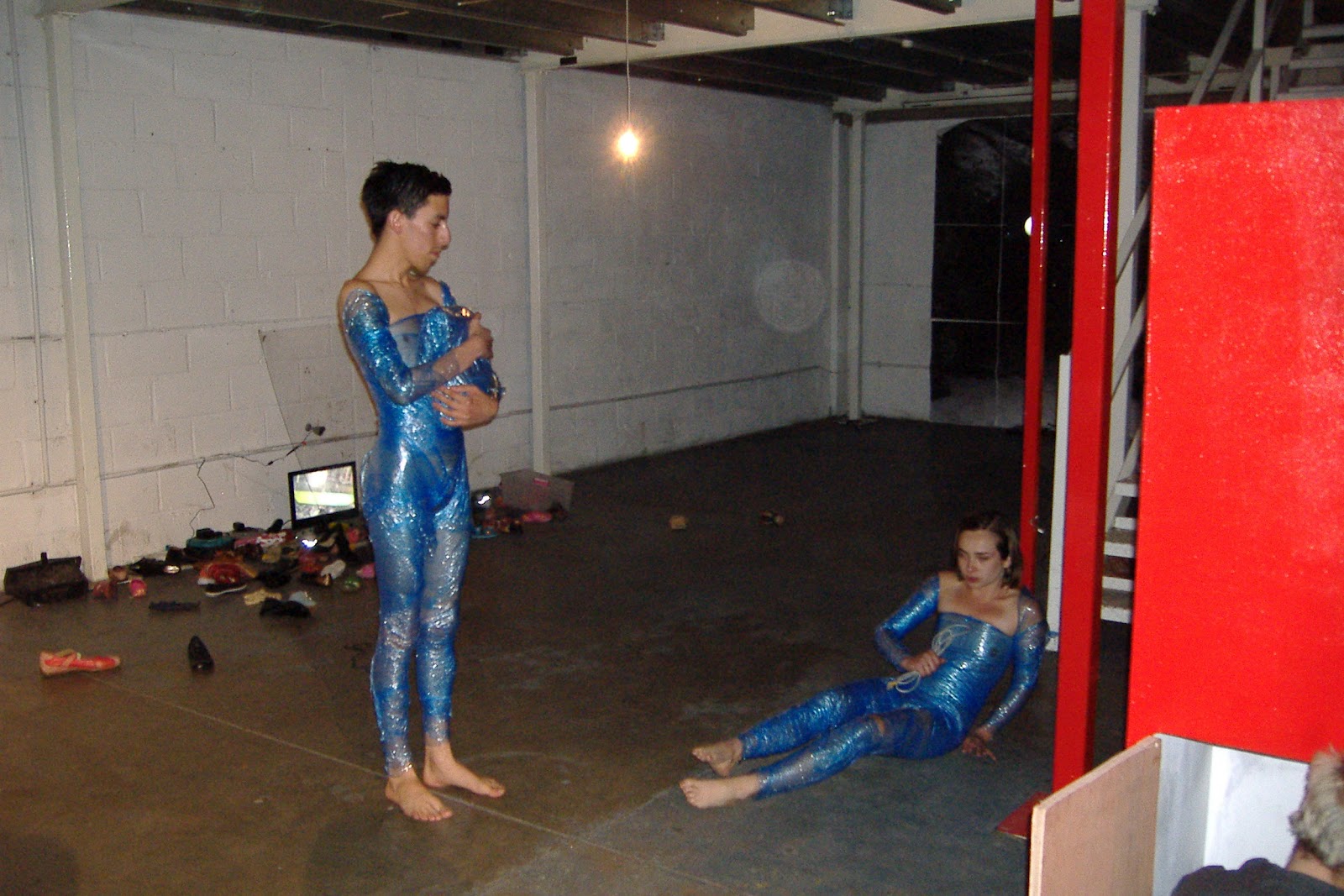 |
| Alicia Radage's Islands (with Sebastian Hau-Walker) |
Soon after was Alicia Radage's 'Islands', performed in collaboration with Sebastian Hau-Walker. The two came regally down the stairs from the upper-level, clad only in tight blue cling-film. The outfits made both performers androgynous, lending them a sort of Bowie-esque 'loving the alien' feel. Even though the outfits were extremely tight and defined every part of their bodies they appeared somehow quite sexless in a futuristic way. Radage lay on the floor clutching a similarly blue, clingfilmed package, while Hau-Walker dragged her to the centre of the room. Tearing open the package on her chest revealed that it was full of soil. Hau-Walker took handfuls of the soil, and eventually constructed a right-angled triangle outline of soil on the ground with Radage in the centre. As this triangle was completed, the positions were reversed and Hau-Walker lay on the ground, while Radage laid out an equilateral triangle around him. Once both triangles were completed, the two performers lay in them, and after a short rest started engaging in frantic physical activity. Radage took a length of network cable and used it as a skipping rope, and Hau-Walker ran in frantic circles, breaking the soil outline around him. After a few minutes of this, Radage lay down on the floor, arms splayed in a cruciform and Hau-Walker dragged her across the floor, breaking the pattern on the floor.

According to Radage she "explores constructing places out of space when multiple bodies are present". Even with this mind I had mixed feelings here, partly because I'm not sure I understood what was happening, and I didn't think I much of chance of deciphering the symbolism. Every action in this piece seemed to have been carefully choreographed; movements were slow and deliberate; there was a definite air of ritual to the laying out of the soil. Laying out unbroken geometric patterns like this echoes magic ritual and the creation of a sacred space, at two seemingly important points in this performance these outlines were broken. This seems important, but I can't quite put it all together. In a performance as deliberate as this, I figure that every aspect must have meaning of some kind, for example the fact that Radage is using a network cable to skip with must somehow have meaning in and of itself, although I can't work it out.

Even though I was unable to work out any kind of clear message, I could appreciate the performance on aesthetic grounds. The clean artificial blue of the clingfilm was a nice contrast with the chaotic soil, and this conflict between order and disorder was continued in way the patterns were created and destroyed. Unfortunately, the stately method by which the patterns were laboriously set up meant that this was a very, very slow moving piece. When Radage begins constructing the second triangle around Hau-Walker I was silently willing her to hurry up a bit. I understand I'm not here to be 'entertained' as such, but even so, standing up in silence reverently watching as cryptic as this for what felt like 20 minutes or so can get a bit much.

Up next was Marta Frank's 'The Big Match Girl'. The lights were switched off, plunging us into darkness. Frank stood in the middle of the circle reciting a poem: "Bye baby burning / Daddy's gone a hunting / Gone to get a big bear skin / To ash his baby burning in." As she did this, she lit matches, briefly illuminating the room and dropping them at her feet as they burnt out.
I don't think this performance worked particularly well. It seems like a piece that relies on darkness, and where the the only illumination in the room is from the performer. Here there was frequent light from people checking their mobile phone, using the toilet and entering or leaving the room. In addition, although she was performing 'in the round', with people watching from all sides the artist only faced one direction. I was sat behind her, and as a result couldn't really see what was going on very well. As the room was darkened, I didn't really want to move to a better position for fear of tripping over someone. Another factor was the gallery photographer. This was a quiet, intimate and seemingly quite personal piece of work. The artist seemed to consciously isolate herself within the room. To get good photos of the performer lit by matchlight, the photographer had to get right up in her face with a very loud camera. The performance was punctuated by loud 'click click click' noises from his camera. It was very distracting, and considerably detracted from the performance. I understand the need to document proceedings, but when you reach the point where you're actively disrupting the piece it's time to take a step back. I think overall this piece would've benefited from both a smaller audience, and a smaller and more tightly controlled performance space.
 |
| Season Butler |
After two quiet and meditative pieces I was in a mood for something a little bit more bombastic. Season Butler more than provided this. She descended the stairs of the gallery wearing a large paper skirt, to loud music. Now that is a damn entrance. She walked to the centre of the room, and unexpectedly hurled a mug full of what I think was salt behind her. I was standing in the path of this, and although I managed to avoid most of the shards of mug, my glass of wine got an unpleasant shower of salt in it. Oh well, shit happens. This sudden violence sent an immediate murmur of danger through the room, which felt sorely needed. She then took off the paper skirt, which resembled a wedding dress or ballgown, and it crumpled on the floor in a big pile. The now naked Butler peeled off a can of hairspray that was taped to her thigh, and using a lighter to create an improvised flamethrower, torched the dress. It went up in flames quickly and satisfyingly. As it burned away she lay supine on the floor, and lit a cigarette while she watched it burn.

There was a very real sense of danger here. A fire inside a relatively confined space like this seems to set off some kind of fight or flight reaction in people. The strange feeling of fear and excitement, coupled with the provocative performer was very refreshing. The simple fact of having some musical accompaniment also seemed to liven things up a bit. Both this piece and Marta Frank's used fire, but whereas Frank's piece used the matches extinguishing as a symbol of death, Butler used her aerosol flamethrower as a symbol of both life and destruction. In destroying the cumbersome garment, Butler is in one sense liberating it into brief but bright life. There is also a transformative aspect here, after the dress had burned we were left with cinders lying across the floor, looking like a miniature mountain range. This, coupled with the naked femininity of the performer reminded me of images of the Hindu Goddess Kali, a symbol of both annihilation and rebirth.

Next on was Jess Rose. Looking sullen and confrontational she repeatedly applied red lipstick to herself and planted kisses all over a white chair. Eventually she rolled around the floor with the folding chair, locked in a violent/loving embrace with it. The piece, entitled 'Cyffes Fydd y Corff (Darn 2)', was interesting, but seemed a bit one-note and conceptually hollow. The movements here seemed intended to look spontaneous and uncontrolled, a wild communion with an inanimate object, but it felt somehow self-conscious throughout. It had an element of catharsis, but in comparison with the acutely felt anger of Noëmi Lakmaier's earlier performance it felt far more calculated.

 |
| Jess Rose, 'Cyffes Fydd y Corff (Darn 2)' |
After this, a male performer (whose name I am not entirely sure of), walked around the gallery in the darkness singing "Democracy is Hypocrisy" before leaving the room. I'm guessing he's quoting Malcolm X here, although to what end I don't know. Whatever his intentions, the slogan is presented shorn of all context, and becomes meaningless very fast. I really didn't like this piece. It struck me as self-indulgent and smug. I see two ways to decode it, neither which are particularly attractive.
The first is that you recognise the quotation, and attempt a reading based on a knowledge of Malcolm X. Obviously, you're going to immediately think about race; this is after all a white artist quoting probably the most famous 'Black Power' activist of all time to a predominantly white audience. Repeating the phrase over and over again almost seems to mock it. The sentiments behind Malcolm X's view of US democracy as being hypocritical are accurate and well considered. Repeating this phrase over and over as a slogan has (and I'm sure it's unintended) the effect of mocking the idea. The second reading, if you're not familiar with the origin of the phrase, is that you have an artist walking around singing a cryptic slogan that doesn't mean anything. In isolation "Democracy is Hypocrisy" barely works as political sloganeering, let alone a coherent statement or philosophical point. It was half-arsed, like a parody of performance art rather than the real thing.
I left pretty soon after this piece, and it left a bit of a bad taste in my mouth. But I did have a great time last night. Everyone at these events is friendly and welcoming. The artists seem more than happy to explain what they're doing, and the organisers are generous to a fault. In terms of actual artistic content I felt it was a bit of a mixed bag, but even though I didn't like all of it, I appreciated the effort and thought that went into pretty much everything there.
Please let me know in the comments if I've missed anything, or screwed something up.
Wednesday, August 29, 2012
Wednesday, August 29, 2012
- 0 Comments
 |
| They stole my colour scheme! |
The 'wedding comedy' is one of the most restrictive subgenres around. You can reconfigure and twist it, but there are boundaries and jokes that you can't avoid. A catastrophic stag do with consequences, a barmy family, a mounting sense of tension during the ceremony, a terrible best man's speech, tension between the groom and the father-of-the-bride. 'A Few Best Men' strolls down this well-trodden path bereft of any sense of originality or surprise.
This is the latest film from Stephan Elliott, who has fallen long, long way from 'Priscilla, Queen of the Desert' (1994). We're told the story of British backpacker David (Xavier Samuel) who impulsively proposes to an Australian girl named Mia. The rest of the film chronicles David and his friend's visit to Australia for the wedding. Oh, you wouldn't believe the scrapes these guys get into! Actually, having said that, remember that film 'The Hangover'? Well take the basic concept of that, and then dial everything down. Dial it right down to the point where everything is bland and inoffensive, and any sense of danger has been completely sucked out. What you're left with is this insipid rubbish.
 |
| Oh. What scrapes these lads get into. |
The three "lads", Tom (Kris Marshall), Graham (Kevin Bishop) and Luke (Tim Draxl), are cut from familiar cloth. Tom is the laidback, cool one, Graham is the highstrung, nerdy one and Luke is the morose, moody one. This is the kind of role Kris Marshall could play in his sleep. He plays his role as an extension of his (seemingly) career defining role as Nick in 'My Family'. It seems cruel to say, but he's getting a bit old for this sort of thing. Tom has the 'cool' looking floppy haircut, but this and the studenty outfits they put him in all looks a bit strange on a 39 year old. Having said all that, he probably is the best thing in the film.
That's faint praise, being the best thing in this film is like being the best piece of chewing gum stuck to the pavement. On the opposite end of the likeable scale is our groom, as played by Xavier Samuel. He's an actor who looks like he's been designed by committee, a man who woodenly lurches from one scene to the next, annoying everyone as he goes. From the moment we meet him we instinctively dislike him, and this dislike only grows as the events of the film unwind. In this instance, it's easy to blame the actor entirely for this dislike, as the character of 'David' has a lot of sympathetic qualities. He's an orphan searching for a replacement for his lost family, searching for it in his in-laws and in his friends. The character is genuinely in love, and is totally convinced that this wedding is the right thing to do. This combination of certainty and tragedy in the past isn't exactly original, but you have to really screw up to get an audience to hate the earnest orphan type. But Xavier Samuel makes us hate him with gusto!

Predictability isn't something to avoid at all costs in comedy. There can be a great deal of pleasure in watching someone unknowingly approaching the banana peel, anticipating the inevitable tumble. Here, and especially in the shadow of 'Bridesmaids' and 'The Hangover', the anticipation seems hollow. Everything is too obviously telegraphed and by the time the punchline has crawled past us an hour later we're bored. There is no pleasure in waiting for the gag here, when we're introduced to the father-in-law's prize ram in the first half a strange sense of nihilism sets in. Your expectations are lowered to the point where the best possible outcome is that the film gets it over with quickly. There are a few actual honest-to-god funny moments in this film, but they're laboriously set up and few and far between. When your highlights are characters walking into contrived situations, and someone saying "it's not what it looks like", you might want think about writing some actual jokes into your film.

For a 'The Hangover' ripoff to work well you need a genuine sense of danger. That film had a tiger, a kidnapped baby, homicidal gangsters, a stolen police car and a drunken marriage. If nothing else, the stakes were high. In 'The Hangover' you feel that there actually could be consequences for these actions. In 'A Few Best Men', we have a very similar situation, though entirely neutered. These characters could just theoretically ignore things for a few hours, and enjoy the wedding.
One of the hallmarks of the wedding subgenre is the tension leading up to the ceremony. Traditionally in these sorts of films the emotional highpoint is the vows and the kiss with the bride. Here the actual ceremony happens fairly early on, and while I guess any sliver of originality is something to cling onto, it has the effect of draining all the anticipation from proceedings. If our happy couple are actually married early on, then what is the worst that could happen?

Compounding this is a weird decision to make Rebel Wilson's 'Daphne' a fake lesbian. She's introduced to us as gay, but soon after reassures us that she's only pretending to be a lesbian to annoy her father. The pretence is entirely redundant (why not just make her actually gay?), and leads to some quasi gay-bashing jokes that feel especially strange coming from the director of 'Priscilla'. The father's homophobic comments feel queasily close to punchlines in their own right, especially when the film gets laughs from his referring to his daughter as 'he'.
It's always depressing to film bereft of any ambition or passion. There's a palpable sense of boredom from everyone here, clearly a film like this is no-one's passion project. Please don't go and see this film, it'll only encourage producers to make more of them. This is a depressingly joyless and cynically calculated piece of crap.
Sunday, August 26, 2012
Sunday, August 26, 2012
- 0 Comments
 |
| Yoko Ono |
I've always had a soft spot for Yoko Ono; "the woman that split up the Beatles". People arguing that she rode the coat-tails of John to fame and fortune seem to ignore the obvious and genuine love between them. In the sixties Ono stood in opposition to the staid and institutional artistic establishment. Her art, working within the Fluxus aesthetic, seems designed to be ephemeral, composed of whatever materials are to hand, and in Ono's case, to re-contextualise mundane objects and our environment.
This exhibition gives us a retrospective of her work through the years, covering the mid-60s to the modern day. Placing it in the halls of the Serpentine Gallery seems to reposition Ono firmly within the artistic world, an attempt to transform her into a valued artist in her own right.
 |
| 'Helmets' 2001/2012 |
We begin and see a room full of WW2 army helmets dangling from the ceiling. Looking inside them reveals they're full of jigsaw pieces showing the sky. Behind them are three mounds of dirt, each apparently from a different country at war. The message seems fairly clear here, national borders are thought constructions, consensual agreements amongst humanity that are taken so seriously that people will gladly die for them. The helmets reinforce this lack of division between people, all soldiers, no matter which country they fight for still look up to the same blue sky. Sitting unheralded behind all this is a burnt, tattered and torn 'War is Over, If You Want It' poster. It looks its age, far from the elegant black and white design we're familiar with. The scars upon this poster symbolise the battering this philosophy has taken in the last 40-odd years. It's important that even through the stains and tears, this message is still visible, as accurate as ever. It may have taken some knocks along the way, but the core of John Lennon and Yoko Ono's message of peace is still as relevant as it ever was.

One of the primary aims of this exhibition seems to be to try and make people question their space, to examine what the architecture and objects around them mean. In terms of modern art, the recontextualising of a common object seems almost a bit too obvious. After all, Duchamp's 'Fountain' is approaching its centenary, but Ono is consistently throughout theis exhibition in attempts to 'open our eyes'. Signs on the floor inform us that "This is the ceiling" and when you look up, you see "This is the floor" written above. Around the room handwritten graffiti tells us "This room is bright blue" and "This room gets as wide as the ocean at the other end". Ono is encouraging us to alter our perspective, to question the common consensus and create our own world.
 |
| Still from 'Fly' 1970 |
The notion of your creating your own artistic world from the mundane runs through the video work here. Much of this looks at the human body, be it her 'Film No. 4' (1966) which shows us a series of buttocks or the excellent 'Fly' (1970) which shows a fly wandering in closeup over a nude female body. I was particularly taken with 'Fly', which I saw as a nice combination of repulsion and intimacy. We see a fly perched on a nipple and wandering through pubic hair. The initial reaction is disgust, but the shots are held for so long that we see the fly as something gentle and vulnerable, dwarfed by the human landscape it finds itself on.
 |
| Video exhibits at the Serpentine, |
The most famous films on display are two 'Cut Pieces'. In these films, exhibited facing each other we see Ono in 1965 and 2003 undergoing the same artistic process. The concept is that Ono sits on stage motionless while members of the audience walk up to her and cut a piece of her clothing from her body. She remains passive as her clothes fall away into a pile of rags. Watching both the '65 and '03 versions is an interesting juxtaposition. Even though the act is the same, age gives it a different meaning. The younger Ono seems vulnerable and innocent. At this stage in her life Ono had yet to endure the slings and arrows that moronic Beatles fans would hurl at her, and you look at her with no small amount of pity knowing what she is to endure. In contrast, the '03 performance shows a woman entirely in control of events and her own image. She sits regally, as people (who seem a little nervous) stand up and gingerly cut pieces from her. The more her body is revealed, the more power she seems to gain. "This is me, take it or leave it", is what the message has morphed into. It's the performance of a woman who has come to terms with her life story and public image.
 |
| Amaze (1971) |
The largest piece in here is 'Amaze' (1971), a maze of perspex walls. At the centre is a kind of font that shows the reflection of the ceiling above. The water is tactile, drops are splashed around the inner sanctum, a kinetic disturbance within the static architecture. Making your way through the maze is difficult, and although I managed it without injury it seems very easy to bonk your head on an invisible wall.
 |
| Film No. 4 (1966) |
Even though I made it through the maze without incident, afterwards I managed to bonk my head against a wall that was as invisible, yet much more dispiriting. After viewing the entire collection, I'd drawn the conclusion that Ono is encouraging her audience to reconsider the spaces and objects around them as poetic and artistic objects. So I stood in a room looking at large sheets of translucent rice paper covering the windows. They hung down in large strips, and in two of them holes had been torn allowing us to see the lush park outside.
"Ah", I thought, "I get it. Underneath this blank, disposable canvas lies a beautiful world, and if we make a small effort, it can be revealed to us." So I reached up, and tore a hole through the paper to view the park outside. Immediately a security guard ran up to me and angrily asked me what the hell I was doing. "I-I thought I was supposed to do this!" was my surprised answer. I pointed to a similar hole not far from mine. "That's part of the art", I pointed to another hole. "That was an accident". People were looking by this point. I slinked away, red-faced and embarrassed.
 |
| A piece of art that I apparently damaged. |
This embarrassment was soon replaced by indignation, and the more I thought about it, the more the incident began to colour the whole experience. This art when first exhibited in the 60s was alive and exciting. Looking at videos of Ono's famous 1966 Indica exhibition we see people interacting and handling the exhibits. There is no cultural capital attached to these works, they exist to perpetuate ideas and concepts. Fast forward to 2012: these same pieces of art are on display and they're no longer alive in this way. They're artefacts, preserved in aspic, pieces of nostalgia for a different time.
 |
| 'Ceiling Painting' 1966 (when I saw it there was a cord in place) |
The best example of this is 'Ceiling Painting' (1966), described by John Lennon thusly:
"There was a ladder that led up to a painting that was hung on the ceiling. It looked like a blank canvas with a chain with a spyglass hanging on the end of it,. I climbed the ladder and looked through the glass and in tiny letters it says YES. So it was positive. I felt relieved. It didn't say no, or fuck you or something, it said yes."
If you squint it still says 'Yes' on the ceiling, but that's about as far as you're going to get. There's a rope barring anyone from actually climbing the stepladder. What was once a dynamic piece of art with a positive message has been neutered. What is the point of this if we can't interact with it as intended? The rope barring anyone from climbing the ladder has now effectively become part of the piece. The message in 2012 is a resounding 'NO!'.
Similarly symbolic of the loss of vitality is a clock sealed in a perspex box; 'Eternal Time' (1965). A stethoscope hangs in front of it, and I'd guess the intention is for us to wear the stethoscope, and listen to the clock ticking away. Under the watchful eyes of the Serpentine security team I didn't dare touch the thing, not that I would have heard anything if I had. The clock probably stopped sometime in the early 1970s.
It's intensely frustrating to be told you can't do something, and these imposed boundaries warp the intentions of the exhibition. To use an over-worked phrase, Ono encourages us throughout this exhibition to 'think outside the box'. Yet when we do we find ourself in yet another box, another set of boundaries. Midway through this exhibition I was having a wonderful time appreciating the humour and freedom, but by the end I'd been quite forcefully shown that this was an elaborate illusion.
In the end it feels you're seeing the mummified husks of Ono's art rather than a living breathing collection. It's a sobering reminder than no matter how experimental and avant garde something is, it will eventually become frozen, static and absorbed into the art establishment.
Yoko Ono: Into the Light finishes on the 9th of September 2o12
Yoko Ono: Into the Light finishes on the 9th of September 2o12
Friday, August 24, 2012
Friday, August 24, 2012
- 0 Comments

'Shadow Dancer' is a film full of people making difficult choices. Choosing between logic and emotion, between their family and their politics and ultimately between sacrifice and preservation. Primarily set in Belfast (though filmed in Dublin) in 1993, we follow the story of Colette McVeigh (Andrea Riseborough), and her involvement with both the IRA and MI5. Born into a staunchly republican family, she's fuelled by passion and grief as a result of seeing family members killed in the conflict. In the opening scenes she's involved in an abortive attack on the London Underground and subsequently captured by Mac (Clive Owen), an MI5 agent. He offers her a stark choice, work for us, or spend the rest of your life in prison.
It is the consequences of this decision that propel the rest of the film forwards. Marsh maintains a fairly close focus on Colette, and we watch as she's silently torn apart by guilt, fear and anger. Andrea Riseborough portrays this turmoil raging inside her very effectively, and our complicity in her situation ratchets up the tension. Every conversation or intimate family moment is shot through with the fear of discovery.
Almost from the off, Colette is stuck between two worlds, and her allegiance to both of them is tenuous. Whilst her family is firmly and actively involved in the IRA, it seems that her passion for republican politics has cooled upon becoming a mother. Her son is her emotional weak spot, and both sides exploit it for all its worth. While she has absolutely no allegiance to the British Government, Mac as an individual seems like a kind and caring man, who assures her that none of his informers have ever come to harm. He also dangles the possibility of a witness relocation programme and a new identity for her and her son in front of her. A tantalising prospect for someone who seems unavoidably entangled in the social web of the IRA. The film is notable by its absence of father figures; both Colette's father and the father of her child are conspicuously absent and on some level, Mac seems to become the nearest thing she's got to a supportive male in her life. He's the only person she can confide in, and the only person she can now speak to without worrying about what she says.
 |
| Mac (Clive Owen) and Colette (Andrea Riseborough) |
Watching a conflict that takes place in a recognisably British social landscape, with red telephone boxes, British police uniforms and terraced housing seems to ground this conflict. When we see a family sitting around in a recognisably British house discussing an assassination attempt, or being shouted at by armed British policemen with machine guns it forces us to remember that these events took place on British soil. It's an incredibly intimate conflict. As writer Tom Bradby told us in a Q&A after the film, "this is a conflict between people that spoke the same language, ate the same food, watched the same TV shows".


James Marsh seems to have gone out of his way to create a restrained, austere film. The film is almost unbearably slow-burning at points, although Marsh maintains an undercurrent of tension throughout through long tracking shots and the use of mobile handheld cameras. In a wonderful sequence at the beginning we see Colette boarding a Tube in London, and the camera remains fixed on her blank face as she travels through the tunnels. Where is she going? What is she doing? What's in that bag? Is that someone following her? As she winds her way through a maze of tunnels and deep into the infrastructure of the London Underground we hear muffled evacuation warnings. A shot in this sequence, of Colette gazing up from the dirty, dark underworld at the clear blue sky high above her, inaccessible and covered by a grate seems emblematic of her story.
The events of this film are inexorably propelled forward by politics, although they seem extremely distant. Occuring faintly in the backdrop, glimpsed on television news is the Downing Street Declaration, jointly declared by British Prime Minister John Major, and the Taoiseach of the Republic of Ireland, Albert Reynolds. This declaration affirmed the right of the people of Ireland to self-determination. It's a momentous political moment, and provided the impetus for the ceasefires of 1994. But, this all takes place far in the background, and seems very distant from the emotional conflicts of our characters.
Bradby declared in the post film Q&A that he and director James Marsh had sought to "drain the politics out of the film". It's an interesting decision to take, and one which they've done with almost too much gusto. The ideology and philosophy, even the basic goal of the IRA - to create a united Ireland - isn't spelled out at all. This leaves the film with a vacuum at the centre. It would be difficult for British audiences to come into this film without any knowledge of the conflict in Northern Ireland, but I can't help but wonder what international audiences would make of it. The rationale for this decision to scrub any direct political discussion from the film is that this is a character drama, and not an analytical argument about politics. Marsh and Bradby go out of their way not to take sides and paint both the IRA and MI5 as being equally murky, each with little regard for an individual human life in the 'big picture'.

 |
| Colette and her family, Gerry (Aiden Gillen), Connor (Domhnall Gleeson) and Ma (Brid Brennan) |

While watching the film, I was repeatedly reminded of 'The Battle of Algiers' (1966). In both films we see an underground revolutionary force taking on the might of an established military power. We see politics and warfare invade the domestic sphere, and the consequences of asymmetrical warfare on both sides. There is a famous sequence in the '66 film that shows women carrying bombs through security checkpoints and detonating them in public places that is strongly reminiscent of scenes in 'Shadow Dancer'. I see 'The Battle of Algiers' as the superior film, as it manages to marry politics successfully to a character-based narrative. 'Battle' was controversial on release, and was intensely criticised for the sympathetic treatment of the FLN revolutionaries in a conflict that took place a decade before the film's release. So, after twenty years, is it too soon to try and address the ideological conflict at the heart of the Northern Ireland conflict? The character-based drama in this film is gripping and intense, but without exploring why tensions are so high it feels ever so slightly shallow.
Despite my uneasiness at these important yet unexplored aspects, this film does work amazingly well as a thriller. There are several high-tension scenes where Marsh expertly ratchets up the tension by cutting around to show simultaneous events. One of them almost approaches a Hitchcockian atmosphere. We cut between Colette desperately and quietly trying to get through to Mac on a room, while an IRA gunman she's working with tries to find out where she is. We're not quite sure where in the small house Colette is, and every door he opens could be the one she's hiding behind. Another credit to the director is his trust that the audience is paying attention, and can be trusted to connect the dots themselves without things being spelled out. There's an interrogation scene mid-way through the film, and as we're led through the corridors we glimpse a man rolling a plastic sheet out on the floor in one of the rooms. After the interrogation we see him rolling it back up. The implication is clear; if the wrong answers were given the verdict was a quick death.
 |
| Kate Fletcher (Gillian Anderson) |
These sorts of moments occur quite frequently in the film, and it rewards a viewer that pays attention. Often we will be shown documents that both camera and character will glance at, and we'll be expected to draw our own conclusions. The fact that we both reliably deduce what the important information is, and what the character's reaction to it will be is a credit to the Bradby's script and Marsh's direction. There are surprising twists and turns in the plot, but they always feel like a logical and appropriate direction for the story to take.


While Riseborough and Owen are both excellent, the film is buoyed by some fantastic supporting performances. Two stand-outs are David Wilmot as IRA enforcer (and torturer) Kevin Mulville. The aura of menace that surrounds him is palpable, and even before we know what his job is we feel repelled by him purely as a result of the way the central family react to his presence. He's treated like a bad smell, is repeatedly verbally abused and ordered out of houses. What Wilmot manages to do here is to imbue this violent, repulsive man with an essential sadness. His presence silently standing outside the house is an omen of death, and yet while he's torturing suspected MI5 informers he never takes an iota of sadistic pleasure from it. You get the feeling that he sees his job as unpleasant, depressing and cruel, but ultimately a necessary evil. It's his cross to bear, he acts like he feels that if he wasn't doing this job, it could be someone far worse.

Taking a similar role on the side of MI5 is Gillian Anderson's Kate Fletcher. She, like the IRA enforcer is a utilitarian realist. Both of them like to think they keep the bigger picture in mind, and if individuals have to die to further these goals it is sad, but for the greater good. The difference between the character's couldn't be more visually different. Fletcher is surrounded by computers, in a relatively clean and modern (for 1993) office. When we see her home it is, as one audience member described it, 'like a Barrett showhome'. Stepping into her personal world is a bit jarring; the rest of the film is set in grubby, run down council housing and disused condemned flats. This difference in surroundings emphasises the detachment and ultraprofessionalism of Fletcher. She genuinely sees this as a job, and seems to consider herself free of ideology. Anderson scarily conveys this self-assurance, and the way in which she effortlessly rids herself of emotion even when weighing up the lives of people is quite chilling.
One factor in the film that was mentioned during discussions afterwards was the bright red coat that Colette wears throughout the film. In a washed out colour palette this coat jumps off the screen, making her stand out in nearly every outdoor scene. Logically, it'd be a bit silly to wear such a recognisable coat if she's engaging in clandestine behaviour, she stands out like a sore thumb from a distance. I think Marsh was conscious of this, and decided to make this item of clothing an external representation of the character's fractured psychology. As she informs on friends and family she begins to feel increasingly exposed, and this costume decision visually outlines that for the audience, explicitly painting her as vulnerable and as a target.


I deeply enjoyed this film as a straight, tense thriller. On those grounds it works brilliantly, all the characters are neatly defined and manage to act unpredictably, yet in retrospect, consistently. A difficult writing trick to pull off. The direction is always confident, relying on an attentive, intelligent audience willing to emotionally engage with the leads. But, in a film where so much revolves around the effects of politics and policy, it suffers from the decision to excise any examination of it. It's a frustrating criticism to make, as a shift in focus onto ideology would necessarily detract from the focus on character and arguably make the film worse narratively. But "draining" the film of politics seems to me like the easy way out; a way to pre-emptively defuse any controversy about the wider implications of the film's events. I'd rather see a film that attempts to tackle big issues at the expense of the narrative, rather than one which ignores them and, as a result succeeds.
With this in mind, though the film thrills and entertains, it ultimately feels slightly hollow.
'Shadow Dancer' is on general release from the 24th of August 2012.
'Shadow Dancer' is on general release from the 24th of August 2012.
Tuesday, August 21, 2012
Tuesday, August 21, 2012
- 0 Comments

This is the second play staged by the Old Red Lion Theatre in their repertory season. The first was their updating of Shakespeare's Henry V as an analogy for the run-up and events of the War in Iraq. 'The Revenger's Tragedy' is also set in the modern era, taking Thomas Middleton's early C17 tale of greed, sex and psychopathy and placing it squarely and appropriately in the 1980s.
The play takes a refreshingly anti-authoritarian stance for something first performed in 1606. It tells the tale of a young man, Vindice (Mark Field), on a crusade to avenge the death of his fiancee. She was poisoned by a nobleman for rejecting his advances, and now Vindice is left with nothing more than her skull, which he totes around Hamletlike at all times. The Duke's family is astonishingly venal, a motley gang of sinister rapists, drug addicts and illegitimate incestuous bastards. Everybody seems to have their own agendas, enemies, lovers or potential targets for their lust and rage. This is a play with a reputation for ultra-violence, and almost as soon as you're introduced to this evil, amoral bunch you're anticipating their hopefully bloody and painful deaths on stage.
 |
| Mark Field as Vindice (in character as Piato) |
As in Henry V, the actors take on multiple roles here and it can become a little confusing as to who is playing who and who wants what, but fortunately a combination of distinctive costuming, clever body language and a fast-moving and twisty plot kept me interested even when I wasn't wholly sure as to who was who.
As soon as you enter the theatre you're dragged into the intense headspace of Vindice. You take your seats in the middle of an improvised ongoing scene. Bathed in deep red light that represents a darkroom, but also shows passion and fury we see Vindice pacing about, muttering to himself. Surrounding him are pictures of the Duke's family. He mutters angrily to members of the audience as they sit down. It's a nice way to suck us into Vindice's world of psychic pain right from the get go.
Field ends up playing a nicely delineated 'nested' performance. For a large portion of the play he's undercover as the lasicivious Piato. Piato is played deliciously over-the-top, a camp, Eurotrashy metrosexual with a line to any kind of drug and sexual encounter you could hope for. Advertising a talent like this makes it relatively easy for him to infiltrate the Duke's family and gain the trust of his sons.
 |
| Jack Morris as Lussurioso |
Of the three, Jack Morris' Lussurioso was my favourite. He was unpleasantly slimy and lizardlike as the Henry V/Blair parody in Henry V, but here he takes it to a whole other level. It's rare to see so unpleasant a sneer walk the stage - he radiates contempt for everyone around him, and seems consumed with his base desires. On some level he almost seems to be channelling a funhouse mirror distortion of Gordon Gekko. His costume of braces, sock suspenders and big glasses has become cultural shorthand for the 1980s culture of unabashed greed and consumerism. Lussurioso employs 'Piato' in an attempt to scheme a way to deflower Vindice's virginal sister. So, in short he's employing the man with a violent vendetta against his family to arrange the prostitution of his own sister. Like I said, with all the characters playing roles within the narrative, and the actors also playing multiple roles it can be a bit difficult trying to work out who's trying to kill/fuck who.
 |
| Nicholas Klime |
The actor with the widest range in this play is definitely Nicholas Kime, who plays an unrepentant, egotistical rapist, an awkward, introverted illegitimate bastard in an incestuous relationship with his mother and Vindice's innocent virginal sister - who's introduced working out to Jane Fonda. Over the play, and through these roles Kime effortlessly conveys vastly opposing emotions, playing extroverted and introverted at the drop of a hat, and switching between predator and victim in a disconcertingly easy fashion. These character changes seem to cement the links between these characters, embroiling them all, revenger and victim alike in the same seamy sea.
There is a bit of a barrier in the language and meter used. When I see Shakespeare, I'm usually familiar enough with the plot and dialogue so I don't have to concentrate too hard on deciphering every line. In the last year I've been to two Elizabethan/Jacobean plays of which I've known almost nothing about the plot beforehand. One is this, and the second was 'The Duchess of Malfi' at the Old Vic, another tale of blood and revenge. It can feel like your brain is working on overtime, both untangling and appreciating the poetry of the language, while also trying to focus on the wider narrative. Fortunately, the language in 'The Revenger's Tragedy' seemed slightly more naturalistic than other plays I've seen from this period, and was easier to follow with some sequences sounding almost contemporary (although this may well be a credit to the cast). My favourite bit of dialogue came very early on as Vindice talks about his dead fiancee's skull:
"My study's ornament, thou shell of death,
Once the bright face of my betrothed lady,
When life and beauty naturally fill'd out
These ragged imperfections,
When two heaven-pointed diamonds were set
In those unsightly rings: then 'twas a face
So far beyond the artificial shine
Of any woman's bought complexion."
This has got obvious Hamlet-y connections, but Field's delivery is spot on, and sells us very quickly on the grief and desire for revenge that consumed Vindice, and manages to sustain this level throughout the play. As Piato, Vindice makes frequent asides to the audience, showing the strain that the louche, carefree persona is having on him. This is a play where even the 'good guys' are driven mad with revenge and grief, but Fields keeps our sympathy, even when he's carrying out the imaginatively sadistic and violent death of the duke.

The 1980s aesthetic is conveyed brilliantly, with interludes of Katrina & The Waves and Duran Duran exploiting nostalgic cultural memories. The primary colours of the lighting also plunge us back into this slightly tasteless time. At certain places we feel as if we have entered an 80s nightclub. The free and open use of cocaine, which is generally violently rammed up the character's noses also helps set the debauched tone.
By the time the body count racks up in the finale we're primed for some blood n' guts. We've had it demonstrated to us in a myriad of ways why the world would be better off without these people in it. Director Nicholas Thompson doesn't shirk from his duty here. The deaths are all memorably frantic and grossly realistic. By the end we're faced with a stage full of twitching, stabbed corpses. It's the kind of play where one of the biggest laughs comes when someone callously tosses a severed head onto the floor. All of this lurid violence feels a little bit campy, those that die are so cartoonishly evil that it's hard to relate to them as realistic people. It's probably this that keeps it from becoming overly disturbing as the characters work out their homicidal impulses.

I very much enjoyed this. Violent revenge dramas like this are a good reminder that bloodlust in an audience is by no means a modern phenomenon. We're used to thinking of Elizabethan/Jacobean plays as a bit antiseptic at times, concerned more with language than action. Here, when you're watching the sinister and self-centered Lussuriosa breathing his last you can imagine the groundlings salivating and cheering on his bloody demise.
The elan and style with which this company get through this bloody tale more than compensates for the occasional moment of confusion or distraction that comes from keeping track of the double-crossing, twisty plot. If you have a choice of seeing this or Henry V, I'd definitely prioritise this one.
The Revenger’s Tragedy is at the Old Red Lion Theatre, Angel (www.oldredliontheatre.co.uk), until September 29.
Subscribe to:
Posts (Atom)


