Recent Articles
Showing posts with label art. Show all posts
Showing posts with label art. Show all posts
Wednesday, July 10, 2019
Wednesday, July 10, 2019
- 0 Comments

The first time I saw Silvia Ziranek perform was in front of a garage behind some flats in Bethnal Green. She was clearly a cut above the rest: my conclusion was that she was brilliant and that "It's a difficult thing to look classy with a panettone balanced on your head, but she effortlessly manages it."
Now she's the subject of an exhibition in the lobby of One Canada Square. This monolithic skyscraper is one of the primary symbols of capitalist Britain: a giant glass and steel obelisk penetrating the docklands sky, capped by a glass pyramid with a blinking eye on top. The symbolism kinda writes itself. In and around it lie the lairs of big finance: Morgan Stanley, Credit Suisse, Citi, HSBC, Deutsche Bank and so on. So how does Ziranek's playful, feminine and enigmatic perspective fit into this pin-striped world?

As it turns out, it doesn't. And that's why the exhibition works. The lobby of One Canada Square is a cavernous, marbled place designed to impress and intimidate - to instil in visitors the notion that this is where very important things happen.
IT IS IS IT subverts that. Most eye-catching are the selection of sloganeering badges ("ANYONE CAN APRON", "IT'S ME OR NEVER", "NOT UNDIRTY") that have been distributed throughout the years at her performances - blown up to fifty times their original size and pasted onto the walls. Seeing them festooned on the walls (and on Ziranek herself) makes the building (or at least its lobby) feel like an extension of the artist herself. Accompanying them are various messages, prose that agonisingly teeters on the edge of comprehension:
"ONLY POLITICS ARE REQUIRED TO MAKE THIS BEAUTIFUL BRICKWORK COMPLETE OR DID YOU WANT TO MARRY A BOOKEND? MARRY AN OAK: FOLK MAY ENJOY DEBATING YOUR NO-RUST POTENTIAL AS AN OCCASIONAL MUST-HAVE"
In addition to the badges, there are various paraphernalia from her archive: outfits, photographs, jewellery, leaflets and an extremely fetching collection of tiaras. There are also several life-size photographs pasted onto the walls. These show Ziranek in an appropriately regal-looking gold and purple outfit, hand on cocked hip, haughtily staring down the hordes of bankers that will pass by her each day.

The bits of the exhibition that emphasise the contrast between these two worlds are what made it fizz for me. I loved the austere white exhibition cases lined with pink fur, official-looking perspex boxes full of poppy and disposable stickers and sculptures made from children's lettering or safety scissors.
The biggest risk that this exhibition is running is that Ziranek's best work over the years is herself. Billed as "one of Britain's foremost Performance Artists", it'd be all too easy for this exhibition to lack a lodestar without the artist herself being present - how are you supposed to place this stuff in context without actually seeing her perform?

It's an impossible question for me to answer given that I'm familiar with her work, though there's such a strong sense of her personality in this art that any viewer should be able to quite accurately infer who Silvia Ziranek is and what she represents.
I can't quite get over how surreal it is to see an artist I'm familiar with in such intensely corporate surroundings. This is the kind of setting that would steamroller most artists into fine dust, but IT IS IS IT succeeds as a distillation of Ziranek's work to date and mischievously tweaks the nose of the patrician class this building caters for.
IT IS IS IT is at One Canada Square, Canary Wharf until 16 August.
Friday, November 9, 2018
Friday, November 9, 2018
- 0 Comments

Reviewed by David James
Rating:

Picture this: I'm sat in the front row of a theatre with four women sat on chairs in front of me. The set is a gigantic piece of curved plastic with no horizon. To an ambient electronica soundtrack, the women simultaneously recite a poem at various speeds and tones, resulting in an overlapping chorus that sounded like "we are the shattering the shimmering this is the shimmering we are the shattered this is the shattering shimmering this is a shattering place..." and so on. This is Sue MacLaine's vessel - and it's hypnotic.
I felt like I was coming up on psychedelics, especially as sitting in the front row seemed to encourage the performers to periodically lock eyes with me - a lazer gaze that was in danger of burning right through my skull. I kinda wobbled on my seat and felt a bit light-headed. t was cool - but what the hell does it mean?
Well, the show bills itself as being about the "radiance of survival", which sounds nice but doesn't exactly clarify things. Clearing things up a bit is that the performance is bookended with a description of the medieval practice of the Anchoress, in which a woman would be walled up inside a church where she would remain for the rest of her life. She'd be fed through holes in the wall, dispense spiritual and personal advice, contemplate the nature of God and, in a pretty metal twist, dig her own grave. Cool.
MacLaine stages the contemporary interpretation of this, with the four performers (Tess Agus, Angela Clerkin, Kailing Fu and Karlina Grace Paseda). They present a spectrum of modern femininity, are walled off from one another (by circles drawn on the stage) and deliver a litany for today. This adds up to a chaotic catalogue of modern life, an avalanche of nouns and verbs about finance, sex, politics, tech and a tonne of other stuff.

It's an almost unbearable avalanche of information, neatly simulating 'worry-fatigue'. There is so much shit going on in the world right now that it's difficult to keep track: you expend your energies campaigning for the NHS just as you worry at the USA's rapid slide to white nationalism while climate change keeps you up at night. Then you watch a TV show about plastic pollution in the oceans - which you'd forgotten about as it had been swallowed up the constant doom-laden cavalcade of bad news. And shit! I should really do more about fixed odds betting terminals...

It's an almost unbearable avalanche of information, neatly simulating 'worry-fatigue'. There is so much shit going on in the world right now that it's difficult to keep track: you expend your energies campaigning for the NHS just as you worry at the USA's rapid slide to white nationalism while climate change keeps you up at night. Then you watch a TV show about plastic pollution in the oceans - which you'd forgotten about as it had been swallowed up the constant doom-laden cavalcade of bad news. And shit! I should really do more about fixed odds betting terminals...
It's too much for one person to handle - you would go nuts if you tried. vessel suggests an alternative, or as writer/director Sue MacLaine puts it: “I would argue that choosing to withdraw and being in silence is a political act. Trying to serve from an internalised place is as valuable as external shouting."
A 'withdrawal' from the depressing realities of life is pretty seductive. After all, what can one person do in the face of a burning, miserable hellworld? Why not just, y'know, pretend that it isn't happening and take some me-time?
But it is awfully convenient to say that doing nothing is a political act and that internalised protest is "as valuable" as doing literally anything to kick back against a culture gone rotten. It leaves the thrust of the show as an off-putting cry for more solipsism in the midst of a planet being ruined by those exact impulses. To put it bluntly: if you conclude that your political action is withdrawal and silence then you are a coward.
Thing is, vessel obviously doesn't agree with that because it's a piece of theatre being loudly performed in public - the opposite of withdrawal and silence. It results in a weirdly conceived show that's a bit like a dog endlessly chasing its own tail.
Perhaps the best indication of its confused priorities is the way the show romanticises the situation of an Anchoress. vessel envisages them as venerated symbols of femininity in a community, their cell functioning as a symbolic womb from which a true understanding of reality can spring from within their isolation. The reality was a medieval peasant with mental problems bricked into a wall - not the best model with which to approach the modern world!
vessel is a fine piece of writing, an aesthetic marvel and a great performance - but it's a call to inactivity. And that's the last thing we need right now.
vessel is at the Battersea Arts Centre until 24 November. Tickets here.
vessel is a fine piece of writing, an aesthetic marvel and a great performance - but it's a call to inactivity. And that's the last thing we need right now.
vessel is at the Battersea Arts Centre until 24 November. Tickets here.
Thursday, June 22, 2017
Thursday, June 22, 2017
- 0 Comments


It's Wednesday evening and London has been sweatily stunned by a nuclear heatwave. A thick haze oozes from the asphalt, the tube has become a temporary sauna, London Zoo's resident penguin colony is wishing they could change out of their tuxedos. So what better place to be than in a sweltering bombed out church with a corrugated iron roof, where sucking in a lungful of humid air takes real effort?
I'm a sticky mess, fanning myself with a programme, sweat stinging my eyes and my bottle of water quickly depleted. But if I'm roasting, how on earth must the dancer dressed like a giant vulva feel?
Ovalhouse and BraveNewWorld's Trinity is a bit like being trapped in a really good music video - but one in which the star is mysteriously absent. It's an abstract procession of bizarre & beautiful costumes and ritualistic dancing set to some extremely monged music. Taken purely on its own merits it's a trip. Nightmare nuns troop across the stage with spotlights shining out of her face, a mutated pregnant monster woman clumsily wobbles through the crowd, a woman made out of charcoal crumbles before our eyes. It's dead cool, if you're into the whole pretty weirdness thing.
But what does it mean? I think that a successful piece of theatre should be able to communicate what it's about without the audience having to resort to supplemental material. With that in mind, I purposefully didn't read the supplied programme before going in.
I worked out pretty quickly that it was about the historical subjugation of women. The play is stuffed full of yonic imagery, with the highlight being the 'nun' costume transforming into a giant flapping vulva with the nun's hood becoming a clitoral hood. There's also a tonne of religious imagery, all amplified by the religious setting. It's easy to glance up, past the plaques of dead Victorians, and see the stained glass, lily-white Jesuses peering down at us, bemused by what's going on in his Dad's front room.
So, what I got from it was a critique of how Christianity has oppressed and objectified women over the centuries, stealing the essential power of the matriarchy and enslaving women as biological machines whose function is to cook, clean and pump out the next generation of misogynistic zealots.


How did I do? The programme sez: "Trinity explores the aesthetics of gender and the idea of sacredness in our visual culture, challenging the objectification and iconification of the female form, from the Venus of Willendorf to the Virgin Mary. The performance questions the ethics and politics involved in the representation, mutation and transformation of the body in our collective visual consciousness..."
Well, I guess I was in the right ballpark at least. Trinity is one of those shows in which you get out precisely as much as you're willing to put in. Some people will probably dismiss it as a load of pretentious/portentous bollocks, but give it a fair shake and try and think about what you're seeing and it kinda, sorta, nearly comes together in a satisfying way.
And at least it looks and sounds great. Guoda Jaruseviciute, Valentina Ceschi and Kate Lane are all talented, committed performers (and they must have been literally cooking in those costumes), and the technical and artistic design doesn't put a foot wrong.
But, despite the fact that I did genuinely enjoy myself, I suspect that the show is being deliberately obscurantist to camouflage that, for all the top notch visuals, there's a bit less going on under the hood than the programme claims.
Trinity is at the Peckham Asylum until 27 June. Tickets here.
Trinity is at the Peckham Asylum until 27 June. Tickets here.
Friday, September 30, 2016
Friday, September 30, 2016
- 0 Comments

"Is a man not entitled to the sweat of his brow? 'No!' says the man in Washington, 'It belongs to the poor.' 'No!' says the man in the Vatican, 'It belongs to God.' 'No!' says the man in Moscow, 'It belongs to everyone.' I rejected those answers; instead, I chose something different. I chose the impossible. I chose... Fordlandia."
So said Henry Ford, christening his secluded utopian city, located deep in the heart of the Amazon. Here, far from the prying eyes of Big Government, the philosophical concepts that powered Ford's company could blossom, and a pure technological, moral and cultural revolution would ensue. Optimism fizzed as the ground was broken and first buildings erected. Hopeful workers journed to the rainforest in droves, eager for a taste of Ford's bright new future. Yet now the dream is in ruins; machinery clogged up with muck, roofs caved under the weight of vines; the jungle having reclaimed its land.
Okay, okay. Henry Ford didn't actually say the quote up above. It's from the videogame Bioshock, in which a 20th century industrialist sets up a secluded utopian city, Rapture, based on his own philosophical principles. The city is run under strict behavioural controls. Everything quickly goes to hell, and the city ends up ruined and reconquered by nature. Also it's full of crazed genetic mutants. The similarities are striking*, Fordlandia a powerful symbol of reliance on ideology, mankind's hubris and the nature's indifference to men's dreams.
*Okay there's currently no evidence of hordes of crazed genetic mutants in Fordlandia
The city once more proves its inspirational worth in Studio Swine's Fordlandia exhibition, at the London College of Fashion. The concept behind the collection is to imagine what Fordlandia might have been like if it had succeeded. To this end it uses materials from the rainforest - primarily the abundance of natural rubber, but also woods, animal skins and tribal inspired designs.

Thing is, Fordlandia posits that for Ford's project to have succeeded, nature and industry would have had to have entered a symbiotic relationship, each taking inspiration from the other. This is the world that Fordlandia presents: a sustainable, ecologically minded hand-made paradise of natural fibres, organic forms and hand-crafted objects. Now, you can go back and forth as to whether this would be how a working jungle-city might look, but one thing's for sure - Ford would have hated it.
From what I can gather from Greg Grandin's excellent book Fordlandia: the Rise and Fall of Henry Ford's Forgotten Jungle City, the place was intended to dominate and pacify nature rather than work with it. The jungle was slashed and burned, the bulldozed level - as if Ford were trying to exorcise some untamed spirit from the soil. Sewn into the fabric of the city was an aggressive sense of industry, the city and its citizens part of some giant machine dedicated to churning out rubber. This rigidity can be seen in the way Ford envisaged his workers living: strict work schedules, uniforms, a ban on alcohol consumption, dietary controls on unhealthy food and (perhaps most monstrous of all) enforced square dancing *shudder*.
But perhaps the clearest example is the failure of Fordlandia's raison d'etre: rubber production. The monetary and industrial justification for the place was that it would solve the problem of farming rubber trees. Whilst experiments had been made in transplanting them elsewhere, botanists figured their natural climate would be most successful. What they didn't understand was the rubber tree's place in an ecosystem. Their regimented rows of trees generally failed to take roots and those that did were ruined by blight.

Fordlandia was so fiercely geared to conquering nature through human ingenuity that I just can't connect the philosophy of this exhibition to the history. A 'successful' Fordlandia would have somehow pummelled the jungle into submission through the application of science, managed to harness industrial production of rubber and created a wholly artificial, synthetic society that existed in hermetic seclusion in the rainforest. For it to become ecologically minded, with an arts and crafts aesthetic simply doesn't make sense.
What this exhibition has come up with isn't an extension of Fordlandia, it merely shares a root idea: what would a sustainable urban environment within the rainforest look like (we'll ignore Manaus for the moment). The exhibition blurb says that it "imagines a world where Fordlandia is a success". It doesn't. That would probably look like an unfriendly, near-totalitarian misery-fest. What Fordlandia proves to be is a slightly underwhelming collection of rainforest-influenced furniture and clothes that don't really have much connection to the historical Fordlandia at all.
Fordlandia is at the London College of Fashion until 10 December. Details here.
Tuesday, September 27, 2016
Tuesday, September 27, 2016
- 0 Comments

Encountering London in videogames is often winceworthy. Whether it by design or technological limitations, games often present a tourist's guide to London - taking in the Houses of Parliament, Buckingham Palace and Piccadilly Circus with a couple of badly voice-acted cockneys thrown in for good measure.
It's rare that a game manages to capture even a smidge of London reality; glass and aluminium dominating imperial Portland stone and the vestiges of medieval buildings; that distinctively London psychic mood of short-term impatience and long-term tolerance; the class, religious and racial divisions that carve up the neighhourhoods and the simple Darwinian scrabble for shelter, food and money that fuels the human engine of the city.
At last night's lecture, panelists Jack Gosling, Jordan Erica Webber and Tristan Donovan attempted to pin down what makes London tick in videogames, giving us a guided tour through the city's appearances in the medium, from the bedroom coders of the 80s to modern triple A blockbusters.
Tristan Donovan kicks things off by dragging us back into gaming's primordial ooze with the 1978 text adventure Pirate Island. Our capital's first appearance in the digital medium is the inauspicious introductory sentence "I am in a flat in London". It goes on to explain that you can see a bottle of rum, some trainers and a sack of crackers (now that's a scene I can relate to). Similar text adventures followed, most notably social satire Hampstead, which skewered Thatcherism and set the stage for a continuing theme of gamified London-set class struggles.
 |
| Promising beginnings. |
 |
| Lara explores Aldwych Tube Station |
Text gave way to single colour sprites, which gave way to 16-bit colours and parallax scrolling, which eventually ceded to texture mapped polygons. It's here designers and developer first had the irresistible urge to translate some glimmer of London reality into games. An interesting entry is Core Design's 1998 Tomb Raider III, in which the impeccably British adventurer returns home to explore blocky renderings of the British Museum, the (then relatively recently) abandoned Aldwych tube station and the rooftops around St Paul's Cathedral.
 |
| Bosh! |
This lit the touchpaper for the still-ongoing trend to create realistic virtual Londons to fight, race and generally cause havoc in. A notable entry was Team Soho's 2002 release The Getaway, which is essentially Grand Theft Auto by way of Guy Ritchie. The game itself is a bit of a dog, but it's at least impressive for trying to accurately model central London from Hyde Park all the way up to Shoreditch High Street. Problem is, the PS2 couldn't render the hustle and bustle of the city, leaving the streets sterile and bereft of life - falling into a kind of urban uncanny valley.
Most modern games, outlined by Jack Gosling, opt to present a tightly choreographed smaller areas, sidelining scope in favour of attention to detail. A prime example is Naughty Dog's 2011 Uncharted 3: Drake's Deception, in which Nathan Drake begins his adventure fighting skinheads in an East London boozer, before descending into an abandoned tube station/secret occult library. Though the game gives us a 'wow moment' with its neon vision of the City of London's skyline, Jordan Erica Webber explains just how much work into virtually recreating the stained urinals of some crappy pub. Though the player will probably be more occupied with the tracksuited thug punching them in the face, the level is crammed with location appropriate graffiti, grotty props and general dank. You can practically smell the stale piss..
 |
| I preferred Nanda Parbat. |
Other London set games exploit its history. Countless Sherlock Holmes games have conjured up foggy gas-lit Victorian streets, and other titles offer a smattering of alternative Londons invaded by Nazis, aliens or sometimes alien Nazis. Most prominent is Ubisoft's 2015 globe and time-trotting Assassin's Creed series winding up in Victorian London. The game map encompasses vast swathes of the city, giving people a peek at London past. On top of that, we're allowed to frolic with luminaries like Dickens, Darwin and Queen Victoria - even undertaking missions alongside Karl Marx as a kind of ragged trousered exsanguinist.
In a perverse twist, a believable virtual historical London is more achievable than contemporary virtual London. For one, we're all tourists in the past, the haze of time neatly sidestepping nitpickers whose immersion might be shattered by a phone box being on the wrong corner. For another, perhaps it is simply impossible to render a believable London in a videogame - and even if you could would the tangled street layout, crammed pavements and neverending traffic even make for a fun gaming space?
 |
| It's weird to look at real-life buildings and think "I stabbed someone on top of that thing". |
For my part, I find encountering London in games fascinating. It's one of the few ways you can explore the city through other people's eyes: finding myself curious as to what neighbourhoods they choose to render, what architecture caught their attention, what litters the streets or simply what dreams London sparks inside them. The duller ones manacle you to the top of a tour bus, but the best come within a whisker of capturing what it feels like to walk these grey streets. And who knows what the future may hold.
An excellent talk and a great introduction to what looks like a fascinating programme.
London and the History of Videogames is part of CITY | SPACE | VIDEOGAMES. More information here.
Monday, September 19, 2016
Monday, September 19, 2016
- 0 Comments

You feel a weird combination of reassurance and worry walking through the doors of an NHS clinic. The staff are busy yet friendly, the walls are festooned with upbeat primary coloured posters and there's a pleasantly paternalistic atmosphere. This is a place designed to make you well, doing its level best to send you out the door in better shape than you walked in.
But then you notice the damp on the walls, the peeling paint and furniture that hasn't been replaced in 20 years. The NHS is suffering the death of a thousand cuts: the victim of a government ideologically opposed to a free at the point of use publicly owned health service. Jeremy Hunt assures us that they're merely 'modernising' the NHS when anyone with a glimmer of sense can see that he's setting it up to fail, its carcass fodder for the circling corporate vultures of the American healthcare industry. I mean, if it's not making investors any money, what's the point of it?
So it's wonderful to see an exhibition like The Art of Caring - a collection of work from nurses, patients and artists depicting their ideas on the theme of caring, specifically nursing. The exhibition is collaboration between Kingston University, The Arts Project and Camden & Islington NHS Foundation Trust, featuring work that ranges from photography, painting, performance and sculpture. Some of it is professional and polished, some is rough and passionate, but all displays a tenderness and empathy that perfectly suits the surroundings.
 |
| (Fractured Memories) Doll Therapy by Aran Illingworth |
There's a lot to take in here, but I particularly enjoyed the following. (Fractured Memories) Doll Therapy by Aran Illingworth. It's a quietly devastating canvas piece about Alzheimers, capturing a painful morsel of misery in the eyes of someone whose memory is gradually eroding away. The arts n crafts textile look adds to the emotional wallop, not only looking like something a kindly grandmother might make, but the rough shapes and soft fabric underlining the subjects humanity and increasingly blurry edges.
 |
| Comfort and Joy - Susie Mendelsson |
On a slightly different wavelength is Susie Mendelsson's Comfort and Joy, a bizarre mixed-media sculpture of a creepily wizened homunculus approaching a baby from behind while a tiny man stares on in horror. It's disturbing stuff, the soft manufactured plastic of the doll contrasting with the hand-carved chaos of the monster. That title has got to be a joke, because there's precious little comfort or joy in this. If I had to pick out a meaning, it seems to speak of a mother's trauma at losing a baby, then feeling guilt that the next one survives. Even as she cares for her healthy baby, she cannot help but imagine the forgotten one, balefully staring on in jealousy.
 |
| One Day at a Time - Susie Mendelsson |
Also by Mendelsson is One Day at a Time, depicting a worried looking person weighed down by faceless little men. This is a little easier to parse, but no less effective. Here the effect of the paranoias, traumas and miseries of the past is literalised, showing them crawling all over an apparently normal person going about their day to day life. It looks suitably nightmarish, the haunted expression of the central figure conveying a palpable desperation.
 |
| Charlotte CHW |
Sunday's event was capped off by a live performance from Charlotte CHW, who was also exhibiting photographs. Dressed in a suit that perfectly matched the brickwork of the building, she writhed about against the walls and on the floor accompanied by a soundtrack of breaking glass. Watching this it's difficult not to look up at the gently spooky Victorian brickwork and wonder just how long this hospital is going to last. Generations of Londoners have walked through these halls, each with their own individual ailments and stories to tell.
The performance understands this history, treating the building like a psychological sponge that's sucked up a century of trauma and needs to be squeezed dry. Charlotte's movements are slow, painful and precise - it's like you can see dust crumbling from her joints as she repeatedly collapses and rises, trapped in some infinite loop of pain, healing and more pain. I dug it.
Anyhow, The Art of Caring is well worth checking out, demonstrating not only the public's affection for the NHS and its nurses, but just how critical its long-term support systems are. Whether you've sprained your ankle, suffered trauma in Blair's oil wars or are watching an elderly relative succumb to dementia, the NHS will always be there. But it also needs us to fight for it.
Art is Caring is at The Conference Centre, St Pancras Hospital, 4 St Pancras Way, London NW1 OPE (9am-5pm) until 13 October 2016.
Thursday, September 1, 2016
Thursday, September 1, 2016
- 0 Comments

"A woman might piss it out." These are the immortal words of Thomas Bloodworth, Lord Mayor of London, on viewing the early Great Fire and deciding not to take action to halt its spread. After casting a cursory glance over the conflagration, he went back to bed and presumably had a nice doze. Over the next three days it destroyed more than 75% of the city he was in charge of, consuming 13,200 houses, 87 parish churches, St Paul's Cathedral, and most of the buildings of the City authorities.
So, as far as municipal cockups go, it's a biggie. Boris Johnson may have been infuriatingly shortsighted, but at least he didn't destroy most of the City of London.
 |
| Martin Firrell's Fires of London |
After the Great Fire, most of the City's population were moved into temporary shelter in Islington and Highgate, some remaining there up to 40 years later. With much of the City a smouldering ruin, ambitious architects began to draw up plans of a 'New London', of Parisian style boulevards and grand squares. But tradition (and commerce) prevailed, with the City being built to much the same street plans as before, but with stone buildings and stringent fire regulations.
This leaves us (more or less) with the London we know today. From a modern viewpoint the Great Fire now seems like more of an opportunity than a tragedy; historians paint 17th century London as a tinderbox just waiting for a fire to hit it, so it had to burn sometime. In addition, it's often theorised that the fire helped stamp out bubonic plague in London. There were repeated epidemics prior to 1666, but none after.

Now, to mark the 350th anniversary, events coordinator Artichoke are laying on an arts festival across the Square Mile. It's a kaleidoscope of installations, performances and lectures - from eye-catchingly ginormous set-pieces to sober academic talks on the cultural, political and social interpretations of urban disaster.
I attended the press launch last night, getting a taste of what's planned for the City over the weekend.
Most obviously eye-catching is David Best's 'London 1666', in which a huge 120m wooden replica of 17th century London will be towed between Blackfriars and Waterloo bridge and incinerated. The structure is the work of London schoolchildren and young carpenters on a work experience programme. I've just seen it on video, but it's a hauntingly pretty skeleton, crowned by the lost spire of Old St Paul's.
 |
| Of All the People in All the World |
I was lucky enough to get a preview of Of All the People in All the World, by Stan's Cafe. Set in the fascinating surroundings of Inner Temple, the exhibit is watched over by the stern faces of the four judges who settled the many legal disputes following the Great Fire. Essentially, this is art meets infographics - all based around the principal that a single grain of rice represents a person.
So, for example, you can compare the population of London in 2016 and 1666, see how what portion of the 1666 population was made homeless and then compare it to other great conflagrations. Reducing each person to a grain of rice is both darkly amusing (especially when notable people like Charles II are represented by a lonely grain) and also strangely moving. It's a strange feeling to gaze down at a heap and realise that somewhere in there is a grain that represents you.
So, the festival is on from the 30th to the 4th, with full listings here: http://www.visitlondon.com/greatfire350
My personal picks are:
London 1666: Watch it Burn - 20:30, 4th September on the river.
"London 1666 is a collaboration between American "burn" artist David Best (Temple) and Artichoke to create a once-in-a-lifetime event. Built with a major learning and participation programme that has engaged hundreds of young Londoners over the course of several months, an extraordinary 120-metre long sculpture of 17th-century London skyline will appear on the river Thames and be set alight, in a dramatic retelling of the story of the Great Fire of London of September 1666."
Of All The People in All the World - 30th Aug - 4th September, Inner Temple Hall
"Of All The People In All The World brings historical and contemporary statistics to life using an unusual medium: rice. With one grain representing one person, this performance installation will explore London from 1666 to the present day, linking the City with the world: triumph and fire, travel and trade."
Fire: Threat and Saviour - 19:00, 2nd September, 280 Bishopsgate
"Why are we so fascinated by fire? From the Fire Brigade’s highest-ranking female officer, to historians and an archeologist, hear five unique perspectives on this topic as part of the London’s Burning programme."
When Things Go Wrong: 21st Century Responses to World Trauma - 14:00, 3rd September, Barbican Cinema
"The London’s Burning programme explores contemporary crises, and the different responses to disaster and devastation. How do figures of authority manage the public’s concern and distress? In this talk, the panel will examine the rhetoric used to discuss catastrophe and the psychology of crisis and mass emergency behaviour."
Thursday, August 25, 2016
Thursday, August 25, 2016
- 0 Comments

Something peculiar happened last night in Clapham. From within a well-to-do townhouse came billowing clouds of talc, dusting the street in a thin alabaster layer. If you'd have glanced up, you might have been a naked woman, face whited out, hurling fistfuls of the stuff from an open window. This is The Skeleton House.
With its owner mysteriously absent, the house is in the custody of artists, who are using it as a home, studio, residency, workshop and exhibition space. Considering that performance art tends to take place in industrial warehouses, semi abandoned buildings in odd areas and (occasionally) car parks, it's surreal to step through the door of a typical terraced house and find someone licking the walls with a mirror strapped to their back.

That someone is Natalie Ramus with Site:Requite:Trace. Sadly, these are the last days of The Skeleton House as the owner is returning in early September. In just a few weeks this curious suburban anomaly will revert to type, though Ramus aims to pay tribute to the way the place has cradled the people that've lived and worked within its walls.
To achieve that, she's blindfolded herself, strapped a mirror to her back, wrapped a ribbon umblical cord around her body (trailing off somewhere upstairs) and spent the night licking the walls. It's a strange kind of communion; a performance utterly unconcerned with actually being observed. As we arrive, Ramus is the only person who's begun, so she gathers a little appreciative crowd. Then, as the other performances start up, people filter away. Eventually she's left alone, blindly exploring the house in slow motion with her tongue as the primary sensory organ.
She ends up licking the fireplace, observed by only one person. It's gentle, meditative and quietly respectful, somehow sanctifying the house. Her contributions (and those of the other artists) pile up against the ghosts of the past and future Claphamites to come.

This segues nicely into Sebastian Hau-Walker's Ausculta (Vision Serpents). On heading into the kitchen we're instructed to take a set of wireless headphones, a pillow, an orange and lie down on the floor. Projected onto the ceiling is grainy camcorder footage of Sebastian as a boy, graduating from kindergarten and generally being a rather sweet child. Meanwhile, the adult Sebastian perches like a gargoyle on the kitchen counter, dressed in Clockwork Orange white and a mortarboard.

He then creeps along the kitchen counter, orange clenched between his teeth. As he explores the cupboards he finds VHS tapes (presumably of the projections). As he hums Auld Lang Syne he bashes them against his head and the oven, eventually cracking them open. Then he takes the reels of tape and fixes them to the ceiling, causing them to unspool in a beautiful silvery column, piling up in shimmering heaps on the audience. By the end of the performance he's naked, wearing a tattered black cloak of tape and surrounded by the physical remains of his treasured family memories.

There's a lot of meaning to unpack here, but this is a kickass piece of performance art. In purely visual terms the sight of videotape unfurling in liquid columns from the ceiling is absolutely fascinating to watch. I had the fortune to be sat right below one of them and the sensation of tape piling up on my face and chest was fantastically, awesomely weird.
And what does it all mean? Well, probably only Sebastian knows the full story, but it's certainly autobiographical and deeply personal. It's easy to try and fill in the blanks between the child on screen and the adult bashing a videotape against his skull. Other than the home videos, we hear distorted heartbeats and fuzzy organic soundscapes through the headphones. By the end of we're laying amongst the jumbled, frozen knots of his own history, now just piles of polyethelene.

Unpicking things a little further, Sebastian makes reference to his Mayan heritage in the introduction. Following a bit of post performance Wikipediaing, the serpentine quality of the unspooling tape and Sebastians actions make this a translation of a Mayan bloodletting ritual. This facilitates communication between the past and present - which we see all to viscerally in the distorted, artifacted videoportal projected onto the ceiling. On top of that, by the end he's quite literally cloaked in his own past, the tape echoing feathered ceremonial cloaks that signified the spiritual power of the Shaman.
It was dead good stuff and precisely the kind of performance art I like: sincere, unironic and refreshingly open. Sebastian's personal connection to symbology and use of his own history rendering it devoid of the masturbatory obscurantism that can gum up pieces like this.
Last up were Alicia Radage and Robert Hardaker with S O M E T I M E S W E W E A R A N T L E R S / / S O M E T I M E S W E W E A R H O R N S. This felt like The Wicker Man on diazepam.

Mostly naked apart from a couple of twigs, Robert and Alicia stood facing a bedroom wall. At the centre of the room was a chair sat in a big pile of talcum powder. Dangling from the ceiling was fishing wire festooned with white-painted leaves. In achingly slow motion, the pair navigated towards each other along the wall, eventually coming together in an embrace. Ordinarily this would look sorta sexual, but Robert's cock and balls were bound up in a gaff, leaving him flat and androgynous.
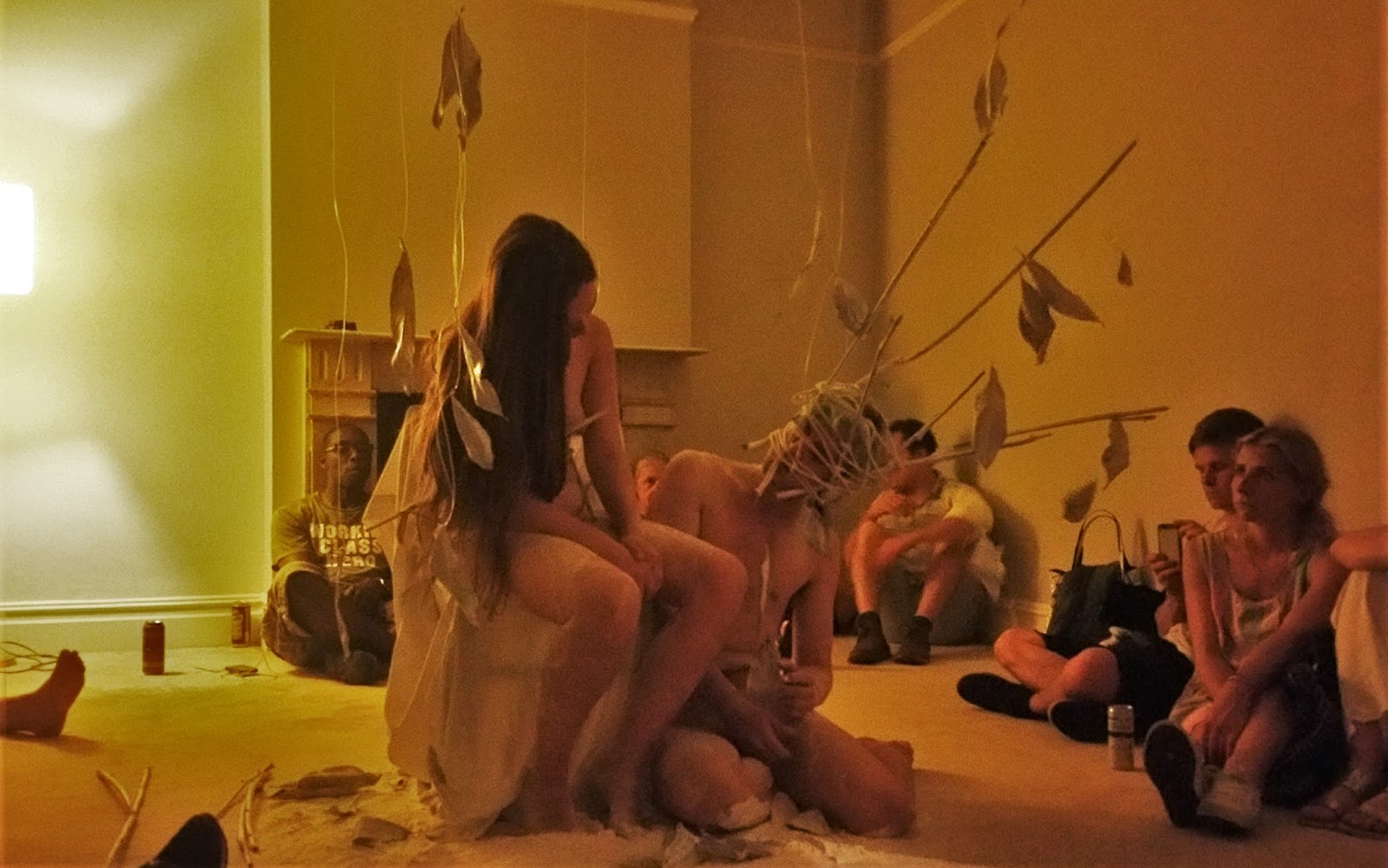
Then Alicia moved to the chair, with Robert sat alongside her. With precise motions she constructed a tall of twine and twigs around his head, leaving him looking like he'd walked out of a Guillermo del Toro movie. When the crown was finished, he began to writhe around, pulling down the dangling leaves with a satisfying *twhip* as the cords gave way. He then stood in front of Alicia and removed the gaff, letting his cock dangle free.

Alicia stared on blankly, then, as Robert kneeled in front of her, she got up and began to toss big heaping fistfuls of talcum powder out of the window into the street - as if the very house had begun to boil. Then, shaking out the sheet on the chair, a blastwave of white enveloped the room. To cap it off they retreated to their rear of the room and gently anointed each other with red wine, concluding the performance.

So what does all that mean? Beats me. But whatever it was, it was extraordinarily beautiful and hypnotic, a mysterious ritual that felt equal parts pagan and fetish, but with a warm undercurrent of affection and a subtle romance to it. It's easy to read Alicia as representing a historical all-femininity, beginning as a powerful matriarch and gradually being transformed into the submissive by the increasingly unbound masculine presence that swirls around her. But then, in the finale we're all coated in the same flesh and working from the same organic baseline, represented by the ashlike powder around them.
It's also startlingly intimate; a performance that all but demanded silence and attention from those concerned. The atmosphere felt a bit like being in church, the kind of instinctive hush that comes over a crowd in the presence of religious superseriousness. Sustaining this over more than hour requires some serious performance chops, not just to maintain this intensity for so long, but the confidence to know that people will be fascinated by it.
Walking out of there I felt like my brain had been in for an MOT. I really should do more writing about performance art - I miss seeing stuff so strange, so open to interpretation, so unconstrained by commercial considerations and so utterly fearless. A hell of a night, and a wonderful way to close out The Skeleton House.
Subscribe to:
Posts (Atom)