Recent Articles
Showing posts with label ]performancespace[. Show all posts
Showing posts with label ]performancespace[. Show all posts
Tuesday, February 18, 2014
Tuesday, February 18, 2014
- 0 Comments

New lands, new spaces and new ambitions: ]performancespace[, cosily burrowed like a hermit crab into a warehouse near the Hackney Wick canal has upped sticks and moved to nearby Fish Island. Their new building, squirreled away within a maze of drab Victorian brickwork and sarcastic pop-inflected graffiti, feels like a rabbithole away from the frantic outside world. The decor here is so new you can smell the paint drying, the cushions unsullied by the crease of human backsides and the walls a pristine, virginal white. But they wouldn't be pristine for long!
Saturday was the inaugural event at this new location; the building freshly stocked with the fashionably dressed, the interestingly haircutted and the artistically open-minded. Waiting in the wings was a swarm of artists ready to unleash an embarrassment of performance art that would baptise this place with paint, spices, charcoal, makeup, minerals and marbles.
 |
| Sarah Zaltash |
Setting the tone for the night was Sara Zaltash, with a durational performance that lasted most of the night. Sat on the floor she recited a mantra while drawing a neverending charcoal circle around herself. Round and round she went, the circle getting thicker and more defined as she used more and more charcoal. In retrospect these marks outlined the themes we'd be seeing tonight; transforming the space into a canvas. There's something faintly magical about the idea of sitting within a self-made circle, the lines acting as a protective barrier against the outside world. For me this protection extends outwards; the walls of the gallery allowing the artists to safely explore concepts; the water surrounding Fish Island creating a bubble of artistic expression - we can even go so far as to say that Goldsmith's circles recall the M25 - a protective loop around London itself.
 |
| Marita Fox |
Marita Fox was up next. Dressed all in black with circular black shades on she moved with a wiry insectoid grace. With Kafka hanging gently in the air she writhed like a pupae in a bubble wrap chrysalis. Emerging from within she unfolded her limbs and with a sudden thump, elbow-dropped a cardboard box. Within was more bubble-wrap, cotton wool - and deep within that two white hands. She cradled these with her own black gloved hands, showing them to us with a look of incomprehension etched upon her face. Visually it was striking as hell, Fox mixing theatricality with the kind of style you'd usually expect to see staring out of a photoshoot from a mid 90s issue of Skin Two.
 |
| Zoya Sardashti |
Zoya Sardashti was on next, dancing to a projection of graffiti. The picture was of an emaciated, skull-like Statue of Liberty, and she danced an kind of aggressive, strutting semaphore at it. With a mean look on her face she stomped back and forth in front of the projection, daring it to respond. As she marched she kept a fixed, fierce look on her face, often making eye contact with the audience, implicating us within the work and subtly asking us which side of this conflict we're on. It looked cathartic and personal: an opportunity for her to work out her frustrations with a symbol of the unblinking might of cultural imperialism.
 |
| Charlotte Law |
Soon after was Charlotte Law with a brief (yet memorable) performance. Nearly naked, she picked up a handful of ochre (I later found out this was a combination of iron ore and olive oil) and rubbed it all over her body. Then she smooshed herself against the clean gallery pillars, using her body as a human potato printer and leaving a reddish-brown imperfect silhouette. Job complete she left, leaving us staring at the handprints and impressions she'd left behind. Once again we see the gallery undergoing some kind of weird blessing; the minerals Law slapped on inextricably melded with the sterile walls of the gallery. I'm a big fan of brevity, generally preferring the tightly focussed statement to the meandering and freeform, so I liked this. Within the space of a few quick actions Law created three striking images; first her own body covered in the ore, then her communing with the pillar; then finally the pillar on its own - pregnant with her presence.

Luisa Amorim's performance marked a bit of a change of pace. Miming to a backing track (of her own voice I think), she asked the crowd to perform various tasks while standing in a big tub of blue paint. Perhaps it was the young girl running around in front of Amorim, but there was an air of children's TV about this. The clear diction and friendly presence was simultaneously friendly and authoritative, and getting us involved in the various tasks she laid out kept everyone engaged. Throughout people around us unexpectedly piped up, having been given cue cards in advance - dragging us into her light, eccentrically creative and pleasant world.

Performance art generally concentrates on stimulating our eyes and ears, though the immediate aspect of the medium easily allows for all of our senses to come into play. With that in mind I always enjoy work that gets taste, touch and, in this performance, smell involved. Nicolina Stylianou's performance involved her mixing various spices with water and spitting that into a jug. I'm no spice expert, but I think I could detect the smell of cumin and cinnamon. When she left there were smears of spices mixed with water on the floor, laid out in mixtures like paint on an easel and a tangy whiff hanging in the air.
 |
| Tim Bromage |
After this we switched gears to Tim Bromage. Dressed in a smart suit he launched straight into a solemn poem about the story of Icarus. My heart sank a bit; "oh well, you can't win them all". But then with perfect comic timing he broke out of his reverie and flipped things around; raising his eyebrows and remarking candidly that this was all a bit too serious. En masse, we exhaled in a burst of relieved laughter. But it was what came next that was truly interesting. Picking up a banjo he began to play, but stopped mid-way through having, (as he put it) "lost it". Again he tried and again he stopped. And again. The crowd grew anxious. Tim seems like such a nice guy that we all wanted him to succeed - and then it struck me that this collective will for him to succeed might have been the whole point of the exercise.
 |
| Charlotte Hailey-Watts |
Next up was Charlotte Hailey-Watts with an audio piece. With butcher's grass lain on the floor, the scratchy sound of the inner loop of a Tears for Fears record infinitely brushing away, a backing track from a laptop playing and a mic in her hand she slowly constructed a sonic soundscape. The bit I found the most interesting was how she positioned herself within all this. Supplicated on a rectangular mat Hailey-Watts looked as if she was engaged in Salat - the Islamic prayer. It created a interesting frisson between her free-form, outsider style rubbing up against a thousand years of concrete institutionalism. At the conclusion of the performance she lay down and went to sleep on the mat, creating an oasis of calm. This dead stop was apparently the cue for another performer to begin, but for me it worked as a much needed meditative break.
 |
| Emma Louvelle |
Entering the final stretch was Emma Louvelle's dance piece, set to Madonna and a musician I didn't recognise (if anyone knows please comment, it was a nice song!). Louvelle frolicked within symbols of mainstream femininity: makeup, body hair removal, cuddly toys and pop music; transforming mundanity and fluffy stereotypes into a viciously sharp weapon. Lit from behind like a detective conducting an interrogation she ran a razor over her legs and smeared rouge over her face, ending up as a shamanic, over-the-top caricature of what a woman 'should' be.

After that was Christian Patracchini, who rolled a series of silver-spray painted marbles against a wall. After the vicious energy of what had just come before this felt a little too austere for my liking. Sure you can get a dab of kinetic enjoyment from the clickety-clack of the marbles bumping into each other and the randomness of their interactions was at least pretty interesting to look at, but it seemed oddly subdued compared to what had comed before. We were heading towards the end of the night now, so this sudden drop in momentum was a bit disappointing. That said, towards the end he started hurling the marbles at the wall so hard that they pinged back towards the us at high velocity. That's the kind of stuff I enjoy: particularly watching members of the audience quietly yelping in surprise as they took a high velocity marble to the shin.
 |
| Ram Samocha & Gerald Royston Curtis |
The final performance was a joint work between Ram Samocha and Gerald Royston Curtis. They popped up two black and white sheets of paper on the wall and began to draw on them with huge, exaggerated motions. I think Gerald was writing 'zapamiętać' in overlaid letters on his (Polish for 'memorise') while Ram was running through a numeric sequence. As the drawings became more built up the meanings collapsed into a tangled pile of loops and lines, something compounded when they switched sides and began to draw on each other's work. Consciously or not, these pictures summed up many of the marks we'd already seen made that night; the loops of Sara Zaltash, the smeared iron ore of Charlotte Law, the dust in the air the spice of Nicolina Stylianou and the painted footprints of Luisa Amorim.
At the end of the night the gallery felt properly inaugurated, the space now inhabited by the same spirit of playful adventurousness that characterised everything I enjoyed about the old warehouse. I'm already looking forward to the next time I'm there!
(apologies for anyone's performance I didn't cover - I had to pop out for a bit and I think I missed at least one. Let me know if I've gotten anyone's name wrong.)
Thursday, October 17, 2013
Thursday, October 17, 2013
- 2 Comments
 |
| Nina Arsenault |
After an introduction from Lois Weaver, who recited a bewilderingly long list of organisations and projects that were being represented, we were off. The four speakers , Phoebe Davies, Adrien Sina, Poppy Jackson and Nina Arsenault covered a lot of ground between them: looking back into early 20th Century feminist performance and forwards into an intersectional, inclusive future.
The first speaker, Phoebe Davies, began by outlining how she came to identify as a feminist. It's a depressing fact that the label 'feminist' has been severely tarnished by the slings and arrows of morons. The classic feminist stereotype of the slovenly, masculine, viciously misandrist bra-burning she-barbarian (a stereotype that has its roots way back in caricatures of the suffragettes) still holds firm in the minds of many. With this gargoyle in place it's no wonder that women don't rush to identify with feminism. And anyway, weren't all those battles won back in the 1970s? Gender equality is enshrined in law, women occupy numerous high-ranking positions in society - hell, Barbie became an astronaut - what more do you want?
 |
| One of Phoebe's pop up nail bars |
You could argue that reducing these women to fashion ephemeralia is a form of trivialisation, but looking at the pictures it's difficult to argue that Davies' project isn't extraordinarily positive. I like that it doesn't hector girls towards feminism, it doesn't tell them what to think, just gives them the information and tools to find out more using a medium they're comfortable with. This project appears to have been pretty damn successful with pop-up nail bars opening up around London, run by the girls who devised the designs.


After staring optimistically into the future we plunged into the past: Adrien Sina wading through a primordial soup of feminist/feminine performance in the avant-garde. Beginning with Valentin de Saint Point's 1912 futurist manifesto Manifeste de la Femme Futuriste, we rocketed through to the commencement of World War II, taking in a dizzying array of artists and their interpretations of femininity. Compressing all this into a 20 minute talk is a Herculean task and frustratingly we were given little time to stop and appreciate what we were being shown. The Powerpoint presentation whizzed through countless fascinating pictures without pause - I wanted time to stop and smell the roses! I admit being teased like this is an excellent advert for Sina's book, but I would have loved to hear him talk without time constraints.
While there were some very lucid participants, the theme that emerged from those speaking was a faint self-obsession. Person after person would sit at the table and begin speaking about themselves. Sure, individual stories can be useful as a tool to divine a wider social experiences, here though, it added up to a fuzzy opacity. The topic of the evening was supposed to be live art performance, yet things drifted pretty damn far from that topic right away.
It was the efforts to wrench things back to the topic of the evening that were the most interesting, particularly a woman called Jennifer (whose surname I don't know.. anyone?) who told us of an astonishing performance piece by Alisa Shvarts, who artificially inseminated herself as many times as she could over nine months, and then induced abortions using abortifacient drugs. Now that's a damn performance worth writing home about. Another of her performances, where Shvarts ran a police investigatory rape kit on herself in public was described as a simple yet enormously effective performance piece.
 |
| The 'Long Table' in action |
There was also an all too brief segue into Marxist-Feminism, a topic which as far as I'm concerned really gets to the core of the importance of feminism. Understanding discrimination against women as an inevitable symptom of capitalist ideology and class division is a debate I want to hear more of, but it was largely drowned out in a white noise of "ums", "ahs", "likes" and "sort ofs". Weaver's format is well thought out, very sensibly constructed and the participants last night were all smart and sincere but I don't think too much of value was produced in this Long Table.
The highlight of my night was the talk and performance by Poppy Jackson and Nina Arsenault. Poppy is a London-based performance artist who "explores the female body as autonomous zone". I last saw her at Sigmund Freud's house back in the summer at the Totemic Festival where she was smearing dirt on Freud's nice clean windows, a metaphoric action so tidy it speaks for itself.
Nina is a transgender columnist, writer, artist, actress and sex-worker. This night was the first time I'd encountered her work, but whoa nelly! It's great stuff! It's as if her body is her canvas, sculpted into sublime surgically precise perfection all paid for by work in the sex trade. She functions as a work of art, a performance simply by her presence, without even doing anything.
The two have been collaborating over Skype for a number of months, their five day performance beginning that night building on the foundations of work the two have done before. So Nina has been doing exercises like spending two hours whipping herself while riding an exercise bike every night and going without any kind of light for four days; living in a darkness so pitch black that she couldn't tell whether her eyes were open or closed. Poppy explains that the point of exercises like these is to force a personality through a genuine spiritual experience, creating an artificial, but no less powerful catharsis.
After their talk we traipsed over the road to [performance s p a c e] where a large black box had been constructed in the centre of the building. Within it were Nina and Poppy. Poppy was shaving her legs with a straight razor, dipping it in a steel bowl of water and reshaving the same spot over and over again. Nina was smeared in talcum powder, sat in front of a full-length mirror in a silver shimmery dress slowly posing. The floor was covered in sawdust and scattered around the room were various objects. A wedding cake sat on a table in the centre of the room, a funeral urn was in the corner and laptops were playing videos on various projectors.
Overlaid on this was a recorded stream of consciousness monologue by Nina, her speech vocoded into robotic monotony as she talked about institutionalism and various sex acts. Projected onto the wall was cut-up footage of her being fisted, all shot with the artistic sensibility of a video nasty snuff film. I was told that somewhere within the room was a live snake which would add an Edenic layer to the piece. I couldn't spot the snake though, and thought it might be metaphorical, but later reflected that you probably don't feed a metaphor frozen mice.
Staring in through the windows at this little diorama makes you feel like a visitor to a human zoo. The sawdust on the floor, the repetitive behaviour of the artists and the little toys left to grind away the animal's boredom all add up to an feeling not unlike gawping through the plexiglass window at the terminally depressed animals of London Zoo. The act of observation can feel harmless from the point of view of the observer, but being stared at like a specimen day in day out must add up to a cacophony of unwanted attention. Suffering open stares and leers is one of the quintessential feminine experiences, and this performance magnifies the effect tenfold
It's a hell of a neat bit of performance art, the room practically pulsating with the energy of traumatic memories, aesthetics that straddle the line between erotic/grotesque and a constant sense of danger: razorblade pressing against flesh and pink tongue waggling obscenely out of a white powdered face. In a way they are just giving an audience what we want, permission to stare the feminine form yet with a sour, twisted note underlying everything. Go and check it out sometime over the next few days!
This was a kickass night of intelligence, history and sly, smart provocation. Thanks to everyone involved!
 |
| Poppy Jackson |
The two have been collaborating over Skype for a number of months, their five day performance beginning that night building on the foundations of work the two have done before. So Nina has been doing exercises like spending two hours whipping herself while riding an exercise bike every night and going without any kind of light for four days; living in a darkness so pitch black that she couldn't tell whether her eyes were open or closed. Poppy explains that the point of exercises like these is to force a personality through a genuine spiritual experience, creating an artificial, but no less powerful catharsis.
After their talk we traipsed over the road to [performance s p a c e] where a large black box had been constructed in the centre of the building. Within it were Nina and Poppy. Poppy was shaving her legs with a straight razor, dipping it in a steel bowl of water and reshaving the same spot over and over again. Nina was smeared in talcum powder, sat in front of a full-length mirror in a silver shimmery dress slowly posing. The floor was covered in sawdust and scattered around the room were various objects. A wedding cake sat on a table in the centre of the room, a funeral urn was in the corner and laptops were playing videos on various projectors.
 |
| Nina Arsenault |
Staring in through the windows at this little diorama makes you feel like a visitor to a human zoo. The sawdust on the floor, the repetitive behaviour of the artists and the little toys left to grind away the animal's boredom all add up to an feeling not unlike gawping through the plexiglass window at the terminally depressed animals of London Zoo. The act of observation can feel harmless from the point of view of the observer, but being stared at like a specimen day in day out must add up to a cacophony of unwanted attention. Suffering open stares and leers is one of the quintessential feminine experiences, and this performance magnifies the effect tenfold
It's a hell of a neat bit of performance art, the room practically pulsating with the energy of traumatic memories, aesthetics that straddle the line between erotic/grotesque and a constant sense of danger: razorblade pressing against flesh and pink tongue waggling obscenely out of a white powdered face. In a way they are just giving an audience what we want, permission to stare the feminine form yet with a sour, twisted note underlying everything. Go and check it out sometime over the next few days!
This was a kickass night of intelligence, history and sly, smart provocation. Thanks to everyone involved!
Friday, October 4, 2013
Friday, October 4, 2013
- 0 Comments

As I hurled my half naked body against a steel-grated fence I felt a bit ridiculous. Fucking a fence, I figured, is going to look silly however I go about it so I may as well go all out on this. I dug my fingertips deep into the slats, whipping it backwards and forwards, metallic reverberations filling the air as I furiously slammed my groin over and over into the quivering barrier. Why was I lewdly rubbing myself against a fence on an overcast Autumn day? To explore the division between public and private space, to understand something about society’s treatment of the mad and, on a personal level, to end summer with a bang.
Saturday, September 7, 2013
Saturday, September 7, 2013
- 0 Comments

Werner Herzog once said "we are surrounded by worn-out images, and we deserve new ones." The doomy Bavarian director repeatedly came to my mind during sin∞fin The Movie, firstly because the title Performances at the End of the World is reminiscent of Herzog's own Encounters at the End of the World - both of which feature beautiful Antarctic photography - and secondly because VestandPage are hellbent on providing us with fresh iconography, new perspectives of the human body and its relationship with the aggressive, unfriendly world. Similarly Herzoggian is their commitment to placing themselves in dangerous situations in the name of seeking new images: blood spattering onto ice; a freezing man balefully staring at use from a crevasse; skin being carved open; two naked lovers frantically embracing inside an ice cavern.
Tuesday, August 20, 2013
Tuesday, August 20, 2013
- 0 Comments

Being at Hackney Wicked feels like standing in the eye of a cultural hurricane. The event, set in and around the old industrial workspaces of Hackney Wick, celebrates the new prime industry of the area: art. Like a peacock fanning his feathers, Hackney Wicked is showing off what it can do: warehouse doors are thrown open, stalls are set up, canal barges lash themselves to the tow path and plastered all over practically every available wall is a neat and new art. Covering the whole event would be a fools errand - just looking at the guide to the festival is bewildering. It's a multi-fold out, huge double sided piece of paper in a tiny font laid out in rather Byzantine arrangement. "Is what I'm looking for an exhibition, an open studio or a performance?"
Tuesday, July 30, 2013
Tuesday, July 30, 2013
- 0 Comments

Hackney Wick is about to explode. The battle lines are drawn. On one side are the long-term residents of the area, those who've watched a slow decay and think of warehouses as a place to store things rather than an exciting residential opportunity. On the other are the artists, most of them relative newcomers, springing into the neighbourhood with floppy haircuts, expensive coffees, limited edition Converse and omnipresent Apple Macs. The best representation of this conflict is the the graffiti covered exterior of the Lord Napier pub. Disused since the nineties, pub wall has had a photograph pasted on it comparing 'then' and 'now. A line-up of bearded men drinking bitter is contrasted with an empty, graffiti covered street. Below it some unhappy local has scrawled "If U R a so called artist in "The Wick" then U R a CUNT!"
Tuesday, October 23, 2012
Tuesday, October 23, 2012
- 0 Comments

Hackney Wick often feels like one big open air gallery. Every time I go there the walls have had a new lick of brightly coloured paint. The area revels in its cultural ‘outsider’ status, which feels appropriate enough given that it's a bit of an geographical outsider. Saturday night was a wet one and unlike some places in London, rain does not particularly romanticise Hackney Wick. The run-down buildings grow more desolate, the open spaces lose some of their reclaimable charm and the cold streets empty.
It was to this environment that I stepped off the number 26 bus and made my way to ‘Run ! City! Run!’, a performance art event by Cluster Bomb [collective]. As far as I can tell they're incestuously* linked to ‘[performance s p a c e]’ (review of the last event of theirs I attended here), sharing the same space and some members while, as far as I can tell, not explicitly being a part of it.
*not literally incestuously FYI
As I approached the meeting point I began to see people in ponchos hanging out on street corners holding mini-megaphones. They were dotted up and down the street, and seemed to be communicating with each other at distance, like beacons in the night, or a long distance version of Chinese whispers. For people that were standing out on a very miserable night they were in suspiciously good spirits. Rounding the corner to the event I saw a huddled mass of umbrellas on a raised patch of concrete just outside the workshop.
 |
| Sebastian Hau-Walker |
Sebastian Hau-Walker ran up to us brimming with enthusiasm, mini-megaphone in hand and asked us to introduce ourselves to the crowd. I have to admit at this point I was a little sceptical of what was to happen and a tiny bit grumpy. I’d spent much of the day marching around the streets of London in fruitless support of trade unionism. I was tired, and not even the enormous can of energy drink I’d guzzled on the bus here was bolstering my spirits. Earlier, thoughts had flitted through my brain of just sacking the whole thing off and hiding under a duvet on the sofa at home. I only vaguely knew what the performance was going to be, but I half suspected it was going to be physically strenuous for both the artists AND the audience. This energetic enthusiasm then, while obviously sincere, worried me a bit.
I shouldn’t have been so miserable, and I quickly learned to count my blessings. I was wrapped up warm under an umbrella, while the performers were running around in skimy athletic gear, writhing through puddles and patches of wet grass. In the face of steel-jawed commitment like that, it’s impossible to stay grumpy for long.
As an audience we began as a huddled group, standing bunched together while the artists ran around us, megaphones in hand, distorted feedback and voices burbling up from each one. It was disorientating and felt vaguely dangerous, the performers sprinted past us, seemingly not taking much care to avoid us in the slightest. Being circled like this is an odd sensation, I’m used seeing performances in the round, but it’s far rarer to be a member of the audience surrounded on all sides. I began to feel a bit like a buffalo must feel when circled by a pack of wolves. Instinctively I wanted to press into the middle of the herd, both so as to not get bashed into by one of the runners, and also to not be a cause of them tripping over and lying in a wet, injured heap on the ground.
This uneasy mood continued through much of the next sequence, when one of the performers began aggressively confronting the audience and questioning their right to “be here”. She was speaking to us, but also at the same time indirectly addressing the rest of the performers, who were slowly climbing over the wall behind her. All of this serves to unnerve the crowd. Whoever it was doing this questioning did a damn good job of it. It’s difficult to be suitably authoritative when you’re being rained on and wearing soaking wet athletics gear, but she managed it magnificently. This demanding of credentials strongly reminded me of videos I’d seen of the reactions of guards to people attempting to film the Olympics site before the games. Throughout the outdoor sequences of the performance the red-lit tip of Anish Kapoor’s ‘Orbit’ was ominously visible, just over the top of the wall. The performers were even at one point wearing the same type of hi-vis jackets as the Olympic guards.
 |
| A hectoring. |
As we were being hectored, everyone else involved in the show was busy carefully climbing down what must have been a wet and slippery wall. The thing was about 10ft high, so this looks pretty damn dangerous. The performers look like they know what they’re doing though, and as this was the last performance I guess they’ve done this quite a few times before already. Even so, I worried that the performance was going to be radically altered by the thwack of skull on concrete. They seemed to anticipate this reaction, and as the performers dangled and dropped from their cubbyholes they fell into a limp, writhing pile on the ground.
 |
| pictured: a slithering, wet pile of artists. |
This slithering, wet pile of artists moved slowly towards us, clutching their heads in what could have either been pain or ecstasy. I had to admire their commitment as they dragged themselves over the wet bricks, managing to neatly avoid the megaphones on the ground, which were still sending out waves of weird, distorted sound. The performers eventually bunched together, and in slow motion stood up and raised their arms to the heavens. Is this some kind of mimed religious fervour? Their mud spattered and soaked clothes put me in mind of religious pilgrims: wide-eyed flagellators whipping their sins away.
Next they moved through the crowd, lining up against a wall – before picking up a pile of bricks, and assembling them into small piles. This neatly linked to the next part of the performance when we moved inside the warehouse. Here we see a pile of bricks in the centre of the room, under a dim light. The performers climb the tower, which looks vaguely unsteady. As they all balance on top, the thing wobbles, bricks cascade down the sides.
 |
| Clambering the pile |
The performers stay balanced somehow, and then the sounds of ‘Born Free’ are heard coming from an amp hidden inside the bricks. Sebastian stands alone atop the pile, singing happily and clearly. Considering the rest of the performance has been overtly abstract, confusing behaviour this feels very surreal, while also being funny. It reminds me of Dean Stockwell singing 'In Dreams' in ‘Blue Velvet’. It’s also nice to have it demonstrated these are not particularly po-faced artists. They don't expect you to react to every little thing they do with intense solemn seriousness. Frankly you’d have to have had a sense of humourectomy not to occasionally find some of this sort of stuff a bit silly at times.
 |
| And now the weather. |
To round off the night, a projector is turned on showing (I think) a map of cloud formations projected onto a sheet, while a woman solemnly warns us of impending bad weather. Eventually, we’re gently moved on from here, and as we enter a café area where we're served beer and tea by a rather offputtingly vinegar faced man. The piece is over.
There's so much going on here that it’s difficult to work out what thread I’m supposed to be following. What happens at the beginning seemed to bear little or no relation to what happens in the final stages. It’s difficult to tell whether this is a symptom of an equality of ideas between the members of Cluster Bomb, or simply that someone has so many ideas that seem relevant now that they want to perform them as soon as possible.
I liked a lot about this performance. I’ve got a particular appreciation for people that really throw themselves into something. Spending your night outside in the cold, pouring rain shows a level of commitment that makes you sense the philosophies and aesthetics presented are passionately felt among the group. There was a unity of purpose that’s refreshing, and it’s clear that whatever this all means, they’re totally on board with it.

I find the performance quite hard to imagine without rain beating down throughout and it seems like a nice bit of cosmic luck that they get to perform under such miserable weather. The rain grounds the performance, preventing it feeling sterile or overly considered. It adds a chaotic element to what we’re seeing, while at the same time upping the danger to the performers. This wet weather is seemingly directly addressed in the final “Forecast” sequence, where we’re ushered away from impending disaster. It’s more than a little ironic that after quite a while actually standing in bad weather, that we’re warned of a possible, conceptual storm to come only when we're safely inside.
The choice of area where all this takes place is feels very appropriate. It’s the ghost of a building, a brick skeleton. The use of bricks throughout the performance is interesting. I saw them as a symbol of creation and destruction, both yield interesting results. When we see the performers building their miniature megaliths out of discarded bricks, they’re engaging in microscopic form what they’re doing in macroscopic form by repurposing the urban space. When we move inside the building, and find the heap of bricks it’s lit grimly, like a gravestone. I’d initially assumed that this was going to be a downbeat ending; ‘no matter what, everything falls apart in the end’. When it’s then revealed that there’s music emanating from inside the rubble I reconsidered, and decided that what was trying to be said was something along the lines of ‘the fate of destruction is also the joy of rebirth’.

I’m fully aware that this review is in intense danger of collapsing into a big pile of pretentious waffle, and this leads into my criticism of the piece. ‘Run! City! Run!’ is obviously about something, and at times I felt I was tantalisingly close to figuring out what it was. It’s like a puzzlebox, where fully decoding the symbolism of one aspect might unlock the rest of it. But I couldn’t, and when I attempt to work out an over-arching theme I come up short.
Writing about this I get a nagging sensation that I’m seeing patterns where there aren’t any. Am I trying to impose some order or narrative on a piece that’s purposefully obtuse? I enjoyed ‘Run! City! Run!’, and it more than achieves what I consider success in performance art; namely to open the viewer’s mind to a fresh perspective, or to outline a previously unconsidered link between seemingly unrelated things. Despite this, even though it was never anything less than fun to watch I’m left with an annoying itch that I can’t quite scratch.
All pictures © Marco Berardi (http://www.bmarcob.com/)
Friday, August 31, 2012
Friday, August 31, 2012
- 0 Comments

In the shadow of the Olympic stadium, a diverse and international group of artists from have been sequestered in an industrial warehouse owned by ]performancespace[. The artists have been living and working intensively throughout the summer in what look like fairly spartan conditions. The aim of this concentrated focus is to allow these artists to "practically and critically interrogate their personal practices". I've come to the conclusion of this process; an open performance event in the Hackney Wick warehouse.
The evening featured several installations and performances by some of the artists. Everyone was welcoming and friendly, but then I've come to expect this kind of friendliness from the performance art community. It's hard to consider anything going on here as elitist or aloof, especially as you're choosing which delicious cake you're about to have a piece of (I chose New York Cheesecake). Everyone's happy to discuss their work, to explain how the space works and what it's been like to live here.

 |
| Glow in the dark vodka jellies! |
Dotted around the room from the beginning were various pieces and ongoing performances that had begun sometime earlier in the day. The most immediately attention grabbing were Arianna Ferrari's 'Drum' and Lauren Brown's 'Untitled'.
Through the art space, I could hear a slow rhythmic booming of uncertain origin. Initially I thought this was mood music, something being piped in to put the people attending slightly on edge. As it turned out, this booming sound was coming from a small, dark space in the corner of the warehouse. As you enter the small room, which is draped entirely in black cloth you notice movement behind one of the sheets. Pulling back this curtain makes you feel like an intruder, a peeping-tom seeing something you're not supposed to. Behind this you see a woman with contact microphones taped all over her semi-naked body. A drummer standing next to her emotionlessly beats out a slow organic rhythm, striking the drumsticks against her ribcage. The action of pulling back the curtain makes you complicit somehow, and the soft curtains bring to mind Lynchian imagery, pulling back the curtains of reality and normality to reveal disturbing things you might not want to see beneath the surface.
 |
| A wider view of the warehouse. |
The conversion of the artist's body into instrument or machine is interesting stuff. As I've been made all too well aware of recently, the dividing line between the organic human body and machine is much more blurred than you'd expect. Ferrari has taken this to a logical conclusion, sacrificing all of her agency and humanity to become a pure tool. She doesn't even have the capability to suggest what rhythm is beaten from her body. It's neat stuff, and this surrendering of freedom leads me neatly on to the next ongoing performance.
 |
| Lauren Brown's 'Untitled' |
Lauren Brown's 'Untitled' is an exploration of sensory deprivation and overload. The artist is blind, naked and has headphones blasting noise strapped to her head. She's placed in a box in the centre of the gallery, and attendees move around her without her being conscious of them at all. This experience is explained as a recreation of a torture that detainees at Guantanamo Bay receive. The CIA have used sensory deprivation/overload as a torture method since the 1950s, often preferring it to physical torture as this doesn't leave marks upon the victims. The desired outcome is the destruction of the victim's personality which can then be reconstructed by the torturer. There was a clock on the outside of the box Brown was in, and I initially thought she'd been in there for nearly three days. Upon closer inspection it was three hours - even so, I imagine that time becomes a bit more elastic when you have no method of timekeeping.
 |
| Lauren Brown undergoing sensory overload/deprivation. |
It was interesting watching people interact with Brown as she was undergoing this process. Obviously communication is a one-way street here, she cannot see or hear you. The power is very much with us, numerous people reached out to stroke her hair. The extreme power imbalance between the artist and ourselves made for an interesting dynamic, without access to conventional human interactions people treated her as something animalistic and feral. Understandably, the artist would jump in surprise when people unexpectedly stroked her hair, and the person stroking would jump back in surprise as if expecting to be bitten. Much has been written about the effects of power imbalances between prisoners and guards and I saw a tiny bit of this here in microcosm. After all, if people are touching her without consent, how might they react when placed in prolonged contact and in a codified position of authority?
 |
| Lauren Brown being helped from the box. |
Later in the evening, and with over three hours having elapsed on the clock, Brown emerged, looking drained and disorientated. My initial reaction was that three hours didn't seem like a huge amount of time. I've read accounts from CIA backed isolation studies where patients would be placed in soundproofed underground pitch black rooms with white noise piped in. The patients would be fitted with dark goggles and rubber eardrums as well as cardboard tubing being placed over the arms and hands "thus interfering with his self image". These patients were kept in these conditions for extreme lengths of time, one for a terrifying 35 days. Compared to this, three hours in an art gallery seems like a cakewalk, but then I wasn't the one to go through so who am I to criticise? As far as opening our eyes to the methods our governments will use to break what they consider an enemy it was effective. It is one thing to read about this in the news, but quite another to see it happening to someone in front of our eyes.
 |
| Noëmi Lakmaier's ''This Is Just For You 1, 2 & 3' |
The first performance piece was Noëmi Lakmaier's 'This Is Just For You 1, 2 & 3'. These are self-described explorations of "control, anger and catharsis". The performance I saw was one of a series of three, and I am not sure where in the series it falls. The artist sat surrounded by shoes of various sizes and styles. In front of her was a sheet of perspex, and behind this a computer monitor with a webcam pointing back at the artist, showing a live mirror image. Lakmaier picked up the shoes, and hurled them angrily and in frustration at the digital image of herself. They'd bounce off the perspex with a loud banging sound, causing the image on screen to flex and distort with each hit.

I have no idea if Lakmaier self-identifies as disabled, but throughout the rest of the night she was using a wheelchair. Taking this into consideration, the choice of shoes as a weapon to attack an digital representation of herself seems particularly powerful. Her anger and frustration were palpable as she threw each shoe as hard as she could against the perspex. To my eyes she's attacking the way she's perceived, explicitly demonstrating her feelings towards the illusory screen-self construction. Upon the conclusion of the piece, she dragged herself across the room, and into her wheelchair.
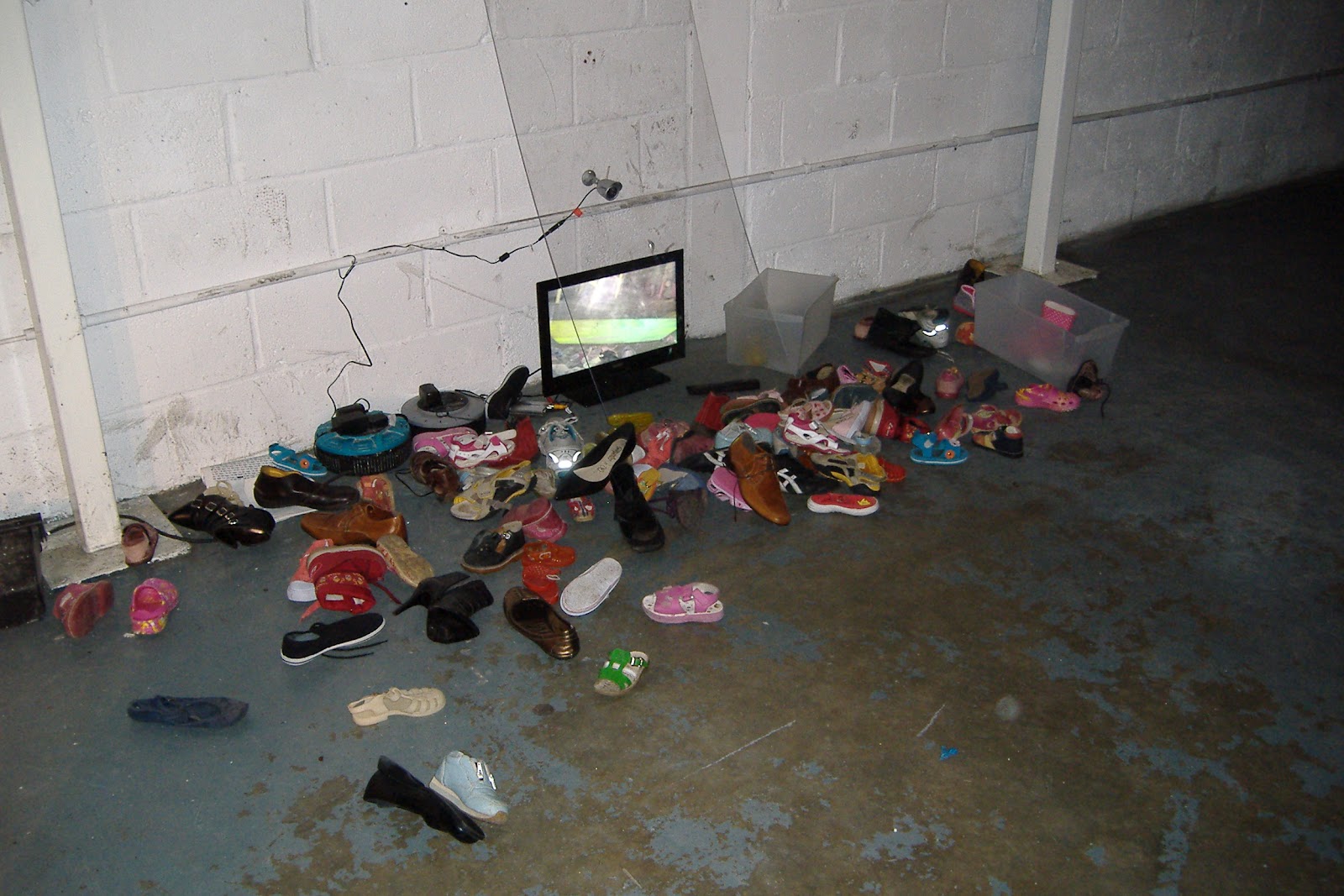
It's difficult to analyse this without taking note of the fact that a few hundred meters away the first day of the Paralympics was in full swing; presenting a very different vision of disability to Lakmaier's piece. The Paralympics tend to present a somewhat sanitised vision of disability. The participants are described in terms winning personal battles, of "overcoming" their conditions to reach success. It seems unlikely we would ever see a cathartic release of anger like Lakmaier's piece in any context in the Paralympics, although I imagine that most of the athletes participating have had their moments of intense frustration and loss of control of their own. In terms of frustration felt, it's notable that these Paralympics are sponsored by ATOS, the organisation tasked with certifying as many people as possible as 'fit for work' and to therefore cut their benefits. I've read accounts of people in final stage terminal illnesses, or those in constant excruciating pain being certified as 'fit for work', often against the advice of the patient's GP. With this as backdrop, Lakmaier's explosive anger against the televised image of herself seems timely, appropriate and incisive.
 |
| Alicia Radage's Islands (with Sebastian Hau-Walker) |
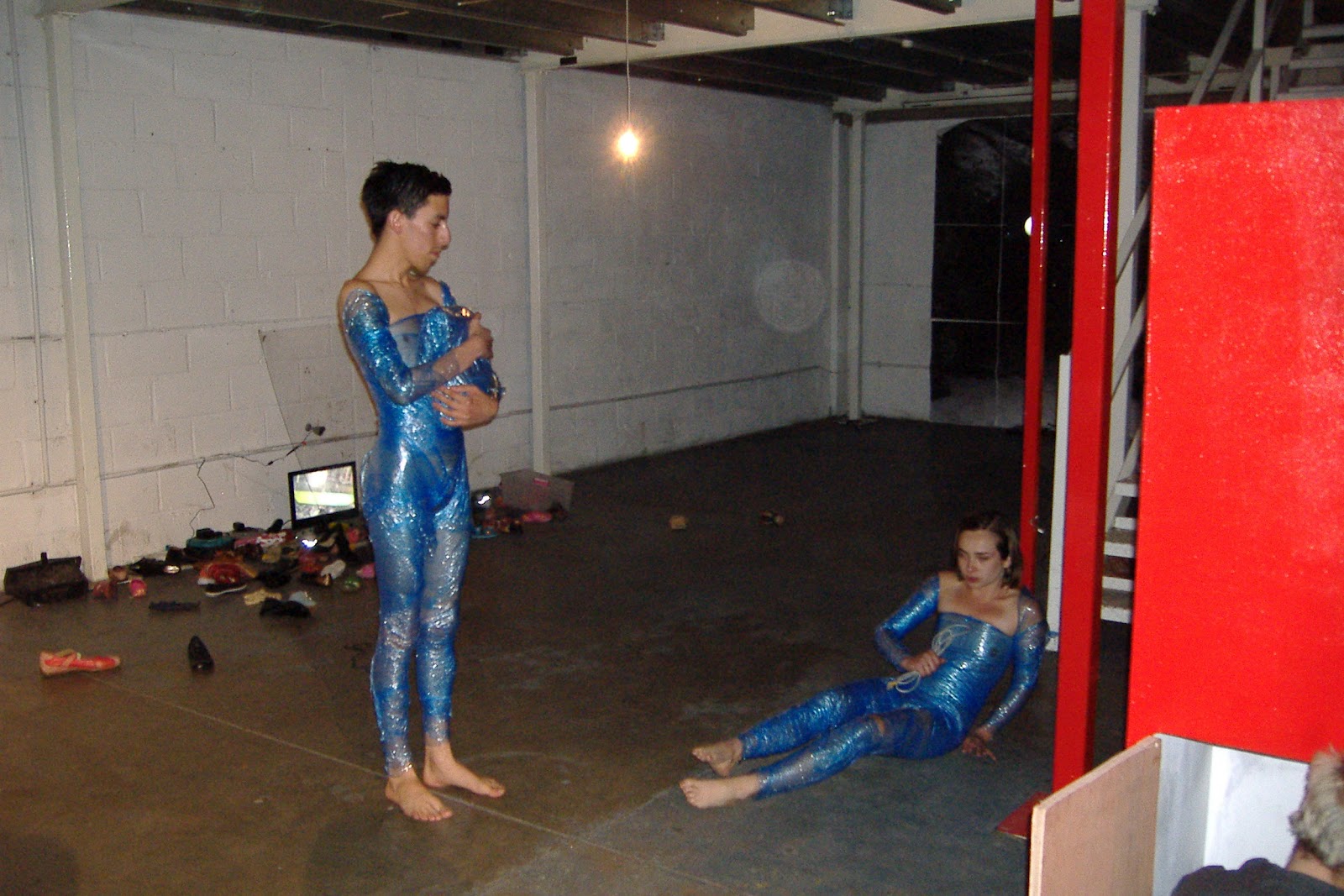
Soon after was Alicia Radage's 'Islands', performed in collaboration with Sebastian Hau-Walker. The two came regally down the stairs from the upper-level, clad only in tight blue cling-film. The outfits made both performers androgynous, lending them a sort of Bowie-esque 'loving the alien' feel. Even though the outfits were extremely tight and defined every part of their bodies they appeared somehow quite sexless in a futuristic way. Radage lay on the floor clutching a similarly blue, clingfilmed package, while Hau-Walker dragged her to the centre of the room. Tearing open the package on her chest revealed that it was full of soil. Hau-Walker took handfuls of the soil, and eventually constructed a right-angled triangle outline of soil on the ground with Radage in the centre. As this triangle was completed, the positions were reversed and Hau-Walker lay on the ground, while Radage laid out an equilateral triangle around him. Once both triangles were completed, the two performers lay in them, and after a short rest started engaging in frantic physical activity. Radage took a length of network cable and used it as a skipping rope, and Hau-Walker ran in frantic circles, breaking the soil outline around him. After a few minutes of this, Radage lay down on the floor, arms splayed in a cruciform and Hau-Walker dragged her across the floor, breaking the pattern on the floor.

According to Radage she "explores constructing places out of space when multiple bodies are present". Even with this mind I had mixed feelings here, partly because I'm not sure I understood what was happening, and I didn't think I much of chance of deciphering the symbolism. Every action in this piece seemed to have been carefully choreographed; movements were slow and deliberate; there was a definite air of ritual to the laying out of the soil. Laying out unbroken geometric patterns like this echoes magic ritual and the creation of a sacred space, at two seemingly important points in this performance these outlines were broken. This seems important, but I can't quite put it all together. In a performance as deliberate as this, I figure that every aspect must have meaning of some kind, for example the fact that Radage is using a network cable to skip with must somehow have meaning in and of itself, although I can't work it out.

Even though I was unable to work out any kind of clear message, I could appreciate the performance on aesthetic grounds. The clean artificial blue of the clingfilm was a nice contrast with the chaotic soil, and this conflict between order and disorder was continued in way the patterns were created and destroyed. Unfortunately, the stately method by which the patterns were laboriously set up meant that this was a very, very slow moving piece. When Radage begins constructing the second triangle around Hau-Walker I was silently willing her to hurry up a bit. I understand I'm not here to be 'entertained' as such, but even so, standing up in silence reverently watching as cryptic as this for what felt like 20 minutes or so can get a bit much.

Up next was Marta Frank's 'The Big Match Girl'. The lights were switched off, plunging us into darkness. Frank stood in the middle of the circle reciting a poem: "Bye baby burning / Daddy's gone a hunting / Gone to get a big bear skin / To ash his baby burning in." As she did this, she lit matches, briefly illuminating the room and dropping them at her feet as they burnt out.
I don't think this performance worked particularly well. It seems like a piece that relies on darkness, and where the the only illumination in the room is from the performer. Here there was frequent light from people checking their mobile phone, using the toilet and entering or leaving the room. In addition, although she was performing 'in the round', with people watching from all sides the artist only faced one direction. I was sat behind her, and as a result couldn't really see what was going on very well. As the room was darkened, I didn't really want to move to a better position for fear of tripping over someone. Another factor was the gallery photographer. This was a quiet, intimate and seemingly quite personal piece of work. The artist seemed to consciously isolate herself within the room. To get good photos of the performer lit by matchlight, the photographer had to get right up in her face with a very loud camera. The performance was punctuated by loud 'click click click' noises from his camera. It was very distracting, and considerably detracted from the performance. I understand the need to document proceedings, but when you reach the point where you're actively disrupting the piece it's time to take a step back. I think overall this piece would've benefited from both a smaller audience, and a smaller and more tightly controlled performance space.
 |
| Season Butler |
After two quiet and meditative pieces I was in a mood for something a little bit more bombastic. Season Butler more than provided this. She descended the stairs of the gallery wearing a large paper skirt, to loud music. Now that is a damn entrance. She walked to the centre of the room, and unexpectedly hurled a mug full of what I think was salt behind her. I was standing in the path of this, and although I managed to avoid most of the shards of mug, my glass of wine got an unpleasant shower of salt in it. Oh well, shit happens. This sudden violence sent an immediate murmur of danger through the room, which felt sorely needed. She then took off the paper skirt, which resembled a wedding dress or ballgown, and it crumpled on the floor in a big pile. The now naked Butler peeled off a can of hairspray that was taped to her thigh, and using a lighter to create an improvised flamethrower, torched the dress. It went up in flames quickly and satisfyingly. As it burned away she lay supine on the floor, and lit a cigarette while she watched it burn.

There was a very real sense of danger here. A fire inside a relatively confined space like this seems to set off some kind of fight or flight reaction in people. The strange feeling of fear and excitement, coupled with the provocative performer was very refreshing. The simple fact of having some musical accompaniment also seemed to liven things up a bit. Both this piece and Marta Frank's used fire, but whereas Frank's piece used the matches extinguishing as a symbol of death, Butler used her aerosol flamethrower as a symbol of both life and destruction. In destroying the cumbersome garment, Butler is in one sense liberating it into brief but bright life. There is also a transformative aspect here, after the dress had burned we were left with cinders lying across the floor, looking like a miniature mountain range. This, coupled with the naked femininity of the performer reminded me of images of the Hindu Goddess Kali, a symbol of both annihilation and rebirth.

Next on was Jess Rose. Looking sullen and confrontational she repeatedly applied red lipstick to herself and planted kisses all over a white chair. Eventually she rolled around the floor with the folding chair, locked in a violent/loving embrace with it. The piece, entitled 'Cyffes Fydd y Corff (Darn 2)', was interesting, but seemed a bit one-note and conceptually hollow. The movements here seemed intended to look spontaneous and uncontrolled, a wild communion with an inanimate object, but it felt somehow self-conscious throughout. It had an element of catharsis, but in comparison with the acutely felt anger of Noëmi Lakmaier's earlier performance it felt far more calculated.

 |
| Jess Rose, 'Cyffes Fydd y Corff (Darn 2)' |
After this, a male performer (whose name I am not entirely sure of), walked around the gallery in the darkness singing "Democracy is Hypocrisy" before leaving the room. I'm guessing he's quoting Malcolm X here, although to what end I don't know. Whatever his intentions, the slogan is presented shorn of all context, and becomes meaningless very fast. I really didn't like this piece. It struck me as self-indulgent and smug. I see two ways to decode it, neither which are particularly attractive.
The first is that you recognise the quotation, and attempt a reading based on a knowledge of Malcolm X. Obviously, you're going to immediately think about race; this is after all a white artist quoting probably the most famous 'Black Power' activist of all time to a predominantly white audience. Repeating the phrase over and over again almost seems to mock it. The sentiments behind Malcolm X's view of US democracy as being hypocritical are accurate and well considered. Repeating this phrase over and over as a slogan has (and I'm sure it's unintended) the effect of mocking the idea. The second reading, if you're not familiar with the origin of the phrase, is that you have an artist walking around singing a cryptic slogan that doesn't mean anything. In isolation "Democracy is Hypocrisy" barely works as political sloganeering, let alone a coherent statement or philosophical point. It was half-arsed, like a parody of performance art rather than the real thing.
I left pretty soon after this piece, and it left a bit of a bad taste in my mouth. But I did have a great time last night. Everyone at these events is friendly and welcoming. The artists seem more than happy to explain what they're doing, and the organisers are generous to a fault. In terms of actual artistic content I felt it was a bit of a mixed bag, but even though I didn't like all of it, I appreciated the effort and thought that went into pretty much everything there.
Please let me know in the comments if I've missed anything, or screwed something up.
Subscribe to:
Posts (Atom)


