Recent Articles
Showing posts with label Anton Chekhov. Show all posts
Showing posts with label Anton Chekhov. Show all posts
Wednesday, December 19, 2012
Wednesday, December 19, 2012
- 0 Comments

The last time I saw Chekhov's 'Uncle Vanya' I screwed up. I'd been sent some tickets to a production in the Camden People's Theatre, and didn't do any research beforehand. I turned up and sat in the centre of the front row, the play started, and everyone began speaking in Russian. I'd inadvertently wandered into a foreign language version of the play. I made it through the thing, doing my best to work out what was going on just from who was crying and who was shouting at whom. That version: 'Uncle Vanya in Languages' was very small-scale, so when I snapped up some tickets to a full, swanky, star-studded production in the West End I was eager to find out exactly what the hell happens.
'Uncle Vanya' has a reputation as one of those plays where 'nothing happens', but this is unfair, this is a play that's got a lot bubbling beneath the surface. We meet a cast of characters struggling to carve themselves a space to live on their own terms in a hostile world. These people are a miserable bunch of losers, trapped in a static, twilight world. But, crucially, they're also recognisable and sympathetic losers.
 |
| Vanya (Ken Stott) and Sonya (Laura Carmichael) |
The setting is the Russian countryside where we find the titular Vanya (Ken Stott), living with the plain Sonya (Laura Carmichael) in a staid, rural existence at a country estate owned by Professor Serebryakov (Paul Freeman). The Professor and his young wife Yelena (Anna Friel) have come to visit, causing much friction between all parties. Everyone is in love with one another, but none of the affection is returned. Vanya lusts after Yelena, Sonya is in love with a young Doctor Astrov (Samuel West) that visits the elderly Professor, Yelena ostensibly faithful, but obviously sexually frustrated and also pining for the doctor.
Basically, it's complicated. All of this simmers under the surface for much of the play, with characters sniping and bitching about each other and making Morrissey-esque monologues that spell out exactly how heaven knows they're miserable now.
This production has an weighty sense of permanence. The sets are huge and wooden, seemingly carved out of one enormous tree. This envelopes the characters in the world; it's like the stage has put down roots. As the production goes on we move between different rooms in the house, all with the same heavy wooden furniture, huge brick ovens and tiny windows that lit in a perpetual sunset. It's a fine bit of stage design, and is wonderfully lit, the characters posing like something out of an old daguerrotype of a bygone age.
 |
| Yelena (Anna Friel) |
The performances range from the brilliant down to, I'm afraid to say, the cringe-worthy. The measure of success here is the ability of the actor to say two things at the same time. Chekhov's characters, especially here, rarely say exactly what they mean. They constantly mask their true feelings and deep passions, bottling things up inside until an eventual eruption.
It's Ken Stott's Vanya who's does this best, showing us a man who is having the worst kind of mid-life crisis. In a time without penis extension sports cars he desperately attempts to assert his masculinity by ineffectually lusting after Yelena. Vanya is a miserable shell of a man, mocking the Professor for producing nothing of worth while frittering away his (apparent) talents and intelligence maintaining the man's estate. Stott constructs a portrait of a man who's realised that he's reached the age where he's officially 'old'. There is no escaping it. He bemoans the opportunities he's passed up, and fears the future heading his way. It's easy to laugh at Stott's Vanya; he's a vain, silly, jumped up little man, but after a certain point we feel a bit guilty laughing at him.

Towards the mid-way point of the play he, besotted and puppy-like, heads out to pick some autumn roses for Yelena, and returns to find her passionately kissing Doctor Astrov. He freezes, his heart breaking and Stott immediately makes us guilty of mocking this poor man earlier in the play. For all his insecurities and unattractive self-pity Vanya is still a man clutching onto some dignity, a man living with a faint flicker of hope in his heart. We watch this flicker being extinguished before our eyes, the character's increasingly melodramatic actions throughout the rest of the play are grounded upon this moment; a wonderful bit of acting.
Anna Friel's Yelena is another great performance. Yelena stands apart from everyone else in the house, placed on a pedestal and exalted. She's admired by most of the male characters more for what she represents than what she is. She's metropolitan, beautiful and probably most importantly, relatively young. Vanya bemoans what he perceives has her 'throwing away her youth' on remaining faithful to the aging professor. Friel's porcelain features are her best weapon, a composed, buttoned up demeanour which is so calculatedly placid that it's obviously artificial. Her faithfulness to the Professor could seem artificial too, but this shines through as actually being genuine, in the way she's obviously a good person trying to do the right thing.
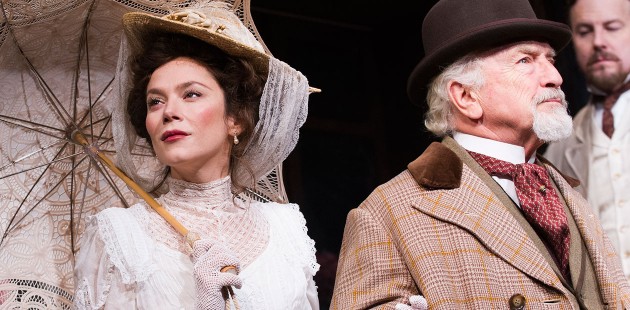 |
| Yelena (Anne Friel) and the Professor (Paul Freeman) |
Most of the rest of the cast is successful to varying degrees. Samuel West's Doctor Astrov has a pleasant dreaminess to him as he talks of conserving forests, and imagining the effects of his work on societies 1,000 years in the future. He's a bit of a fool, throwing himself at Yelena and (wilfully?) misinterpreting her reactions to his advances. His dialogue about the climate change and vegetarianism feels awfully prescient given that this play is about 110 years old.
Unfortunately there is a dodgy cog in this mostly functioning machine, and that's Laura Carmichael's Sonya. Her performance has already taken on semi-legendary status, purely for her being interrupted on opening night by a drunken Sir Peter Hall, founder of the Royal Shakespeare Company and former director of the National Theatre. During Carmichael's closing speech, when she repeatedly says "Life must go on", he responded by shouting "No! Please stop now!".
I disagree with the time and the place in which the criticism was made, but I have to say I find it perfectly accurate. I feel a bit sorry for Carmichael, who is clearly trying very, very hard to do a great job. But it's impossible not to notice that practically every line reading she gives is intoned in the exact same way. She starts out speaking relatively normally, and then by the end of the sentence the pitch of her voice gets higher. It's like everything she says can be read as a question, and it drove me bananas.

Stage and television and film acting require a different set of skills, you can't afford to be as subtle as you can with a camera with a theatre audience and things necessarily must be played a bit bigger. This has translated to Carmichael changing up her facial expression every single second. It's like someone's plugged the muscles of her face into a wall socket! Here eyebrows are maniacally working themselves up and down, her lips moving around, her eyes flaring and narrowing. It's distractingly bizarre.
Sonya is a character lacking in confidence, someone fully aware of their lack of beauty and experiencing cruel pangs of unrequited love. Carmichael isn't really plain, but it's easy to see why you'd think she might be a good choice for the role. She's got a bird-like flighty physicality, and her eyes seem well-suited to wistfully gazing across a room at someone. But for all this, the performance just doesn't add up. The now notorious final speech is a total disaster, something that's supposed to sum up the themes of the play, but here just sounds incredibly insincere and utterly over-rehearsed.
This production is a good one, it's got some of the most intricate and clever staging I've seen recently, and nearly all of the cast acquits themselves well, some magnificently. Chekhov's themes still ring relevant to audiences in the modern day; these are recognisable and comprehensible emotions and actions. You'd have to be a pretty strange human being not to recognise facets of yourself in these characters, they function both as a mirror and as a warning of a future to avoid. It's just a pity about Carmichael's performance. I feel the deepest sympathy for her. Getting heckled on your opening night has got to suck, big time. But it's got to suck even worse when the heckle was completely accurate.
Monday, June 4, 2012
Monday, June 4, 2012
- 0 Comments
 |
| Carlo Bellanovo as Uncle Vanya |
I have rarely felt such a sudden combination of confusion and dread as when I realised that this play wasn't in English. Ah crap, have I gone to a Russian language play by mistake? Not for the first time I found myself wishing I'd done just a tiny bit of research before turning up to a theatre. I'm generally of the opinion that the less you know about something before you see it, the more honest your analysis. However, being faced with a play where, from the look of things I won't be able to understand any of the dialogue, detailed analysis seems like a tall order. To make things just that little bit harder I've never read any Chekhov or seen any plays of his before, so I don't even have the crutch of knowing the outline of the plot.
But as the play progresses I begin to pick up on things. What I had assumed was Russian turns out to be a panoply of European languages. Ah-ha! I haven't gone to a foreign language play by mistake - it's a stylistic choice. Experimental theatre I can deal with, and even though I remain somewhat confused I start to feel like I've got a chance of puzzling this out. I start to pick out each individual language and try and decipher what I can. Eventually a character speaking English arrives on stage. I hang on his every word like a drowning man clinging to a piece of driftwood.
From the off it is clear that this is a production that requires its audience to do some mental heavy lifting. The night was cold and wet, and apparently Londoners have got other things to do than go to an experimental Chekhov play. There are about as many people on stage as there are in the audience. I sit in the front row, my nose right up against the fourth wall. In the absence of language, I find myself having to work out what is going on from other cues.
I begin to analyse the character's costumes, and soon note a unifying theme. They characters, save one, are all dressed in black with one colour accented. For example, Uncle Vanya wears black and a yellow tie, and Helena wears crimson stiletto heels and red lipstick. The characters in the play all seem caught up in their own internal miseries and tragedies, is the colour scheme to show that they're more similar than they realise? Does it show that despite what the characters might think, there are only minor differences between them. The only character to break this theme is Sofia, who is dressed in pure white. Is this a virginal symbol? In the absence of language I have to invent my own colour theories to explain the character's relationships with each other.
 |
| Can Orhan as 'Mikhail' and Daniela Caliandro as 'Helena' |
Even through the language barrier, I can appreciate the strength of the performances. It's somehow relaxing and meditative to watch long sequences where I have no idea what is being said. I find myself forced to focus on body language, tone of voice, eye contact and facial expressions rather than dialogue. It's strangely liberating to free yourself from trying to interpret language, like you're giving a different part of your brain a workout. Once I'd settled into the rhythm of the play I found that, oddly, I was able to empathise with some of the actors much more than a lot of other English-speaking plays that I've seen recently.
By necessity I found myself paying more attention to body language than I would normally have. There are subtle levels of positioning that I picked up on, certain characters seem to pose themselves in distinctive ways. For example Mikhail (Can Orhan) alternates between gallant heroic chest-out style poses and more crumpled and desperate poses depending on whose company he is in. It's clear the body language is one of the things that the company wants to the audience to pay attention to, and with this focus you might expect there to be a plethora of huge, overly theatrical movements. It's a credit to the company that they're not, and a lot of the important character moments are restrained and subtle
Some of what I considered the best character moments weren't spotlighted at all, and happened while the audience's attention was 'supposed' to be somewhere else on stage. My favourite was when Sonya places her head in Marina's lap and lets the old nurse dab away her tears. If the play had been in English my attention would have been elsewhere, and I would have missed that small, but well-acted and important moment. All of the cast acquit themselves very well, and everyone seems to have interpreted their roles with a great deal of thought. Having said that, there were a few performances and moments that stood out in particular.
One moment in particular was during a monologue by Sonya (Emilia Ufir). She fixed me with a full on confrontational stare for about a minute, it was a hugely effective and uncomfortably intense moment. I didn't want to look away and felt a bit like a deer in the headlights. It's the kind of experience that I go to the theatre for, and it pretty much knocked the wind out of me. I've been to a lot of productions in enormous auditoriums lately, and you just wouldn't get that kind of piercing interaction there. A similar moment to this was the close of the first half of the play, when Helena (Daniela Caliandro) sings 'Twinkle Twinkle Little Star'. This happened right in front of me, and was, again a nicely intimate and emotionally honest moment.
Another outstanding performance was the central role of Uncle Vanya (Carlo Bellanova). The actor has a marvellously dramatic mane of long curly hair, making it look somewhat like he's wearing a periwig. It gives him a feral, unkempt air, in stark contrast to the other characters who have much more restrained and naturalistic styles. He is the character who goes through the widest range of emotions, and it's a little scary to watch him at the extremes. There is a great moment where he writhes on the floor in the grip of infatuation. it seems unselfconscious, and perfectly sells the desperation and loneliness of the character. Another is when he bursts into a scene wielding a gun and shoots at Aleksandr. His screaming and wailing is disturbing to watch, as is his emotional collapse soon after.
 |
| Emilia Ufir as 'Sonya' and Daniela Caliandro as 'Helena' |
Despite all these positive qualities, there were a few problems with the multilingual format of the play. A synopsis of the plot was provided on the programme, which was on our seat as we entered the auditorium. As the audience enters, Marina (Matveevna) is already on stage and in character. I was not sure if the play had already started, and it felt somehow rude to read through the programme while someone is already acting on stage. I read it during the interval, and in retrospect it would have been helpful to know who was who and what was going on throughout the first half. Even with this synopsis (and after watching the play) I still don't really think I have a grasp on the plot and although I could pick up on which characters are feeling which emotions I still don't really know why. For example, Mikhail, the doctor, has some kind of plot arc involving planting trees, and being able to metaphorically (or maybe actually as far as I know) see 1000 years into the future. I didn't really have any idea what this had to do with anything. I can just about tie it thematically to Aleksandr's threat to sell off the country estate, but this was just one of many plot points that seemed to hang freely without any connection to the rest of what I thought the narrative was. It seemed that concessions were made in that important moments and soliloquies were in English, but again, these sequences seemed more like free-floating pieces of standalone drama that were hard to tie into an over-arching narrative.
I respect the idea and philosophy behind the performance, but if you come into it 'cold' it is very difficult to mentally put the pieces of the puzzle in the right places. As a result, even though the interactions between the characters are very strong and all of the acting is great, it is hard to get genuinely emotionally invested in what will happen. I'm sure it'd be a completely different experience if I was familiar with Chekhov's work, or spoke multiple languages but I'm not and I don't, so I have to review it from this perspective.
Aside from this, there are a few minor issues. One is that the walls of the theatre are not particularly soundproof, and throughout the play, the audience hears fairly loud traffic noises from the street outside. At one point, after Vanya attempts suicide an ambulance drove past, sirens blaring. It felt strangely serendipitous. Also in sound terms was that someone's camera kept making a loud bleeping sound throughout the play, which was a bit distracting. You'd think they could have set it to silent out of consideration for both the cast and audience.
I'm glad I came out for this, and despite my initial reservations I found myself enjoying it immensely. It was a tough mental workout though, and I had to work at not letting my mind wander and keep my focus on body language and facial expressions. I don't think it was a very good introduction to the works of Chekhov, but as a piece of experimental theatre it was definitely worthwhile. This is, to say the least, an ambitious first piece of work for a company, and I hope it means they're going to make a name for themselves with more experiments as interesting and compelling as this one.
Subscribe to:
Posts (Atom)


