Recent Articles
Showing posts with label Arebyte. Show all posts
Showing posts with label Arebyte. Show all posts
Saturday, March 12, 2016
Saturday, March 12, 2016
- 0 Comments

Hackney Wick is under a death sentence. You might not have heard about it; but the grit, grime and graffiti is on the way out and these beautiful post-industrial warehouses are scheduled to be bulldozed. In their place will rise columns of steel and glass; beehive-sterile luxury living for the well-to-do, the streets dotted with corporate commercial opportunities.
Perhaps this is just the inevitable next step in the neighbourhood's gentrification, but you only have to look at the drab, depopulated and wind-blasted misery of the neighbouring Olympic Park to feel a deep shudder of dread.
So it's prime time for arebyte Gallery to host The Wick in Layers, a project from Masters students at the RCA studying Information Experience Design and Visual Communication. The starting point for the project is Josephine Berry's Autonomous Art in the Neoliberal City.
"If one takes the Queen Elizabeth Olympic Park as a prime example of the neoliberal city's attempts to marry economics, control and happiness, its crisis of political ideology and aesthetic form becomes quickly apparent. In this disarticulated space of planting and place branding, art and athletics, picnicking and policing, entered through the Westfield shopping mall, the triumph of biopolitical economics over civic values and municipal idealism is all too evident." (Preview here)
The objective of the exercise is to "investigate the systems and networks of arebyte's local area ... creating a space of fluid meaning and connections that reflect the everchanging narratives surrounding the area." What this boils down to is an exhibition that distills the atmosphere and mood of Hackney Wick to an easily identifiable core.

Most immediately eye-catching is Yinan Song's video that juxtaposes graffitied walls, the forbidding green fence that encircles the Olympic Park and the Overground station. The graffiti leaps out as bright bursts of primary colour, overlapping images bristling with communal creativity. It's a neat metaphor for the artist population; all working on their own themes yet all gently overlapping and contributing to a tapestry of sorts. Meanwhile the jagged metal angles of the Olympic stadium squat, spider-like, over the top, squeezing out the energy through sheer mass.

At the centre is Georgia Ward Dyer's table, constructed from found materials around Hackney Wick. Whereas Song explores iconography, Ward Dyer delves into the web of interpersonal connections that comprise the area. This table was used to serve a dinner last night, to which Hackney Wick residents were invited; from her fellow artists to Olympic Park advisors to the landlord that owns the arebyte building.

I've always been a big fan of any installation that combines meaning with a slap-up dinner; so I was a bit gutted I missed it. Still, it works as an easily understandable, friendly and community orientated exercise that cuts through an awful lot of conceptual art bullshit. After all, what's the point in trying to communicate something about a community when you suffocate it underneath strained pretension?

Similarly clear-minded is Wei Lun Chang's exploration of the bylaws that govern behaviour in the Olympic Park. These are a byzantine tangle of small-print that dictate everything from how many dogs you're allowed to walk at once to the circumstances in which you can fire a bow and arrow. The small print density is overwhelming; the overall impression a disquieting authoritarian thicket.
This contrast between self-governing public urban space and strictly controlled private space is a pressing issue (especially with the debate surrounding Boris' pet 'Garden Bridge'. Annelise Keestra and Franziska Hatton explore it further in their audio/video piece, mirroring footage from the two places to a soundtrack of conversations with residents and workers. Unfortunately, due to the fact that this was a bustling and chatty Friday night private view, I couldn't hear the audio.
I could, however, appreciate the care that's gone into presenting the work, projecting the video onto a suspended screen that can be watched from both sides. I'd have loved to have been able to get the full picture with the audio, but the video at least contrasted the two very differing environments well.

Finally, quiet and minimalist, was Jordan Gamble's look into the 'hackney candle'. Wax drips down into a jar filled with brick, silk and the detritus of Hackney Wick's history. Maps on the wall next to it show us the changes this land has seen in just 200 years. Bucolic agriculture gives way to heavy industry gives way to fashionable, forwarding thinking art. The place has been in flux for generations, this piece explaining that any changes will, someday, be changed themselves as the accreted drip drip of history proceeds towards the infinite.
The Wick in Layers is one of the most impressive exhibitions I've seen lately; combining intelligence, artistry and politics to zero in on the psychogeographical state of Hackney Wick. It's a bit of a shame that it's only running for this weekend - but if you're a resident of the area or at all concerned with gentrification and development I'd highly recommend paying arebyte a visit!
The Wick in Layers is on until the 13 March. Details here.
Wednesday, July 8, 2015
Wednesday, July 8, 2015
- 0 Comments

Surrounded by cranes, shorn of floodlights and apparently devoid of life, the London Olympic Stadium has become the centre of a ghost town. Its neighbours, the velopark and aquatics centre, are generally closed to visitors, park paths are punctuated by steel mesh barriers and the sculpted greenery brings to mind an abandoned golf course. Colossal pedestrian boulevards; once funnels for thousands of happy Olympic spectators now host only the occasional lost Westfield shopper and steadily diminishing numbers of curious tourists. Looming over it all stands the skeletal Orbit, now less like a celebration of British architecture and more like a memorial to happier days.
There are, of course, big plans for the stadium. After much legal kerfuffle, West Ham football club are to be its new tenants, hopefully ushering in a new sense of purpose and atmosphere to this increasingly sterile place. But what's to be done in the meantime? After all, nature abhors a vacuum. This is where Ariel Narunsky steps in; proposing a gigantic piece of artwork to occupy the stadium.
This is Judgment: a spiral running track enveloped by walls, sending visitors through a 6000m long corridor that ends with them proceeding down into the earth and through a tunnel. Making your way through the thing looks like a pretty unrewarding (albeit hypnotic) experience, roughly akin to being a rat stuck in a maze. But even a rat gets a piece of cheese at the end, visitors to this end up unceremoniously squirted out somewhere south of Victoria Park.

The exhibition imagines what a visitors centre for this construction would be like. Played completely straightfaced, it behaves as if this enormous proposal has been accepted and will soon undergo construction. With sans serif corporate font, colour coordinated businessquirky orange and cosy sofa-based infomercial watching, the atmosphere is cool, controlled professionalism.
Judgement is a curious mix of the corporate and absurd; the project would require the decommercialisation of a hugely expensive piece of London real estate, one already subject to much legal quibbling. It'd also mean the construction of a tunnel bored right through the rat's nest of subterranean London. All for a piece of art that seems purposely designed to dehumanise, bore and antagonise those within.
The back of the glossy programme lists the corporate sponsors of Narunsky's project; including the Queen Elizabeth Olympic Park and Balfour Beatty, the building company in charge of the redevelopment of the park. After examining every carefully laid out display in the exhibit; the posters bleating stentorian gobbledegook like "An Unknown Game with Ultimate Things" or "New Things Are Near"; the promotional video that draws parallels between Roman gladiatorial games designed to distract an unruly populace and the chic 3D printed models I began to wonder - do these companies realise they're being made fun of?

To my eyes Judgement is a multi-levelled satire; taking aim at the worth of sports, egotistical design and authoritarian architecture. The idea of a pointless leg and mind numbing running track subverts the original idea of the stadium, boiling back its purpose until all the grandiosity has disappeared to reveal people fruitlessly running in circles.
Narunsky's rat's maze design, from which deviation is neither tolerated or possible, neatly echoes the Queen Elizabeth Park's winding paths that subtly manipulate the visitor through a predetermined route. There are no great walls in the Olympic Park, but the slightest sense of adventurousness will (and I'm speaking from personal experience) herald the arrival of a black-painted and logo-clad Audi estate driven by unfriendly men in hi-vis jackets pointedly asking what it is you're up to.
Similarly, the sheer scale of the project is calculated to intimidate and impress. Public art on this scale is, rightly or wrongly, criticised as an act of ego by both those commissioning and designing. There's an almost aggressive desire to leave your fingerprints on the urban landscape, to mould the public experience around your vision. In it's spiral design and oval shape, Judgement recalls that very fingerprint - as if a 10 mile tall Narunsky has bent down and pressed his thumb into the soft stadium floor.
It's a neat, slyly subversive exhibition, one that adopts the aesthetic and tone of corporate art so fully that its been embraced by the very people it's mocking. Worth checking out.
Judgement is at arebyte Gallery until 7th August. Details here.
Monday, March 30, 2015
Monday, March 30, 2015
- 0 Comments

I love it when art and science climb into bed together. There's something thrilling about the friction of rigorous objectivity of science rubbing up against the subjectivity of art. Over the 2013-14 term I followed the progress of the Central St Martins Art & Science group, which combined the two brilliantly (articles here, here and here). These exhibitions stoked my curiosity, and I hungered for more in the same vein.
I found it at Arebyte Gallery's Wired Up "exploring social, neural and bacterial networks through art and science collaboration". Working as part of the University of Westminster's Broad Vision project, teams of artists and scientists have been devising work centred around the idea of being 'Wired Up'. In 2015 we're all wrapped up in network cabling like a fly in a spiderweb; every person a node in a hundred different networks, which are themselves networked together. It's a dizzying train of thought, one that proves the seed for some fascinating work.
 |
| Internet |
The most initially eye-catching was Internet by Alex Cottrill, Francisco Sajara Vidinha and Mary Woolf. A bamboo model of a telecommunications tower stands in front of a projected map of London. The map has been coloured to show the 'heat' of wireless signals in the capital. As can be expected from a major modern metropolis, this is a blister of angry red activity, only the very edges showing some lull. These shifting colours reveal London as a pressure cooker of electromagnetic activity, watched over by gigantic masts that we've quickly trained ourselves not to notice.
The piece also works on a straightforwardly aesthetic level. The organic bamboo tower works as a counterweight to its steel real-life counterpart and the illumination of the projection against it creates beautiful shadows and patterns. Also, quite simply, the shifting colours of the heatmap pop off the white gallery walls, making for an eye-catching display.
 |
| Living Wires |
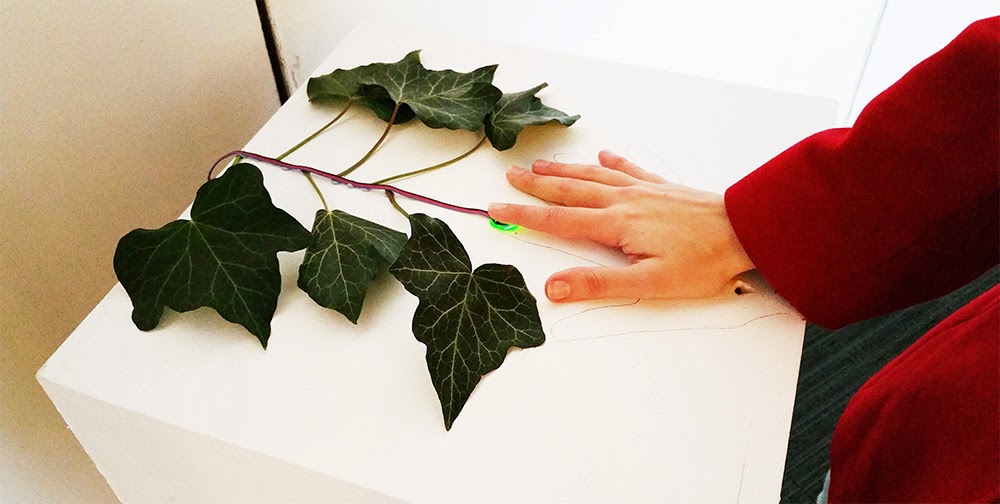
Nestled up against it is a similarly neat piece: Riccardo Branca's Living Wires. The artist explains that he's really working in collaboration with Physarum Polycephalum (a slime mould), to create an interactive exhibition that reacts to your presence. This consists of a box upon which a branch rests, terminating in a heartrate sensor. This is hooked to a projection that displays a closeup of the slime mould, which throbs in time with you. I've always dug slime moulds; they famously display a weirdly alien intelligence - able to puzzle out the optimum routes through mazes and (apparently) escape containers. Pretty impressive for a mould, and this one proves to be an excellent partner for Branca.
In Living Wires, the participant 'makes contact' with this inhuman world, giving us a taste of what it might be like to be part of a distributed plant consciousness. It's a teensy-weensy taste of course, functioning more as thought experiment than simulation, but in terms of provoking ideas it more than succeeds.
 |
| This is the best I could do in low light with my phone. |
These pieces border the edges of a darkened box in the centre of gallery. This is The Room, by Mateusz Gidaszewski, Camila Gaspar, Shin-Young Wiz Choi, and Charlie Dixon. After being blindfolded, you enter a darkened space and are presented with softly glowing jars of liquid. Shake them gently and they glow brighter. Once you have them all glowing, the mirrored walls of the room place you within a spooky constellation of ever-dimming and growing lights, with squirts of peppery scent combining to create a strangely religious atmosphere.
The glowing fluid are cultures of Dinoflagellate (nocticula) and photobacterium phosphoreum. The action of shaking them, which introduces oxygen to the bacteria and makes them glow, proves extremely compelling. There's something magical and primordial about the gentle movements of the glowing liquid, the infinity of the reflected mirrors giving the illusion that we're in the boundless ocean, or perhaps floating through the interstellar void. I could have stayed in there for hours.

Most fun was Sensory Interfaces, by Coral Hermes, Pippa Ischt, Dagamara Rutkowska and Patrycja Wilosz. This comprised three interactive stations that combine our senses (vision/taste, touch/sound, vision/sound) and a fourth that explores the future of our senses. Devised no small amount of humour and imagination, this was straightforwardly fun. A highlight were two boxes, one containing cotton wool and one containing rocks. Place your finger in the former and you get soothing classical music, in the latter you get Slipknot.
It's a clever joke, and this light-hearted sense of exploration continues with the experiment that links taste and vision. Presented with a series of coloured liquids, you're invited to taste them and then sort them by flavour. The twist is that they're not the colours you'd expect them to be; for example, the lemon/lime flavour is dark orange and black cherry is bright yellow. It's curious how our brain fools us with expectations - I could have sworn that the bright yellow liquid was lemon flavoured...
The vision/sound station is slightly less inspired next to the other two, but then these are two senses every human being knows to combine anyway. Finally the future headset, as represented by a faux-VR cardboard headset constructed from a mobile phone gives us a faintly endearing look at the future. There's something indefinably pleasant about this installation, which is geared - Science Museum style - to ensuring participants enjoy themselves while learning.
This is but a taste of what was on offer, though unfortunately this was a two day exhibition so your chance to see it has passed. But I'll be keeping an eye on work of this ilk, science and art perfectly dovetailing into one another to create exciting new hybrids.
Top picture from Dysfunctions by Andrea Fachini and Christopher Verhauwart
Friday, March 6, 2015
Friday, March 6, 2015
- 0 Comments

The text in the picture above, found tucked away on a bookshelf in the corner of LikeMe Labs neatly summarises my feelings. This show is a peculiar experience, acting largely as a springboard for the audience's personal thoughts and neuroses. Even defining those present as an 'audience' feels limiting, Alisa Leimane smudging the boundaries between the art/observer, personal/public and reality/fiction.
So what is it? Well, this normally austere gallery has become a lot more homely. Carpet covers the floor and there's domestic touches like a stocked fruitbowl, coat hooks, a clothes rail and a sofa. A half-used tube of lip gloss casually lies next to the information sheets. Further on there's a large white cube, the outside of which is peppered with framed screengrabs. Shots of Tinder matches jostle for space with chatlogs and hand-written notes. The interior of the cube contains an office, within which the artist appears to have temporarily set up shop.

Alisa explained that what we're seeing are the results of a several distinct online personalities she's constructed. This collection of parapersonalities exist across social media and dating websites, the world at large revealing their own desires as they interact with them. So, for example, one glamorous personality might have an upmarket house, a nice dog and spend her free time in swish Indonesian hotels. Meanwhile a more grounded version of Alisa has to contend with mould growing on the walls of her London flat. Through carefully selected Instagram photos, using wigs, outfits and locations to tell a subtle narrative, these Alisas live out wildly different online lives. This is explained as a social experiment: to see which personality/haircut/class gets the most 'likes' - to blossom into a true social media butterfly.
Not knowing what's real plays on the nerves. Even when sat across from Alisa I wasn't sure if I was chatting to 'her' or some lightly fictionalised character she was playing for my benefit (the presence of books 'on acting' don't help. This mild paranoia grew when I glanced to my left to see a printed copy of my recent Facebook status updates. A Truman Show shiver of worry came over me, as I walked around the gallery I began to second-guess each person there. Surely that 1950s looking blonde with the selfie stick must be part of the exhibition? Am I talking to strangers or disguised friends? After all there is a large selection of wigs and costumes at the back... Am I being played for a mug? Should I play along with the fiction?

This whirlwind of worrying thoughts, only slightly smoothed over by a couple of glasses of wine, gets to the heart of LikeMe Labs. Consciously or unconsciously we all create these online persona; presenting an idealised, edited and censored simulacra of reality for public consumption. That we only show the positive stuff on Facebook is pretty far down the dishonesty scale, but the porkies really ramp up once we get into the realm of online dating.
If our Facebook persona are heightened versions of ourselves, our online data profiles present the person we'd desperately love to be: cultured, beautiful, interesting and personable. Working as our own. dedicated, PR team we cast this perfect 'us' into the online-dating pond like a worm on a hook, hoping against hope that not only will someone bite, but that person will forgive our various lies and accept us for who we 'really' are.

LikeMe Labs shaves back the self-deception and exposes the bones of this process, the walls festooned with confused men never quite sure whether they're talking to a real person or not. Gradually you pick up on the narratives - in particular the relationship between Robert and Alisa. This comes to a confusing head when Robert turns up and (apparently unexpectedly) launches into an improvised beatboxing session for Alisa's benefit. Later there's a pretty funny gynaecological monologue (not by Robert), but I couldn't quite work out where that fit into the night. Again, the lines between what we play out on the comfort of our phones and laptops is wrenched into the real world.
LikeMe Labs turned out to be an unexpectedly dislocating and slightly scary experience. The night is full of meaty questions, the true implications of which only dawn on you during sleepless late nights. Has the age of social media transformed us all into enormous narcissists? What is a person's 'true' personality? If everyone we meet is 'in character' then who the hell are we even talking to?

This all adds up to a work that's less installation and more psychological study, the internal monologue of each individual that attends as important as whatever's nailed to the walls. I do wonder how effective it'd be without a bunch of people milling around to exchange ideas with, but any exhibition that leaves me with a knotted head full of conflicting ideas is definitely doing something right.
LikeMe Labs is at Arebyte Gallery until 20th March 2015.
So what is it? Well, this normally austere gallery has become a lot more homely. Carpet covers the floor and there's domestic touches like a stocked fruitbowl, coat hooks, a clothes rail and a sofa. A half-used tube of lip gloss casually lies next to the information sheets. Further on there's a large white cube, the outside of which is peppered with framed screengrabs. Shots of Tinder matches jostle for space with chatlogs and hand-written notes. The interior of the cube contains an office, within which the artist appears to have temporarily set up shop.
Alisa explained that what we're seeing are the results of a several distinct online personalities she's constructed. This collection of parapersonalities exist across social media and dating websites, the world at large revealing their own desires as they interact with them. So, for example, one glamorous personality might have an upmarket house, a nice dog and spend her free time in swish Indonesian hotels. Meanwhile a more grounded version of Alisa has to contend with mould growing on the walls of her London flat. Through carefully selected Instagram photos, using wigs, outfits and locations to tell a subtle narrative, these Alisas live out wildly different online lives. This is explained as a social experiment: to see which personality/haircut/class gets the most 'likes' - to blossom into a true social media butterfly.
Not knowing what's real plays on the nerves. Even when sat across from Alisa I wasn't sure if I was chatting to 'her' or some lightly fictionalised character she was playing for my benefit (the presence of books 'on acting' don't help. This mild paranoia grew when I glanced to my left to see a printed copy of my recent Facebook status updates. A Truman Show shiver of worry came over me, as I walked around the gallery I began to second-guess each person there. Surely that 1950s looking blonde with the selfie stick must be part of the exhibition? Am I talking to strangers or disguised friends? After all there is a large selection of wigs and costumes at the back... Am I being played for a mug? Should I play along with the fiction?
This whirlwind of worrying thoughts, only slightly smoothed over by a couple of glasses of wine, gets to the heart of LikeMe Labs. Consciously or unconsciously we all create these online persona; presenting an idealised, edited and censored simulacra of reality for public consumption. That we only show the positive stuff on Facebook is pretty far down the dishonesty scale, but the porkies really ramp up once we get into the realm of online dating.
If our Facebook persona are heightened versions of ourselves, our online data profiles present the person we'd desperately love to be: cultured, beautiful, interesting and personable. Working as our own. dedicated, PR team we cast this perfect 'us' into the online-dating pond like a worm on a hook, hoping against hope that not only will someone bite, but that person will forgive our various lies and accept us for who we 'really' are.
LikeMe Labs shaves back the self-deception and exposes the bones of this process, the walls festooned with confused men never quite sure whether they're talking to a real person or not. Gradually you pick up on the narratives - in particular the relationship between Robert and Alisa. This comes to a confusing head when Robert turns up and (apparently unexpectedly) launches into an improvised beatboxing session for Alisa's benefit. Later there's a pretty funny gynaecological monologue (not by Robert), but I couldn't quite work out where that fit into the night. Again, the lines between what we play out on the comfort of our phones and laptops is wrenched into the real world.
LikeMe Labs turned out to be an unexpectedly dislocating and slightly scary experience. The night is full of meaty questions, the true implications of which only dawn on you during sleepless late nights. Has the age of social media transformed us all into enormous narcissists? What is a person's 'true' personality? If everyone we meet is 'in character' then who the hell are we even talking to?
This all adds up to a work that's less installation and more psychological study, the internal monologue of each individual that attends as important as whatever's nailed to the walls. I do wonder how effective it'd be without a bunch of people milling around to exchange ideas with, but any exhibition that leaves me with a knotted head full of conflicting ideas is definitely doing something right.
LikeMe Labs is at Arebyte Gallery until 20th March 2015.
Tuesday, November 18, 2014
Tuesday, November 18, 2014
- 0 Comments

Every day we struggle to define ourselves in relation to the amorphous mass of humanity. In a sea of styles, opinions, tastes and philosophies we compete to stick our head above the parapet and yell "I exist!". What is a Facebook wall, a Twitter page, a culture website or an Instagram feed if not a way to to assert our individuality in a world where we're silently categorised by pure demographics? But what is this identity made of? How strong is it? Can you destroy it and don a new one? Is who you are determined by what you do, see and hear or by what you think?
It's these questions that Mark Farid wants to answer. That's is why he's spending 28 days with virtual reality goggles strapped to his head, vicariously experiencing someone else's life through twin HD cameras and microphones attached to a subject.. This is, to say the least, an ambitious project. Questions arise almost immediately. How on earth can he spend a month in virtual reality? Whose life is going to be observed? How will he eat, shower or sleep? Won't his eyesight get ruined? Who's going to look after him? And so on and so on.
Well, the only criteria for the life to be recorded, known as the 'Other', is that they're a heterosexual male who is living with a girlfriend or wife. It'd be interesting in itself to see how Mark would react to living in a woman's head for a month, but that arguably diffuses the focus of the exercise. Having a partner allows the Other to explain what they're doing at any given time; for example rather than just going out to the shops he'd say "I'm going out to the shops to get some milk", allowing Mark to understand what's going on.
If all goes to plan the artist will be a silent passenger in a complete stranger's head: seeing, hearing and tasting everything they do. This complete lack of autonomy sounds equally frustrating and boring, after all life can be dull enough when you're the one in charge of what you're doing. I imagine what Mark wants to experience as being a very special kind of hell, stuck as the ultimate backseat driver; silently fuming at all the 'wrong' decisions, idiotic comments and wincing with embarrassment as someone makes a fool of themselves.

Professor Simon Baron-Cohen has made a series of predictions as to the psychological impact of this; "he might become more empathetic ... he might experience distorted perceptions and even delusions". Mark himself predicts that "after five or six days my breakdown will happen, and then it becomes interesting." I detected a slightly cavalier approach to mental health in this answer; so I asked Mark if he considers himself a masochist. He denied it, but to my eyes anyone who will willingly subject themselves to something that comes close to torture for so long in the name of art must derive some satisfaction from inflicting pain upon himself.
After all, even though Mark will be viewing video through VR goggles, this is still a form of sensory deprivation, the duration and intensity reminiscent of the CIA's astonishingly unethical MK ULTRA experiments. They'd take volunteers, remove stimulus (placing goggles on them that diffused light and headphones that played constant low noise) and confine them for extended periods of time to observe the psychological impact. The most relevant of these experiments involved altering the receptiveness of the subject to new ideas; for example taking psychology students, removing external stimulus, and exposing them to recordings of voices expressing creationist, mystical and generally delusional opinions, notions that scientists could be expected to oppose.
What was discovered was that after prolonged periods of sensory deprivation the subjects would become overly vulnerable to any stimulation. They'd would find themselves in agreement with whatever they were told, even if they were ideas that they'd have automatically dismissed as ridiculous prior to the experiment.
Of particular note to Mark is a quotation from Alfred McCoy's excellent book A Question of Torture: CIA Interrogation, from the Cold War to the War on Terror: "Even short term deprivation produced a devastating impact upon the human psyche. After just two to three days ... the subject's very identity had begun to disintegrate". He later reports that the subjects "all suffered eerie hallucinations akin to mescaline use as well as deterioration in the capacity to think systematically and concludes by noting the potential for "serious disturbance" in the subject's life.
Long term impacts included, at worst, regression to a child-like mental state, though and former subjects had a worrying tendency to end up homeless, schizophrenic, drug addicted or victims of suicide (or any combination of the above). Now, Mark, curator Nimrod Vardi and director John Ingle repeatedly underline that this is not a test of endurance, that they'll have medical professionals monitoring Mark and if its judged that he's experiencing permanent damage they'll stop the experiment immediately. Even so, after a load of publicity, hype and fundraising there'll be obvious pressure to keep this going as long as feasibly possible.
Now I have absolutely no problems with someone harming themselves for the sake of art, it's Mark's body and as long as he's not harming anybody else he can do with it what he likes. In addition I'm ghoulishly curious as to how long he can stand it (my prediction is that if the CIA's guinea pigs freaked out so quickly, he'll crack within the first week and the medical team will stop the experiment).
A man exploring whether its possible to erase his own identity and live the life of another used to be the stuff of science fiction. But with new technology, imagination, ambition and Mark's willpower and endurance we can explore questions that will become ever more relevant as we face a digital future in which apparently anything is possible.
I deeply hope Mark raises the money to fund this crazy experiment, if only because I want to live in a world where things like this can happen. To my eyes he stands like an explorer of old confronted by an infinite ocean. What's on the other side? You may have to sacrifice your safety, health and sanity to know (and maybe the ocean really does stretch on forever), but sometimes these sacrifices are truly worthwhile.
More articles to come as this experiment develops.
Kickstarter here.
Website here.
Of particular note to Mark is a quotation from Alfred McCoy's excellent book A Question of Torture: CIA Interrogation, from the Cold War to the War on Terror: "Even short term deprivation produced a devastating impact upon the human psyche. After just two to three days ... the subject's very identity had begun to disintegrate". He later reports that the subjects "all suffered eerie hallucinations akin to mescaline use as well as deterioration in the capacity to think systematically and concludes by noting the potential for "serious disturbance" in the subject's life.
 |
| A CIA experimental isolation cubicle. |
Now I have absolutely no problems with someone harming themselves for the sake of art, it's Mark's body and as long as he's not harming anybody else he can do with it what he likes. In addition I'm ghoulishly curious as to how long he can stand it (my prediction is that if the CIA's guinea pigs freaked out so quickly, he'll crack within the first week and the medical team will stop the experiment).
A man exploring whether its possible to erase his own identity and live the life of another used to be the stuff of science fiction. But with new technology, imagination, ambition and Mark's willpower and endurance we can explore questions that will become ever more relevant as we face a digital future in which apparently anything is possible.
I deeply hope Mark raises the money to fund this crazy experiment, if only because I want to live in a world where things like this can happen. To my eyes he stands like an explorer of old confronted by an infinite ocean. What's on the other side? You may have to sacrifice your safety, health and sanity to know (and maybe the ocean really does stretch on forever), but sometimes these sacrifices are truly worthwhile.
More articles to come as this experiment develops.
Kickstarter here.
Website here.
Thursday, August 21, 2014
Thursday, August 21, 2014
- 0 Comments

Futurology is a mug's game. History is riddled with people making idiots of themselves when predicting the future, from Victorian underwater cities to the famously dumb 1977 assertion "there is no reason anyone would want a computer in their home". It turns out that aside from the most vague, obvious ideas (computers will get faster, technology will get smaller) it's downright impossible to predict the twists and turns technology will take and how they'll alter our behaviour.
But this hasn't stopped the graduates of The Royal College of Art from trying! But rather than pompously declaring what the next big thing is going to be, this Next Brave New World is extrapolated from contemporary life. These sci-fi visions aren't so much serious predictions, more explorations of what the end-point of 2014 trends. Laced with satire, humour and imagination they lead us into the human genome, to outer space, even up the M1 to Blackburn.
 |
| Superbivore by Kathryn Fleming |
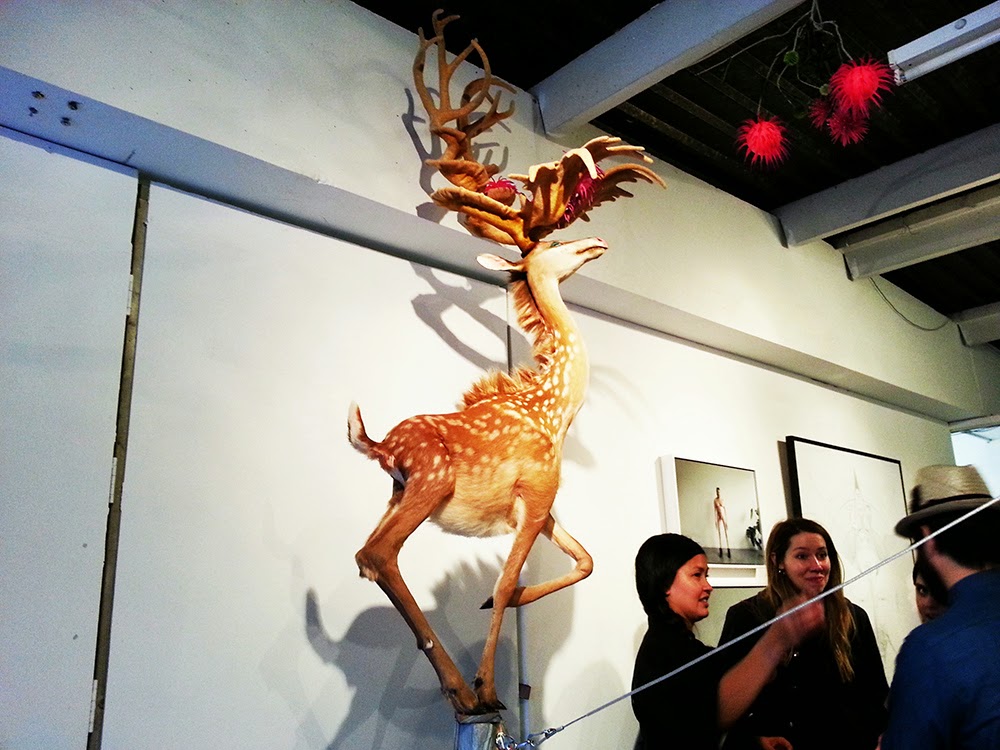
Immediately catching your eye is Kathryn Fleming's menagerie Endless Forms/Endless Species. Throughout human history man has altered the ecosystems around him; be it medieval deforestation, 20th century dam construction or genetically modified supercrops. Fleming makes references the idea of the Anthroposcene: that humanity's impact upon the environment is so large that it constitutes a new geological epoch.
It's a concept fascinating and worrying in equal measure, one that Fleming has approached through subtle humour and imagination. Two taxidermied "synthetic biology" animals pose in the centre of the gallery - man's sticky fingers rummaging in the genetic cookie jar brought to life. Perched gracefully atop a crag is her Superbivore, a majestic deer/goat/giraffe hybrid topped off with a tangled coral reef antler. Below it prowls the Retro Reflective Carnivore, a fierce-looking six-legged predatory coil of muscles combining the best of feline and canine.
It's one thing to imagine genetic manipulation, quite another to have a three dimensional, lifelike example of it in front of you. It's posited that these creatures would roam around a future Regent's Park, now converted into hothouse for evolutionary selection; a self-sustaining zoo where predator and prey can exist in competition - each engaged in their own race for survival. Fleming's creations are beautifully realised and her graphic design excellent, strongly reminiscent of Jurassic Park with all the potential for disaster that implies.
 |
| Indivicracy - by Alexa Pollman |
Nestled alongside are another set of beautiful creations: Alexa Pollman's Indivicracy. As opposed to the genetic experimentation, Pollman's is more a political prediction. It posits the gradual collapse of nation states and traditional nationalities - replaced by identities constructed around economic activity. The jumping off point is the emergence of transitory groups of migrant workers shipped from around the world to fuel building booms in Middle Eastern cities. Required to surrender their passports, the shady companies that exploit them shear away their nationalities, reducing them to depersonalised economic assets to be moved at their employer's whim.
Pollman imagines groups of truly transitory humans, united by their constant motion rather than the geographic location they happened to be born in. Her realisation of this is a costume that emphasises motion; a body fused into a clothing-vehicle with limbs that terminate in wheels rather than hands. Race, gender and age are suppressed, leaving an identity that's summed up by behaviour. Rendered in soft cloth it's a remarkably tactile creation, yet the blank, expressionless hoods with their blank eye-hole bear more than a passing resemblance to Klan hoods - underscoring the whole thing with sinister undertones.
 |
| Smile, The Fiction Has Already Begun by Zoe Hough |
This queasy atmosphere continue in Zoe Hough's Smile, The Fiction Has Already Begun. Projects like the 'Happy Planet Index' push back against traditional ideas of a countries success; measuring not the economic output but the happiness of the population. At first glance it seems like a nicely hippy dippy sort of plan, all hugs and smiles. But as Hough later points out, a happy population is more likely to be law-abiding and economically productive - factors that may lead governments towards manipulating our emotions to force us to be happier.
Her exhibit imagines Blackburn, apparently one of the least happy places in the UK, being made happy. Black clothing is heavily taxed, the population walks around with rictus grins plastered on their faces and everyone skips everywhere. It reminded me of the Ned Flander's vision of the future from The Simpsons, where the real horror is that happiness is rigorously enforced. Her exhibit combines corporate iconography and design, showing the machinations of glass-tower dwelling London bureaucrats mirrored in a very creepy video of a 'happy' Blackburn.
 |
| The Validation Junky by Adam Peacock |
Further manipulation of the human form occurs in Adam Peacock's The Validation Junky, an complex piece that treats the modern body like a piece of plasticine, playing God and reshaping us into something 'better' suited for modern living. Peacock argues that our bodies evolved for a hunter/gatherer life on the savannah, not to be hunched over the halflight of a computer monitor. He splits the body from the brain, first picking apart the 'post-industrial brain' as a complex diagram of political, social and emotion needs built atop Maslow's hierarchy of needs; realised in a huge intricate diagram and a fantastic book that showcases his ideas by building up layers of transparencies. Accompanying this are his bizarre future bodies designed for a sedentary lifestyle. They're troll-like and vaguely infantile - freakish yet weirdly logical for modern life.
Finally we reach out into space with Henrik Nieratschker's The Boltham Legacy. A fictional British industrialist has embarked upon a 400 secret space mission to bacterially colonise a distant planet, allowing him to gain the upper-hand in future space mining. Displayed, as if in some 2414 museum are the artefacts; a letter written by Boltham to his family, a diagram of the precious metals up for grabs at this planet and his elegant equipment.
 |
| The Boltham Legacy by Henrik Nieratschker |
The upper-class British tendency for imperialism and outer space are a potent combination; the methods Nieratschker imagines weirdly reminiscent of reproductive fertilisation; the bacterial container as sperm cell and planet as egg. Given that NASA go to enormous trouble to sterilise their spacecraft to prevent bacterial stowaways, it's interesting to ponder the ethical dilemma of us conducting our own planetary invasions; a thought experiment that loops right around the ethics of modern mining of polar regions or rainforests.
Following the exhibition there was a wonderful dinner where each artist presented a course influenced by their work on display. As we gobbled down delicious cocktails, pancakes, soups, biscuits and cakes the artist explained their motivations and thought processes, as well as taking questions from the audience. The gathered crowd proved remarkably well-read, shooting perceptive questions at the artist on topics ranging from the politics of fashion to the differences between wild and domestic animals.
 |
| Yum. |
I've always been a big proponent of art as food and this dinner was one of the best examples I've come across, and served as a perfect way to get to know the artists. And the food was absolutely delicious. Five fascinating future visions, five delicious courses at dinner and five genuinely interesting, smart young artists: a damn good night and a damn good exhibition.
Monday, August 4, 2014
Monday, August 4, 2014
- 0 Comments

Reader Access Agreement
This copy of London City Nights "the Website" and accompanying article are licensed and not sold. This material is protected by copyright laws and treaties, as well as laws and treaties related to other forms of intellectual property. David James or his subsidiaries, affiliates and suppliers (collectively "DJ") own intellectual property rights in the material writing. The reader's ("you" or "yours") license to read, download, copy or change the material within is subject to these rights and to all the terms and conditions of this Reader Access Agreement ("The agreement")
Acceptance
BY CONTINUING TO READ YOU ACCEPT AND AGREE TO BE BOUND BY THE TERMS OF THIS AGREEMENT, INCLUDING ALL COPYING, DOWNLOADING AND STORAGE OF MATERIAL. CONTINUED READING IMPLIES CONSENT TO ALL TERMS AND CONDITIONS WITHIN INCLUDING TERMS AND CONDITIONS OF EXTERNAL COMMENT SOFTWARE AND IMAGE HOSTING. IF YOU DO NOT AGREE TO ALL THE TERMS OF THIS AGREEMENT YOU MUST STOP READING IMMEDIATELY AND MUST NOT COPY, DOWNLOAD OR DISTRIBUTE THE MATERIAL WITHIN.
I bet your eyes just glazed over. Mine certainly did. How much of this deathly dull legalese do we skip through over the course of a week? Nobody reads them, nobody cares and I'm not even sure they're legally enforceable. But as we sign over our rights with a disinterested click of a mouse what are we agreeing to and what might the possible consequences be? Profile Picture by Mark Farid explores this hazy world of digital consent, showing us the consequences of signing over our personal information.
As you enter the gallery you come face to face with the Facebook login screen. A sign next to it commands: "Login to Facebook. Click Allow. Wait for the camera to take your picture automatically. Click confirm once you like the photograph and the image is uploaded to your Facebook. Continue to the exhibition upstairs." With twin lights illuminating your face it looks vaguely shrinelike and so, wanting to get the full experience for this article, I dutifully entered my login details.

There was a sensible part of me that was murmuring "what are you doing you idiot this computer could be virused up to the nines" but I've been to Arebyte loads of times and I suppose I trust them this much. Anyway, I very definitely made sure I was logged out before I left. No harm done, right?
On heading upstairs you're first confronted by your face projected onto the gallery stairs, then by a quick summary of your personal information, together with the last photo you'd uploaded. Listed is your name, age and other assorted personal information - your likes, dislikes and the last three links you've posted. It's slightly disconcerting, but hey, if people know I like watching movies and listening to bands who cares?
Then you turn the corner. Suspended from the ceiling of the gallery are three printers, spooling out long tangled snakes of paper. Glancing at them in curiosity I wondered what they were printing out. Then I spotted my name and some rather familiar text... My private messages! A nervous grin plastered itself across my face as I desperately tried to remember if I'd said anything incriminating or insulting in the last few weeks. I felt a combination of embarrassment, annoyance and fear as I saw every bit of rubbish I'd nattered on about recently spill through the public's grubby hands.
 |
| Someone else's profile information (anonymised) |
I was slightly annoyed about this, but then I suppose I brought it upon myself. Apparently other people were less sanguine - one couple getting into a fierce argument as it was discovered one of them was chatting with a strange man and further more complaining of invasions of privacy. Farid is right on the edge of an ethical line here, revealing the kinds of information that could conceivably wreck friendships and destroy relationships is dangerous territory.
This danger is precisely why this is so good. It takes guts to piss people off like this in service of your argument. I love art that explains itself forcefully, straightforwardly and immediately, an installation with something to say and a punkish playful attitude in saying it. Anyway, the perfect counter-argument to anyone that's really got a bee in their bonnet about this is that they agreed that this would happen.
Also helping is the simple fact that Farid's point about how frivolously we scatter our personal data is a good one. The obscene wealth of Facebook and Google (to name the two most prominent companies) proves that one of the most sought after commodities in the 21st century aren't minerals or food - it's information. Like gardeners putting up fly paper in a greenhouse they create a compelling, enjoyable network to inhabit, which we then become mired in -unable to escape.
 |
| My secret chat info. Thrilling I know. |
In a cruel twist, the more we put into these systems the more we get back from them, and the more the companies learn about us. There's a good argument that the being that knows you best in the world isn't your wife, husband, mother, father or friends - it's Google. Their algorithms hoover up the secrets you'd rather stay secret - embarrassing problems, fears and phobias and your most perverse sexual kicks.
As this data grows a profile on a distant server farm gather more and more information, bulging at the seams with everything it can find out about you - the aim to decide how best to sell you stuff you don't need. So what are prostituting our minds for? Free social networking? Free email? Free maps? And you know what? I'm actually relatively okay with this.
I like using Facebook and I like using Google. Each company has its fair share of ethical black holes, but if they want to mine my brain to try and sell me shit (which is probably blocked by AdBlock anyway) then I'm largely fine with it. What's important is that we recognise what's going on, and Farid's Profile Picture spells out how much we data we put out without the slightest consideration.
It's a smartly tech-adept, brave installation. The visual of the paper spilling from above like manna from heaven, tangling into chromasomal knots on the floor is both striking and aesthetically pleasing, and the enjoyment of sifting through the text gives you voyeuristic tingle. Most importantly it's art that makes you feel something - a sensation that's often lacking in this coolly conceptual climate.
Friday, March 14, 2014
Friday, March 14, 2014
- 0 Comments

290 miles northwest of San Francisco, way out in the California desert lies The Hat Creek Radio Observatory. Across the scrub, among the tumbling tumbleweeds sit 42 radio telescopes, their huge faces gazing up into the universe carefully listening for the song of the stars. These are the cosmic ears of planet Earth, the sieve through which we sift the tangle of interstellar radio waves and so learn about our place in the universe. It was this array that immediately leapt to mind when I walked into the arebyte Gallery; Kian-Peng Ong's Particle Waves installation swaying like seaweed, emitting the soothing sound of wind, water and space.
Ong is a Singaporean artist with a multi-disciplinary focus. Lauded by art world luminaries in Japan, China and Singapore and chosen for inclusion in numerous art festivals he's the very model of an international artist, exhibiting in Brazil, the USA, Slovenia and South Korea. This is his first time exhibiting in London; or for that matter even being in London - so I'd imagine he wants to make a good first impression on us.

Particle Waves consists of twelve small mechanical sculptures, a small moving arm that holds aloft a clear plastic bowl that contains a hundred or so tiny metal balls. As the arm moves the bowl tilts and the balls shift inside. Cumulatively they make a rushing sound, like a calm sea lapping the surface of a beach, wind rustling through leaves or a gentle hum of radio static. Wires connect these sculptures to an exposed 'brain'; a circuit board bristling with tiny wires that governs their movement. Though everything is roughly in synchronicity each dances to their own tune, the work in constant motion as the electrical signals ripple out from the brain, the bowls tilting in subtly different ways giving the illusion of a kind.
It's a very chilled out installation; you see people around the gallery sitting around with their eyes closed, drinking in the soothing sounds of nature, a faint smile tickling the corners of their mouths as they picture a relaxing seascape, perhaps dredging up some long forgotten childhood memories of sandcastles, ice cream and sunbleached blue skies. It's easy to get lost in a meditative daze, something about the rolling, swaying analogue fuzz tickling a primal part of the brain - people instinctively taking pleasure in this sound in the same way a cat can't help purring as it's stroked.

But there's a perversity at the heart of this. arebyte is decked out in pretty typical gallery fashion: concrete floors and plain white walls, a cold minimalism designed to focus attention on what's inside. The gallery itself sits at the centre of the run-down industrial labyrinth of Hackney Wick, the asphalt and cement of London stretching out for miles and miles in all directions. The sculpture itself is consciously mechanical, turning gears, exposed circuits and twisted wires underlining it as artificial, industrial and fake.
So Ong has brought a slice of the natural world into this cold, urban space - not recreating it with water and sand, but with technology and programming. There's a subtle satirical element here; an argument that we're so divorced from the rhythms of nature that we're reduced to appreciating an artificial simulation. There's a smidge of Baudrillardian philosophy within this; the installation seeks to "bring an outdoors natural experience indoors" but makes no bones about it's own artificiality. We clearly see the technological methods by which the sonic illusion of a seascape is created, and yet nobody seems to care. And why would we?
 |
| the 'brain' |
To really experience the sound of waves crashing against a beach would involve stimulation of all of your senses: the vast blue sea stretching out to the horizon with white breakers lapping the beach, the sun beating down upon your skin, the sand scrunched up between your toes - even the faint tang of salt on your tongue. By comparison, this simulation takes place in a sterile, climate-controlled and unnatural place, and yet we can't deny the vivid, deeply felt pleasure that it creates. Again I think of the radio telescopes that the piece visually recalls; science and art both trying to make some sense of this crazy, jumbled up world.
A lovely installation; food for ear, eye and brain, and one that slots in perfectly with arebyte's current exploration of how the squishy organic chaos of the human anatomy intersects with the cool digital precision of technology. As we become more intertwined and attached to the devices we surround ourselves with do we become more digital, or do they become more analogue? Ong's piece stands at this crossroads, the digital instructions and construction of the work rubbing up against the 'natural' analogue sound it creates. Well worth a look.
Particle Waves is at arebyte Gallery from 11th March - 10th April, Tue-Sat 12-6pm.
Subscribe to:
Posts (Atom)