Recent Articles
Showing posts with label Bread and Roses Theatre. Show all posts
Showing posts with label Bread and Roses Theatre. Show all posts
Monday, May 23, 2016
Monday, May 23, 2016
- 0 Comments

It’s a balmy Saturday night in London, the perfect time for barbecues and tossing back cold n' cheap beer. Instead I’m trapped in a bathroom with a suicidal paedophile as he pukes his guts out. This is Squirm, a brief n’ breezy one hander written by Serafina Cusack starring Nathaniel Fairnington.
In an hour long fit of introspection, the 25 year old Rory tells us how he fell for a fifteen year old girl. What follows is a seamy cocktail of self justification (“She was so mature for her age!”) and gross self loathing. Rory takes us through his three year relationship with the teenager, their eventual breakup leaving Rory generally miserable. But he's specifically miserable this morning - riddled with guilt and paranoia after having lured a drunken 14 year old back to his flat and had his way with her.
The contradiction between knowing you’re doing wrong and just not caring provides Squirm’s dramatic gristle. Rory has spent years in denial, silently telling himself that his last teenage squeeze was some kind of true love affair, perhaps thinking of that notorious Woody Allen quote: “the heart wants what it wants”. Now, after waking up next to the skinny, immature body of someone who swore that they’re turning fifteen really really soon, the reality of his actions catches up to him. The slow realisation dawns: "oh my god, I'm a paedo!".
Of course, this is obvious to everyone but him. In creepily detailed recollections he fetishises teenager's sexual awkwardness, innocence and underdeveloped bodies, in one memorable portion practically drooling as he looks down at the child sleeping in his bed and delights that she’s “all mine!”.
In the popular imagination the paedophile is a creepy old man: a hunchback in a dirty raincoat peering at the kids through thick, smudged glasses. This quintessential pervert can that can be quickly identified and shunned, a very visible monster. Rory doesn't fit this stereotype, he's handsome, physically fit and charming, with a hint of boyishness to him even in his mid 20s.
I’ve spent a decent portion of my working life working with sex offenders of all stripes, and while lots of them are obviously creepy motherfuckers, there’s a lot of Rorys out there. These are predatory men who skirt the edges of social acceptance, able to convince themselves (and often others) that their sexual attraction to children doesn't cause anyone any harm and anyway, it's a small minded society that has the real problem. Inevitably that train of thought reaches the end of the line and, like Rory, these people must face the consequences of their actions and who they are.
Throughout this blistering self-excoriation, the word ‘squirm’ is repeated like a mantra. Rory is constantly squirming with disgust, his heart squirms in his chest and we meet him physically squirming in a bathtub of tepid water at the show’s start. It becomes quickly apparent that Appetite Theatre, who explain that their strength is dealing with “uncomfortable subjects”, wants us in the audience to squirm in our seats.
But Squirm didn’t get me squirming. Don’t get me wrong, it’s an effective bit of writing (I detected the influence of Chuck Palahnuik), doling out juicy revelations, accurately capturing the blinders of masculine lust and with a fantastic ear for descriptive language. Simiarly, Nathaniel Fairnington proves to be a versatile performer, initially defining Rory as an average guy in his twenties before exposing his curdled soul (he having a nice line in mimicry.
The crux is, for all that's interesting in Squirm it’s difficult to get past that Rory just isn't particularly compelling: an hour in his company is about thirty minutes too long. He’s just about three dimensional but after about halfway through I was wishing he’d just get on with killing himself so we could skip the repetitive cycle of "woe is me! *pukes in toilet*". Ultimately, peeking into the mind of a somewhat repetent paedophile is kind of interesting, but not that interesting.
Squirm is far from the worst thing I’ve seen lately, but it’s far from the best. I respect a company and production that strikes out into uncomfortable territory, but this is a piece that could use a a refit and a rejiggle. For example, it'd screw with the dramatic purity of the monologue, but I found myself wanting to hear the Rory's victim's side of the story.
The seeds of something good are here, but the end product, like it’s paedo subject, is a little off.
★★★
Thursday, February 4, 2016
Thursday, February 4, 2016
- 0 Comments

I've got a pretty good sixth sense for impending theatrical crapitude. One man vanity productions are a classic bad omen, as are plays entirely based around tortuous metaphors and am-dram Shakespeare. The 'classic English farce' is another giant red light, a soup of cripplingly bourgeois bubble-wrapped quasi-humour that generally feels like you're watching an prime time ITV sitcom circa 1988.
So, alarm bells were blaring as I sat down for Jessica Bray's Swing By Around 8, which ominously promised "an unconventional dinner party full of innuendoes, miscommunication and wine". As anticipated, what followed was crammed with masturbatory middle-class wibbling, a cast of thinly sketched archetypes and, of course, a veritable avalanche of crappy innuendoes.
But, crucially, mercifully and sixth sense defyingly, it was funny.
Katherine and Matt (Elizabeth Lloyd Raynes and Donncha Kearney) are having relationship problems. They're in their early 30s and, after being together for nine years, things have started to go a bit stale. To spice things up a bit they've decided to dip their toes in the murky waters of swinging. Enter (via a mutual friend) Amelia and Elliot (Laura McKee and Jonathan McGarrity).
With a dinner party all set to go and a mood-setting playlist cued up, the two couples get to know one another. Almost instantly, Katherine and Matt have a quiet crisis, their guests have brought their dog and seem oblivious to the oncoming orgy. Is it possible that they don't know? Do they think they're at a regular dinner party? How on earth do you ask and maintain a sense of polite decorum. What will the neighbours think?

Billed at an hour but coming in closer to fifty minutes, Swing By Around 8 is a brief and breezy play that's unlikely to lodge in the memory for long. Every character is sketched broadly and, while there's semblances of narrative arcs, they abruptly terminate. Theoretically we're supposed to care whether Katherine and Matt work through their problems - their desperate scrabbling to maintain the relationship is presented sincerely - but by the curtain pretty much everything is left unresolved.

It's on the strength of its jokes that the play relies, and for the most part, here it succeeds. Swing By Around 8 is hardly Oscar Wilde - the tone can best summarised by Bray's ruthless mining of every comedy atom from the word 'spatchcock'. Still, though the set-up might be creaky and the punchlines visible a mile off, they work: I laughed.
Much of this is down to a cast who all have well-developed funnybones. Kearney in particular as a nice line in aloof disbelief, getting a decent amount of mileage his well pitched deadpan reactions, Raynes provides an effectively strained eroticism and awkwardness that never fails to amuse and McGarrity has a nice line in smarmy lotharioness.
My fave was Laura McKee, who also impressed in last December's Full Circle. She's got an nice loose-limbed physicality which adds a kinetically comedic element to her performance. The funniest bit of the play is her drunken cod-flirtiness with a policeman (Sam Blake) that she believes to be a strippergram. It's just straightforward and direct comedy - and works gangbusters.
Swing By Around 8 isn't rewriting the comedy rulebook. It's not even suggesting any edits. Were there not references to wireless speakers and the internet you could imagine this as a restaged production from the 1970s and no-one would be any the wiser.
That said, it's light, undemanding and has brevity on it's side. Most importantly it's funny. There are few things worse than an unfunny comedy, but this wrung more than a couple of genuine giggles from me. So, a success. A safe and unambitious success, but a success nonetheless.
★★★
Swing By Around is at the Bread & Roses Theatre until February 6th.
Photos by David Loveday
Tuesday, September 29, 2015
Tuesday, September 29, 2015
- 0 Comments
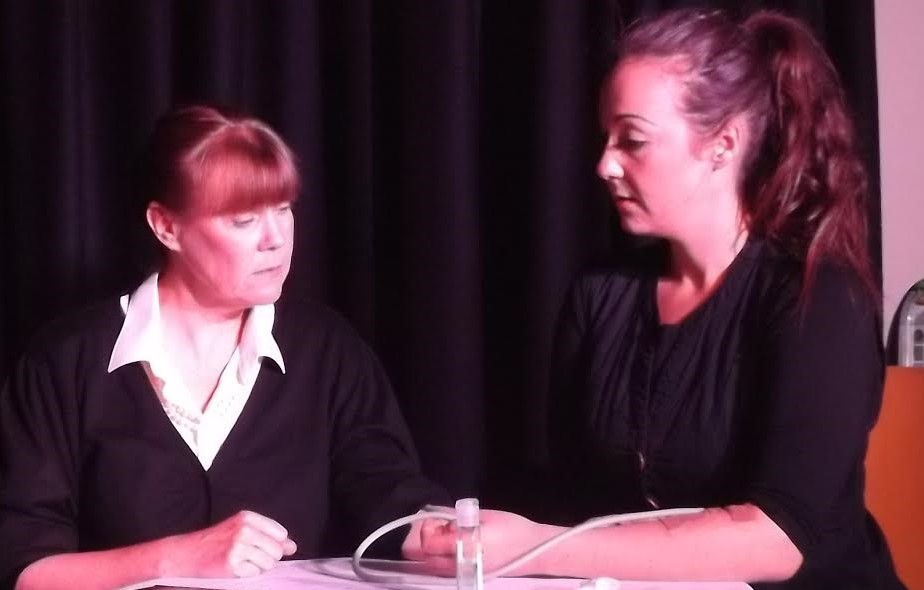
It's 2043 and life is shit. Britain has finally gone full dystopia, just as we somehow always knew it would. Building upon the stratified society of the 2010s, this future is sharply divided between the haves and have nots. In the haves camp is Bea (Cathryn Sherman), a septuagenarian living the a gilded life in a luxury flat. Representing the have-nots is Abi (Rebecca Pryle), a poverty-stricken yet fiercely intelligent young woman trying to scrape together the money to get into university and study medicine.
The best and most lucrative way for her to achieve this lies in her veins. Young, healthy blood is a valued commodity for the elderly rich, staving off senility and wrinkles. And so, cannula firmly wedged into her arm, Abi pays periodic visits to the "vampire" Bea, siphoning blood into her creaky veins.
Writer Emma Gibson's future a chillingly plausible one. Recent experiments conducted on mice, suggest that old mice that receive infusions of young blood experience a burst of brain cell growth. Also, as birth rates decline and life expectancy increases, the average age in Britain will begin to skew upwards, meaning the young will increasingly have to work in service of a creaky elderly population. We already live in a baby boomer housing market, where fixation on property value keeps prices unaffordably high for young buyers.
More broadly, Gibson's future is a logical extension of the free market capitalism so enthusiastically espoused by modern Conservatives. She shows us a world where everything has become a commodity, from the blood in your veins to your sexual organs to the organs in your body (valued by shifty body parts dealer Caleb (Sam Wilkinson)). Layered on top of this is a world of classist privilege, where the working class are forced into menial jobs to serve the bourgeoisie and gently steered away from education and jobs.

As a political statement Bloodletting is blunt. It's allegorical future all but beats you about the head with references (among others) to the modern state of the NHS, sincere criticism of the Conservative government and tuition fees. Characters occasionally break into didactic speeches that so nakedly convey the writer's politics they may as well start using Powerpoint slides.
But you know what? I'm fine with that. Subtlety is all well and good, but sometimes you need to beat an audience over the head with your point. There's a thrilling unadulterated rage in this play, which has no time for pretentious allusions. This is writing a play like firing a gun, something also felt in its brevity. At a scanty 50 minutes, Bloodletting says what it wants to say without any faffing around and I respect that.
Bloodletting's political prescience is the best thing about the play. Everything else is... alright. Though the world Gibson creates is plausible, her dialogue is a bit thinly written with a couple of seriously groanworthy moments. Clumsily exposited in the first couple of scenes is the existence of a mutated HIV, all but guaranteed to kill within five years of contracting it. Given that the heroine prides herself on the purity of her blood, you can probably see where this one is going. Even so, it's difficult to suppress a cringe when she exclaims "You've infected me with HIV-M!"
The writing deficits are exacerbated by performances that settle at competent. Best is Cathryn Sherman's Bea, who mixes up a cocktail of casual superiority, class guilt and self-disgust that serves ther character well. Pryle and Sherman are a slight step down; Abi's frustrated intelligence and despair isn't communicated particularly effectively; and Sherman makes the most of an extremely broadly sketched character.
This isn't any great shakes in staging either. I don't want to criticise too much on this, as there's obviously budget constraints at play. That said, a couple of tables and chairs don't particularly evoke a nightmare future.
For all these flaws, I dug Bloodletting. That it works at all is entirely down to the righteous indignation that fuels the writing. Clearly cathartic for Gibson, the play intelligently diagnoses what's wrong with society and stands as a stark warning of the ideologies of selfishness, commodification and classism. Sure it's a little creakily constructed, but I'd rather see a creaky play with something to say than a glitzy big-budget void.
★★★
Thursday, May 28, 2015
Thursday, May 28, 2015
- 0 Comments

Or The Secret Diary of Jesus Christ, Aged 14 3/4. Tucked away in the top room of the pleasantly lefty Bread and Roses Pub, Alexander Nye's Son of Man makes an effort at tackling some weighty metaphysical questions. What is the true nature of the Christian God? How does he relate to other deities? What was Jesus up to during his difficult teenage years? What informed the philosophies and teachings of this most influential of religious leaders?
Set in 6AD, we meet a teenage Yeshua (Jesus' original name) dealing with some pretty familiar growing pains. He's falling out with his family, butting heads with authority, struggling to define his own identity and becoming quietly convinced that there's something indefinably special about him. Given the mysterious nature of his parentage, his blue eyes and light hair, most treat him as Mariam's (Claire-Monique Martin) bastard Roman child, making him a pariah unable to participate in Jewish religious ceremonies.
The background to this is the relationship between the twin towns of Nazareth and Sepphoris, separated by just three miles. Nazareth is strongly Jewish, while Sepphoris is a cosmopolitan, Roman-controlled worker's town that tolerates freedom of religion and other, more salubrious, activities. Prime among them is a brothel, staffed by the atheist prostitute Ishtar (Thalia Anagnostopoulou). Itinerant religious teacher Eli (Michael Musa Idris) is a reluctant friend of Ishtar's, spending his downtime in the brothel when he's not preaching his visions of an awe-inspiring 'Christ Angel', through whom God made the universe.
Eli, Yeshua, Mariam and Ishtar and others soon become entangled, each representing differing religious perspectives. As the characters bounce off one other, the young Yeshua begins to gain perspective on his actions, philosophies and ethical code - eventually setting himself on the path to become the badass zen-terrorist Messiah we're all familiar with. It's basically Batman Begins with less ninja training and more epistemological debate.
It's also a tale doled out with a whiff of self-satisfied blasphemy. So, the virgin Mary ends up unhappily working as a prostitute, devoted proto-Christian Eli ends up in a passionate gay tryst with his student, the prostitute Ishtar spends part of a scene rubbing her "cunt" (a word enunciated here with particular relish) on someone's head and, perhaps most heretically of all, it's heavily implied that Christ's divinity arises from epilepsy rather than God. I've got no beef with any of that, but in concert they feel like a somewhat juvenile attempt to shock.
But it doesn't succeed at shock, instead landing at camp. For example, when a character is traumatised upon learning their penis has leprosy it rather undermines the thoughtful spiritual questioning and instead brings to mind a Bible translated by John Waters. This campness is further sustained by the characters taking any opportunity to descend into histrionics. Damn near everyone goes balls out crazy at some point, replete with loud yelling, threats of violence and megalomaniacal ranting.

Still, at least that means that Son of Man isn't boring. There's nearly always something eye-brow raisingly bonkers happening on stage, and a couple of the characters and performances are genuinely interesting. The two best are Michael Musa Idris' Eli, combining a beardy masculine forthrightness with genuine intellectual curiosity. In terms of sheer physicality he deeply impresses, constantly tearing up bread and banging his thick wooden shaft against the stage. Anagnostopoulou's Ishtar, memorably described as a "philostitute", is also great fun to watch; finding a spiky, lascivious moment in almost every line and injecting much needed upbeat femininity into a tale of angry, serious men.
Entertaining as all that is, trying to work out what Son of Man is actually about turns out to be a bit of a headscratcher. There's an unfocussed quality to the writing - one moment we're exploring the Jewish right to Israel, the next homosexuality and Leviticus, the next colonisation under a foreign power, the idea of feminist prostitution and many, many more.
Most significantly, we're pummelled with all sorts of competing religious viewpoints; that the God of Israel and the Creator God are separate deities, that the various pantheons of Roman, Greek and Canaanite religions are reflections of characteristics of the one true God, the importance of the 'Christ Angel' in Messianic prophecy and so on. What I took away was that while Christianity might present itself as a straightforward truth, the realitylies in a deeply confusing knot of competing ideas and visions, only some of which found their way into the modern Church.
It's certainly an interesting piece of theatre, though not a truly successful one. Still, I can't fault the ambition in trying to recreate Biblical Nazareth above a pub in Clapham. The best praise I can give is that it successfully held my attention, primarily through curiosity at which weird philosophical direction it would spin off in next.
★★★
Son of Man is at the Bread and Roses Theatre from 26th May to 13th June at 7.30pm. Tickets here.
Subscribe to:
Posts (Atom)