Recent Articles
Showing posts with label Disney. Show all posts
Showing posts with label Disney. Show all posts
Thursday, November 17, 2016
Thursday, November 17, 2016
- 0 Comments

Princess is completely baffling. It bills itself as "finding the feminism in Disney", yet feels more like being trapped in a shitty goth nightclub. Rather than some exploration of gender politics, this is primarily a bunch of attractive dancers in bad wigs hurling themselves around the stage to dated plastic pop music.
Tautly muscled men in papier mache rabbit heads strike poses, women dressed like cheerleaders in a Marilyn Manson video shake their asses, a troupe of people with hexagonal heads march across the stage. At one point someone perches in a giant wobbly teacup. With furrowed brow and thoroughly scratched head, a couple of words reverberated around the inside of my skull: what the fuck is this?!
It's never a good sign when you have to retreat to the programme to understand what you're looking at, but sometimes you don't really have a choice. So, twenty minutes I gave in and popped it open, to be told that a summary of what I was watching right now was "to be a true princess one must submit to all the wishes and woes, the young girl fails to be initiated. Striving to become the perfect princess she must shake of [sic] her demons". I glanced back up at the stage to see a topless dude barrelling around the stage flapping big glittery wings. Hmmm.
This general bewilderment never lifted. Without the programme's (somewhat garbled) assistance I doubt I'd ever have worked out even the broad strokes out of the plot - which is apparently about a young girl's self empowerment through.. uh.. princesses? I guess? Smothered deep within the impenetrable choreography, boring pop music and revealing costumes there's apparently some kind of deconstruction of the princess archetype, but it's so faint you want to call up the Large Hadron Collider dudes and ask them to work on unearthing it.
This vagueness, coupled with the fact that much of the show features sexy girls in revealing costumes wiggling their butts, makes Princess's claims of "finding feminism in Disney" risible. Giving it as much credit as possible, the conclusion that animated princesses are questionable role models for young girls begs to be met with a deadpan "well duh."


By the midway point most people will have concluded that if it doesn't make sense by now, it's probably not ever going to. So you just check out and enjoy the skimpily clad dancers cavorting around in front of you. On this base level of appreciation Princess scrapes by - I'm not going to sit here and deny I don't enjoy watching attractive people writhing around in silly costumes. But even the dancing looks a little under rehearsed. I'm usually pretty easy to please on this front, but even I notice that the performers are off the beat, out of sync with each other and/or missing their cues.
Let's face it, it's never a good omen when one person simultaneously writes, directs, choreographs, sings the songs and produces a show. There are a handful of multitasking polymath geniuses out there, but all too often it's a sign that you're in for a vanity project. When you've had as much experience with crappy theatre as I have, you can read between the lines and realise that it's less that the show could only ever work with one person doing all these jobs and more that everyone else realised early on that they'd be onto a loser.
By all accounts the guy responsible for this, Stuart Saint, is a talented dude. He's done five straight years of well received panto in the Leicester Square Theatre, and you can tell Princess is something of a passion project for him. In interview he explains that Princess has been worked on since 1996(!!!), and this extended creative gestation has done the show no favours whatsoever. Sometimes you've got to face up to the fact that, even with 20 years of work behind you, it's sometimes best to 'kill your darlings'.
Saint would have done well to heed the words of a latter-day Disney Princess and let it go, because this lumpen heap of 'I don't know what the fuck' is pleasing nobody.
Friday, December 18, 2015
Friday, December 18, 2015
- 0 Comments

And it starts so promisingly...
That booming John Williams opening note, the iconic logo and an opening crawl that convincingly promises high adventure. Then it's off: colossal spaceships eclipse a planet, on whose surface we find Max von Sydow and Oscar Isaac under assault from the forces of a retooled Empire. It's immediately recognisable as that good ol' grubby-as-hell Star Wars universe. And it's like we've never left.
The duff prequels are already forgotten a couple of minutes in, and it feels like J.J. Abrams has achieved the impossible: a successful relaunched of Star Wars, With the nervous anticipation with which you watch a high-wire act without a safety net, we're introduced to a new generation of Star Wars heroes and villains and, even more tantalisingly, reunited with our old friends Han, Leia, Chewie and the rest. We explore exciting new worlds populated by reassuringly rubbery aliens. We learn of galaxy spanning threats, mystical mysteries and are teased by prophetic hints.
It's all good. Then, sometime around the middle of the film, it curdles. What initially felt like understanding gradually shifts towards shameless aping. By the time The Force Awakens rolls credits it's proved Aesop right: "familiarity breeds contempt".
It's not as if The Force Awakens is a bad movie. I'm no die hard fan of the series, but even I feel a giddy thrill at watching the Millennium Falcon dive and wheel through the shattered corpse of a Star Destroyer. The simple synthesised hum of a lightsaber presses my buttons, as does the screaming blare of a passing TIE fighter, or the friendly beep-boop-beep of droids old and new.
I can't deny the emotional tug of Han Solo's return, especially as (miraculously) Harrison Ford gives a shit. Neither can I fail to enjoy newcomers like Oscar Isaac's dashingly square-jawed Poe Dameron or John Boyega's Finn, each of whom smoothly and personably slide into the series canon alongside the more familiar names
I'm also impressed by Abram's subtle metanarrative. New protagonist Rey opens the film inhabiting the broken remains of the franchise, subsisting by selling off tiny fragments of the previous films to unscrupulous buyers. She's surviving on our childhood dreams, both her fictional existence and The Force Awaken's success dependent on how effectively they can mine the past.
Similarly fun is the eventual appearance of amusingly named master villain 'Supreme Leader Snoke' (Andy Serkis). Abrams is too classy to take overt jabs at Lucas, but having the villains in thrall to a gigantic CGI projection is a well pitched wink, contrasting Lucas' 'evil' digital poison with Abram's heroic latex n' rubber puppets and makeup.
But, despite all that loveliness, The Force Awakens underwhelms. Firstly, it becomes apparent at the halfway mark that The Force Awakens is a loose remake of A New Hope. We start in the desert with a lost droid that's found by a wistful teenager. She proceeds to be sucked into an intergalactic war where she learns the power of the force and helps destroy a planet-sized doomsday device. Along the way we visit a space bar inhabited by all varieties of bug-eyed alien, escape an Imperial base and witness a planet being destroyed.
A slavish repetition of the series' greatest hits is a bit unambitious: what initially appeared to be a bold continuation of styles and themes becomes wheel-spinning. Worst of all, it fails to live up to A New Hope. Among many other deficits, Rey's transformation from naive peasant to brave warrior isn't a patch on Luke Skywalker's hero's journey, the make-up of this post-Return of the Jedi universe is never explained and a planet destroying superweapon that eclipses the Death Star is introduced and destroyed with a narrative shrug.

Secondly, the film falls prey to Marvel-esque franchise-itus. The Force Awakens is designed to usher in a profitable new era for the franchise with, god help us, one new instalment each year. As such, the film is crammed with narrative strands that I assume will be addressed years from now in Rian Johnson and Colin Trevorrow's sequels.
Granted you expect all that, but still, it lessens the emotional heft of the climax. For example, powering much of the plot is that Adam Driver's Kylo Ren is extremely upset at Han, Luke and Leia. This anger has driven the Ren to the dark side, resulted in the disappearance of Luke Skywalker and provides the bedrock for key events in this film's climax.
Problem is - we've got no idea what he's so goddamn miffed about! This deflates tension from what should be heart-pounding scenes. I assume we'll eventually find out sometime in 2019 or so why he's angry, at which point these scenes might have an ounce of pathos. Until then, the back-end of the film just doesn't work.
It doesn't take much thought to understand why The Force Awakens is riddled with these deficiencies. Disney paid $4 billion for Star Wars with the intention of launching a cinematic universe with no apparent end. The inaugural film thus functions primarily as a prologue, establishing tone, cinematic style, introducing characters and, most importantly for Disney, encouraging the audience to return for whatever they dish up next.
To Abrams credit it does all that. Unfortunately it means The Force Awakens isn't much of a film in its own right - if you were feeling particularly uncharitable you could dub it a feature-length teaser for the myriad pleasures Disney are yet to release. What's left is an nakedly commercial product uplifting by a smattering of artistry and a heavy nostalgia kick.
A mild, yet painful, disappointment.
★★★
Monday, July 13, 2015
Monday, July 13, 2015
- 0 Comments

In Still Ill Morrissey sang, "Does the body rule the mind or does the mind rule the body?". Inside Out asks the same question, an animated summer blockbuster entirely about a 12 year old girl's fears. The twist is that we experience them from inside her head, as the personifications of her emotions bicker amongst each other for control.
They are Joy (Amy Poehler), Sadness (Phyllis Smith), Fear (Bill Hader), Anger (Lewis Black) and Disgust (Mindy Kaling); miniature primary coloured cartoon figures that embody each emotion. Their HQ is in the centre of the brain, and they jockey for position in an effort to influence the girl's behaviour. The actions they nudge her towards result in new memories, which appear as glowing bowling ball sized spheres, which roll down ramps and end up lodged deep within the mind. This inner world is precisely what Pixar's famed for; a fantastical scenario that's instantly comprehensible.
The narrative it's in service of is almost brutal in its straightforwardness. Riley (Kaitlyn Dias) is a happy young girl who enjoys ice hockey, acting silly and hanging out with her friends. But change comes a-knockin', her family upping sticks from snowy Minnesota to San Francisco. Lonely and isolated in her new environment Riley gradually becomes homesick and miserable. Within her mind this is shown as 'Joy' being accidentally jettisoned from the mind, with Sadness in tow. Disgust, Fear and Anger are left to take the controls, while Joy and Sadness battle their way back to primacy and come to terms with each other's existence.
Adaptation to changes in personal circumstances run right through Pixar's oeuvre, from Andy moving house in Toy Story to Ratatouille's Remy navigating life alone in the big city to Carl's disquiet at the skyscrapers sprouting up around his suburban home in Up. Though the particulars of each story are surreal (talking toys/rats, flying houses etc) the emotions are instantly relatable.
Inside Out takes these underlying themes to their logical conclusion. This makes for an intensely focussed children's film; one without an antagonist, pop culture references and even the traditional comedy sidekick (well, sorta). The eventual thrust of all this is a fable that encourages its audience to be in touch with sadness and understand that it's perfectly natural to feel blue once in a while.

This is a pleasantly emotionally mature message, Inside Out's conceit giving us a scaffold upon which we can imagine their own emotions competing for control. It's also a view of human nature where the individual is entirely a product of their environment and memories. This determinism stands at odds with the typically Manichean Disney fare of pure-hearted hero/ines and irredeemably evil villains. Inside Out isn't exactly radical cinema, but still, this mechanical psychology separates it from the subliminal Judeo-Christian value systems that lie at the heart of most children's (and lets face it, most adult's) mainstream cinema fare.
It's a credit to the writers and directors that Inside Out is such an intellectually satisfying film. If it were to that standard in every way it'd be up there with Pixar's best; but in places, sadly, it comes slightly unstuck. In a rare mis-step, the character design is a smidge unimaginative, with the 'heroine' emotion, Joy looking rather like a young Marge Simpson and the rest of the emotions broadly descriptive designs that lack that special Pixar pop.
This feeds into an ever-so-slightly safe aesthetic. It's as though the high narrative concept requires the environment design to be predictable in order to let us comprehend it. I can understand that, but I'd rather have seen the Pixar animators/designers let off the leash in creating a world purely of the imagination.
Admittedly there is the odd visual flourish, specifically a battle through the land of abstract thought that twists and flattens the characters, or a sequence where a 'dream movie studio' is hijacked to create bizarre imagery to wake Riley up. Unfortunately these are the exception rather than the rule; the later action sequences serviceable yet uninspired.
Nitpicking aside, Inside Out is an excellent piece of cinema. After the triple blows of the awful Cars 2, the disappointing Brave and the mediocre Monsters University I feared that Pixar had lost their golden touch - by my money their last inarguably excellent film was Toy Story 3, five long years ago. Inside Out restores the studio's lustre, underlining their status as a powerhouse of imaginative, emotionally satisfying cinema.
★★★★
Inside Out is on general release from 24 July 2015
Monday, January 19, 2015
Monday, January 19, 2015
- 0 Comments

Peeling back the mirror-polished carbon-fibre shell of Big Hero 6 reveals a bustling throng of fascinating influences. At its most basic level Disney's latest is a superhero origin tale via Japanese pop culture: mashing together sentai shows, classic manga and Marvel comics into a surprisingly coherent whole.
In a Neal Stephenson-esque touch, our hero is named Hiro Hamada (Ryan Potter). He's a young, spikey haired robotics prodigy. We first meet him defeating all-comers in an underground robot fight club, his harmless and cute looking contender proving to be more capable than it first appears. Though he triumphs over his opponents, his brother Tadashi (Daniel Henney) warns that this is a waste of his talents and drags him to his "nerd school". This proves to be a prestigious high-tech university, where students are given access to the latest materials and development technology.
After introducing Hiro to classmates Honey Lemon, Go Go, Wasabi and Fred, Tadashi shows off his own laboratory. Here we meet his masterpiece: Baymax (Scott Adsit), a nurse robot that Tadashi envisages helping people worldwide. With his soft white spheroid proportions and minimalist features Baymax looks the Michelin Man as redesigned by Apple. He's programmed to scan and offer medical assistance to anyone suffering even a minor scrape, only deactivating when told "I am satisfied with my care".
But this is a superhero movie and tragedy is always just around the corner. And so, as Act 2 opens, a bereaved and numbed Hiro has taken possession of Baymax and is gradually molding him towards becoming an all-purpose crimefighter in order to get revenge on those that've wronged him. He's soon joined in his quest by the other university students, each with their own technological superhero suit, as they attempt to track down a mysterious masked villain.

This is by the numbers, but there's enough little wrinkles present to set Big Hero 6 apart from the crowd. The biggest is Baymax, who's as funny a character as Disney have created in the last 20 years or so. With his rounded body and dainty motions his every tiny motion packs a gag, especially when trying to reconcile his nurse programming with the kickass robot superhero Hiro desperately wants him to be. By the time Hiro has outfitted him with a jetpack and is flying about on his shoulders there's more than a touch of How To Train Your Dragon to the pair, but whereas Hiccup is trying to make his dragon less fearsome, Hiro is trying to subvert his instinctively caring nature and turn him into a badass.
The film is easily at its best when the action is confined to Baymax and Hiro, the directors giving a masterclass in comedy physicality as Hiro squeezes and shoves the rubbery robot through action sequences, playing straight man to the robot's concerned inquiries about his physical and mental health. Occasionally it feels as if the film was developed entirely from the idea of 'A Boy and his Bot', there's so much focus on them that the other characters end up a bit undeveloped.
While eye-catching; fellow Big Hero 6ers Wasabi, Fred, Honey Lemon and Go Go are relegated to being 'the fast one', 'the girly one' and so on. The villain of the piece has a visually dazzling superpower yet suffers the same problems, his motivations understandable but drawn in simplistic strokes. He does have a empathetic dimension but this pales in comparison to, say, Tangled's Mother Gothel or pretty much any Pixar baddie. Even with a paltry ten or so characters there's only really room to develop Hiro and Baymax, the rest a victim of a short run-time and (I suspect) some trimming of a longer script.
The flip side of that is that the film rockets along at some speed, serving up exciting action sequences and comedy skits at breakneck pace. These car chases, superhero fights and slapstick (or all three at once) are beautifully conceived and executed, crammed full of tiny details and gags so quick you'll blink and miss them.

Though it might be a touch on the short side, Big Hero 6 certainly is dense. My personal highlight was San Fransokyo. The only clumsy thing about this wonderful mashup is the name; otherwise it's an intelligent cocktail of pagodas, townhouses, trolley-buses, blimp/turbines and futuristic architecture. This neon denseness reminded me a hell of a lot of Studio 4°C's excellent Tekkonkinkreet (with a more than a smidge of Osamu Tezuka), a tech utopia populated by oversized advertising statues, dayglo flourishes and an abundance of careful details that really reward the close observer. A lot of people have spent a lot of time realising San Fransokyo and their efforts were well spent, this is one of the most attractive fictional locales I've seen in some time.
Big Hero 6 isn't going to go down in history as an all-time Disney masterpiece and it's certainly not going to achieve the same level of cultural penetration as last year's Frozen. That said, it's an energetic, imaginative and precision-crafted animation with a tonne of love poured into it (and in Baymax at least one truly memorable character). But though pretty and entertaining it falls short of the classic it could feasibly be.
★★★
Big Hero 6 is released 30th January 2015
Thursday, October 16, 2014
Thursday, October 16, 2014
- 0 Comments

Apparently based on some book Alexander... is a typical Disney live action quasi-comedy starring a cute kid and his crazy family. They are; Dad Ben (Steve Carell), Mum Kelly (Jennifer Garner, older brother Anthony (Dylan Minnette), older sister Emily (Kerris Dorsey) little brother Alexander (Ed Oxenbould) and baby Trevor (Elise and Zoey Vargas). The plot, such as it is, involves lead moppet Alexander having a bad day. No-one gives a shit when he moans, so, consumed with hatred, he wishes that everyone would have a day as bad as he has.
Apparently some dark deity was listening, as over the course of the next day everyone else in the family encounters disaster. The father's job interview goes terribly, the mother makes a typo in a children's book etc etc. This adds up to a series of set pieces where people fall over, are sick on things or wear silly outfits.
Look, I get it okay? This is cinema as temporary babysitter, something to hold a child's for 85 minutes while their parents have a quiet doze. Is it good? Well, by the metric of whether I enjoyed any of it it, no it is not good. How about by the metric of what it's setting out to do? Maybe there's something vaguely defensible here.
Over the last five or six years Disney have developed an idiosyncratic live action aesthetic. They shoot in glistening grain-free hyper-HD and digitally crank the colour saturation through the roof. The grass glows neon green, the sky an iridescent Sega blue, skin of the heroes a moist, shiny pink. Disney's Stepfordian candyland reality is so sweet it makes your teeth painfully tingle - credit where credit's due this effect isn't easy to create. But the cumulative effect, even over this svelte runtime, is enough to make me nauseous.

This, combined with the crap family friendly humour, adds up to a movie that makes me want to blow my fucking brains out. The general tone reminds me of a sitcom that's overstayed its welcome, where all the characters have succumbed to a comprehensive process of Flanderisation. If the idea of a baby accidentally sucking on a permanent marker amuses you, if the sight of a teenage boy in a pastel blue 70s suit makes you snort happily or if Steve Carell boxing a CGI kangaroo is your kinda thing then by all means check this out. (Incidentally at the screening I attended the film played to stony, seething silence).
It's almost annoying that I hate this movie so much as, objectively, it's more painfully average than a genuinely disastrous. Sure Steve Carell appears to be on doped up autopilot, but at least Jennifer Garner looks happy for the work. The kids aren't the complete pits either and at least Dylan Minnette as the older brother has a sense of comic timing. In a way I almost wish Alexander... were completely, obviously awful, at least then it might be vaguely interesting to pick apart.
But it's not. It's just gloopy garbage cinema. Worse, it's just mindnumbingly boring, less a film and more a way to flush time down the toilet. Being boring isn't even so terrible (I sat through and sort of enjoyed Jeanne Dielman for god's sake), but this is a bad, bad kind of boring, so much so that even being angry at it is boring. Truly, this is my cinematic kryptonite.
So I'm going to close up by pointing out that sure, you could shut your kids up for an hour and a half by taking them to this. But bear in mind the expense: with tickets, popcorn, drinks etc under your belt, taking two children to see this could feasibly set you back a cool £70. On the other hand sedatives are readily available (and cheap!), especially when you calculate the reduced dose needed to render a child's tiny body unconscious. You do the maths.
But don't see this. It is a bad film.
★
'Alexander and the Terrible, Horrible, No Good, Very Bad Day' is probably being released at some point in the near future.
Friday, August 22, 2014
Friday, August 22, 2014
- 0 Comments

Baseball and cinema make a weirdly compelling combination. I've never seen a truly astonishing American football or ice hockey film, and the only classic basketball film is a documentary (maybe there's an argument for Space Jam). But there's something different about baseball, some mystic weight that's all to easy to find in the sport. The Kevin Costner baseball duo Field of Dreams and Bull Durham are essentially baseball as a path to Zen enlightenment, and Robert Redford's The Natural weaves the sport into the fabric of Americana. I even have a soft spot for A League of Their Own.
Can Disney's Million Dollar Arm scale these lofty heights? Well, no. Not really. In fact, for a film about baseball, there's actually very little baseball in the film - the sport itself more of a background noise. Instead what we get is a movie where a busy, single urban professional in his 40s learns the importance of family and responsibility. I strongly suspect that, deep in the cellars of the Magic Kingdom, there's a machine churning out doggerel like this by the yard.
Our stressed, deal-hungry professional (with a Blackberry bolted onto the side of this head) is JB (Jon Hamm), struggling sports agent. He used to be a big shot, but after making the decision to go it alone his business is struggling - unable to attract any big stars to his management service. The spark of creativity still flickers within him and he's sure he can find some hot young, unexploited talent. But where?
In a bizarre sequence we see a depressed JB late-night channel-surfing, beer in hand. He flicks onto a cricket game. In boredom he flips the channel. It's Susan Boyle singing I Dreamed a Dream on Britain's Got Talent. JB grimaces. Back to the cricket. Grimace. Flip back to Boyle. Ant n Dec grin madly at the camera. Grimace. Cricket. Flip. Boyle. Flip. Dec. Grimace. Flip. Cricket. Boyle. Ant. Cricket. SUSAN BOYLE! ANT! DEC! CRICKET!
EUREKA! (he jumps to his feet)
"I'm going to set up a pan-Indian televised talent show to discover new pitching talent and pay a million dollars to the original! And I'll call it... Million Dollar Arm".
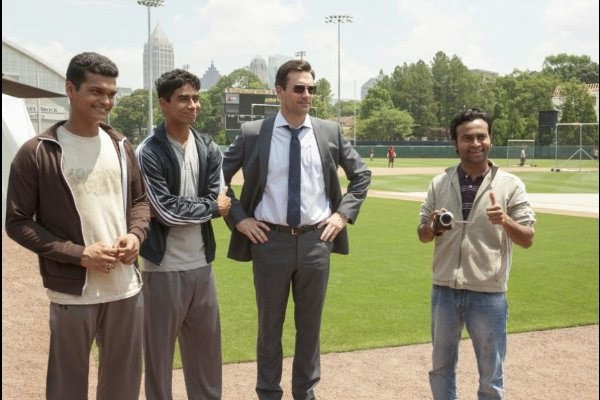
Before we know it he's on a plane to a India to ferret out hopeful kids who can throw a baseball real fast. He winds up with Dinesh (Madhur Mittal) and Rinku (Suraj Sharma), two kids from poverty (though a sanitised Disney kinda poverty) and flies them back to the US. Hijinks ensue. They don't know what pizza is. They don't understand how a lift works. You get the picture. Worse, though this is their rags to riches story, the focus of the movie is almost entirely on a rich, white American and the hardships he must suffer.
Everyone ends up living in Jon Hamm's house where he gradually assumes a paternal role for these kids, all the while gradually growing closer to sexy medical student tenant Brenda (Lake Bell). Blah blah some stuff goes down, there's a bit of mild misery and doubt, and then a big triumphant moment where they throw a ball real fast, Jon Hamm smooches Lake Bell and we go home happy.
Problem is that this sports story bullshit is so damn hokey and the film is so utterly drained of anything interesting that it's difficult to care. This is a movie obviously produced to a strict template; from the plot to the casting right down to the visual style and score. What's left is processed cinematic junk food - competently produced junk food - but lacking anything interesting.

Watching Jon Hamm working his way through a film that requires him to sit behind desks, make pitches to clients and wear smart suits unavoidably brings Mad Men's Don Draper to mind. Consequently, this feels like the shittiest Mad Men episode ever. The vague similarities in tone mean you get frustratingly anaesthetised flashes of what Hamm is best at; presenting a calm, collected surface persona while he's going crazy inside. But with a script this bland Hamm quickly defaults to autopilot - I hope he at least got a nice holiday in India out of it.
Visually Gillespie sticks like glue to the live action Disney visual style; all subtly over-saturated colours, conventional cinematography and grain-free superslick digitalism. To be fair the India scenes are a huge step above everything else in the film, but it's the Taj Mahal rather than Gillespie that's doing the real leg-work here. That said the wide-shots of the Indian countryside and cityscapes crammed with life are at minimum competently executed. Everything else is cinema by numbers: a sludgy, semi-invisible rhythm of vaguely pretty LA locations populated by pretty people.
The word I've been avoiding all review is boring. But hell, tiptoeing around it isn't going to help matters. Million Dollar Arm is a boring, overlong slog of a movie; you don't care about the stakes, everybody has a simple A-B character progression and it's all couched in Disney's trademark mildly pleasant quasi-humour. It's difficult to see who this is going to appeal to; it's too slow-paced for children (they were ignoring the film and playing in the aisles), and way too simplistic for an adult audience.
This is the kind of movie that you end up watching on a long haul flight when you've exhausted every other option. Not awful. Just super bland.
★★
Million Dollar Arm is released August 29th
Monday, December 2, 2013
Monday, December 2, 2013
- 0 Comments

When Disney bought Marvel Comics in 2009 many feared the worst. Would Spider-Man become tinged by Disney's everything's-just-peachy attitude? Would The Punisher wind up with a smartass talking bird sidekick? Not quite. The opposite has happened: a Disney Princess musical complete with loveable singing sidekicks and floppy fringed Prince Charmings has wound up infected with Marvel superhero DNA. Frozen is essentially fairytale princess romance by way of X-Men: a weird cocktail of classic Disney animation, Marvel superhero sensibilities and a contemporary fascination with genre subversion. With so much packed in it's a miracle that Frozen works at all, let alone that it's actually really good.
Frozen takes inspiration from Hans Christian Anderson's The Snow Queen - though the stories share little in common beyond a broadly similar plot and characters. The centre of Disney's film is the relationship between two sisters; Elsa and Anna. They're young princesses of a vaguely fantasy tinged Scandinavian country named Arendelle, and Elsa is next in line to the throne. Not only that, but she possesses magical powers, able to conjure ice and snow at will. One day while playing. she accidentally seriously injures her younger sister, resulting in her parents placing her seclusion in the castle until she learns to repress her powers.
 |
| Damn good looking CG snow. |
We skip forward in time the two sisters' teenage years. Anna has no memory of her elder sister's powers, assuming that her distance and seclusion is a result of some personal slight she committed. Eventually the time comes for Princess Elsa's coronation. Placed before the nobility of the kingdom she desperately tries to control her powers, almost freezing the rod and sceptre she's asked to hold. Later, at a ball she finally loses it, lashing out in a dramatic icy rage, leaving the castle and heading off for a life of seclusion in the mountains. Unfortunately a side effect of her icy rage is that the kingdom is frozen solid, and so Anna must venture into the freezing peaks to try and thaw both the land and their relationship.
Princesses in peril is Disney's bread and butter. If they couldn't knock this sort of material out of the park there'd be something dreadfully wrong in the House of Mouse. Throughout the film there's a constant feeling that you're in a very safe pair of hands, a confidence borne of 80ish years of making animated musicals. But what elevates Frozen above merely being an alright Disney film is that its fully aware of the audience's trust in Disney, mercilessly exploiting our expectations from start to finish.
Don't assume by that I mean it's an Shrek or Enchanted style piss-take of genre cliches. For example, Frozen plays it straight when it introduces developments like the magical properties of "true love's kiss". It's more that the film assumes that the audience is familiar with past Disney animations, allows us to draw conclusions about what's going to happen and then slyly subverts them. There's an understated intelligence to the way things play out: the script unpredictable and written with classical fairytale sensibilities.
Emotionally the film's onto a winner from moment one. The dilemma over Princess Elsa's ice powers is taken wholesale from the classic Marvel playbook; her relationship with them a symbol for repressed desires and guilt - a parallel to adolescence. The furore over whether she's a monster or not is straight out of X-Men, and while she's undergoing her dilemma she ends up dressing a bit like Magneto - leading me to wonder if she was going to go full-on supervillain for a bit.
 |
| Elsa in her rather Dr Manhattan-y ice palace. |
If Elsa has been created with an eye towards Marvel, Anna has a more Disney outlook. With her mop of ginger hair and charismatic chattiness she's instantly charming, ably voiced by Kristen Bell, her every expressive motion expertly animated to accentuate her personality. As the one that sets out on a quest to save her sister she becomes our de facto protagonist, teaming up with a quintessentially Disney group including a hunky ice-cutter, his cute reindeer sidekick and a smart-talking enchanted snowman.

Let's talk about this enchanted snowman for a moment. His name is Olaf and his gormless buck-toothed grin leers out of every piece of marketing material. Not helping matters is his disturbing resemblance to the demonic Gabbo from the classic Simpsons episode Krusty Gets Kancelled. I realised not far into Frozen that it was going to be pretty great, yet at the back of my mind I was dreading the arrival of this hateful looking creature, who I just knew would throw a dampener on the whole thing. Astonishingly Olaf is not just tolerable - he's actually really funny. If this film can make that thing funny, ice-powers are far from the only magic on display.
The only real slack element are the songs. There was a lot of hype about these as they're written by the lethally clever song-writers behind Avenue Q and The Book of Mormon. It's not that they're particularly awful, just that they're so damn boringly produced that they contrast unfavourably with the obvious imagination everywhere else in the film. That said, they're not completely awful, just mediocre - though a particularly dire ditty called Fixer Upper comes painfully close.

Right up the end Frozen continues to impress, concluding with a touching ending that affirms the special bond between sisters. It's perhaps a fool's errand to argue that a film about pretty magical princesses has a feminist outlook, but at the very least the film's heart is in the right place when it comes to gender politics. The two sisters in the film are allowed full autonomy within the plot, rescuing each other rather than kowtowing to the attentions of the buffly handsome men.
With Frozen Disney proves that despite stiff competition from Pixar, Dreamworks and myriad others, there's still some intangible magic that only they're able to reliably summon.
★★★★
Frozen is on general release from December 6
Monday, October 21, 2013
Monday, October 21, 2013
- 0 Comments

As Mary Poppins famously sang: "A spoonful of sugar helps the medicine go down". So it's appropriate that Saving Mr Banks is a sickly sweet sugary film, but it's not a spoonful that slides down, more great granulated gobs of the stuff pumped down our throats like force-fed foie-gras geese. I'm no enemy of sweetness, light and optimism but there are limits dammit. Especially when in this case, the glittering 'goodness' of the story is a whitewash for a rather depressing and sordid bit of creative prostitution.
Saving Mr Banks is ostensibly the story of how Disney's Mary Poppins made it to the screen. It takes the form of fuzzy biopic of Mary Poppins author P.L. Travers as she grapples with Disney creatives and struggles to retain control of her intellectual property. This isn't so much about the process of shooting Mary Poppins, but rather a dramatisation of script editing meetings and creative conferences. What it boils down to is the adversarial relationship between P.L. Travers (Emma Thompson), an uptight, emotionally repressed, archly stern English lady and Walt Disney (Tom Hanks), a cool, laid-back genius, friend to everyone he meets.
Disney wants the rights to Mary Poppins, we learn at the beginning of the film that Disney has been trying for 20 years to secure them, but Travers, who's fiercely protective of her creation, has repeatedly told them where to stick their cheque. This year things have changed, Travers is close to bankruptcy and faced with losing her beloved house. Feeling the pressure, she reluctantly agrees to meetings with Disney about a film adaptation. Travelling to L.A. she is horrified to discover that they plan to turn her book into an all-singing, all-dancing musical with animated penguins and Dick van Dyke as cheery cockney chimney sweep Bert. The rest of the film shows her being slowly won over by the Disney corporation until the glittering premiere where, obviously, Mary Poppins is a rousing success.

Interweaved are flashbacks to Travers' childhood in rural Australia, where we examine her relationship with her father, Travers Gof (Colin Farrell). These show us why Travers is so aloof and reserved, exploring the dark secrets that lie in her past and the real-life origins of Mary Poppins.
The critical problem with Saving Mr Banks is that its morally inverted, pushing us to identify with the powerful as they crush the weak - like rooting for Goliath over David. The film wants us to cheer on the Disney Corporation, their mission in the film an altruistic spreading of peace and love for all children by the seizure of intellectual properties from authors. Perhaps if this film wasn't made by Disney this would be a bit easier to swallow, but a film by Walt Disney productions that spends an inordinate amount of time fellating the frozen corpse of their founder leaves a bad taste in the mouth.
Adding insult to injury is the constant portrayal of Travers as behaving unreasonably in seeking total control of her intellectual property (something that seems a bit hypocritical given how viciously Disney protects its IP). Saving Mr Banks acts as though a story being adapted into a Disney film should be the ultimate ambition of any children's author, so Travers' fiercely independent creative vision becomes an obstacle to be demolished rather than something to be celebrated.

A personal annoyance in film criticism is people moaning that a film based on real events bends the truth to make a better story. Usually I couldn't give a toss, but Saving Mr Banks is an especially egregious example, transforming Travers, in real life an adventurous, mystical, openly bisexual badass into a stuffy old British stick in the mud. Sure she's grumpy and miserable, but considering she's having to betray her principles and selling off her IP I think that's perfectly understandable. The film even goes so far as to portray her as anti-feminist, something that really rankles when you know that Travers was vocally furious that the Disney film showed the suffragette Mrs Banks giving up her women's rights campaigning to become a happy housewife.
The hurdle that the film has to clear is that the real-life Travers absolutely detested the Disney adaptation of her work, going so far as stipulate in her last will and testament that no Americans (and the Sherman brothers specifically) were to be involved in any future Mary Poppins productions. Saving Mr Banks gets around this not inconsiderable problem by engaging in some pretty seedy historical revisionism. For example, it's true that Travers left the premiere of Mary Poppins in tears, in the film these are tears of cathartic joy, in reality they were tears of horror and shame at seeing her beloved work whored through Disney's very safe, very cosy and very fluffy lens.
I repeat that I don't usually care about movies warping reality if it's in service of drama. But Saving Mr Banks doesn't do it in service of drama, rather to create a hagiography of the Disney corporation, and Walt Disney in particular. Tom Hanks' Walt Disney is a non-character, doling out saccharine nuggets of wisdom to his goody two-shoes, vaguely cultish work-force. This is the idealised image of "Uncle Walt" that the Disney Corporation wants to promote, a saintlike genius loved by all, existing in a beatific state of flawlessness. Within this straitjacket Hanks barely has room to breathe, settling for a vague paternalism and homely monologues delivered in an accent that makes him sound peculiarly like Agent Smith from The Matrix.

The 1960s sequences of the film are at least visually interesting: a sanitised Mad Men pastiche for kids - the early 60s devoid of booze, cigarettes and sexism with nice retro wallpaper. Thompson and Hanks are at least professionals enough to get us through this morally questionable material with little fuss, squeezing the maximum humour from the ropey script. It's the Australian sequences where the film really falls flat on its face. Colin Farrell as Travers' father never feels remotely like a real person and the film rapidly devolves into sentimental, melodramatic, syrupy bullshit.
Disney's Mary Poppins is indisputably a classic. But here that's beside the point, Saving Mr Banks is a film that lionises a huge corporation exerting its full weight upon a financially vulnerable writer, taking a woman of intelligence, integrity and viciously exploiting her talents for financial gain and now in 2013 lying about how psychologically positive the experience was for her. If Travers was apoplectic about her creations being Disneyfied one can only imagine the reaction to her actual life receiving the same treatment. Saving Mr Banks is a perfect example of the old adage that history is written by the victors.
★
Saving Mr Banks is released on November 29th
Monday, July 1, 2013
Monday, July 1, 2013
- 0 Comments

Monsters Inc was and is a fantastic film. It deftly creates a complex, surreal and comprehensible world that makes a weird amount of sense. I imagine there's tonnes of stories that can be done within this universe, yet Monsters University focuses on one of the more prosaic and (frankly) kind of dull. Was there anyone that walked out of Monsters Inc dying to know just how Mike and Sully got their qualifications? Does Pixar imagine that this is the story we're clamouring to hear? Do they picture people idly wondering either they went to technical college or university, what they majored in, perhaps even speculating on the subject of Mike Wazowski's no doubt meticulously researched dissertation. Now, finally, we learn the answers to these burning questions.
Sunday, March 24, 2013
Sunday, March 24, 2013
- 0 Comments

It's a dark and stormy night. As a young couple cuddle in bed the mud of the garden is stirring. Slowly the earth tears itself asunder and someone - someTHING claws its way out of the dirt. The man gets up for a drink of milk. As he goes to the fridge he notices the back door's open. He takes a drink of milk, pausing for a moment, some deep animal instinct telling him that not all is not well. Quick as a flash a small black flash skitters past the camera. He shrugs, figuring it must be the wind. Climbing back into bed with his wife he cuddles her as she curls up under the blanket. Then his wife walks in from the bathroom. Who... WHAT is in bed with him? A shiver runs down your spine. It's a classically constructed horror set up. But this isn't a horror film; The Odd Life of Timothy Green is a (slightly confused) small town Disney fairy tale.
Subscribe to:
Posts (Atom)