Recent Articles
Showing posts with label Gallery Petit. Show all posts
Showing posts with label Gallery Petit. Show all posts
Wednesday, June 11, 2014
Wednesday, June 11, 2014
- 0 Comments

The London summer is finally here. How long it's going to stick around nobody knows, so let's enjoy it while we can This onset of light, heat and happiness casts the city in a fresh light - makes for the perfect backdrop to the current exhibition at Sandra Higgins' Gallery Petit, Maripaz Jaramillo's Ellas. These are paintings of women rendered in simple, bright chunks of colour - women almost literally radiant, like they're lit from within.
Maripaz Jaramillo, born in Manizales, Colombia in 1948, has had a stratospheric rise through the world of Colombian art. Following formative years at the Universidad de Los Andes in Bogotá, Jaramillo spread her wings and moved first to Cali "a hot sensuous city" to London to study graphic art at the Chelsea College of Art, then in Paris, before finally returning to Bogotá. Over these years she carved out a well-deserved reputation as an eminent Colombian artist. Her recent projects include painting a portrait of President Juan Manuel Santos and his wife, and contributing a mural (in the same expressionist style as the Ellas pieces) to Medellin University.
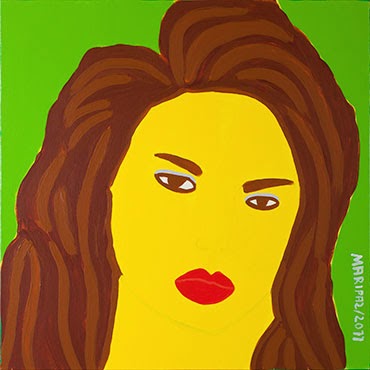
Facing these paintings is like staring into a 100 watt bulb, a luminosity that practically requires sunblock. These bright colours have some instinctive cheering effect on the brain, and, coupled with the sunlight beaming through the windows of the gallery, makes them thrum with life. I later learned the colouring of the yellow skin arises from a trip to Egypt. There Jaramillo discovered that traditionally women are to be painted with yellow skin as they're supposed to stay out of the sun (and men in browner shades).
This tradition is news to me - and as a mark of where my tastes generally lie my first thought was of The Simpsons. But this might not be so off the mark - part of the reason The Simpsons became so internationally popular was because the yellow hue of their skin allows whichever ethnic group is watching the show project their own nationalities onto them. For example, in the Middle East they read the characters as Middle-Eastern and so on throughout the world.

The universality of this tone has the same effect in Jaramillo's work; allowing us not to see these women as individuals of any particular nationality or ethnicity, but as representations of a universal feminine joy; the simplicity of their features allowing us to project our own memories and experiences of pleasure, laughter and exuberant energy onto them. This subtle connection means the paintings conjured up half-forgotten happy memories, the sight of a lover tossing their hair in a breeze on a sunny day, or the simple pride in making someone you care about laugh.
These slabs of colour, coupled with the minimalist approach to the features also reminded me of the work of Patrick Nagel. Nagel is, to put it mildly, pretty damn unfashionable in 2014; the art of a hair salon in dire need of a renovation and of dusty old Duran Duran LPs. Cheesy (and let's face it, kinda sexist) though his work is, there are certain aesthetic principles he shares with Jaramillo's Ellas. Nagel's process was to keep reducing his images down to their most basic geometric elements - to see just how much you can get across with as little elements as possible, much as we see here. But where Nagel's subjects have the definite whiff of the necrophile to them, Jaramillo injects more life - accentuating vibrancy and spontaneity rather than diminishing it.

That said, there's two works at the gallery that come from a very different, darker, place to the rest; These two, both entitled Maquina de la vida, are from 1973. They're drawings of prostitutes, rendered in harsh monochrome - the only colours used serve to accentuate the sickly fleshiness of their bodies and their lurid makeup. These demonstrate Jaramillo's progression as an artist from (in her words) "contempt for academia", "decay" and a passion for the "grotesque" into the optimism we see in her more recent work. I like these older pieces, though they tickle a very different part of my sensibilities than the rest.

Whereas the Ellas series grant divinity, the 1973 works drain it away - anchoring the prostitutes in an organic, corporeal mire. There's a dead-eyed, zombie-like quality to the women, the artist making visible the scars of sacrificing humanity so they can make it through just one more client. There's an aggressiveness to these two that's absent from the contemporary work; a forthright boldness borne of a desire to "address the fundamental problems underlying our society".

Perhaps the joyousness of the modern works contrasted with the despair of what came before indicates mission accomplished for the artist? Perhaps it's that she's now happy, free and successful and wants to communicate this happiness to us. Perhaps it's just her working from the truism that you catch more flies with honey. Whatever the reason, the progression from darkness to light is fascinating to ponder. So while the UV beams down upon us, try and get yourself to Chelsea and bask in this sensuous, radiant and optimistic exhibition.
Ellas by Maripaz Jaramillo is at Sandra Higginas Fine Art, Gallery Petit, Chelsea until 20th June 2014
details at: www.sandrahiggins.com
Thursday, December 12, 2013
Thursday, December 12, 2013
- 0 Comments

Joyful destruction as creative impulse: that's my distillation of punk. A forest fire scorches the earth clean of life leaving behind a smoking hellscape. As gnarled, rotten wood collapses into ash, green shoots spring up. The inferno was punk: the last 'big crunch'. In '77 the death knell of dreariness rang out across the land in a squeal of guitars and "fuck off grandad"s. Culture stared into the bathroom mirror and with a sly smile pulled out a razorblade and began some very necessary mutilation.
This was Year Zero: clothes, music, art, prose, film all infected by a desire to chop, tear and reprocess. To melt down the banality surrounding you and forge snarling, streamlined bullets, aimed right at the brainpan of a wageslave society mogadonning its way down dull, unfriendly streets. Punk was a neon atom bomb falling out of a drizzly grey sky - and the epicentre of the explosion was Sex, 430 King's Road. Run by Malcolm McLaren and Vivienne Westwood, the boutique catalysed the nascent punk movement: fetish and bondageware rubberly dangled from the racks, graffiti, agitprop and chickenwire decorated the walls, very angry, very raw music crackled across the room Behind the counter kids that would become idols: Vicious, Hynde and Matlock.
Richard Walker was a student at Camberwell College of Arts in the 70s, spending his days walking down the Kings Road mixing it up with this electric cocktail of fashionistas, artists and musicians. We're here to see some surviving artefacts; a series of screen prints of titanic idols, faces chopped and sliced in chaotic collage. This is Rip It Up & Start Again, a flirty teaser for a wider dissection of punk's legacy scheduled for Spring 2014. The work is nestled within Gallery Petit: Sandra Higgins wonderfully warm living room gallery on Harcourt Terrace - a hop and a skip around the corner from punk's Ground Zero on the Kings Road.
 |
| A.M. World (1977) |
The series works as a crystallisation of the punk movement: the ragged, collage style its own manifesto. Celebrity faces ripped from black and white newspapers are surrounded with blunt, scissored out blocks of colour and frantic scribbles. In A.M. World, David Bowie, in full Thin White Duke mode, leans in for a smooch. Walker severs the face from the body, showing us Bowie's cut-glass features as mask. His photograph is composed of a hailstorm of halftone newsprint - forcing us to wonder how much of this picture is real and how much we're unconsciously interpolating. I don't know about you, but the idea of David Bowie as a series of transitory masks filtered through our perceptions works for me.
 |
| Bianca's Valentine (1978) |
Many of these works feature a kind of forced baptism into punk culture. Face after famous face is dunked into deep blocks of colour, features washing away into abstraction, image trumping individuality. In Bianca's Valentine, Bianca Jagger projects a million pound smile from within a golden mane. Her disembodied hand hovers somewhere beneath her, raising a chunk of unidentifiable red matter to her lips. The effect is both carnivorous and the predatory - an 'icon' in both the modern and classical definitions of the word.
 |
| Pink Posing Patti (1975) |
I love the different ways in which the photos merge with Walker's collage. For example; Bowie is a a mask atop a formless void of a body, Jagger is a half-figure divorced from the shapes surrounding her, peering through a gap in a wall. But it's Pink Posing Patti that most intrigues, the lines of her body and features completely melting into the shapes around her, showing us a figure entirely at one with her environment. Patti Smith played midwife to the nascent punk movement - fusing an abrasive 'up yours' curl of the lip with literate, poetic lyrics and insisitent guitar lines. Importantly, Patti Smith isn't dissolving into formlessness here, she's expanding to include a huge variety of influences - a portrait of musician as receptive, open and expansive.
 |
| A Really Good Time (1977) |
A Really Good Time shows a faceoff between Bryan Ferry and Jerry Hall, the design depicting Hall's Jaggerward trajectory away from Ferry. From a 2013 perspective I could not give less of a shit about gossip column bullshit from the 70s, and neither, I suspect, did Walker when he made it. We see Ferry, a grinning idiot hiding behind a ham-like hand, and Hall painted up like a ridiculous Warhol Monroe. The two pictures look to have been literally torn apart - scraps of paper left on top of each other. It doesn't take too much squinting to see these as vicious knife slashes, an orgiastic destruction with the leftovers packed into mortars and fired back against the mainstream that birthed them.
Even after a quarter century punk retains its potency. It's cultural movement as scalpel, sharp enough to cut through insincerity and lies, bony, mean, pierced and instinctively battling bullshit. Those who dismiss it as adolescent nihilism with a penchant for mindless destruction and cheap offence are missing the (burnt) forest for the (burnt) trees - there's a molten core of DIY creativity here that can't be extinguished. What punk does (and what this exhibition indicates) is that the building materials of a new culture are stacked all around us. So pick up a stick of dynamite and plant it in the foyer of some stuffy cultural institution. When it goes off, dash in, boot down the rest of the crumbling ruins and build something better, something razorsharp, something whipsmart. I look forward to seeing the full exhibition in 2014.
‘Rip it Up and Start Again’ opens is on until 10th January at Gallery Petit, Chelsea, London
Viewing by appointment only. To schedule a visit, or for further information, contact: sandra@sandrahiggins.com.
Tuesday, November 19, 2013
Tuesday, November 19, 2013
- 0 Comments

Our lives are governed by abstract, robot Gods. Somewhere there's a chunk of silicon with an algorithm coded onto it that literally plots the course of your life. Coolly dispassionate anonymous calculators govern how much money you have, the price of commodities and the security of your job. On a macroscopic level these algorithms govern the financial status of countries and thus the world. Can you imagine an army of virtual robots making millisecond trades against other infinite robots around the world? Probably not, yet there are portals to this spectral plane floating through electromagnetic space, hubs in New York, London, Paris and Tokyo. The byzantine financial sphere is so vast and so ethereal that it attains spirituality by default, traders becoming high priests with a window to the whimsy of the all-powerful free-market.
It's precisely within this soft space between cold financial logic and spirituality where we find Marc Blane's Financial Statements. These are mixed media works that demonstrate the links, stastics and pie charts caught in the act of morphing into mandalas, dreamcatchers and prayer rugs. Using dollar bills as raw material Blane decapitates George Washington, suturing his head to wriggling, spermy tails. Now we've got a three-way collision; finance, biology and anthropology smashing headlong into each other, the product simultaneously all of the above and new.
Marc Blane was born in New York and has lived there ever since, now exploring the 'idea' of New York through the materials and symbols that make up an urban fabric. He was involved in the 1980s East Village 'Downtown scene', occupying a cultural sphere with luminaries such as Jean-Miche Basquiat, Jeff Koons and Robert Mapplethorpe. The scene sunk its foundations in fertile cultural soil, and Blane mined it extensively - his work composed of the over-looked detritus of city life: bottlecaps, crushed cans, empty bottles and lumps of street asphalt and tar.
 |
| Bottle from Abandoned Buildings |
Relics of his past performances litter the floor; green bottles containing photographs of the Bronx tenements the bottles were tossed from. These are as good an example of Blane's oeuvre as you're going to get; trash teased up into high culture and impregnated with meaning. Street-familiar chopped and screwed into unfamiliar configurations; signposts that leading you untrodden neural paths - impregnating you with new ideas.
 |
| L to R: Growth Portfolio, Open Ended Portfolio, Declining Portfolio, Value Portfolio |
The centre of this exhibition is four pieces: Growth Portfolio, Open Ended Portfolio, Declining Portfolio and Value Portfolio. The curved lines and dollar spermatozoa stand out against the ancient, dark brown of the linen background. It's the kind of aged colour you'd expect to see behind museum glass, perhaps some tattered relic of a forgotten Pharoah. Much like an archaeological dig, the work demands that the viewer do some decoding. But whereas in archaeology you might find a button from which a whole outfit can be extrapolated, this work thrusts us up against the bleeding edge of current financial events.
Representing money/capital as wriggling little spermatozoa is clever and totally appropriate. I shouldn't need to outline too much the similarities between biological and and financial systems - both rely on many complex systems seamlessly interacting, and rely that constants like exchange rates or protein folding will hold true. Blane shows an impressive pragmatism in treating money as a potent creative fuel. It's easy to play at being 'above' such vulgarity as money, but as far as I'm concerned a person behaving like money isn't important is like a car pretending not to run on petrol.
In choosing the sperm, an invasive, masculine creative symbol, Blane positions money as a zombie slave to genetic and economic programming. In every piece on display the eyes of Washington are obscured, the obvious inference is that the creed that founded the United States has been perverted by the modern economic systems. This feels a bit on the nose, my reading is that Blane is showing us that currency is divorced from morality, existing as a man-made force of nature, uncontrollable, unaccountable and all-powerful. Why does money need eyes anyway? We all happily submit ourselves as guide dogs.
Given this focus on finance it's perhaps unsurprising that the work was produced from a studio on Wall Street in New York. This is art produced from within the belly of the great beast and brings with it a confident authority. Economics and financial markets are a difficult subject to approach in art, firstly because the objectivity of hard figures and the subjectivity of creation interpretation are at odds with each other and secondly (and more simply) that the world of finance is unwelcoming by design, stuffed with jargon and practically inaccessible to the layman.
 |
| Black Mandala |
Here though, the theory is stripped away and the crucial essence remains. These are still graphs of sorts, but shorn of context they become emblematic of all graphs. Simple lines trend up and down, potentially changing the lives of millions of people at the stroke of a pen. That these curves can be both utterly abstract and loaded with social importance feels a paradoxic; I found myself asking what I'd think if I was told these had been discovered etched on the wall of some forgotten cave, accompanied by ghostly faded mammoths and woolly rhinoceroses.
This intrinsic humanity is also on display in Genesis Mandala, Copyright Mandala and Black Mandala, works containing similar elements to the Financial Portfolio series, yet reconfigured in subtly different ways. They're prayer mats showing symmetrical pictograms with s the George Washington sperm design intruding and escaping from them. Blane explains that the typical function of a mandala is to focus the mind through deep fractal detailing, but these mandalas are voids that terminate in abrupt full stops. In a sardonic twist, it's only after careful reflection and appreciation of the beauty of Copyright Mandala that you realise it's composed of the © symbol; the might of codified law busting a ragged hole right through any meditation.
I appreciate the ways in which Blane has tried to bring together past and present, art and finance, chaos and order within the same space. I like art because it gives me new eyes, filtering the familiar through new prisms, sparking off new connections and trains of thought. So, what I took away from this was that for all the misery and havoc they cause, the current global financial problems aren't unique, rather they're a recurring phenomenon that echoes through history; the South Sea Bubble; the Overend Gurney Crisis; the 1929 Wall Street Crash; Black Wednesday; the 2008 crash - all symptoms of a universal human condition, reverberating through civilisations past and present.
On the other hand it's perfectly fine to view these works as 'simply' pretty pictures - yet as with all the exhibitions I enjoy, the more thought you put in, the more you get out. Blane's Financial Statements acts as a kind of catalyst in the audience, lighting a mental touchpaper and throwing up a shower of brilliant sparks.
 |
| Copyright Mandala and Genesis Mandala |
On the other hand it's perfectly fine to view these works as 'simply' pretty pictures - yet as with all the exhibitions I enjoy, the more thought you put in, the more you get out. Blane's Financial Statements acts as a kind of catalyst in the audience, lighting a mental touchpaper and throwing up a shower of brilliant sparks.
Mark Blane - Financial Statements is on display at Gallery Petit, 46 Harcourt Terrace, SW10 9JR, from 20 November - 6 December 2013. To arrange a viewing please contact Sandra Higgins via email at info@discoverartnow.co.uk or by phone on 0207 244 7194
Wednesday, July 3, 2013
Wednesday, July 3, 2013
- 2 Comments

I always feel like an interloper on the clean, leafy streets of Chelsea. Zebra crossings lead to to confrontations with angry revving Range Rovers acting like the simple act of stopping to let me past is an affront to their dignity. Inside the pub talk is of second homes in Provence and the cost of private schooling children with names like Freddie and Max. Give me the East End any day of the week. So as I walked the streets looking for Gallery Petit I was convinced that a heavy hand was about to fall on my shoulder and an authoritative voice echo from above asking me to get back on the tube, quickly and without making a fuss. As it turns out I did eventually hear a voice from above, but fortunately one of a infinitely friendlier variety. It belonged to Silvia Ziranek, waving at me from an balcony overlooking the street.
Subscribe to:
Posts (Atom)