Recent Articles
Showing posts with label Japan. Show all posts
Showing posts with label Japan. Show all posts
Monday, October 12, 2015
Monday, October 12, 2015
- 0 Comments

Arguably, buying gig tickets on the basis of a couple of bonkers music videos is a bad idea. Then again, Kyary Pamyu Pamyu's music videos are amazing. Viral smash Pon Pon Pon is her most notorious work, but others, particularly Waste Land and Candy Candy, are a fantastic showcase of her 'throw everything including the kitchen sink into the video' style.
If you clicked any of those links having not seen her before, you've probably either closed the window in confusion or dug her super-surreal hi-octane imagery. Also, if you watched Pon Pon Pon, then congratulations! You now have that playing on a loop in your head for a week.

So it's pretty safe to say she's an acquired taste. Even as someone who enjoys Kyary in small doses, I was a bit apprehensive about a full concert of her music. Not helping matters is that her team were at pains to let the British press know that "Kyary is not supposed to be musically talented. She is more about image." So it was to some surprise that Crazy Party Time 2015 not only supplied the expected Harajuku fashion-weirdness, but was genuinely musically enjoyable.
Admittedly, I was pretty drunk, but extremely loud pounding techno and giant dubstep drops played accompanied by bright flashing lights does it for me. Kyary herself chirps away in some bizarre hybrid of English and Japanese, singing complex, almost Dylanesque lyrics like: "Chewing chewing chewing chewing chewing cutie cutie chew chewing love" or "Pon pon wei wei wei / pon pon wei pon wei pon pon." Some of her songs appear to be entirely chorus, mantra-like repetitions of five words over and over again until they're tattooed onto your brain.
 |
| A typical Kyary Pamyu Pamyu gig-goer. |
Compared to a Western pop concert, it's disconcerting how little room Kyary is allowed to express herself. It's like watching a hyper-realistic clockwork girl; someone's wound a key in her back and pushed her out onto the stage. It's a weird sight - a rictus grin plastered over her face as she works through complex semaphoric dance moves and poses so precise she appears to be communicating in sign language.
This total absence of spontaneity makes for a odd atmosphere, contributing to the surreal nature of the music and imagery. There's something faintly inhuman about the way she marches with her legs completely straight around the stage, and the little girl kawaii poses she constantly strikes. She's the multi-coloured centrepiece of the night, yet ably assisted by some fantastic dancers clad in primary coloured wigs, similarly eye-catching dresses and masks that range from grotesque to sweet - looking a bit like a catwalk Sentai team.

All that is accompanied by a video display flashing up imagery from her videos. Googly-eyed skulls rush at us, followed by processions of candle-headed ghouls and kaleidoscope visions candy, cakes and cherries. This onslaught of sweetness is a sight to behold; gazing back over the crowd most people are slack-jawed and beaming, bright lights dancing in their glazed eyes. Lots have come dressed for the occasion, the crowd a sea of pastel-coloured pigtailed wigs, sailor suits and slightly scary face paint - stuff you just don't tend to see at your average floppy-fringed Camden indie gig.
Kyary Pamyu Pamyu's Crazy Party Time 2015 wasn't the most musically accomplished concert I've ever attended. It wasn't the most catchy. It wasn't even the craziest. What it was was a hell of a lot of a fun. There was this infectiously good-natured vibe to the whole thing, a crowd buoyed up on Kyary's sugar rush music. The 90 minute set flew by; leaving me exhausted, sweaty and smiling uncontrollably. Damn good times. Damn good.
Tuesday, November 11, 2014
Tuesday, November 11, 2014
- 0 Comments

It's been two years since I last saw SIRO-A. So finding myself in the Leicester Square Theatre on a snoozy Sunday afternoon watching them feels like a major shot of deja vu. Back then I said it was "a perfect fusion of cybernetic fashion and laser cool visual overload". Futuristic dance music theatre is still very much up my street (if I ever get tired of laser beams just shoot me in the head), but does early 2013 style still cut it as 2015 hoves inexorably into view?
SIRO-A are six Japanese guys who straddle the line between dance, mime, performance art, comedy and glowsticks-in-the-air-mad-mental-crazy-raving. Dressed all in white with white painted faces, they look as if they've just hopped off a flying saucer ready to deliver shiny spaceage philosophy to our boring old world. This is achieved by a series of projections of prerecorded animations and visual effects that they move in perfect synchronicity with. For example, a member will be chased around the stage and beaten up by a projected 'ball', which moves in weird, physics defying ways.
The evening is divided into a series into a series of sketches which vary from the artistic to the comedic. Most of these I instantly remembered from the last time I saw them. These are their 'greatest hits', it's easy to see why they're maintaining them. At first my heart sank a little bit, thinking that I'd come to the exact same show two years on. I mean, they're good and all, but most of them rely on surprises and punchlines that lose their impact when you know what's coming.
But soon the new 'rebooted' stuff began with a bevvy of cool new sketches. Most obviously pleasing is a minimalist miming of hit films. Cutting up everything from Skyfall to Mamma Mia to The Full Monty, the piece intelligently pares down films to their basic elements, sending audiences into fits of laughter as they realise what's to happen next. Elements within are represented by words, so Rocky beats up a gigantic 'MEAT', or strippers hurl off 'TROUSERS'.
The highpoint of the new stuff was a voyage through a sinister haunted castle. The intrepid explorer had to content with a gigantic sorcerer composed of disembodied hands and feet and a Mr Noseybonk style mask. Here the projection effects appear almost three-dimensional, the creatures hands and feet thrusting outwards as our hero dodges and fights them off. This analog film is a slight departure from their usual minimalist style, but it pays off gangbusters, making for a series of highly memorable images and a remarkable shock ending.


Aesthetically, the points of reference are films like Tron: Legacy with its streamlined, neon-bondage cyberpunk. More obscurely, I see visual and sonic quotes of the work of Tetsuya Mizuguchi, designer of the dance music/trip-out videogames Rez, Lumines and Child of Eden. In a bit of a paradox SIRO-A manages to be both retro and futuristic all at once, a vision of a world to come as imagined by a blissed out early 90s raver.
The music is similarly slightly retro dance, banging big beat electro tunes, the kind you’d expect to hear ringing out over the beaches of Ibiza in 1999. This atmosphere gives me a little thrill of nostalgia, the kind of pleasure you get when you step into Cyberdog in Camden Market and realise that that somewhere in the world is still plugged into the 1990s Matrixy-William Gibsony vision of trenchcoats, neon and rubber.
Last time I saw SIRO-A this stuff set my soul on fire, but unfortunately this time they only managed a faint smoulder. The main reason for this is familiarity, but also that this time I was sat near the back of the theatre with a view that underlines the limitations of the space. The Leicester Square Theatre is perfect for stand-up, but a full-on audio-visual experience really pushes the limits of what can be done here.

I've seen YouTube videos of SIRO-A interacting with gargantuan projection screens, to intense effect. Here though, the image looks like chopped off at the top, as if the group are straining to cram every effect into the space. The smaller screen also prevents us from becoming properly immersed in the music and lights, especially from way back in the audience.
Ideally I’d have liked to have seen this late at night in a place like the Brixton Academy, somewhere where there’s room to dance a bit, where the projections can really tower over you and where your senses can be overpowered. It’d be fantastic to see this in the ‘right’ state of mind to fully appreciate a room full of laser beams, dry ice, flashing colours and pounding pounding techno music.
I still had a good time, but the shine has worn off a little. There's still a basic thrill in watching these cool as hell cybernauts go at it, but the unpredictability that buoyed them up in 2013 has been replaced with familiarity. After all it's difficult to be dazzled by the new when you can easily remember what's going to happen next. That said, if you are new to SIRO-A you'll be downright dazzled their often beautiful performances.
SIRO-A's reboot doesn't exactly invent the wheel. But so what? It was a pretty damn good wheel to begin with.
SIRO-A are at the Leicester Square Theatre until the 11th of January 2015. Tickets here.
Thursday, May 1, 2014
Thursday, May 1, 2014
- 0 Comments

Hayao Miyazaki sits at the pinnacle of animation; his only equals Walt Disney and John Lasseter. His 30 year filmography, from Nausicaä of the Valley of the Wind to The Wind Rises, is beloved by children and adults across the whole world. Miyazaki poured his inspiration, his sweat and his passions into his cinema, never putting a foot wrong through his long, lauded career. And now it's coming to an end. Last year he announced that The Wind Rises was to be his final feature length film, followed by a relaxing, well-earned retirement.
It's appropriate then that The Wind Rises summarises Miyazaki's twin obsessions; aviation and morality. This is a highly fictionalised biopic of Jiro Horikoshi, man who designed fighter planes for Japan during World War II - the crux of the film the internal conflict of a talented, passionate genius whose masterpieces tear his world apart. We follow Horikoshi from his childhood daydreams of flight, through his education and finally his professional career working for Mitsubishi as war looms menacingly over the horizon. Save for the occasional dream sequences this is much more grounded than Miyazaki's usual fare, a straightforward, sober and emotional story so deeply felt that it feels like a true passion project.
From his first films, Miyazaki has always adored flight. Practically every film he makes has an exhilarating flight scene; highlights being Nausicaä piloting her Mehve, Satsuki and Mei being carried across the night sky in My Neighbor Totoro, Kiki riding her broomstick, the hero of Porco Rosso diving into aerial combat and Chihiro riding on Haku's back through the clouds in Spirited Away. Miyazaki sees the notion of flight as freedom, or his words, "a liberation from gravity". When his characters rise above the clouds they literally see the bigger picture, the action of viewing their world from on high exposing opposing sides as part of a larger whole.
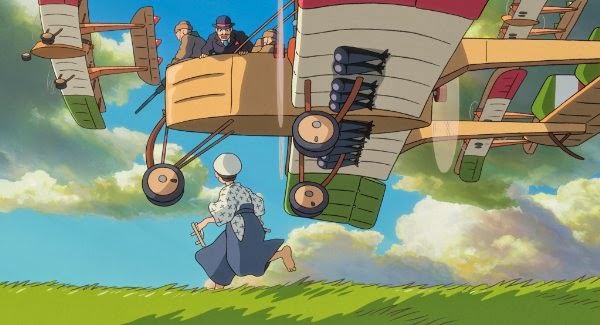
This goes hand in hand with his deeply held humanist morality. In contrast to the starkly manichean world of Disney with its clearly defined boundaries between good and evil, Miyazaki's movies never feature a true villain. There may be an antagonist, but care is taken to give them sympathetic motivations for their actions. My favourite example being Eboshi in Princess Mononoke, she's cutting down a forest in order to expand her industrial town which seems like classic environmental villainy. The twist is that Eboshi is a straightforwardly feminist defender of social outcasts, providing a refuge for former prostitutes and lepers. In Miyazaki's movies, just as in reality, good and evil are never as clear cut as they might seem.
These preoccupations reach their ultimate synthesis in the character of Jiro Horikoshi. We have to square his innate nobility, passion and quiet heroism with the fact that he's furthering the aggressive military ambitions of authoritarian imperialism. Even with the full knowledge of the misery his creations will wreak upon the world, we can't help but want him to succeed in creating beautiful flying machines - to realise his dreams even with their terrible cost.
As we progress through his life, we encounter portents of the oncoming war. A stunning sequence shows us Horikoshi navigating the Kanto Earthquake of 1923, which with its shockwaves tearing down buildings, enormous fires and earth-shaking booms is an eerie premonition of the later destruction of Hiroshima and Nagasaki. On a research trip to Nazi Germany we watch the secret police chase a man down, watching the shadows of a beating around an alley - a mysterious man (voiced the English dub by none other than Werner Herzog!) speaks darkly of inevitable, oncoming annihilation.
It's difficult not to read Jiro Horikoshi as a mirror of Miyazaki himself. Both men are expert draftsmen that transform pencil on paper into reality, both are torn between their professional careers and their personal lives, and most obviously, both dream of flying. These parallels raise an obvious question: how on earth are Horikoshi's planes and Miyazaki's animations connected? After all, one visits death and destruction upon the world, the other brings joy to millions.
The disquieting answer reveals a depressed, introspective Miyazaki - a man at the pinnacle of his profession, yet introspective, full of regrets and apparently a bit depressed. Knowing a little about Miyazaki's personal life, his estrangement from his son Goro and the amount of time he's devoted to his art at the cost of a family life helps appreciate the movie -a master film-maker questioning whether all these technical and artistic achievements were worth sacrificing his relationships for.
 |
| Here you have an artist puking blood onto a canvas. Draw your own conclusions. |
To that end, The Wind Rises sits apart from the rest of Miyazaki's filmography, hitting a sober, contemplative tone that makes it difficult to recommend for younger audiences. It's essentially a low-key, intimate arthouse film, yet produced to the highest possible standards of traditional animation - a unique combination in cinema. It's beautiful from top to bottom; art design, organic sound work and considered philosophy crystallising into a film that's as precision engineered as Horikoshi's fighter planes.
It'd have been easy for Miyazaki's final film to have been a triumphant victory lap, for the master to roll out one last optimistic fairytale. For him to give us this muted, introspective, rather depressing slice of self-criticism speaks volumes as to his honesty and intelligence. The Wind Rises is a Rosetta Stone for understanding the man behind the magic, and so the perfect capstone to a glittering career.
★★★★
The Wind Rises is on general release from May 9th
Tuesday, October 22, 2013
Tuesday, October 22, 2013
- 0 Comments

I love a film that stops and smells the roses. It's a hallmark of a confident, artistically minded director with the confidence to slow down and focus on atmosphere. I Wish is almost entirely devoted to contemplative rose-sniffing, Kore-eda proving himself a director supremely unconcerned with driving, propulsive plot and far more interested in domestic routines, minute details and tiny social interactions.
At the core of I Wish are Koichi (Koki Maeda) and Ryunosuke (Ohsiro Maeda), two young brothers separated by their parent's separation. Koichi lives with his till jocket mother in Kagoshima, a city in the shadow of an active volcano. Ryunosuke lives with his indie-rocker father in Fokuoko, living a slightly neglected, if relatively happy, vegetable-growing existence. Within Kagoshima, much talk is made of a new extension to the bullet train or Shinkansen that will pass through their town. Schoolyard legend says that if you travel to the point where the oncoming bullet trains pass each other, the force generated will grant wishes. So gathering up their friends the children calculate where the trains will meet and make plans to travel there to fulfil their wishes; in Koichi's case that his broken family be reunited; for others variously to resurrect their dead dog; to become a great artist; to succeed as an actor and so on.
These desires are granted their own little subplots, and quickly Kore-eda builds up a complex tapestry of domestic life in suburban Japan, a microcosmic world of little desires, worries, ambitions and routine. I Wish is all about the details of life, the film pausing to observe the children's routine of brushing up the volcanic ash that falls into their schoolyard, ordering octopus balls for lunch from a street vendor or showing us exactly how to make good karukan cake.


It's an unbashedly idyllic portrait of Japanese life, showing us a land of caring family units, sensitive teachers, close-knit friends and friendly welcoming strangers. I've never been to Japan, but I suspect that cosy, comforting picture that Kore-eda paints is just a bit idealised. It's telling that I viewed the film at a screening held by the Embassy of Japan in London. They're keen to increase tourism to Japan, with their current focus apparently being on promotion of the bullet train. With that motive in mind, it's slightly suspicious how positive I Wish is about the Shinkansen. It's surreal watching a film where a real-life mass transit system is romanticised to the point where it gains magical wish-granting powers. Then again the Shinkansen is a really neat train as far as trains go.
Kore-eda's Japan is pretty far from the stereotypical cinematic Japan of neon-drenched Shinjuku, Hello Kitty obsessed teenagers and giant robot animé. Paradoxically, even though this is a 'normal' low-key Japan the cultural differences in cultures are that much more striking. The biggest surprise is how blasé every adult in the film is about a group of young children disappearing for a day or two. Aided by a friendly school nurse and a knowing smile from the teacher they cut class and take an overnight trip to what seems like a very distant place.
The highlight is when, needing a place to stay for the night, the 8 children happen across a random elderly couple hanging up their washing. They take them into their house, feed them, wash them, give them a big cosy bed and drop them off in a field. It's difficult to imagine this sequence of events happening in Britain, to put it mildly. Here, the missing children would be splashed across the front pages of the newspapers, heat-vision helicopters dispatched, the elderly couple viewed with extreme suspicion and condemned for not alerting the police.


There's a good argument that Kore-eda has created a child's eye view of the world. Everything is tinged with a cute optimism, from the poppy and bouncy score to the dialogue, mining a nice vein of humour by having everyone talk at cross-purposes, the adults mainly existing in a kind of deadpan confusion at their children's behaviour. As the central characters, the Maeda brothers are utterly convincing: their conversations having a sparky, improvised air. But every performance in the film adds an individual touch of authenticity, every action borne of experience.
The finest moment of the film comes in an unexpectedly touching and intense montage when the trains pass that acts as a summation of all the tiny details Kore-eda wants us to think about. We see crisps lying at the bottom of an empty bag, a bicycle bell sitting on a counter, drawings of a volcano erupting, a sponge cake - all everyday objects - but by this point in the film, imbued with meaning and symbolism. A million tiny moments add up to a life. I Wish is nudges us to appreciate what's going on around us, warning that to only consider the bigger picture means you'll miss the beauty of life.
This movie starts out very slow and has a lot to keep track of. For the first 20 minutes or so I was a bit put off by this, but once you understand this tangle of interpersonal relationships, you empathise with them and laugh along with the gentle humour that suffuses their humdrum, yet important, existences. It feels slightly obvious to compare Kore-eda with the stately, deeply felt films of Yasujirō Ozu, but it's unavoidable, the film making me feel the same appreciation of family and friends as classics of Japanese cinema like Tokyo Story and An Autumn Afternoon.
★★★★
Thanks to the Embassy of Japan for the screening.
Tuesday, February 5, 2013
Tuesday, February 5, 2013
- 0 Comments
 |
| SIRO-A |
It’s half past four on a lazy, overcast Sunday afternoon. Monday morning is just over the horizon and with it the ominous promise of work. Last’s night’s hangover is still gently squeezing your brain and right now a nice cup of tea would be just the ticket. The perfect time for a tripped-out electro-rave laser extravaganza!
SIRO-A are a six man performance group from Sendai, Japan who combine dance, mime, performance art and comedy with cutting edge technology, creating a series of optical illusions where the boundary between reality and video is distorted. Everything SIRO-A do is designed to push against this barrier, making us question whether what we’re seeing is a person or a projection of a person.

Aesthetically, the immediate point of reference for the audience are films like ‘Tron: Legacy’ streamlined, neon-bondage cyberpunk. More obscurely, I see straight visual and sonic quotes of the work of Tetsuya Mizuguchi, designer of the dance music/trip-out videogames ‘Rez’, ‘Lumines’ and ‘Child of Eden’. I absolutely adore this style, but rather than futuristic it feels slightly retro, with roots in the early 90s rave scene. As far as views of the ‘future’ go, it’s been superseded by boring old reality.
The music is similarly slightly retro, banging big beat electro tunes, the kind you’d expect to hear ringing out over the beaches of Ibiza in 1999. This atmosphere sends a little thrill of nostalgia down my spine, the kind of pleasure you get when you step into the Cyberdog shop in Camden Market, a reassurance that somewhere in the world is still plugged into the 1990s Matrixy-WilliamGibsony vision of the future.

This is very much up my street, and as pyramid headed robots stalk across the stage firing bright green lasers from their arms to thumping techno beats I had a huge grin on my face and was bobbing my head excitedly. Things calm down a bit after this intense introduction, switching to a more comedic tone, the performers get menaced by a plague of black dots in a sequence reminiscent of a Looney Tunes cartoon, or enter into a frankly surreal sequence about the life of one of the performers, Abe Toshinori.
This humour balances out the cooler-than-thou aesthetic, and also largely avoids the trap of laughing at Japan rather than with it. It also means that while the performers rarely speak we identify with them through laughter. Everyone on stage is effortlessly expressive, whether they’re playing a character or pretending to be a computer-generated robot man. Even more impressively, they make the illusion that they’re interacting with the videos absolutely seamless.

This interaction is something that looks perfectly natural but must be immensely difficult to get right. To take a simple example, there is a white screen with a black dot projected in the centre of it. One of the performers walks on stage, looks at the projection then ‘picks it up’ and throws it like a ball. These are the basics, the rest of the pieces rely on the performer being in the exact right pose in the exact right spot at the exact right time to get something projected on them in a certain way. They get it right over and over again. I found myself wondering what they can even see from their perspective on stage (probably not much) and it became even more impressive.
The PR makes much of the fact that you won’t be able to tell the difference between the performers and the projected images. This isn’t quite true, at all times its obvious which is which. What confused me at times was whether the performers were following the projection, or the projection was following the performer. In an outstandingly beautiful sequence someone dances across a stage as time-delayed rainbow images of himself move around him, creating a morphing kaleidoscope moving sinuously around the dancer. At this moment it’s impossible to tell who is following who, you’d think it’d be impossible to cartwheel the exact same way at every single performance, but if anyone has the strict discipline needed to get it right, SIRO-A do.

The only downside to all this is, unfortunately, the venue. The Leicester Square Theatre is a small place with a low ceiling and a relatively small stage. It’s perfect for stand-up, but a full-on audio-visual experience like this feels a little restricted. I’d cheated before going to this, looking up a video of the band on YouTube. They were playing with a huge projection screen, and the rainbow images above took up a huge amount of space. Not here. The image looks like it’s been chopped off at the top. The smaller screen also prevents us from becoming properly immersed in the music and lights. The music makes me want to get up and dance but I’m stapled to my seat!
Ideally I’d have liked to have seen this late on stage in the Brixton Academy, somewhere where there’s actually room to dance a bit, where the projections can really tower over you, overpowering your senses. The show is on twice a day, at 16:30 and 19:00, both of which seem like way too early for this kind of thing. It’d be fantastic to see this in the ‘right’ state of mind to fully appreciate a room full of laser beams, dry ice, flashing colours and pounding pounding techno music.

Still, I’ll take what I can get. SIRO-A is like nothing else on in London at the moment, a perfect fusion of cybernetic fashion, laser cool and visual oveload. I had a big silly grin on my face the whole way through and can’t think of many more enjoyable ways for a person to spend an hour of their time.
SIRO-A are performing at the Leicester Square Theatre from the 1st February – 22nd April 2013.
Subscribe to:
Posts (Atom)