Recent Articles
Showing posts with label Olympics. Show all posts
Showing posts with label Olympics. Show all posts
Wednesday, July 8, 2015
Wednesday, July 8, 2015
- 0 Comments

Surrounded by cranes, shorn of floodlights and apparently devoid of life, the London Olympic Stadium has become the centre of a ghost town. Its neighbours, the velopark and aquatics centre, are generally closed to visitors, park paths are punctuated by steel mesh barriers and the sculpted greenery brings to mind an abandoned golf course. Colossal pedestrian boulevards; once funnels for thousands of happy Olympic spectators now host only the occasional lost Westfield shopper and steadily diminishing numbers of curious tourists. Looming over it all stands the skeletal Orbit, now less like a celebration of British architecture and more like a memorial to happier days.
There are, of course, big plans for the stadium. After much legal kerfuffle, West Ham football club are to be its new tenants, hopefully ushering in a new sense of purpose and atmosphere to this increasingly sterile place. But what's to be done in the meantime? After all, nature abhors a vacuum. This is where Ariel Narunsky steps in; proposing a gigantic piece of artwork to occupy the stadium.
This is Judgment: a spiral running track enveloped by walls, sending visitors through a 6000m long corridor that ends with them proceeding down into the earth and through a tunnel. Making your way through the thing looks like a pretty unrewarding (albeit hypnotic) experience, roughly akin to being a rat stuck in a maze. But even a rat gets a piece of cheese at the end, visitors to this end up unceremoniously squirted out somewhere south of Victoria Park.

The exhibition imagines what a visitors centre for this construction would be like. Played completely straightfaced, it behaves as if this enormous proposal has been accepted and will soon undergo construction. With sans serif corporate font, colour coordinated businessquirky orange and cosy sofa-based infomercial watching, the atmosphere is cool, controlled professionalism.
Judgement is a curious mix of the corporate and absurd; the project would require the decommercialisation of a hugely expensive piece of London real estate, one already subject to much legal quibbling. It'd also mean the construction of a tunnel bored right through the rat's nest of subterranean London. All for a piece of art that seems purposely designed to dehumanise, bore and antagonise those within.
The back of the glossy programme lists the corporate sponsors of Narunsky's project; including the Queen Elizabeth Olympic Park and Balfour Beatty, the building company in charge of the redevelopment of the park. After examining every carefully laid out display in the exhibit; the posters bleating stentorian gobbledegook like "An Unknown Game with Ultimate Things" or "New Things Are Near"; the promotional video that draws parallels between Roman gladiatorial games designed to distract an unruly populace and the chic 3D printed models I began to wonder - do these companies realise they're being made fun of?

To my eyes Judgement is a multi-levelled satire; taking aim at the worth of sports, egotistical design and authoritarian architecture. The idea of a pointless leg and mind numbing running track subverts the original idea of the stadium, boiling back its purpose until all the grandiosity has disappeared to reveal people fruitlessly running in circles.
Narunsky's rat's maze design, from which deviation is neither tolerated or possible, neatly echoes the Queen Elizabeth Park's winding paths that subtly manipulate the visitor through a predetermined route. There are no great walls in the Olympic Park, but the slightest sense of adventurousness will (and I'm speaking from personal experience) herald the arrival of a black-painted and logo-clad Audi estate driven by unfriendly men in hi-vis jackets pointedly asking what it is you're up to.
Similarly, the sheer scale of the project is calculated to intimidate and impress. Public art on this scale is, rightly or wrongly, criticised as an act of ego by both those commissioning and designing. There's an almost aggressive desire to leave your fingerprints on the urban landscape, to mould the public experience around your vision. In it's spiral design and oval shape, Judgement recalls that very fingerprint - as if a 10 mile tall Narunsky has bent down and pressed his thumb into the soft stadium floor.
It's a neat, slyly subversive exhibition, one that adopts the aesthetic and tone of corporate art so fully that its been embraced by the very people it's mocking. Worth checking out.
Judgement is at arebyte Gallery until 7th August. Details here.
Monday, July 30, 2012
Monday, July 30, 2012
- 0 Comments

Very soon a momentous event in sporting history is about to take place. At the London Olympics, double amputee Oscar Pistorius will compete in the able-bodied 400m and 4x400m relay races. If he wins these events, something will change forever in athletics - a man relying on an external prosthesis, his 'blades', will have beaten the able-bodied athletes on a world stage. The notion of a physically augmented athlete being the most efficient and quickest contender will take firm hold, inevitably raising a number of ethical arguments about the relationship between the human body and technology.
 |
| Oscar Pistorius competing with able-bodied athletes. |
It all sounds like cutting edge scientific debate - a conversation that previously would have been relegated to science fiction - but the Wellcome Collection's new 'Superhuman' exhibition outlines the long history of how men and women have replaced or extended their bodies capabilities and senses, as well trying to explore where we may be heading.
The first exhibit we encounter in the exhibition is a small statue of Icarus dating from ancient Greece. This is not exactly a cheery start to the exhibition, but it does seem appropriate. The notion of a millennia old story about the dangers of relying too much on technology shows us that these are issues that humanity has grappled with in some form or another for millennia.
 |
| Icarus - 1st-3rd century CE, bronze |
One of the things that the exhibition is keen for us to understand is that human augmentation and prosthesis can take many forms. It's not all robot limbs and glowing red eyes - even something as innocuous as a pair of spectacles or a watch can be considered an augmentation. In the first display case we see items as disparate as a pair of Vivienne Westwood shoes, an iPhone and a blister pack of Viagra. We take many items like this for granted, but in a very real sense they can respectively be considered as augmenting beauty, memory and sexuality - three pretty essential components for humanity.
 |
| Viagra (sildenafil citrate) |
Near this is another demonstration of a socially acceptable form of human modification - plastic surgery. In 'Cut Through the Line' a short film by Venezuelan artist Regina José Galindo, we see the artist standing naked (link NWS), with a plastic surgeon drawing marker pen lines across her body to show the changes he would make to her body. The loops and lines he draws across her look beautiful and faintly primal - as if she's being prepared for sacrifice. It's only when you remember that these lines of ink are guides for the scalpel to cut along that you understand the true import. The impact of the film, and the message it sends are quite clear. Galindo clearly has nothing wrong with her physically, yet to judgmental eyes there will always be a nip or a tuck somewhere that'll somehow bring her closer to an imagined universal standard of beauty. Her passivity as she stands naked with bystanders surrounding her, some filming her seems to both show her as a submissive canvas on which the plastic surgeon artist can realise his vision, while also showing her as an individual who is comfortable with her body as it is, and has no qualms about standing naked in front of people. This video outlines a compelling argument against the race for enhancement- would humanity be better off as a race of conventionally beautiful, technologically enhanced superpeople? If you can afford to recreate yourself like this, then where does individuality lie? And what about the people who're left behind?
 |
| Pair of artificial legs for a child (red shoes), Roehampton, 1966 |
The next section of the exhibition that caught my attention was a display about the prosthetics developed in the 1960s to help victims of the Thalidomide tragedy. Pregnant women who'd taken a drug to prevent morning sickness found that their children were born with underdeveloped limbs, and well-meaning experts on prosthesis stepped in to offer their assistance on giving the children a 'normal' life. Displayed at the exhibition are a collection of these prostheses. Decoupled from their owners they look faintly disturbing, limbs constructed of leather, gas-cylinders powering movement with shoes incongruously placed on the feet. What this display highlights is that prostheses like these seem to be more for the benefit of everyone who has to interact with the person using them, rather than to help them. The people creating them doubtless had the best of motives, but the victims of the Thalidomide tragedy seemed to find it far easier to learn to cope with their limitations of their own limbs rather than learn to use these somewhat clumsy replacements. There is an interesting contrast between a video of a child delicately and neatly eating lunch in school using his foot to hold a spon, and of someone in a prosthetic 'suit' awkwardly trying to control arms constructed of hooks and springs. Manipulating one of these devices is described as like "being in a dream, where you can manipulate things, but can't feel them".
My perspective on this seems to be that doctors were in too much of a hurry to 'normalise' these children. The de facto position seems to have been that the conventional human body shape was what should be aimed for above all else. Their mistake was assuming that if a person looks normal, then the assumption must be that they feel normal - a position that conveniently allows able-bodied people to avoid dealing with the disabled person's condition. If someone can learn to utilise their bodies effectively in a way that works for them, irregardless of whether it might appear a little weird to onlookers, then that is something that should be aimed for.
 |
| Thomas Hicks, Marathon Olympic Champion and his supporters at the marathon, St Louis Olympic Games, 1904 |
The next arena we examine is the world of sports. There are two areas to focus on - athletes using drugs to enhance performance, and physical aids. I was amazed to learn that in the early C20th, athletes would use strychnine to improve performance during marathons. The athlete, Thomas Hicks won the 1904 Olympic marathon after taking two doses of strychnine and brandy to ward off exhaustion. Not surprisingly, he collapsed and nearly died after crossing the finish line. A slightly more recent, and more disturbing example is the death of Tom Simpson in 1967. He was competing in the Tour de France on a bakingly hot day, and race rules at the time restricted athletes to about two litres of water per day. On a steep mountain climb he began weaving across the road before collapsing. While a medical team attempted to save his life he urged them to let him continue the race, shouting "Go on! Go on!". Three tubes of amphetamines were later found in his pocket - the drugs prevented Simpson from knowing he was dehydrated: he didn't realise he was dying.
The last minutes of Tom Simpson
Thankfully, deaths like Tom Simpson's are now extremely rare due to advances in anti-doping detection and an awareness of the dangers of doping. Yet athletes still seek to enhance their bodies with banned substances. One exhibit in this section is a fake penis called a 'Whizzinator' that allows athletes to fake urine tests. In a 2012 study by Leeds Metropolitan University it was discovered that athlete's attitudes towards banned substances was generally negative, although many of them understand the temptation. Athletes believe that 37% of their fellow athletes would use a drug if it was undetectable and guaranteed winning - 9% believe that their fellow athletes would use the drug even it led to guaranteed death within 5 years!
This intense desire to win lies at the heart of all professional athletes - arguably they wouldn't be professionals if they didn't have that burning desire for victory within them. It's easy to understand how they can come to rely on the crutch of a banned substance - especially in circumstances where a coach or instructor is advising the use something as safe, morally acceptable or undetectable.
 |
| Pair of blue and yellow Nike waffle trainers, Nike 1977 |
The other, more uplifting side to human augmentation in athletics is physical prosthesis. This ranges from something as simple as running shoes. On display at the exhibition is an early C20th running shoe - it's a fearsome and uncomfortable looking thing made of hard leather and with a flat sole. Apparently athletes used to soak their feet in brine to toughen themselves up to wear it! So it was somewhat of a revolution when Bill Bowerman, coach of track sports at the University of Oregon developed a 'honeycomb' sole and new running shoe design - many of these innovations are still in evidence in running shoe design to this day.
The displays within the exhibitions are in rough chronological order, and as we get to the final rooms we begin to consider the future of human enhancement. There are a variety of theories, ranging from wearable computers, to internal organic implants, to gene therapy and even more science fiction applications of nanotechnology to the human body. One thing that is agreed is the future of humanity almost certainly lies with further augmentation of our bodies and senses.
There are two short films on display here that more than adequately demonstrate the dangers of this. The first tells us a fictional story of an injured US Marine who wins a contest to turn him into a superhero through prosthesis. The film takes the form of his video diary over a number of months - and we see his progression from a handsome and well-adjusted person to a monstrous and disorientated Frankenstein. Initially he starts out happy, enjoying the look of his new 'blade' legs, but as more and more is subtracted from him he begins to lose his humanity. There is one distressing sequence where his arm has been amputated and replaced with a prosthetic "that'll let me punch through walls", but as impressive as this might be, "it isn't so good at the small stuff" like fine motor manipulations. By the end, after he's had radical brain surgery and his eyes replaced by bleeding mechanics there is almost no trace of the excited and charming man at the start of the documentary - he's been replaced by a scarred and disorientated machine.
The other is a 'documentary' about the fictional condition Metalosis Meligna. The report shows us how people's metal implants have begun to take over their body. It's an extremely effective bit of body horror - reminding me of Shin'ya Tsukamoto's Tetsuo: the Iron Man (1989), with pieces of metal invading and taking over people's bodies. While Tetsuo treats this as surreal and frantic, this takes an almost perversely sober look at the 'metalosis' of sufferer's bodies. It's a nice allegory for our relationship with technology, and the dangers of immersion and reliance upon it.
 |
| 'Metalosis Meligna' Floris Kaayk, 2006 |
The final piece of the exhibition is an autonomous wheelchair 'Psalms'. This piece was created by Donald Rodney, a sufferer of sickle-cell anaemia. He was too ill to attend his gallery openings, and a wheelchair was designed to take his place. The piece incorporates a neural network, and it wanders through the exhibition negotiating paths around us using various sensors affixed to it. Rodney died in 1998, and yet his wheelchair still roams the exhibition without him: a prosthesis making a lonely journey without its owner. This none too subtly points towards a possible future for humanity - that we will dissolve into or be replaced by what we have created to aid ourselves.
There is a theory popularised by futurists like Ray Kurzweil known as the 'singularity'. Here is the basic outline of how it may come about:
"Let an ultraintelligent machine be defined as a machine that can far surpass all the intellectual activities of any man however clever. Since the design of machines is one of these intellectual activities, an ultraintelligent machine could design even better machines; there would then unquestionably be an ‘intelligence explosion,’ and the intelligence of man would be left far behind. Thus the first ultraintelligent machine is the last invention that man need ever make." - I.J. Good - 1965
This is sound thinking, but adherents commonly posit the singularity as a quasi-religious enlightenment of the human race. That it'll be a jump towards post-humanism, the end to all of our woes, that we will soon after become immortal, godlike digital intelligences. Thinking like this is one of my major issues with the notion of augmentation as inherently a good thing for the future of humanity. It seems that something like this would inevitably widen the gap between the haves and have nots - sure some people may jump forward, but at the expense of those left behind.
If a person is likely to experience a vast increase in awareness and intelligence due to an application of technology they are far more likely to be an extremely affluent person than, say a subsistence farmer in a Third World country. The gap between life at the lowest end of the poverty scale is wide enough already, and it is worrying to think of a world where the rich can afford to make themselves physically and mentally superior to us. How will these superhumans consider their interactions with us? The wealthy will have perfect photographic memories, be able to survive without sleep or run for miles - can we expect to be able to compete against them with our clumsy and imprecise organic brains and easily worn out and tiring bodies?
These are issues that we are beginning to have to face in the current day. Elderly people who are not connected to the internet risk losing out on essential interactions with their families - separated from them by an intimidating digital wall. As time progresses, we will find ourselves in their position, faced with a society plugged into each other in ways we might not be able to comprehend, or more likely, won't be able to afford.
There is a good argument that while there may be an initial stratification of society it will eventually even out. Look at mobile phones - once a trademark of wealthy financiers in the 1980s, and now a worldwide technology hugely popular and useful in African countries. The spread of the internet, possibly humanity's first global prosthesis is another way in which technology that was once the preserve of the wealthy eventually becomes accessible to all. I consider there be to be obvious silver linings to this cloud, but for a while it may be a pretty dark and forbidding cloud as we race to catch up with those who can afford to make themselves 'superhuman'.
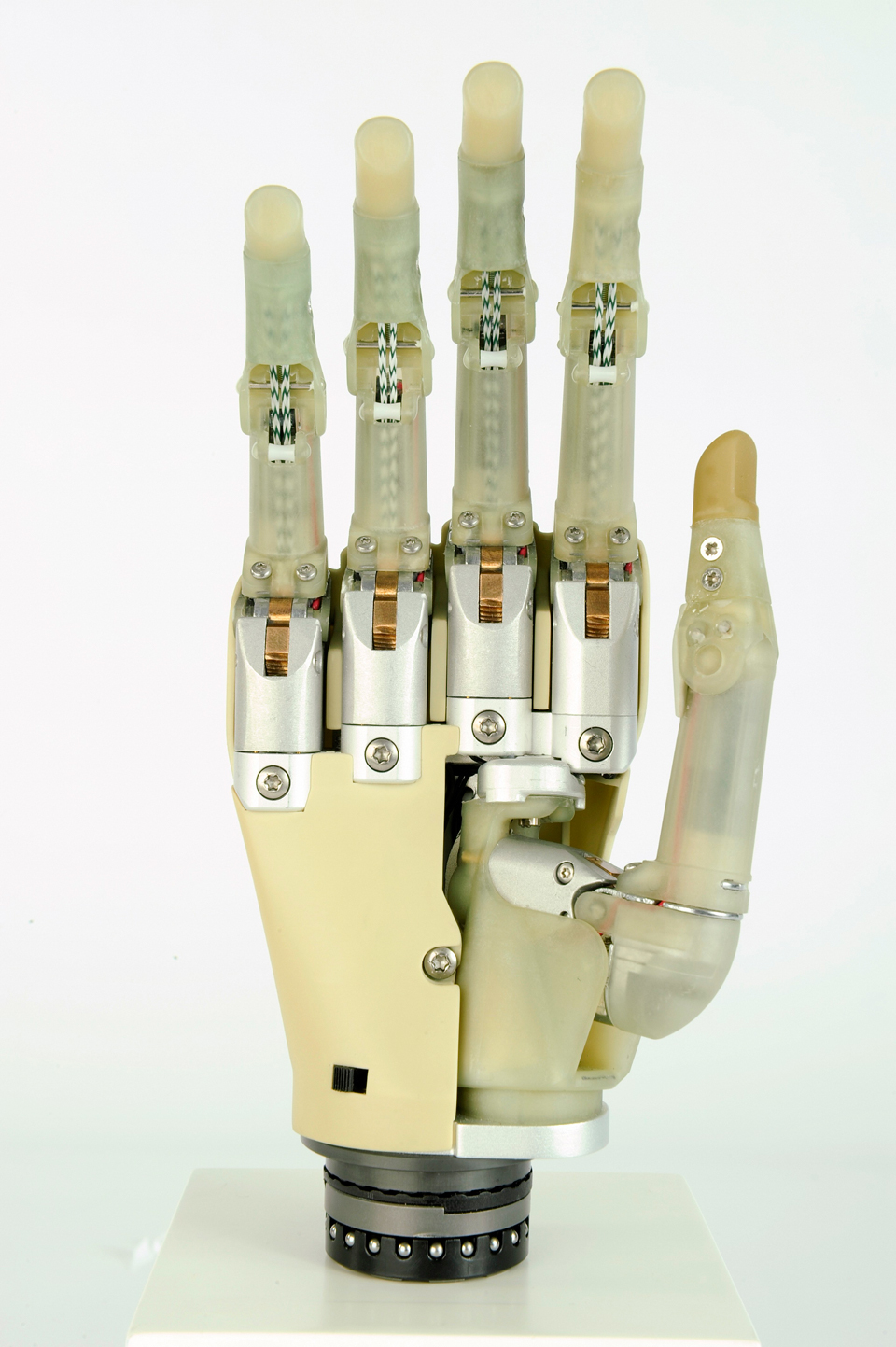 |
| 'i-Limb ultra prosthetic hand', Touch Bionics |
This is a typically excellent, and highly thought provoking exhibition from the Wellcome Collection - a place which really should be more popular among London attractions. It's well laid out, gives us just the right amount of information and most importantly lets us come to our own conclusions about what we see. There is a wry sense of humour to some aspects of the exhibition, and some interestingly provocative choices in what to exhibit. I particularly liked the way that the information cards were pinned to the wall in a stretched, slightly surgical manner. My only criticism is that this is an exhibition that relies very heavily on video and the volume of them varies enormously. There are some that are so quietthat it is very hard to make out what is being said, while conversely a few are so loud that you can hear them across the entire exhibition. But in a summer where people are pushing their bodies to the limits of athleticism in the Olympics and Paralympics it's very timely and any visitors to this should find themselves watching some events in a different light. Highly recommended - and anyone attending should be sure to see the rest of the Wellcome Collections fascinating galleries.
If anyone visited this and wants to add their thoughts I'd be very interested to hear them, post in the comments below!
'Superhuman' is at the Wellcome Collection from the 19th of July until the 16th of October 2012.
Friday, July 20, 2012
Friday, July 20, 2012
- 0 Comments


As you may have
noticed, there is a large sports event taking place in East London this year.
To complement the sports taking place, the organisers have promised a festival
of culture; free arts, music and theatre throughout the country. It's
hard to find too much to disagree with here, surely in the time of austerity
giving funding to top artists to realise projects that the public has free
access to is definitively a good thing?
This lecture is the third De Coubertin Lecture, and the first to
concentrate on culture rather than sports. The first lecture was given
by Christophe Dubi, Olympic Games Deputy
Executive Director at the IOC, and the second by Jacques Rogge, President of
the IOC, these sound, from what I have read, a little dry. So having
tonight's lecture delivered by Eddie Izzard is a bit of a departure, he's a
nice pick though, neatly straddling the line between culture and sports.
Also in attendance was Alan Yentob, Creative Director of the BBC and Ruth
MacKenzie, Director of the Cultural Olympiad.
 |
| Eddie Izzard, running, |
Filing into Boothroyd
Hall you're confronted by the omnipresent '2012' logo. It's projected on
the walls, it's plastered to the front of the lecturn, it's on the screen, it's
on badges pinned to the volunteers chests - despite having had a few years to
get acclimatised to it, it's still a remarkably unfriendly piece of graphic
design. Tucked down below it are two more logos, those of BP and BT.
We begin with a rather poorly thought
section where Izzard runs around the Olympic Park while being asked questions
about it by Yentob. The video and sound link is a little patchy, and the
feed frequently cuts out leaving Yentob stranded awkwardly on stage with either
an awkwardly frozen Izzard in front of him, or a silent black screen. In
principle I guess this sounded like a good idea, but in practice it just barely
hangs together - the only reason it works at all is the infinite charisma of
Eddie Izzard. Perhaps the strangest point is when Izzard notices a truck
coming up behind him, he turns around saying "what's that?" at which
point the video cuts out completely, leaving us to wonder if he's just been
flattened by some poorly trained G4S minion.
If this segment was intended to
showcase to us the glory and wonder of the Olympic Park then it completely failed.
We Izzard running around a desolate concrete wasteland, to a backdrop of
a forbiddingly overcast sky. Huge empty spaces loom all around him, he
cuts quite a lonely figure as he trudges through it, gamely trying to entertain
us. I accept that the place won't truly come to life until it's packed
with throngs of happy spectators, but in its current abandoned state it has an
air of the bleak to it.
 |
| Alan Yentob. |
The park is cold and
unfriendly, with Izzard the only spot of humanity in the middle of it. As he
runs after the truck Yentob pops bizarre questions at him. "Do you
know how many species of plants there are in the Olympic Park?" "Do
you know how many nails were used in the construction of the velodrome
track?" "Do you know how many trees were planted here?"
and so on. If anyone can give these spectacularly dull queries a funny
answer it's Izzard, but even he struggles, generally answering "between 3
and 3 billion?" bemusedly. If this is some kind of advertisement for
how great the Olympic Park is then it misses the mark by quite a huge margin.
Who cares how many damn nails are used in the velodrome? What possible reaction
do they want from us? Are we supposed to be impressed? How the hell
do we know what a large amount of nails for Velodrome track construction is.
"Oh, 300,000 - huh. That's a lot of nails." The
nadir comes when Yentob mentions an oak tree that's been planted in honour of
De Coubertin, but apart this knows absolutely nothing about it.
"Well, where is it?" asks Izzard. Yentob doesn't know.
Yentob only seems to know what's on his hastily printed sheaf of papers.
He and Izzard are entirely adrift in a sea of pointless, mind-numbing facts.
After this, Izzard hops on the back of
a motorbike and speeds through the streets of London towards us. I can't
help but wonder if he's allowed to use the Olympic Lanes. I'd guess so,
but regardless he ends up taking a while to get here.
To fill the time Yentob talks to Ruth
MacKenzie about the events of the Cultural Olympiad. Now, I'm sure
MacKenzie is a very nice, intelligent and charming woman, but what we see on
stage seems to be a wind up PR spewing machine. On the face of it she seems
enthusiastic, but after 10 minutes or so this seems slightly fake. Her
effortlessness in dispensing vast amounts of information about, for example
Stockhausen operas in Birmingham or arts projects in Bexhill seems almost
robotic, like she has spoken about this many, many times in the last few weeks.
It's an autopilot performance, a well-oiled PR machine doing its job and
becomes a bit creepy after a bit.
 |
| Ruth MacKenzie |
As Izzard shows no
signs of turning up anytime soon the floor is opened to questions. I manage to
get one in, asking Yentob and McKenzie about the pre-emptive arrests of street
artists in London. Over the last few days, prominent street artists, (some
who'd even done work for Team GB) have been rounded up by the police,
their equipment confiscated including their phones and laptops. The
arresting police confirmed that the artists were being picked up in relation to
the Olympics - a pre-emptive strike against anyone who'd have the nerve to
protest the games. They were taken to a police station, and informed that
they're banned from the tube, DLR or National Rail, and not allowed within a
mile of any Olympic venue. All this for crimes that the police have
decided that the 'suspects' might decide to commit, but haven't yet. I
wanted to know how this squares with the ethos of the Cultural Olympiad.
They do, after all state on their website "As
part of the Cultural Olympiad, artists have been encouraged to use the UK as a
blank canvas."
So I asked it, half suspecting that I
was about to be dog-piled by a group of burly men in hot pink polo shirts and
dragged into a white BMW. I had even figured out to scream as I was
dragged away and a bag (presumably Adidas branded) popped over my head.
"Don't forget me! Tell my story!" I'd scream desperately.
In the end they just ignored the question, MacKenzie launching into a
pre-programmed spiel about the opportunities they're giving graffiti artists.
I don't really know what I expected for an answer, but being responded to
with a wave of passionless PR bumph was pretty dispiriting.
Eventually Eddie Izzard arrived to give
his speech, considered the high point of the night. In honour of De
Coubertin he delivered it in both English and French at the same time, which is
laudable in terms of cultural inclusivity, but occasionally got in the way of
the humour. Eddie Izzard is one of those rare people who is preternaturally
incapable of being funny. His completely fearless nature serves him best
when he goes off on a tangent - something which, by necessity, this lecture
prevents him from doing. He admits at the start that he doesn't usually
read from notes - it shows. He seems almost straining at the leash to
explore more surreal elements while telling the story of the formation of the
Olympics, and indeed, the funniest moments are when he's not talking about De
Coubertin. There's a great bit about how all wild animals are fit, it's a
glimpse of the Izzard we know and love. I can see how the format and
constrictions of the Olympic ethos restrain the performance - he tries his
absolute best not to swear, and throughout there is a slight air of
self-censorship.
Where he does succeed is explaining why
the traditional Olympic ethos is valuable and positive. As a man who has
run 43 marathons in 51 days he knows more than most what a person can get out
of their body when they apply themselves. It's this correlation between physical
fitness and mental well-being and positivity that strikes the most genuine note
of the evening. For a second I can almost believe in the Olympic ideal as
created by De Coubertin, enthusiastically and convincingly explained by the
impossibly charismatic man on stage. Then I remember the roof-mounted
missile launchers, the hordes of 'brand police' and the VIP Olympic lanes
snaking their way around the city - the illusion sours. I would like to
believe that the Olympics is about sportsmanship, education and culture, but
it's not. It's about exploiting these noble principles to let companies
like McDonalds, Adidas and Coca Cola make a quick buck. It's about
twisting the laws of the host country to protect corporations that have
insidiously wound their tendrils into the purest and most honourable of
intentions.
The evening sputters out in a bizarrely
misconceived question and answer session in which Yentob interviews Izzard.
Izzard tries gamely to make a silk purse out these sow's ear questions, but
when faced with questions like "Did you become a transvestite for the
attention?" What's he to do?
I don't know exactly
what I was expecting out of last night, but I got an effective demonstration of
how De Coubertin's noble intentions and fine ideals can be corrupted and
degraded into a sinister, hot pink spectre, and how three highly intelligent
cultural titans can be seduced.
Subscribe to:
Posts (Atom)