Recent Articles
Showing posts with label Sebastian Hau-Walker. Show all posts
Showing posts with label Sebastian Hau-Walker. Show all posts
Thursday, August 25, 2016
Thursday, August 25, 2016
- 0 Comments

Something peculiar happened last night in Clapham. From within a well-to-do townhouse came billowing clouds of talc, dusting the street in a thin alabaster layer. If you'd have glanced up, you might have been a naked woman, face whited out, hurling fistfuls of the stuff from an open window. This is The Skeleton House.
With its owner mysteriously absent, the house is in the custody of artists, who are using it as a home, studio, residency, workshop and exhibition space. Considering that performance art tends to take place in industrial warehouses, semi abandoned buildings in odd areas and (occasionally) car parks, it's surreal to step through the door of a typical terraced house and find someone licking the walls with a mirror strapped to their back.

That someone is Natalie Ramus with Site:Requite:Trace. Sadly, these are the last days of The Skeleton House as the owner is returning in early September. In just a few weeks this curious suburban anomaly will revert to type, though Ramus aims to pay tribute to the way the place has cradled the people that've lived and worked within its walls.
To achieve that, she's blindfolded herself, strapped a mirror to her back, wrapped a ribbon umblical cord around her body (trailing off somewhere upstairs) and spent the night licking the walls. It's a strange kind of communion; a performance utterly unconcerned with actually being observed. As we arrive, Ramus is the only person who's begun, so she gathers a little appreciative crowd. Then, as the other performances start up, people filter away. Eventually she's left alone, blindly exploring the house in slow motion with her tongue as the primary sensory organ.
She ends up licking the fireplace, observed by only one person. It's gentle, meditative and quietly respectful, somehow sanctifying the house. Her contributions (and those of the other artists) pile up against the ghosts of the past and future Claphamites to come.

This segues nicely into Sebastian Hau-Walker's Ausculta (Vision Serpents). On heading into the kitchen we're instructed to take a set of wireless headphones, a pillow, an orange and lie down on the floor. Projected onto the ceiling is grainy camcorder footage of Sebastian as a boy, graduating from kindergarten and generally being a rather sweet child. Meanwhile, the adult Sebastian perches like a gargoyle on the kitchen counter, dressed in Clockwork Orange white and a mortarboard.

He then creeps along the kitchen counter, orange clenched between his teeth. As he explores the cupboards he finds VHS tapes (presumably of the projections). As he hums Auld Lang Syne he bashes them against his head and the oven, eventually cracking them open. Then he takes the reels of tape and fixes them to the ceiling, causing them to unspool in a beautiful silvery column, piling up in shimmering heaps on the audience. By the end of the performance he's naked, wearing a tattered black cloak of tape and surrounded by the physical remains of his treasured family memories.

There's a lot of meaning to unpack here, but this is a kickass piece of performance art. In purely visual terms the sight of videotape unfurling in liquid columns from the ceiling is absolutely fascinating to watch. I had the fortune to be sat right below one of them and the sensation of tape piling up on my face and chest was fantastically, awesomely weird.
And what does it all mean? Well, probably only Sebastian knows the full story, but it's certainly autobiographical and deeply personal. It's easy to try and fill in the blanks between the child on screen and the adult bashing a videotape against his skull. Other than the home videos, we hear distorted heartbeats and fuzzy organic soundscapes through the headphones. By the end of we're laying amongst the jumbled, frozen knots of his own history, now just piles of polyethelene.

Unpicking things a little further, Sebastian makes reference to his Mayan heritage in the introduction. Following a bit of post performance Wikipediaing, the serpentine quality of the unspooling tape and Sebastians actions make this a translation of a Mayan bloodletting ritual. This facilitates communication between the past and present - which we see all to viscerally in the distorted, artifacted videoportal projected onto the ceiling. On top of that, by the end he's quite literally cloaked in his own past, the tape echoing feathered ceremonial cloaks that signified the spiritual power of the Shaman.
It was dead good stuff and precisely the kind of performance art I like: sincere, unironic and refreshingly open. Sebastian's personal connection to symbology and use of his own history rendering it devoid of the masturbatory obscurantism that can gum up pieces like this.
Last up were Alicia Radage and Robert Hardaker with S O M E T I M E S W E W E A R A N T L E R S / / S O M E T I M E S W E W E A R H O R N S. This felt like The Wicker Man on diazepam.

Mostly naked apart from a couple of twigs, Robert and Alicia stood facing a bedroom wall. At the centre of the room was a chair sat in a big pile of talcum powder. Dangling from the ceiling was fishing wire festooned with white-painted leaves. In achingly slow motion, the pair navigated towards each other along the wall, eventually coming together in an embrace. Ordinarily this would look sorta sexual, but Robert's cock and balls were bound up in a gaff, leaving him flat and androgynous.
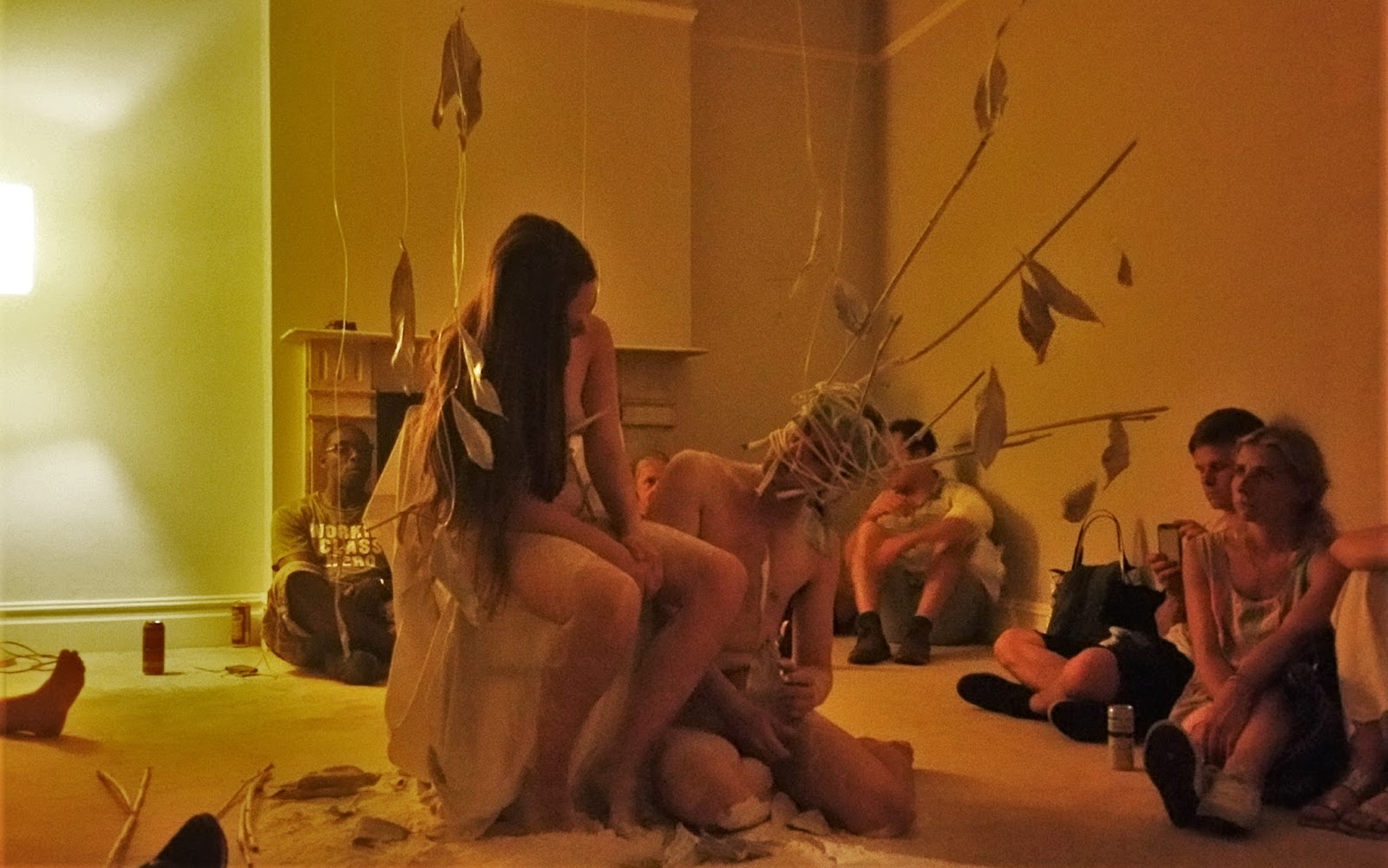
Then Alicia moved to the chair, with Robert sat alongside her. With precise motions she constructed a tall of twine and twigs around his head, leaving him looking like he'd walked out of a Guillermo del Toro movie. When the crown was finished, he began to writhe around, pulling down the dangling leaves with a satisfying *twhip* as the cords gave way. He then stood in front of Alicia and removed the gaff, letting his cock dangle free.

Alicia stared on blankly, then, as Robert kneeled in front of her, she got up and began to toss big heaping fistfuls of talcum powder out of the window into the street - as if the very house had begun to boil. Then, shaking out the sheet on the chair, a blastwave of white enveloped the room. To cap it off they retreated to their rear of the room and gently anointed each other with red wine, concluding the performance.

So what does all that mean? Beats me. But whatever it was, it was extraordinarily beautiful and hypnotic, a mysterious ritual that felt equal parts pagan and fetish, but with a warm undercurrent of affection and a subtle romance to it. It's easy to read Alicia as representing a historical all-femininity, beginning as a powerful matriarch and gradually being transformed into the submissive by the increasingly unbound masculine presence that swirls around her. But then, in the finale we're all coated in the same flesh and working from the same organic baseline, represented by the ashlike powder around them.
It's also startlingly intimate; a performance that all but demanded silence and attention from those concerned. The atmosphere felt a bit like being in church, the kind of instinctive hush that comes over a crowd in the presence of religious superseriousness. Sustaining this over more than hour requires some serious performance chops, not just to maintain this intensity for so long, but the confidence to know that people will be fascinated by it.
Walking out of there I felt like my brain had been in for an MOT. I really should do more writing about performance art - I miss seeing stuff so strange, so open to interpretation, so unconstrained by commercial considerations and so utterly fearless. A hell of a night, and a wonderful way to close out The Skeleton House.
Saturday, November 29, 2014
Saturday, November 29, 2014
- 0 Comments

Cluster Bomb [Collective] have been dissecting and reassembling J.G. Ballard's Concrete Island for about two years. The text has been chopped, screwed, slowed, thrown, mangled and fucked every which way; the artists treating it with the same ferocity as a pack of lions tearing apart a juicy antelope. Some aspects change: the location, the duration, the style of performance and role of the audience. Some remain static: scraggly red wigs, car parts wielded like religious artefacts, the repurposing of found objects.
Last night's performance took place in the shell of The Old Library in Burgess Park. About fifteen years ago the building suffered a full-frontal lobotomy, the books, people and community emptied to leave a damp shell populated only by dead wasps and flies. In the last few months fresh life has been breathed into these peeling walls, the council granting permission for it to be used as a temporary art space. So with the boiler cranked into spluttering life and local beers available behind the counter a miniature urban resurrection has taken place.
That makes it an excellent location to host a tale that sutures the personal to the urban, blends flesh and concrete into mutant forms and ponders precisely what separates man from his industrial creations.
We begin with a suit-wearing man taking the stage clutching the rusty wheel of a car. He lies on his back, slowly spinning the wheel with all four limbs. He's lit from below by harsh stage lighting, throwing a perfectly defined silhouette onto the wall behind him. We're to see a number of odd hybrids tonight; and man/car is the first. There's a whiff of Cronenbergian body horror in this Frankensteined combination of man and machine (as well as a smidge of 80s trash cartoon Turbo Teen - hey I never said all my references would be classy ones).

He's soon joined in the performance by a sinister, combative clown and the sexually aggressive Jane Shepherd. The two of them toss him around the stage in inner tubes, manhandle him to the floor, squirt him with water and draw him down to some weird primal dirt-smeared caveman state.
There's a very loose narrative, though telling a coherent story is obviously pretty low down Cluster Bomb's list of priorities. What sticks in the mind are fragmented individual actions and interactions. There's a moment where, drawn into combat with the clown, our 'hero' wrestles her to the ground climbing above her and sprays her with water. There's a curiously sexually dominate tinge to this behaviour, as if in defeating his demons he's had to regress beyond human to the animal, figuratively marking his territory.
Though we spend much of the performance scrabbling around in the dirt and dust, there's the occasional moment of the divine that seasons the mix. There's a tremendously powerful sequence where Robert's body is washed with water from a petrol tank by Jane. The care with which she anoints his body with the liquid recalls Mary Magdalene washing Jesus Christ and/or the preparation of a sacrificial victim.
There's a ritualistic power in these motions, and even though we're never going to get a direct explanation the meaningful thrum and vibration of what's taking place is palpable in the air. This peaks in the final sequences when Patrick rubs concrete dust over his wet, naked body. It crumbles gently off his shoulders, falling to the floor in microscopic waterfall-like plumes. Above him we see a looped film of a building failing to be demolished, ending up as half a building perched on top of its own ruins. It's a nice series of parallels; linking the organic to the artificial and the biological to the mineral.
Afterwards I spoke to those running the space, who gave me a quick history of the location. Uniquely for London Burgess Park isn't some time old protected green space, but rather reclaimed urban land. The Luftwaffe wiped out most of the housing here and rather than redevelop the land was bequeathed to the public as an open space. The Old Library thus stands as it's own concrete island in the midst of the greenery. Still, lurking just beneath the grass and trees lie dormant, buried networks of piping, cable and tunnel, the forgotten anatomy of the bombed out Victorian terraces.
It makes for a neat psychogeographic coincidence, the location elevating meaning - sprinkling a tiny yet welcome garnish of temporal grace onto an already fascinating performance. I'm sure I'll soon see more reconfigurations of Concrete Island in future events. Bring it on!
I AM / THE ISL△ND has it's final performance tonight at Chisenhale Dance Space London E3 5QZ. Entry £6. Doors 19:30, performance 20:00.
Tuesday, July 30, 2013
Tuesday, July 30, 2013
- 0 Comments

Hackney Wick is about to explode. The battle lines are drawn. On one side are the long-term residents of the area, those who've watched a slow decay and think of warehouses as a place to store things rather than an exciting residential opportunity. On the other are the artists, most of them relative newcomers, springing into the neighbourhood with floppy haircuts, expensive coffees, limited edition Converse and omnipresent Apple Macs. The best representation of this conflict is the the graffiti covered exterior of the Lord Napier pub. Disused since the nineties, pub wall has had a photograph pasted on it comparing 'then' and 'now. A line-up of bearded men drinking bitter is contrasted with an empty, graffiti covered street. Below it some unhappy local has scrawled "If U R a so called artist in "The Wick" then U R a CUNT!"
Tuesday, June 18, 2013
Tuesday, June 18, 2013
- 0 Comments

From my first visit, one thing that always impressed me about LUPA is the willingness to engage with the local community. It's arguable that they don't have much of a choice; running a monthly (and occasionally pretty noisy) performance art event out of a garage surrounded by people's flats is the kind of thing that gets the council cracking down on you in a hurry. But I've never sensed that LUPA's community ties are an obligation; this engagement both a source of pride and something that strengthens the work on display. The world of performance art can seem impossibly insular at times; the same hundred or so artists performing almost exclusively to each other in a mutually congratulatory circlejerk.
Tuesday, October 23, 2012
Tuesday, October 23, 2012
- 0 Comments

Hackney Wick often feels like one big open air gallery. Every time I go there the walls have had a new lick of brightly coloured paint. The area revels in its cultural ‘outsider’ status, which feels appropriate enough given that it's a bit of an geographical outsider. Saturday night was a wet one and unlike some places in London, rain does not particularly romanticise Hackney Wick. The run-down buildings grow more desolate, the open spaces lose some of their reclaimable charm and the cold streets empty.
It was to this environment that I stepped off the number 26 bus and made my way to ‘Run ! City! Run!’, a performance art event by Cluster Bomb [collective]. As far as I can tell they're incestuously* linked to ‘[performance s p a c e]’ (review of the last event of theirs I attended here), sharing the same space and some members while, as far as I can tell, not explicitly being a part of it.
*not literally incestuously FYI
As I approached the meeting point I began to see people in ponchos hanging out on street corners holding mini-megaphones. They were dotted up and down the street, and seemed to be communicating with each other at distance, like beacons in the night, or a long distance version of Chinese whispers. For people that were standing out on a very miserable night they were in suspiciously good spirits. Rounding the corner to the event I saw a huddled mass of umbrellas on a raised patch of concrete just outside the workshop.
 |
| Sebastian Hau-Walker |
Sebastian Hau-Walker ran up to us brimming with enthusiasm, mini-megaphone in hand and asked us to introduce ourselves to the crowd. I have to admit at this point I was a little sceptical of what was to happen and a tiny bit grumpy. I’d spent much of the day marching around the streets of London in fruitless support of trade unionism. I was tired, and not even the enormous can of energy drink I’d guzzled on the bus here was bolstering my spirits. Earlier, thoughts had flitted through my brain of just sacking the whole thing off and hiding under a duvet on the sofa at home. I only vaguely knew what the performance was going to be, but I half suspected it was going to be physically strenuous for both the artists AND the audience. This energetic enthusiasm then, while obviously sincere, worried me a bit.
I shouldn’t have been so miserable, and I quickly learned to count my blessings. I was wrapped up warm under an umbrella, while the performers were running around in skimy athletic gear, writhing through puddles and patches of wet grass. In the face of steel-jawed commitment like that, it’s impossible to stay grumpy for long.
As an audience we began as a huddled group, standing bunched together while the artists ran around us, megaphones in hand, distorted feedback and voices burbling up from each one. It was disorientating and felt vaguely dangerous, the performers sprinted past us, seemingly not taking much care to avoid us in the slightest. Being circled like this is an odd sensation, I’m used seeing performances in the round, but it’s far rarer to be a member of the audience surrounded on all sides. I began to feel a bit like a buffalo must feel when circled by a pack of wolves. Instinctively I wanted to press into the middle of the herd, both so as to not get bashed into by one of the runners, and also to not be a cause of them tripping over and lying in a wet, injured heap on the ground.
This uneasy mood continued through much of the next sequence, when one of the performers began aggressively confronting the audience and questioning their right to “be here”. She was speaking to us, but also at the same time indirectly addressing the rest of the performers, who were slowly climbing over the wall behind her. All of this serves to unnerve the crowd. Whoever it was doing this questioning did a damn good job of it. It’s difficult to be suitably authoritative when you’re being rained on and wearing soaking wet athletics gear, but she managed it magnificently. This demanding of credentials strongly reminded me of videos I’d seen of the reactions of guards to people attempting to film the Olympics site before the games. Throughout the outdoor sequences of the performance the red-lit tip of Anish Kapoor’s ‘Orbit’ was ominously visible, just over the top of the wall. The performers were even at one point wearing the same type of hi-vis jackets as the Olympic guards.
 |
| A hectoring. |
As we were being hectored, everyone else involved in the show was busy carefully climbing down what must have been a wet and slippery wall. The thing was about 10ft high, so this looks pretty damn dangerous. The performers look like they know what they’re doing though, and as this was the last performance I guess they’ve done this quite a few times before already. Even so, I worried that the performance was going to be radically altered by the thwack of skull on concrete. They seemed to anticipate this reaction, and as the performers dangled and dropped from their cubbyholes they fell into a limp, writhing pile on the ground.
 |
| pictured: a slithering, wet pile of artists. |
This slithering, wet pile of artists moved slowly towards us, clutching their heads in what could have either been pain or ecstasy. I had to admire their commitment as they dragged themselves over the wet bricks, managing to neatly avoid the megaphones on the ground, which were still sending out waves of weird, distorted sound. The performers eventually bunched together, and in slow motion stood up and raised their arms to the heavens. Is this some kind of mimed religious fervour? Their mud spattered and soaked clothes put me in mind of religious pilgrims: wide-eyed flagellators whipping their sins away.
Next they moved through the crowd, lining up against a wall – before picking up a pile of bricks, and assembling them into small piles. This neatly linked to the next part of the performance when we moved inside the warehouse. Here we see a pile of bricks in the centre of the room, under a dim light. The performers climb the tower, which looks vaguely unsteady. As they all balance on top, the thing wobbles, bricks cascade down the sides.
 |
| Clambering the pile |
The performers stay balanced somehow, and then the sounds of ‘Born Free’ are heard coming from an amp hidden inside the bricks. Sebastian stands alone atop the pile, singing happily and clearly. Considering the rest of the performance has been overtly abstract, confusing behaviour this feels very surreal, while also being funny. It reminds me of Dean Stockwell singing 'In Dreams' in ‘Blue Velvet’. It’s also nice to have it demonstrated these are not particularly po-faced artists. They don't expect you to react to every little thing they do with intense solemn seriousness. Frankly you’d have to have had a sense of humourectomy not to occasionally find some of this sort of stuff a bit silly at times.
 |
| And now the weather. |
To round off the night, a projector is turned on showing (I think) a map of cloud formations projected onto a sheet, while a woman solemnly warns us of impending bad weather. Eventually, we’re gently moved on from here, and as we enter a café area where we're served beer and tea by a rather offputtingly vinegar faced man. The piece is over.
There's so much going on here that it’s difficult to work out what thread I’m supposed to be following. What happens at the beginning seemed to bear little or no relation to what happens in the final stages. It’s difficult to tell whether this is a symptom of an equality of ideas between the members of Cluster Bomb, or simply that someone has so many ideas that seem relevant now that they want to perform them as soon as possible.
I liked a lot about this performance. I’ve got a particular appreciation for people that really throw themselves into something. Spending your night outside in the cold, pouring rain shows a level of commitment that makes you sense the philosophies and aesthetics presented are passionately felt among the group. There was a unity of purpose that’s refreshing, and it’s clear that whatever this all means, they’re totally on board with it.

I find the performance quite hard to imagine without rain beating down throughout and it seems like a nice bit of cosmic luck that they get to perform under such miserable weather. The rain grounds the performance, preventing it feeling sterile or overly considered. It adds a chaotic element to what we’re seeing, while at the same time upping the danger to the performers. This wet weather is seemingly directly addressed in the final “Forecast” sequence, where we’re ushered away from impending disaster. It’s more than a little ironic that after quite a while actually standing in bad weather, that we’re warned of a possible, conceptual storm to come only when we're safely inside.
The choice of area where all this takes place is feels very appropriate. It’s the ghost of a building, a brick skeleton. The use of bricks throughout the performance is interesting. I saw them as a symbol of creation and destruction, both yield interesting results. When we see the performers building their miniature megaliths out of discarded bricks, they’re engaging in microscopic form what they’re doing in macroscopic form by repurposing the urban space. When we move inside the building, and find the heap of bricks it’s lit grimly, like a gravestone. I’d initially assumed that this was going to be a downbeat ending; ‘no matter what, everything falls apart in the end’. When it’s then revealed that there’s music emanating from inside the rubble I reconsidered, and decided that what was trying to be said was something along the lines of ‘the fate of destruction is also the joy of rebirth’.

I’m fully aware that this review is in intense danger of collapsing into a big pile of pretentious waffle, and this leads into my criticism of the piece. ‘Run! City! Run!’ is obviously about something, and at times I felt I was tantalisingly close to figuring out what it was. It’s like a puzzlebox, where fully decoding the symbolism of one aspect might unlock the rest of it. But I couldn’t, and when I attempt to work out an over-arching theme I come up short.
Writing about this I get a nagging sensation that I’m seeing patterns where there aren’t any. Am I trying to impose some order or narrative on a piece that’s purposefully obtuse? I enjoyed ‘Run! City! Run!’, and it more than achieves what I consider success in performance art; namely to open the viewer’s mind to a fresh perspective, or to outline a previously unconsidered link between seemingly unrelated things. Despite this, even though it was never anything less than fun to watch I’m left with an annoying itch that I can’t quite scratch.
All pictures © Marco Berardi (http://www.bmarcob.com/)
Friday, August 31, 2012
Friday, August 31, 2012
- 0 Comments

In the shadow of the Olympic stadium, a diverse and international group of artists from have been sequestered in an industrial warehouse owned by ]performancespace[. The artists have been living and working intensively throughout the summer in what look like fairly spartan conditions. The aim of this concentrated focus is to allow these artists to "practically and critically interrogate their personal practices". I've come to the conclusion of this process; an open performance event in the Hackney Wick warehouse.
The evening featured several installations and performances by some of the artists. Everyone was welcoming and friendly, but then I've come to expect this kind of friendliness from the performance art community. It's hard to consider anything going on here as elitist or aloof, especially as you're choosing which delicious cake you're about to have a piece of (I chose New York Cheesecake). Everyone's happy to discuss their work, to explain how the space works and what it's been like to live here.

 |
| Glow in the dark vodka jellies! |
Dotted around the room from the beginning were various pieces and ongoing performances that had begun sometime earlier in the day. The most immediately attention grabbing were Arianna Ferrari's 'Drum' and Lauren Brown's 'Untitled'.
Through the art space, I could hear a slow rhythmic booming of uncertain origin. Initially I thought this was mood music, something being piped in to put the people attending slightly on edge. As it turned out, this booming sound was coming from a small, dark space in the corner of the warehouse. As you enter the small room, which is draped entirely in black cloth you notice movement behind one of the sheets. Pulling back this curtain makes you feel like an intruder, a peeping-tom seeing something you're not supposed to. Behind this you see a woman with contact microphones taped all over her semi-naked body. A drummer standing next to her emotionlessly beats out a slow organic rhythm, striking the drumsticks against her ribcage. The action of pulling back the curtain makes you complicit somehow, and the soft curtains bring to mind Lynchian imagery, pulling back the curtains of reality and normality to reveal disturbing things you might not want to see beneath the surface.
 |
| A wider view of the warehouse. |
The conversion of the artist's body into instrument or machine is interesting stuff. As I've been made all too well aware of recently, the dividing line between the organic human body and machine is much more blurred than you'd expect. Ferrari has taken this to a logical conclusion, sacrificing all of her agency and humanity to become a pure tool. She doesn't even have the capability to suggest what rhythm is beaten from her body. It's neat stuff, and this surrendering of freedom leads me neatly on to the next ongoing performance.
 |
| Lauren Brown's 'Untitled' |
Lauren Brown's 'Untitled' is an exploration of sensory deprivation and overload. The artist is blind, naked and has headphones blasting noise strapped to her head. She's placed in a box in the centre of the gallery, and attendees move around her without her being conscious of them at all. This experience is explained as a recreation of a torture that detainees at Guantanamo Bay receive. The CIA have used sensory deprivation/overload as a torture method since the 1950s, often preferring it to physical torture as this doesn't leave marks upon the victims. The desired outcome is the destruction of the victim's personality which can then be reconstructed by the torturer. There was a clock on the outside of the box Brown was in, and I initially thought she'd been in there for nearly three days. Upon closer inspection it was three hours - even so, I imagine that time becomes a bit more elastic when you have no method of timekeeping.
 |
| Lauren Brown undergoing sensory overload/deprivation. |
It was interesting watching people interact with Brown as she was undergoing this process. Obviously communication is a one-way street here, she cannot see or hear you. The power is very much with us, numerous people reached out to stroke her hair. The extreme power imbalance between the artist and ourselves made for an interesting dynamic, without access to conventional human interactions people treated her as something animalistic and feral. Understandably, the artist would jump in surprise when people unexpectedly stroked her hair, and the person stroking would jump back in surprise as if expecting to be bitten. Much has been written about the effects of power imbalances between prisoners and guards and I saw a tiny bit of this here in microcosm. After all, if people are touching her without consent, how might they react when placed in prolonged contact and in a codified position of authority?
 |
| Lauren Brown being helped from the box. |
Later in the evening, and with over three hours having elapsed on the clock, Brown emerged, looking drained and disorientated. My initial reaction was that three hours didn't seem like a huge amount of time. I've read accounts from CIA backed isolation studies where patients would be placed in soundproofed underground pitch black rooms with white noise piped in. The patients would be fitted with dark goggles and rubber eardrums as well as cardboard tubing being placed over the arms and hands "thus interfering with his self image". These patients were kept in these conditions for extreme lengths of time, one for a terrifying 35 days. Compared to this, three hours in an art gallery seems like a cakewalk, but then I wasn't the one to go through so who am I to criticise? As far as opening our eyes to the methods our governments will use to break what they consider an enemy it was effective. It is one thing to read about this in the news, but quite another to see it happening to someone in front of our eyes.
 |
| Noëmi Lakmaier's ''This Is Just For You 1, 2 & 3' |
The first performance piece was Noëmi Lakmaier's 'This Is Just For You 1, 2 & 3'. These are self-described explorations of "control, anger and catharsis". The performance I saw was one of a series of three, and I am not sure where in the series it falls. The artist sat surrounded by shoes of various sizes and styles. In front of her was a sheet of perspex, and behind this a computer monitor with a webcam pointing back at the artist, showing a live mirror image. Lakmaier picked up the shoes, and hurled them angrily and in frustration at the digital image of herself. They'd bounce off the perspex with a loud banging sound, causing the image on screen to flex and distort with each hit.

I have no idea if Lakmaier self-identifies as disabled, but throughout the rest of the night she was using a wheelchair. Taking this into consideration, the choice of shoes as a weapon to attack an digital representation of herself seems particularly powerful. Her anger and frustration were palpable as she threw each shoe as hard as she could against the perspex. To my eyes she's attacking the way she's perceived, explicitly demonstrating her feelings towards the illusory screen-self construction. Upon the conclusion of the piece, she dragged herself across the room, and into her wheelchair.
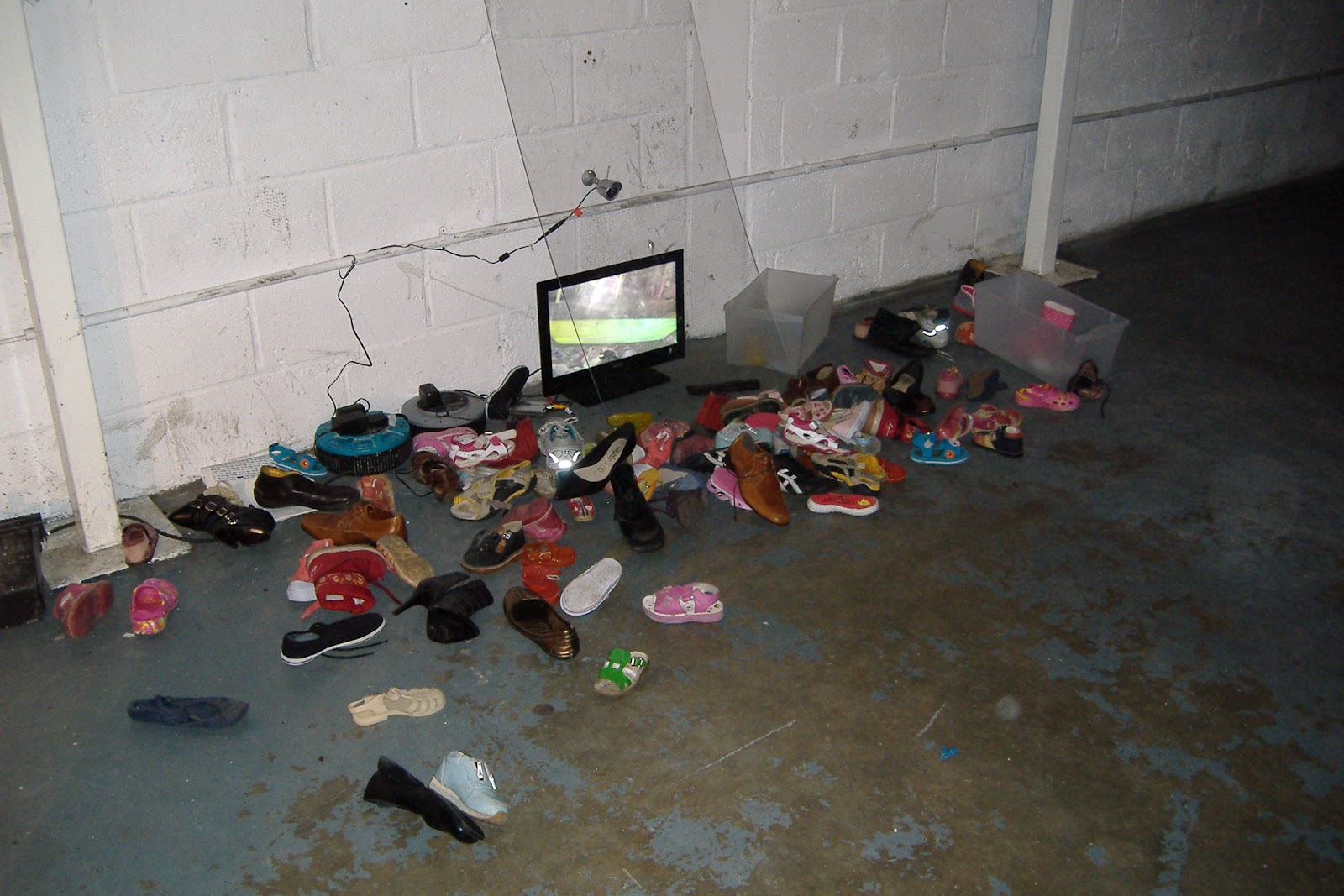
It's difficult to analyse this without taking note of the fact that a few hundred meters away the first day of the Paralympics was in full swing; presenting a very different vision of disability to Lakmaier's piece. The Paralympics tend to present a somewhat sanitised vision of disability. The participants are described in terms winning personal battles, of "overcoming" their conditions to reach success. It seems unlikely we would ever see a cathartic release of anger like Lakmaier's piece in any context in the Paralympics, although I imagine that most of the athletes participating have had their moments of intense frustration and loss of control of their own. In terms of frustration felt, it's notable that these Paralympics are sponsored by ATOS, the organisation tasked with certifying as many people as possible as 'fit for work' and to therefore cut their benefits. I've read accounts of people in final stage terminal illnesses, or those in constant excruciating pain being certified as 'fit for work', often against the advice of the patient's GP. With this as backdrop, Lakmaier's explosive anger against the televised image of herself seems timely, appropriate and incisive.
 |
| Alicia Radage's Islands (with Sebastian Hau-Walker) |
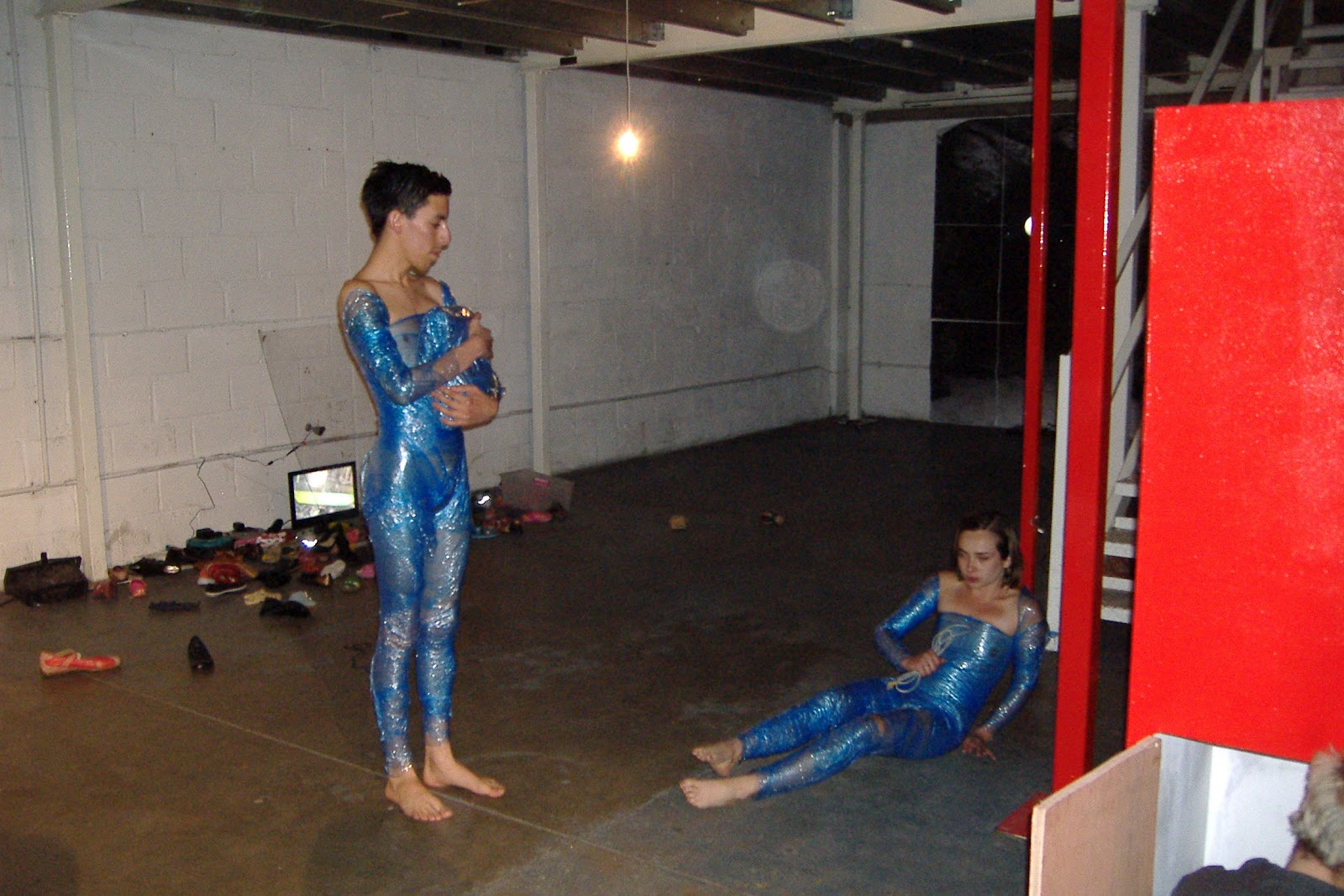
Soon after was Alicia Radage's 'Islands', performed in collaboration with Sebastian Hau-Walker. The two came regally down the stairs from the upper-level, clad only in tight blue cling-film. The outfits made both performers androgynous, lending them a sort of Bowie-esque 'loving the alien' feel. Even though the outfits were extremely tight and defined every part of their bodies they appeared somehow quite sexless in a futuristic way. Radage lay on the floor clutching a similarly blue, clingfilmed package, while Hau-Walker dragged her to the centre of the room. Tearing open the package on her chest revealed that it was full of soil. Hau-Walker took handfuls of the soil, and eventually constructed a right-angled triangle outline of soil on the ground with Radage in the centre. As this triangle was completed, the positions were reversed and Hau-Walker lay on the ground, while Radage laid out an equilateral triangle around him. Once both triangles were completed, the two performers lay in them, and after a short rest started engaging in frantic physical activity. Radage took a length of network cable and used it as a skipping rope, and Hau-Walker ran in frantic circles, breaking the soil outline around him. After a few minutes of this, Radage lay down on the floor, arms splayed in a cruciform and Hau-Walker dragged her across the floor, breaking the pattern on the floor.

According to Radage she "explores constructing places out of space when multiple bodies are present". Even with this mind I had mixed feelings here, partly because I'm not sure I understood what was happening, and I didn't think I much of chance of deciphering the symbolism. Every action in this piece seemed to have been carefully choreographed; movements were slow and deliberate; there was a definite air of ritual to the laying out of the soil. Laying out unbroken geometric patterns like this echoes magic ritual and the creation of a sacred space, at two seemingly important points in this performance these outlines were broken. This seems important, but I can't quite put it all together. In a performance as deliberate as this, I figure that every aspect must have meaning of some kind, for example the fact that Radage is using a network cable to skip with must somehow have meaning in and of itself, although I can't work it out.

Even though I was unable to work out any kind of clear message, I could appreciate the performance on aesthetic grounds. The clean artificial blue of the clingfilm was a nice contrast with the chaotic soil, and this conflict between order and disorder was continued in way the patterns were created and destroyed. Unfortunately, the stately method by which the patterns were laboriously set up meant that this was a very, very slow moving piece. When Radage begins constructing the second triangle around Hau-Walker I was silently willing her to hurry up a bit. I understand I'm not here to be 'entertained' as such, but even so, standing up in silence reverently watching as cryptic as this for what felt like 20 minutes or so can get a bit much.

Up next was Marta Frank's 'The Big Match Girl'. The lights were switched off, plunging us into darkness. Frank stood in the middle of the circle reciting a poem: "Bye baby burning / Daddy's gone a hunting / Gone to get a big bear skin / To ash his baby burning in." As she did this, she lit matches, briefly illuminating the room and dropping them at her feet as they burnt out.
I don't think this performance worked particularly well. It seems like a piece that relies on darkness, and where the the only illumination in the room is from the performer. Here there was frequent light from people checking their mobile phone, using the toilet and entering or leaving the room. In addition, although she was performing 'in the round', with people watching from all sides the artist only faced one direction. I was sat behind her, and as a result couldn't really see what was going on very well. As the room was darkened, I didn't really want to move to a better position for fear of tripping over someone. Another factor was the gallery photographer. This was a quiet, intimate and seemingly quite personal piece of work. The artist seemed to consciously isolate herself within the room. To get good photos of the performer lit by matchlight, the photographer had to get right up in her face with a very loud camera. The performance was punctuated by loud 'click click click' noises from his camera. It was very distracting, and considerably detracted from the performance. I understand the need to document proceedings, but when you reach the point where you're actively disrupting the piece it's time to take a step back. I think overall this piece would've benefited from both a smaller audience, and a smaller and more tightly controlled performance space.
 |
| Season Butler |
After two quiet and meditative pieces I was in a mood for something a little bit more bombastic. Season Butler more than provided this. She descended the stairs of the gallery wearing a large paper skirt, to loud music. Now that is a damn entrance. She walked to the centre of the room, and unexpectedly hurled a mug full of what I think was salt behind her. I was standing in the path of this, and although I managed to avoid most of the shards of mug, my glass of wine got an unpleasant shower of salt in it. Oh well, shit happens. This sudden violence sent an immediate murmur of danger through the room, which felt sorely needed. She then took off the paper skirt, which resembled a wedding dress or ballgown, and it crumpled on the floor in a big pile. The now naked Butler peeled off a can of hairspray that was taped to her thigh, and using a lighter to create an improvised flamethrower, torched the dress. It went up in flames quickly and satisfyingly. As it burned away she lay supine on the floor, and lit a cigarette while she watched it burn.

There was a very real sense of danger here. A fire inside a relatively confined space like this seems to set off some kind of fight or flight reaction in people. The strange feeling of fear and excitement, coupled with the provocative performer was very refreshing. The simple fact of having some musical accompaniment also seemed to liven things up a bit. Both this piece and Marta Frank's used fire, but whereas Frank's piece used the matches extinguishing as a symbol of death, Butler used her aerosol flamethrower as a symbol of both life and destruction. In destroying the cumbersome garment, Butler is in one sense liberating it into brief but bright life. There is also a transformative aspect here, after the dress had burned we were left with cinders lying across the floor, looking like a miniature mountain range. This, coupled with the naked femininity of the performer reminded me of images of the Hindu Goddess Kali, a symbol of both annihilation and rebirth.

Next on was Jess Rose. Looking sullen and confrontational she repeatedly applied red lipstick to herself and planted kisses all over a white chair. Eventually she rolled around the floor with the folding chair, locked in a violent/loving embrace with it. The piece, entitled 'Cyffes Fydd y Corff (Darn 2)', was interesting, but seemed a bit one-note and conceptually hollow. The movements here seemed intended to look spontaneous and uncontrolled, a wild communion with an inanimate object, but it felt somehow self-conscious throughout. It had an element of catharsis, but in comparison with the acutely felt anger of Noëmi Lakmaier's earlier performance it felt far more calculated.

 |
| Jess Rose, 'Cyffes Fydd y Corff (Darn 2)' |
After this, a male performer (whose name I am not entirely sure of), walked around the gallery in the darkness singing "Democracy is Hypocrisy" before leaving the room. I'm guessing he's quoting Malcolm X here, although to what end I don't know. Whatever his intentions, the slogan is presented shorn of all context, and becomes meaningless very fast. I really didn't like this piece. It struck me as self-indulgent and smug. I see two ways to decode it, neither which are particularly attractive.
The first is that you recognise the quotation, and attempt a reading based on a knowledge of Malcolm X. Obviously, you're going to immediately think about race; this is after all a white artist quoting probably the most famous 'Black Power' activist of all time to a predominantly white audience. Repeating the phrase over and over again almost seems to mock it. The sentiments behind Malcolm X's view of US democracy as being hypocritical are accurate and well considered. Repeating this phrase over and over as a slogan has (and I'm sure it's unintended) the effect of mocking the idea. The second reading, if you're not familiar with the origin of the phrase, is that you have an artist walking around singing a cryptic slogan that doesn't mean anything. In isolation "Democracy is Hypocrisy" barely works as political sloganeering, let alone a coherent statement or philosophical point. It was half-arsed, like a parody of performance art rather than the real thing.
I left pretty soon after this piece, and it left a bit of a bad taste in my mouth. But I did have a great time last night. Everyone at these events is friendly and welcoming. The artists seem more than happy to explain what they're doing, and the organisers are generous to a fault. In terms of actual artistic content I felt it was a bit of a mixed bag, but even though I didn't like all of it, I appreciated the effort and thought that went into pretty much everything there.
Please let me know in the comments if I've missed anything, or screwed something up.
Subscribe to:
Posts (Atom)