Recent Articles
Showing posts with label Trafalgar Studios. Show all posts
Showing posts with label Trafalgar Studios. Show all posts
Saturday, June 29, 2019
Saturday, June 29, 2019
- 0 Comments

Reviewed by David James
Rating:

The late 1970s and early 1980s were a golden age for British TV science fiction. Tom Baker was deep into his tenure on Doctor Who, while shows like Quatermass, Blake's 7 and Space: 1999 were cementing themselves in popular culture. What they lacked in budget they made up for with ideas, building passionate fanbases that persist to this day. But there's one show you won't have heard of: Dark Sublime.
It tells the tale of Captain Vykar and plucky crew of the space Skelder, who seek to prevent villainous interdimensional space queen Ragana from breaking through to our universe. All she needs is the Shadow Ruby and we will be doomed to slavery under her sadistic rule.
But that's not what Dark Sublime is about. Set in the present day, we follow Marianne (Marina Sirtis), who played Ragana. It's now been 35 years since Dark Sublime aired and for her, the show is a hazy memory amidst many other roles. That all changes when Oli (Kwaku Mills) enters her life.
But that's not what Dark Sublime is about. Set in the present day, we follow Marianne (Marina Sirtis), who played Ragana. It's now been 35 years since Dark Sublime aired and for her, the show is a hazy memory amidst many other roles. That all changes when Oli (Kwaku Mills) enters her life.
He's a cult TV superfan, having latched on to some grainy bootleg DVDs of the show and discovered something wonderful. He's on a campaign to bring the show back into the public eye, campaigning for a re-release and organising the inaugural Dark Sublime fan convention, at which Marianne will be the star attraction.
Though Marianne is appreciative of Oli's attention, his adulation makes her feel vaguely fraudulent. She simply cannot understand what they are seeing in a silly and dated show that was just another job for her.


Bubbling away in the background (and often in the foreground) is Marianne's relationship with Kate (Jacqueline King). The pair have previously been romantically entangled, though that has runs its course. Now they've settled into a close friendship, though there's still a lingering (and unreciprocated) desire. Anyway, Kate is now in a new relationship with Suzanne (Sophie Ward) and life has moved on.
Writer Michael Dennis (making his debut) has found a decent seam of drama in the world of cult TV fandom, conventions and actors living off their past roles. Most fan conventions any contain rows of desks populated by washed-up actors who once appeared in cult shows and a pile of glossy headshots ready to be signed. What does the man who once played Stormtrooper #14 really think of the people who turn up at his desk?
Casting Marina Sirtis as the lead makes this material fizz. She played Betazoid empath Deanna Troi on Star Trek: The Next Generation, which means she has first-hand experience with dealing with fans at conventions and knows what it's like to be best known for a role she hasn't played in years. Sirtis' experience in dealing with fans shows in her performance, it's easy to surmise that Marianne isn't a million miles away from Sirtis herself.
Dark Sublime is at its best when it's getting under Marianne's skin and exploring her lopsided friendship with Oli. Unfortunately, the play also deals with a tonne of other, much less interesting stuff. For example, there's an interminable scene in which side characters Kate and Suzanne lie on the grass outside Alexandra Palace and idly chat about their jobs.
It means that large portions of the play are, to be brutally honest, very boring. This is particularly evident in the first act, in which the characters and their relationships are established at a glacial pace. By contrast, the second act starts with an energetic bang, with Oli excitedly introducing his convention and what we can expect.

This going to sound extreme, Dark Sublime would improve by leaps and bounds if the entire first act was cut. The fan convention is where the show's themes are strongest, it's where we get to meet big personalities, it's where the funniest gags happen and where there is genuine tension between the fans and the stars. By comparison, much of the first act is people sitting around in a living room having circular, meandering conversations studded with mediocre jokes.
All that's a pity, because Dark Sublime has clearly had a lot of love poured into it. The programme cover is a beautifully designed rendition of The Dark Sublime Annual 1982, and the interior contains tie-in books featuring the cast and TV Times cover stories (all by the obviously talented Clayton Hickman). The general design of the show is also pretty spiffy too - even though I didn't think much of the show I considered buying a t-shirt just because the logo was so cool.
Plus I can't pick any holes in the cast. Sirtis is great, but Kwaku Mills sometimes seems on a one-man mission to entertain us, and pretty much every moment Oli is on stage he's doing something interesting. Also great is Simon Thorp's brief appearances as Vykar, in which he neatly skewers the Shakespearian actor 'lowering' himself to run around with a toy raygun.
It's frustrating that Dark Sublime contains all these objectively great elements, as they end up diluted by so much unnecessary material that even they get washed away in a wave of ennui.
Dark Sublime is at Trafalgar Studios until 2nd August. Tickets here.
Review is of the 27th June preview rather than the 28th June press night.
Wednesday, November 8, 2017
Wednesday, November 8, 2017
- 0 Comments


Cultural dominance is lucrative stuff, as anyone that's glanced at the FIFA corruption investigations will know. Get the right tournament in the right place with the right sponsorship deal can lead to dump trucks full of money unloading in your Swiss bank account, a daisy-chain of backhanders: on one end gold-plated Rolls Royces and on the other slave labour in a baking hot Qatari building site.
But all this seems pretty damn distant from the changing rooms of the non-league team that' the subject of Patrick Marber's The Red Lion. Set entirely in a changing room that has seen better days, we follow three men making their way through the unglamorous side of football. They are club manager Kidd (Stephen Tompkinson), kit man Yates (John Bowler) and talented young player Jordan (Dean Bone).
Over a (rather appropriate) 90 minutes, we discover what the game means to these men. Each lives and breathes football, finding in its rules, structure and harmony a contrast to the chaos of their personal lives. Yet while each briefly tastes escape, the sport also exacerbates their flaws: resulting in a tangled web of backhanders that's dubbed "playing the angles".
The amounts of money talked about here are pitifully small: players are given cash bungs of £30 to keep them sweet, characters complain that they're struggling to pay the rent and, in my favourite touch, mid-way through the play we notice that Kidd has downgraded his phone from an iPhone to a pay-as-you-go dumbphone. The biggest sum of money spoken of is a £7000 transfer fee, destined to divided out into very small slices to very many people.
Marber's typically rapid-fire dialogue is (as always) a pleasure to absorb, but for my money The Red Lion's true excellence is showing us the tug-of-war between the ideals of the sport and its grubby financial reality. The trio treats moments of footballing skill with religious awe: former player Yates describing the moment he scored in an FA Cup match against a professional team like someone who has been born again; and Kidd and Jordon share the simple ecstasy of a player who can run rings around his opponent.
But all too soon you sense the poison leaching down from up on high. Sepp Blatter and Kidd might be worlds apart but they are also intrinsically connected to one another, coaching their corruption in pragmatism and finding solace in dragging others down with them. If Marber had written a play about top-level FIFA corruption I have no doubt that it'd be good, but it'd lack the pathos of watching otherwise good men scrabble in the mud for their handful of shekels.
So yeah, The Red Lion is a good play. If you're a football fan you'll love it. If you're not (like me) you'll appreciate a taut, lyrical, well produced and performed piece of theatre. This universality is the cherry on top (it is presumably not by chance that we never see anyone kick a football, or even see a ball at all) and makes for a play with a meaty sociological scope.
The Red Lion is at Trafalgar Studios until 2 December. Tickets here.
Tuesday, September 26, 2017
Tuesday, September 26, 2017
- 0 Comments


Sex and death go together as well eggs and bacon. Female praying mantises famously consume the heads of their paramours, the male anglerfish is entirely absorbed into the female after sex, and orb weaver spiders of the Argiope genus die after inserting their sperm-transfer organs into the female. It was perhaps while observing nature in all its fucked up glory that some French dude decided that 'la petite mort' was a great name for orgasm.
Working on similar lines is Stephen Clark's Le Grand Mort, a twisted little play studded with knives, bodily fluids, wine, incest, murderous intent and where the air is infused with the smell of frying onions. Except for a couple of short flashbacks, the play takes place entirely within the (fully functioning) kitchen of middle-aged architect Michael (Julian Clary). It's all brushed metal and vaguely OCD cleanliness, each pot, pan and surface appearing surgically sterilised. On the wall is a life-size statue of Da Vinci's Vitruvian man, a bit of interior decor that's so homoerotic it borders on parody.
Michael is expecting company. In a bar that evening he was propositioned by the confident, wordy and intriguing Tim (James Nelson-Joyce). He's a scouser with a lot to say, approaching conversation like a swordsman, forever ducking, feinting and parrying whatever's said back at him. He's also built like a brick shithouse and (somehow inevitably) ends up strutting about buck naked.
The first act is given over entirely to Michael as he prepares dinner (pasta puttanesca - the 'whore's pasta') and delivers a rangy, poetic monologue on sex, death and the cocktail the two add up to - necrophilia. We hear how the beautiful wives of Pharaohs would be left to rot for a couple of days in order to prevent those trusted to mummify her from getting off, which quickly dovetails into a mega-gross urban legend that the mortician entrusted with Marilyn Monroe's body was charging Hollywood's finest perverts a handsome sum to defile her Nembutal swollen corpse.


The monologue is as well written as it is bizarre. The part was written specifically for Clary and he takes obvious relish in delivering the strange subject material, accompanied by the rhythmic chop-chop of knife on board as he precisely bisects some suspiciously glans-like peeled tomatoes. Clary's Michael is measured and compelling, so much so that it's a bit of a shock to the system when the far more outre Tim shows up and ushers in chaos.
From here the play expands outward to encompass incest and child abuse, tumbling into a confused and slightly dream-like repeated reversal of fortunes. Each man wields a knife against the other, the weapon repeatedly swapping hands and the threats feeling more like extremely kinky foreplay than any actual danger of death.
So what do all these ingredients add up to? Clark keeps things purposefully vague, which on one hand gives the play its disorientating wine n' semen haze, but on the other, you sense that these characters are mere vehicles for the playwright's discourse on the relationship between sex and death. Clark identifies the thread that binds them as the desire for ultimate, true intimacy - the penetration of the body by another - be it by cock, blade or hand (a highlight is Michael relating the story of Howard Carter desecrating the body of Tutankhamun). I am generally loath to tie down the content of a play to what I know of the writer's personal circumstances, but it is difficult not to conclude that the morbid subject matter springs from the illness Clark suffered from while writing it, which resulted in his untimely death last October.
Le Grand Mort is not a perfect play. Clary and Nelson-Joyce give it some welly, but both characters are built on wobbly foundations. This leaves the narrative stunted - those who watch theatre with the desire to emotionally engage with the characters will most likely be left in the cold. That said, it's undoubtedly interesting, entertaining and multi-faceted, with the binding together of sex and death lent weight by the circumstances surrounding its writing.
Le Grand Mort is at Trafalgar Studios 2 until October 28. Tickets here.
Friday, July 21, 2017
Friday, July 21, 2017
- 0 Comments

Pig and Runt are at the top of the food chain. They met as newborns on the Cork City maternity ward and have been inseparable for the following 17 years. Their stomping grounds are pubs, offies and nightclubs: their lives a tsunami of cheap booze, dance music and a touch of the old ultraviolence. Feeling isolated in a snooty world they cling to each other, diving deep into Bonnie and Clyde self-mythology as they transcend depressing reality and become rock star super-criminal outlaws.
The pair form a single chaotic organism: emotionally, physically and behaviourally intertwined. And yet cracks are beginning to form. Pig is battling with strong romantic inclinations towards Runt, but she considers him more of a brother than a lover. And then there are the moments where she seems to sense a world beyond dingy urban streets and sulphuric cider. Things are going to boil over between them at some point, and this play shows us how it goes down.
Disco Pigs premiered at the 1997 Edinburgh Festival to critical acclaim, leaving audiences and promoters goggle-eyed. A two-year world tour, a West End production and a feature film followed. And then the play submerged, only popping its head above water for periodic revivals. And so to Trafalgar Studios, where director John Haidar and stars Evanna Lynch and Colin Campbell find out what Disco Pigs feels like 20 years later.
The answer is a satisfyingly retro. Leaving aside the excellent soundtrack for a moment, Disco Pigs taps into a specifically 1990s misanthropy, delivering the romanticised, predatory thrills you see in Natural Born Killers, True Romance and Funny Games (and their common ancestor, Kubrick's A Clockwork Orange). Looking back, this predilection for 'cool' characters slaughtering anyone who stands in their way to an on point soundtrack looks like a bad case of pre millennial tension - with the West in a state of relative peace and prosperity the most satisfying prick to kick against was apparently everyday tedium.


Designer Richard Kent provides a stark backdrop to the action - a bare stage with a malleable curtain at the rear and glowing telly in the corner. Lighting wise it's a show of harsh primary coloured washes, Runt and Pig glowing radioactive green or red as they tear their way through an off license or kick in the teeth of any unfortunate victim who gets in their way. Later in the show, they deploy a fantastic laser, leaving a psychedelic curtain of shifting light above the actors.
Trafalgar Studios 2 is a relatively small performance space, but such minimal staging is still risky, requiring the performers to do the heavy lifting. Fortunately, Lynch and Campbell hurl themselves into the roles like it's their last night on earth, Pig and Run a multicoloured Tasmanian Devil style whirlwind of Adidas, sneers and flailing limbs.
Underneath all the testosterone bluster, Campbell's Pig is quietly sad performance, battling his desires and gradually realising that bravado just isn't cutting it anymore. He gets long moments in the spotlight as he dances to a blistering playlist of 90s dance hits - not giving a shit as he throws shapes with a determined expression. You can see on his face the gradual realisation that Runt is evolving in a different direction, leaving Pig struggling to maintain the status quo.
But Lynch is no slouch. Her Runt is a wirily electric harlequin, her face alternating between a performative punk sneer and wistful glances off into the horizon. Both characters are stuck in the Red Queen's dilemma - running as fast as they can to stay in the same place - yet Lynch's Runt is beginning to realise that there's more to life than this endless cycle of noxious booze and mindless violence.
Bold, uncompromising plays like this are what I go the theatre for and I enjoyed every minute of Disco Pigs (honestly, I'd enjoy any production that plays most of Underworld's Rez). It took me a couple of minutes to pick up the lingo, but as soon as you figure out what the characters are on about the play rattles on with ever-increasing momentum. It's a damn good time is what it is.
Wednesday, September 7, 2016
Wednesday, September 7, 2016
- 0 Comments

Vanities the Musical is about three dull cheerleaders who grow up into three dull middle-aged women. It presents a real head-scratcher: why would someone revive this extraordinarily dated and humongously naff musical?
Set initially in mid 60s Texas, we meet three teenage girls changing into their cheerleader costumes. They are Joanne (Lizzy Connolly), Kathy (Ashleigh Gray) and Mary (Lauren Samuels). Bubbly and bitchy in equal measure, not even the Kennedy assassination distracts them from looking pretty and mooning over boys. The rest of the play follows them through college, their twenties and finally concludes sometime in the 80s. As is expected from this sort of thing, the three start out best buds, their lives diverge and they find they don't have much in common, then they get older and realise they do: cue the hugs and pass the sickbag.
First things first: the cast bear absolutely no responsibility for this shambles. All three actors approach this with steely-eyed musical theatre professionalism, giving their roles some welly and doing their best to mine every atom of humour from deeply unpromising soil. Lizzy Connolly is the funniest, taking advantage of a scene where her character gets drunk to work through some broad, though successful comedy.
Similarly, set design and costuming is worthy of praise. You'd expect the characters in a show called Vanities to look good, and Andrew Riley's costumes and Richard Mawbey's wigs go a long way to capturing the aesthetics of the past. Similarly, Riley's set is a cleverly modular and malleable bit of design which allows for various backdrops and on-stage costume changes.
All that said, you can polish a turd but it'll still be a turd. There's multiple levels of bad here, but let's start with the awful music. Sadly, the production must bear some responsibility for this - the plinky-plonky synthesised tunes sounding like the demo mode on a Casio keyboard. Then again, even if they were played by the London Philharmonic this would still be dreary as all hell.


The style is elevator pop, a book formed of soppy sub-Bacharach ballads that go nowhere and are as emotionally moving as a Hallmark card. The nadir is Cute Boys with Short Haircuts, a test of audience endurance that goes on and on and on picking through crap lyrics like "The cute boys with short haircuts / In a maze of their own / And here I am a little lamb so lost and all alone". Cry me a fuuuuuucking river.
The non-singy bits aren't much better. These are more archetypes than characters, never even approaching three dimensionality. Part of the problem is that the dramatic structure of periodic check ins with the characters over the years means we get to hear all about the semi-interesting things that've happened to the characters, but we never get to see them. It's a pretty egregious violation of the rule of 'show don't tell', and leaves us frustrated - if there's all this drama going on off-stage, why aren't we seeing it!?
All of this is infused with an insipidly bland sentimentality. When the show began I figured that this cleancut All-American perkiness would soon be subverted and satirised, perhaps in a John Waters sort of style. It never comes close, settling for a vomit-inducing paean to the power of female friendship. Now, as we all know, friendship is indeed magic, but there's only so much of this syrupy crap I can take before I'm imagining reaching for a shotgun, sliding the cool barrel into my mouth, awkwardly hooking my toe around the trigger and Kurt Cobaining my brains over the wall.
I couldn't get out of there fast enough. Vanities is the kind of show that leaves you chain-smoking and blankly staring into the dark waters of the Thames, pondering precisely what cancer lies at the heart of the human condition. I mean, sure the wigs were nice and it was funny when that one woman knocked her handbag over, but are people actually entertained by this nightmare? I mean... they clapped...?
An involuntary shudder.
An involuntary shudder.
The skies darken. Apocalypse now. The horror! The horror!
Friday, July 29, 2016
Friday, July 29, 2016
- 0 Comments

Rotterdam sucks. Granted, that's mainly because the Nazis dropped 1,300 bombs on it in one night. With its medieval city centre wiped off the face of the earth, the way was paved for a present of anony-corporate skyscrapers, shopping centres as far as the eye can see and a clawing vacuum where a personality should be. With Utrecht and Amsterdam only forty minutes away by train, why would anyone stay in Rotterdam?
This is the thorny question facing Rotterdam's characters, each of whom is trapped there in a sadistic social and romantic oubliette of their own devising. The core are Alice (Alice McCarthy) and Fiona (Anna Martine), two British women who're deeply in love. Along for the ride is Josh (Ed Eales-White), Fiona's older brother. Complicating matters is that Alice came to Rotterdam as Josh's girlfriend, but was immediately smitten on meeting his sister, who subsequently moved over.
In the opening scene, Fiona throws a bomb into this dynamic. She explains that she's always felt like a man in a woman's body and is planning to undergo a gender transition. Henceforth she will be known as Adrian. With her once-girlfriend looking and behaving ever more masculine, Alice is in a bind. If she's a lesbian but her girlfriend is now a man, does that make her heterosexual? If she's in love with Fiona, does that mean she's automatically in love with Adrian?
The situation proves quite the pickle, compounded by the arrival of the hyper-neon, ultracool 21 year old Dutch lesbian Lelani (Jessica Clarke), who oozes the feminine sexuality that Alice feels deprived of.

It's a plot set-up that never feels remotely contrived, and no doubt analogues of this situation have taken place in countless hetero/homo relationships - be it a woman explaining her need to live as a man or vice versa. Playwright Jon Brittain displays a reassuringly extensive knowledge of trans issues, from the physical and emotional effects of the person undergoing transition to the reactions of those around them.
These days its trendy (almost cliche) to state that gender is performative. In an ideal world Fiona's transition into Adrian is just be someone donning a set of gender signifiers that tessellate better with their psychology. Rotterdam explains that it's not as simple as that; coming from the angle that Fiona is essentially dead after the transition and that there's a new person, Adrian, in her place. Sure Adrian looks similar to Fiona, has the same memories and same basic personality, but they're quintessentially not the same person.
No-one envies Alice having to deal with this - her fears communicated in powerful monologues where she bemoans the social pressure to be tolerant and supportive of people expressing their true gender identity (despite any knock-on emotional consequences for you), worries about whether she can be attracted to a man and angrily reacts to her own sexual identity being redefined without her consent. When the play grapples with these questions about gender, identity and sexuality, it's effective, intelligent and dead serious.
Mercifully, the rest of the time it's goddamn hilarious. Generally maintaining a sharply comic tone, there's at least five or six humongous gags that go off like a rocket. It's always a good sign when your actors have to pause for a moment before delivering their next line to wait for the audience to stop laughing. Some of these come from the more straightforwardly comic characters of Lelani and Josh, both gentle caricatures that bustle on the borders of the core relationship. Some simply arise without a punchline, as the audience collectively figures something out and laughs that they hadn't noticed it before. It's rare to see a comedy this finely balanced - script and performances polished until they shimmer.
All four actors turn in carefully judged performances. Jessica Clark's Lelani injects a jolt of manic energy whenever she appears. Ed Eales-White's Josh is wry but shows a heart a mile wide, quietly suppressing his own feelings in order to support two women he deeply cares for.

In Alice, Alice McCarthy gives us a fully rounded performance, her stress, confusion and general emotional exhaustion combining to make a relatable, likeable woman. I was sat in the front row, getting to see her performance close-up (so close she actually kicked me in the knee). I particularly enjoyed her obvious frustration that her own mini-drama (struggling to come out to her parents) is ridden over roughshod by the more attention-grabbing gender transition.
But you've got to single out Anna Martine's boldly aggressive, intensely vulnerable Fiona/Adrian. A striking physical presence from the get go, she moves with a nervy electricity that makes her happiness infectious and her despair crush like a mace. As the effects of transition take hold, her behaviour subtly shifts towards what initially feels like a caricature of masculinity, toying with audience sympathies. These tectonic character shifts are the fulcrum on which Rotterdam turns: it's difficult to imagine the character being done better than this.
My only criticisms are a couple of overly didactic conversations that have a tinge of being transplanted from books/articles encountered during research and an ending that didn't quite stick the landing. It nearly did, but for me something frustratingly indefinable felt off.
Still, by any standards this is a marvellous piece of drama. I was gutted to miss it at it's original run in Theatre503 and pleased when I heard of this (entirely deserving) West End transfer. Rotterdam is the kind of drama that people will look back on in years to come: neatly encapsulating the explosion of identity malleability that've marked sexuality in the 2010s. All but essential.
★★★★
Rotterdam is at Trafalgar Studios until 27 August. Tickets here.
Friday, May 20, 2016
Friday, May 20, 2016
- 0 Comments

"This has been a shit week. I died." Life is so unfair. One minute you're a happy-go-lucky young woman in a loving relationship with a young daughter, the next you're a freezing lump of decomposing meat trapped in a soggy limbo. That is Alice (Tamia Kari), newly dead, and This Is Living.
Fortunately 'life' isn't completely lonely six feet under. She's visited by her husband Michael (Michael Socha), a decent yet vulnerable man riddled with equal parts grief and guilt, facing up to the prospect of raising their daughter alone. Over the course of the play the two pick their way through their past and future to decide what Michael does next and Alice... well who knows what lies beyond the veil?
Cleverly, playwright Liam Borrett (also directing) never defines precisely what form his afterlife takes. Alice could be anything from a literal ghost, the dream/nightmare of a mourning partner or simply his conscience eating away at him as he contemplates suicide. Whatever she is, it ain't sunshine and roses.
Borrett and designer Sarah Beaton stage the play on a large raised oblong, upon which a thick black tarp is fixed. Water puddles on wrinkled service, creating pools that ebb and flow as the characters move about the stage. It's immediately striking: the water both evoking tears and implying a cold fluidity of motion that fits in perfectly with these wanderings between life and death.
On a purely practical level, full credit to everyone involved for making this wet production work. Splashing about in tepid water for two hours can't be much fun for the actors, and I can just imagine the nonplussed reaction of a lighting designer being informed that they have to place underlighting mere inches from a puddle. But the water really pays off; Tamia Kari appears to be gently rotting the wetter she gets; it accentuates the atmosphere of misery and grief; and the physical moments are that much more visceral when accompanied by arcs of glittering spray.


On top of that, Jackie Shemesh is responsible for one of the most intelligent lighting designs I've seen in a good while. When the play switches gear from afterlife to flashback, the lighting shifts appropriately, seesawing the play between a warm summer's glow and shivering midnight. Most impressive is a moment when the couple stand facing one another. Michael stands with a spotlight that casts a clear silhouette against the back wall, while Alice (despite being lit) casts no shadow at all. It's subtle, striking and spooky in all the best ways.
All that's impressive enough - though these delights would amount to nothing without two sturdy performances at the centre. Kari and Socha more than provide, constantly underlining their characters' normality in the face of the play's surreal supernatural elements. Who can't fall in love with a character who - upon awakening as a magically animated corpse in a gloomy nightmare world - exclaims "Oh god... have I been on the Blue Nun again?"
Both are more than easy to like, and it's obvious they like each other. Kari and Socha's first flirts and romantic encounters have a ring of truth about them, as well as the way they gradually opening up to one another as their lives intertwine. They're also both very funny, and given the grim themes that This Is Living grapples with, some belly laughs are sorely needed to prevent us getting dragged down in the doldrums.
My only real criticism is that the play ends, then it doesn't. No, seriously - the story reaches a satisfying emotional and thematic climax, the lights go out and everyone wholeheartedly applauds what we've seen. Then the lights come back up and we sit through a confusing and entirely unnecessary epilogue. This vestigial scene is narratively extraneous, not to mention that it's aesthetically tone deaf. The play gets its proper round of applause soon after, but this final scene is so obviously surplus to requirements that I can't imagine it'll stay beyond the first couple of nights.
Aside from that, this is great stuff. Borrett, Kari, Socha and Beaton take the audience somewhere that feels theatrically unique - a place of damp, blurred and fuzzy gloom so slick and slippery that its slide between your fingers as you grip it. While some plays flit in and out of memory as passing diversions - This Is Living, with its powerful visuals and emotive storytelling, will stay.
★★★★
This is Living is at Trafalgar Studios until 11 June. Tickets here.
Tuesday, February 23, 2016
Tuesday, February 23, 2016
- 0 Comments

Firebird is utterly brutal. Playwright Phil Davies, a native of Rochdale, unflinchingly examines the notorious sex trafficking gangs that exploited children in his hometown up until a couple of years ago.
The story is a sprawling web of misery, blame and institutional incompetence - so Davies zeroes in on one girl: 14 year old Tia (Callie Cooke). She's a lonely foster child from a miserable estate, and finds herself groomed for sexual slavery by the manipulative AJ (Phaldut Sharma).
The five scene play chronicles their meeting on a rainy night in a kebab shop, her repeated gang-rape at the hands of his friends and her frantic efforts to communicate what's happened to a sceptical police officer. Wrapped around this purestrain misery is the shaky friendship between Tia and fellow 14 year old Katie (Tahirah Sharp), who gradually understands why her new friend is such a "weirdo".
Cards on the table here: nobody who buys a ticket for Firebird is going to have a particularly nice night. This is hardcore misery and believe me, I know it when I see it. When I don't have my arts critic hat on, I work in law and I've participated in many trials studded with acts of unbelievable cruelty. I've watched testimony from traumatised victims of rape, seen stomach-churningly grisly crime scene phones and listened to a 999 call in which a woman gets beaten to death while screaming for help that never comes.
It's the kind of stuff that leaves a mark on you. Firebird does too. The obvious counterpoint to that is that a trial is real life. Can any piece of theatre, no matter how good, really compare? But Firebird reverberates with journalistic verisimilitude: if you're familiar with the case you'll recognise the loosely fictionalised elements strewn throughout the script. If you're not knowledgeable about it you instinctively sense that you're watching a close re-enactment of something that happened.
It felt real.
Alarmingly so.

Davies' excellent writing accounts for a decent portion of this, displaying a hometown familiarity with cadence and dialect that gives the play credibility. The rest is primarily down the heartbreakingly raw Callie Cooke, who gives hands down the best performance I've seen in the last six months.
Her greatest accomplishment is maintaining Tia as an individual throughout the entierty of her ordeal. Crucially the character is both a) genuinely pretty funny and b) one of the most realistic teenage girls I've seen on stage lately. She's stroppy, smart-mouthed but, despite her protests and occasional drunkenness, is clearly a child. Cooke brings an innate charisma to the stage: a quality that makes the sustained scenes of violence, manipulation and police negligence hard to bear. She's, in a word, fantastic.
The visceral quality she brings has a startling effect on the audience. Director Edward Hall makes the smart decision to stage it in the round. This not only induces claustrophobia, but allows us to see the faces of the people sat opposite. I saw members of the audience openly sobbing, gritting their teeth with anger and, most commonly, turning their heads away, unable to continue watching.
For my part I felt a sense of miserable inevitability during the opening scenes, then straight-up gut-churning horror followed by outright anger that this could be allowed to happen. It's the kind of play that makes you want to stand up from your seat and berate the characters.
This anger spirals across the perpetrators of Tia's nightmare; the Asian men bringing to life what was hitherto the racist daydream of teenage white slavery and taking their religious subjugation of women to its sadistically psychopathic conclusion. It extends to the authorities: a police force that really couldn't have given less of a shit about teenage girls' rape accusations (yawning through their interviews), on top of a background of defunded and demoralised local governance that appears to have written off these estates and those that live in them.
Finally the play reaches a kind of moral precipice, staring down in judgment at a society that would prefer to sweep unpleasantness like this under the rug. And so what if a few working class women's lives are destroyed in the process?
Firebird casts a daunting shadow over practically everything else on the London stage right now: a sturdy reminder of what theatre is capable of and what it can do that other storytelling media can't. If this were a TV drama: most would turn it off. If it were a film: most would quietly leave.
But once you've sat down in the basement of Trafalgar Studio there's no escape and no changing channel - you're sitting through this nightmare to the bitter end. It's depressing as hell and will spoil your evening, but Firebird is absolutely must-see theatre.
Thursday, January 21, 2016
Thursday, January 21, 2016
- 0 Comments

Casting Dorian Gray is tricky. The story hinges on his unquestionable beauty, repeatedly described in rapturous terms by the other characters. How do you find someone to live up to that? On top of this, we need to believe that this man is capable of acts of extreme cruelty. I've seen a couple of duff Dorian Grays over the years - most of them stumbling when the casting settled for beauty over talent.
Merlin Holland and John O'Connor at least get it right in Guy Warren-Thomas. He combines an innate purity with growing arrogance and sociopathic tendencies, eventually coalescing into a Dorian that's not just some vicarious avatar for the audience to run through their Victorian playboy indulgences, but someone genuinely worrying.
He's the best thing in the production, my favourite flourish his reaction to hearing that his spurned fiancee Sibyl Vane has killed herself: “So I have murdered Sibyl Vane, murdered her as certainly as if I had cut her little throat with a knife. And the roses are not less lovely for all that. The birds sing just as happily in my garden." It's the first moment in which Dorian realises that his soul is absent. Warren-Thomas plays this beautifully, simultaneously excited and disturbed at how little it's affecting him.
Perhaps it's because I've been watching and listening to a lot of David Bowie (RIP) over the last weeks, but Warren-Thomas' appearance, costumes and general demeanour strongly reminded me of his mid-70s 'Plastic Soul' style. In the mid 70s Bowie was pretty much running on cocaine (weighing just 97lb and sporting a 17in waist), while engaging in omnivorous acts of drug-fuelled predatory sexual degradation with virginal teenagers.

Indeed, in the gel-streaked debauchery sequences Dorian writhes around with Bowie-esque vigour to tripped out music, while coloured gels tossing crazy shadows across his angular features and child bearing lips. He twirls madly, sucking down opium while being caressed by a harem girl and a man in a ridiculous turban who looks like a refugee from pantomime. It's camp but effective - the woozy nightmare opium den accentuated by drug-warped voiceovers that dance on a knife-edge of cheesiness.
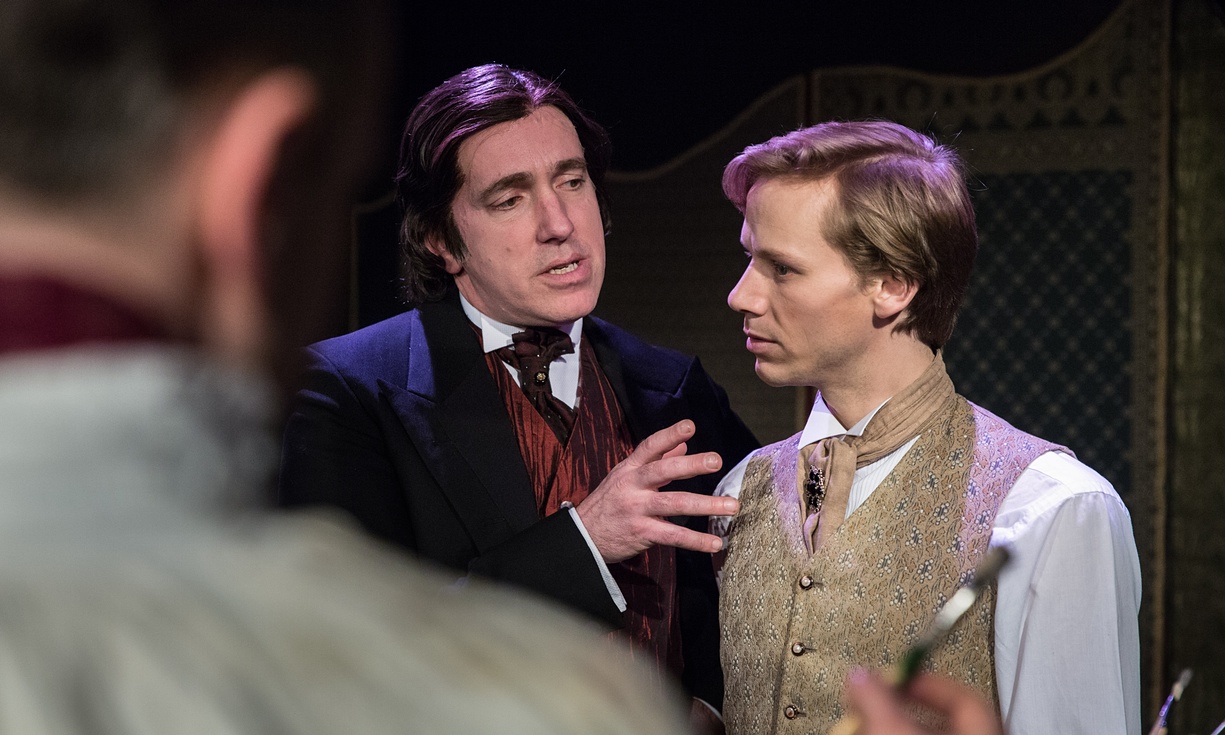
Warren-Thomas' Dorian feels like it's tapping into a wellspring of decadence, updating now quaint Victorian hedonism into self-centred modern fast-living. Indeed, this adaptation accentuates the homoeroticism of the text, promoting subtext to text. Holland (pleasingly (yet irrelevantly) Wilde's only grandchild) does this with the help of the original manuscript, the published version having had the more controversial passages excised.
Facing off against this Dorian is, essentially, Oscar Wilde himself. Henry Wotton has always been a thinly veiled fictionalised Wilde, something this production amps up to maximum. Played by John Gorick, a veteran of playing Oscar Wilde, he looks, behaves and generally is the author trapped in his own story. This doppelganger factor layers on an extra slice of meaning; in the book Wotton eventually realises that Dorian is the logical conclusion of his passion for aesthetics and personal freedom and finding himself disgusted. Here, we see Wilde peering across the 20th century and finding himself alienated..
Though all this is going on under the bonnet, the surface is a neatly executed retelling of a great horror story. With four actors in multiple parts, the company decently recreates a Gothic Victorian sensibility, posing and stuffiness conceals rabid animal desires. As things crank up, Trafalgar Studios' smoke machine gets a decent workout, clouding events in an atmospheric Hammer horror fog.
Unfortunately there's a couple of flaws. It's a consciously minimalist production - a touch too austere given the focus on decadence. Another upshot of this is the often ridiculous contortions the cast must make to navigate between invisible rooms. The characters often walk across the stage, u-turn and walk back along invisible corridors.
Also problematic are comedy peripheral characters that're played a touch too broad. I hope to god these are intentionally funny, because the cast hamming it up like pantomime dames is pretty ridiculous. Though these elements never quite spoil proceedings, they sap away seriousness and distract from the horror elements.
This is a decent translation of a classic work, anchored by John Gorick's Wotton and boasting an effective and occasionally impressive Dorian in Warren-Thomas. While flawed, fans of Wilde won't be disappointed.
★★★
A Picture of Dorian Gray is at Trafalgar Studios until 13 February 2016. Tickets here.
Friday, November 13, 2015
Friday, November 13, 2015
- 0 Comments

The internet allows us to fully realise our lives as narrative. Every experience we have can be converted into a 'milestone' to be disseminated to showcase our personal development, quantify our happiness and display our various successes. Four Minutes Twelve Seconds examines the darkly logical conclusion to this process: grappling with consequences of the 'culture of sharing'.
Sandwiched between two monolithic abstractions of OLED screens, writer James Fritz tells us a tangled tale of Jack, a 17 year old dealing with an online video of him having sex with his girlfriend. Jack, is an off-stage presence throughout, with the central characters his increasingly desperate parents Di and David (Kate Maravan and Jonathan McGuinness).
Written as an unfolding series of revelations, the parents slowly work through denial, bargaining, anger as they navigate a constant stream of revelations that gradually give them (and us) the full picture of what's happened. Along the way we meet their son's best friend Nick (Anyebe Godwin), struggling to square what he knows with his friendship, and ex-girlfriend Cara (Ria Zmitrowicz), bristling with a potent combination of shame and spikiness.
A lot of enjoyment comes in the gradual reveal of the truth, so I will avoid spoilers for the most part, but it quickly becomes apparent that the situation is far more problematic and complex than it first seems. Along the way a mother's pride in her son is shaken to the core, the father reveals a worryingly utilitarian streak and, before our eyes, a hitherto happy marriage crumbles into ash.
Fritz zeroes in on powerfully contemporary social issues: touching upon the effect of hardcore porn on teenage boys, the permanence of online content and, most pertinently, the psychological validation effect of sharing every experience you have with others. Rumbling away in the background are deep undercurrents of class division and family loyalty, thrown into new configurations by a networked society.
Problem is, while it successfully identifies these concerns the play doesn't explore them with any great depth. The mutation of teenage sexuality by free access to hardcore porn (and the subsequent societal reverberations that causes) is a fascinating issue and one worthy of deep inquiry. But Four Minutes Twelve Seconds is content to skim over the surface, slightly hobbling itself with the dramatic choice of keeping Jack, narratively the central character, offstage throughout.

Further flies in the ointment come in the need for a constant drip of revelations. Right up until the final scenes Fritz has been getting away with it - though you half wonder why nobody ever says what they mean - but the performances and writing are naturalistic enough to skim over it. Yet in the final scenes, where Fritz is eager to get his pieces in place for a stalemate conclusion, he twists a twist too far (resulting in snickering from the audience). In a play hitherto composed of recognisable, believable and empathetic choices, a character makes a revelation that simply doesn't wash with what we know of them.
Fortunately, these moments of creakiness are ably papered over by Maravan and McGuinness' superb double act. They prowl around each other on stage, their arguments pushing each other to the corners, circling each other as they grapple with the enormity of what's happening to their son. Maravan in particular hits the emotional high notes with confident brilliance, making some of the character's later (somewhat outlandish) decisions weirdly believable. They also have a neatly honed sense of timing, artfully conveying Fritz's downtempo humour.
Four Minutes Twelve Seconds is a good play. It's not a great play - it proves unable maintain it's early tension and suffers from a surfeit of revelations. That said, it's eyecatchingly staged, excellently performed and the writing crams in an admirable sense of foreboding leavened with splodges of genuine wit. It's lean and muscular - a promising piece of theatre.
★★★
Four Minutes Twelve Seconds is at Trafalgar Studios until 5th December. Tickets here.
Subscribe to:
Posts (Atom)