Recent Articles
Showing posts with label Vaudeville Theatre. Show all posts
Showing posts with label Vaudeville Theatre. Show all posts
Friday, September 12, 2014
Friday, September 12, 2014
- 0 Comments
.jpg)
Forbidden Broadway is luvvie crack. Pricking pomposity is a rich seam of humour and there are few more puffed up targets than the West End. With half a billion pounds (!!!) spent on tickets to the London stage, the West End's collective ego has rarely been this bloated. Corporations hungrily jostle for a piece of the pie and budgets spiral off into infinity as audiences demand ever bigger spectacles. The knock-on effect is a minimisation of risk, theatres clogged with safe investments: safe adaptation translated the safest of safe ways.
These are ripe prospects for parody and Forbidden Broadway takes the stage with knives sharpened. The night functions as a 'roast' of the West End, parodying specific productions and personalities with a series of musical numbers. There's a big hurdle to overcome in parodying West End shows, namely that you really need some serious talent to cover the standard West End songbook.
So it's fortunate that Forbidden Broadway has one of the talented quartets you'll see in the West End right now, parody show or not. Christiano Bianco, Anna-Jane Casey, Damian Humbley and Ben Lewis display a frighteningly accurate talent for chameleonic transformation. One moment they're squeaking about the stage as Matilda Wormwood, the next they're raucous, yelling soldiers or a manic, sequin-encrusted Liza Minelli - their individual personalities shining through the myriad characters.

The success of Forbidden Broadway lies in its ability to make you laugh at references you don't get. To fully appreciate everything here you'd need an encyclopaedic knowledge of not only the current productions of the West End stage, but the professional culture humming away backstage and the last 50 years of musical theatre here and in New York. For example, there's a number devoted to the ego of producer Cameron Mackintosh, the radio gossip of Elaine Paige and the staging preferences of Trevor Nunn.
There is a knowledge barrier to entry, but it's set mercifully low. I go to the theatre in London a couple of times a week and at least a third of these gags went straight over my head - but I still laughed. A pinball fast ricochet momentum builds up, the cast pinging off each other and quickly achieving a gags-per-minute speed that beats damn near anything else on the London stage. Not all of them hit equally, but between the curtain's rise and fall you'll spend more time laughing than not.
Personal highlights were a vicious piss-take of the zombie-like Miss Saigon, compressing the plot into a half-baked splodge of melodrama. It's here that Forbidden Broadway's skills are most keenly felt; the ability to peel away the layers of pretension to poke fun at the core of a musical, picking precise, perfect moments to parody. In mocking the questionable racial politics of the show it flies pretty close to the bone in terms of taste, but does so with enough confidence and verve to get away scot-free.
Another bright spot was a takedown of Once, a show I haven't even seen (but from what I've heard fully expect to despise). We get right to the heart of things from second one; the stage filling with cheeky, cheery accordion playing Irish folk types singing about potatoes and Lucky Charms. It's hardly the most cerebral attack, but the bluntness pays off. This is also the one point in the play where the cast crack up themselves, their enjoyment infectiously transmitting to the crowd.

There are a few moments where not knowing the subject of parody begins to affect the humour. Throughout the show there's playful caricatures of various divas - some of whom I was familiar with and some of whom I'd only vaguely heard of. See Me on a Monday jabs at the singing skills of Bernadette Peters and, to be honest, I don't know a huge amount about her other than that she's a famous Broadway star.
It's in numbers like these that the Broadway origins are exposed. Obvious care has been taken to pick sketches relevant to the London stage, but there's the odd exception that doesn't work as well as the others. A duet between two bitchy Spanish stars of West Side Story is more likely to confuse London audiences than entertain - I had no idea who either of these women were. On a similar bent there's precious little material here that's exclusively London focussed - I was craving takedowns of flops like From Here to Eternity, I Can't Sing! or Viva Forever! But these are quibbles rather than genuine complaints and it seems churlish to complain that my particular bugbears weren't catered for.
The key to Forbidden Broadway's success is that underneath all the acid wit and pitch-perfect comedy it's built on a bedrock of love the medium. It mocks because it wants the stage to improve and grow, the real bile reserved for mediocrity and neverending productions (mocking Les Miserables with Ten Years More!). The frequent insights into backstage politics, the process of prostituting your talent in crappy shows, and the simple boredom of being stuck backstage waiting for your part means the show attacks from a position of experience, insider authority always shines through.
Forbidden Broadway is deeply funny, whip-smart and superhumanly energetic. Honestly, my review could be as simple as this: "I laughed and laughed and laughed". Top stuff.
Forbidden Broadway is at the Vaudeville Theatre until 22 November. Tickets here.
Tuesday, August 26, 2014
Tuesday, August 26, 2014
- 0 Comments

Two slightly hungover men in their late twenties/early thirties attending a Bank Holiday show "suitable for children aged 5-11" raises a few eyebrows. With no child in tow and let's face it, no obvious reason to be there (other than curiosity) we cut a slightly awkward duo. Fortunately the show also insists that it's also suitable for "everyone who loves great stories". I love great stories! At any rate, being sat in a warm theatre beats trudging through the gloomy, wet streets in danger of receiving a day-ruining bus-based puddle splash.
First impressions are sobering; this isn't a show targeted equally at adults and children like Matilda or Charlie and the Chocolate Factory, this is firmly for children. A one woman show, Danyah Miller takes us through a didactic story based on the importance of reading and imagination. She plays the a village librarian and, surrounded by piles of books, she tells us the story of a young boy named Tomas.
Tomas likes to play in the mountains, imagining himself as all kinds of adventurers as he treks alone through the wilderness. Much to the displeasure of his mother he hates reading - and anyway, he isn't particularly good at it. His father doesn't see the point either, referring to books as "sissy stuff" and explaining that you can learn more in a day alone in the wilderness than you can with a month of reading. But gradually the librarian wears him down until he finally appreciates just how awesome reading is.

The simple, carefully pronounced syllables, constant gesticulation and the achingly wholesome pro-reading message put me in mind of those high-wire insomnia fuelled nights. The hidden hours of 4 and 5am tick by, birds incessantly tweet and the bastard sun rises over the horizon. The shops won't open for an hour or two, nobody else is about and unconsciousness is simultaneously so near and so so far. So you flip on the TV and in an anoxic daze, settle for children's TV - dispassionately observing the chirpy presenters through aching, red-lidded eyes.
Swaddled in material that requires no brain power to enjoy, just a vague unfocussed attention on what's going in the rough 180° degrees in front of you, I was settling into a dozy rhythm.
And then the Nazis showed up.
It's fair to say that one of the last things I was expecting in this cosy little children's lesson was the arrival of brown-shirted, jackbooted, fascists, but then I suppose they are the natural enemy of books. The show takes a pretty dark turn as the Nazis proceed to drive the terrified villagers into the woods, destroy all the houses and incinerate the library in hellfire.
The children quietened down. I think I even heard a few traumatised sobs. Thankfully this is a play with a happy end - involving Tomas proving his love of books by entering the burning library and emerging with handfuls of books, then instructing the villagers to do the same. Entertainingly we become the villagers - boxfuls of books being distributed at the back of the theatre which we pass forward towards the stage. By end of the performance we finally realise that, yeah - reading is pretty good isn't it?
All that's just the A-story though and appropriately for a show that fills the stage with books there's a ton of miniature stories nestled within. Highlights are a quick retelling of Hans Christian Anderson's The Nightingale, an improvised story based on suggestions by the audience that features Jaws swallowing the rain in Australia and burping it out onto London and, my favourite, an imaginative retelling of Noah's Ark that explains what happened to unicorns during the flood (spoiler: they turned into narwhals).

Throughout every one of these stories there's a repeated visual metaphor of objects emerging from books. Miller draws objects big and small from them: pop up houses, golden eggs, ladders - even the sea itself. It's a clever device, and the young audience obviously adores anticipating what's going to emerge next. Best received is a kite that mischievously hops from book to book, changing size and drifting up above the stage and a Matryoshka series of books within books. That last one brought the house down, and I made a mental note that apparently the key to entertaining children is to produce a series of consecutively smaller items from one another.
Also keeping things visually dynamic are a series of projections onto the stage. These are carefully judged, so Miller moves a parasol in time with a bird flying across the stage, or we see Tomas running through the pages of a book. Most affecting is the sequence in which the village burns to the ground. The house lights darken and one by one the tiny pop-up book houses on stage are consumed by fire, until huge flames dominate the stage.
The only disappointing aspect is that the top half of the stage is occupied by acrobatic equipment and ladders. I think the show shares its set with Jacqueline Wilson's Hetty Feather, and that Miller ignores them goes noticed by children around me. But based on the reactions of the children around me the show went down like gangbusters. One of the useful things about watching a show surrounded by children is that they're not afraid of making boredom, and though collective attention wandered once or twice, they were engaged and happy throughout.
This is far from the most complex and thoughtful piece of theatre I've seen lately but then it's not supposed to be. I Believe in Unicorns has a noble heart, a surfeit of goodwill - I can't imagine that children won't enjoy the hell out of it. It's only on until the end of the week so if you want to keep your son or daughter occupied for an hour or so until term starts there's few better options.
I Believe in Unicorns is at the Vaudeville Theatre until 31st August. Tickets here.
Wednesday, September 25, 2013
Wednesday, September 25, 2013
- 0 Comments

A good comedy is damn difficult to review. You can say something is hilarious, rib-tickling, smirksome, chortleworthy and so on, but you're just repeating yourself - how many different ways can you say something is plain funny. If you begin to describe the best bits then you're spoiling the punchline and dissecting why it's funny feels like you're missing the point a bit. But yes, The Ladykillers is funny. Funny, funny funny. This is an adaptation of the funny 1955 Ealing Studios film of the same name starring the very funny Alec Guinness. The writer for this stage version is TV funnyman Graham Linehan writer of Black Books (very funny), Father Ted (very very funny) and The IT Crowd (..... sporadically funny).
Wednesday, December 19, 2012
Wednesday, December 19, 2012
- 0 Comments

The last time I saw Chekhov's 'Uncle Vanya' I screwed up. I'd been sent some tickets to a production in the Camden People's Theatre, and didn't do any research beforehand. I turned up and sat in the centre of the front row, the play started, and everyone began speaking in Russian. I'd inadvertently wandered into a foreign language version of the play. I made it through the thing, doing my best to work out what was going on just from who was crying and who was shouting at whom. That version: 'Uncle Vanya in Languages' was very small-scale, so when I snapped up some tickets to a full, swanky, star-studded production in the West End I was eager to find out exactly what the hell happens.
'Uncle Vanya' has a reputation as one of those plays where 'nothing happens', but this is unfair, this is a play that's got a lot bubbling beneath the surface. We meet a cast of characters struggling to carve themselves a space to live on their own terms in a hostile world. These people are a miserable bunch of losers, trapped in a static, twilight world. But, crucially, they're also recognisable and sympathetic losers.
 |
| Vanya (Ken Stott) and Sonya (Laura Carmichael) |
The setting is the Russian countryside where we find the titular Vanya (Ken Stott), living with the plain Sonya (Laura Carmichael) in a staid, rural existence at a country estate owned by Professor Serebryakov (Paul Freeman). The Professor and his young wife Yelena (Anna Friel) have come to visit, causing much friction between all parties. Everyone is in love with one another, but none of the affection is returned. Vanya lusts after Yelena, Sonya is in love with a young Doctor Astrov (Samuel West) that visits the elderly Professor, Yelena ostensibly faithful, but obviously sexually frustrated and also pining for the doctor.
Basically, it's complicated. All of this simmers under the surface for much of the play, with characters sniping and bitching about each other and making Morrissey-esque monologues that spell out exactly how heaven knows they're miserable now.
This production has an weighty sense of permanence. The sets are huge and wooden, seemingly carved out of one enormous tree. This envelopes the characters in the world; it's like the stage has put down roots. As the production goes on we move between different rooms in the house, all with the same heavy wooden furniture, huge brick ovens and tiny windows that lit in a perpetual sunset. It's a fine bit of stage design, and is wonderfully lit, the characters posing like something out of an old daguerrotype of a bygone age.
 |
| Yelena (Anna Friel) |
The performances range from the brilliant down to, I'm afraid to say, the cringe-worthy. The measure of success here is the ability of the actor to say two things at the same time. Chekhov's characters, especially here, rarely say exactly what they mean. They constantly mask their true feelings and deep passions, bottling things up inside until an eventual eruption.
It's Ken Stott's Vanya who's does this best, showing us a man who is having the worst kind of mid-life crisis. In a time without penis extension sports cars he desperately attempts to assert his masculinity by ineffectually lusting after Yelena. Vanya is a miserable shell of a man, mocking the Professor for producing nothing of worth while frittering away his (apparent) talents and intelligence maintaining the man's estate. Stott constructs a portrait of a man who's realised that he's reached the age where he's officially 'old'. There is no escaping it. He bemoans the opportunities he's passed up, and fears the future heading his way. It's easy to laugh at Stott's Vanya; he's a vain, silly, jumped up little man, but after a certain point we feel a bit guilty laughing at him.

Towards the mid-way point of the play he, besotted and puppy-like, heads out to pick some autumn roses for Yelena, and returns to find her passionately kissing Doctor Astrov. He freezes, his heart breaking and Stott immediately makes us guilty of mocking this poor man earlier in the play. For all his insecurities and unattractive self-pity Vanya is still a man clutching onto some dignity, a man living with a faint flicker of hope in his heart. We watch this flicker being extinguished before our eyes, the character's increasingly melodramatic actions throughout the rest of the play are grounded upon this moment; a wonderful bit of acting.
Anna Friel's Yelena is another great performance. Yelena stands apart from everyone else in the house, placed on a pedestal and exalted. She's admired by most of the male characters more for what she represents than what she is. She's metropolitan, beautiful and probably most importantly, relatively young. Vanya bemoans what he perceives has her 'throwing away her youth' on remaining faithful to the aging professor. Friel's porcelain features are her best weapon, a composed, buttoned up demeanour which is so calculatedly placid that it's obviously artificial. Her faithfulness to the Professor could seem artificial too, but this shines through as actually being genuine, in the way she's obviously a good person trying to do the right thing.
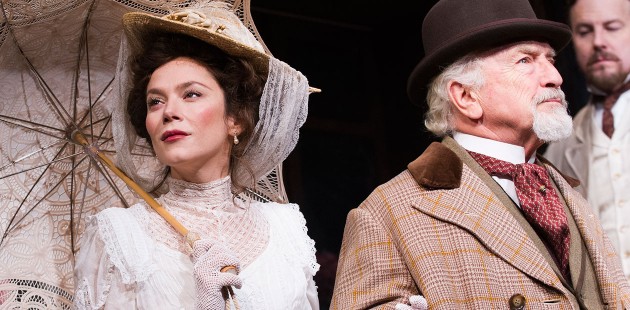 |
| Yelena (Anne Friel) and the Professor (Paul Freeman) |
Most of the rest of the cast is successful to varying degrees. Samuel West's Doctor Astrov has a pleasant dreaminess to him as he talks of conserving forests, and imagining the effects of his work on societies 1,000 years in the future. He's a bit of a fool, throwing himself at Yelena and (wilfully?) misinterpreting her reactions to his advances. His dialogue about the climate change and vegetarianism feels awfully prescient given that this play is about 110 years old.
Unfortunately there is a dodgy cog in this mostly functioning machine, and that's Laura Carmichael's Sonya. Her performance has already taken on semi-legendary status, purely for her being interrupted on opening night by a drunken Sir Peter Hall, founder of the Royal Shakespeare Company and former director of the National Theatre. During Carmichael's closing speech, when she repeatedly says "Life must go on", he responded by shouting "No! Please stop now!".
I disagree with the time and the place in which the criticism was made, but I have to say I find it perfectly accurate. I feel a bit sorry for Carmichael, who is clearly trying very, very hard to do a great job. But it's impossible not to notice that practically every line reading she gives is intoned in the exact same way. She starts out speaking relatively normally, and then by the end of the sentence the pitch of her voice gets higher. It's like everything she says can be read as a question, and it drove me bananas.

Stage and television and film acting require a different set of skills, you can't afford to be as subtle as you can with a camera with a theatre audience and things necessarily must be played a bit bigger. This has translated to Carmichael changing up her facial expression every single second. It's like someone's plugged the muscles of her face into a wall socket! Here eyebrows are maniacally working themselves up and down, her lips moving around, her eyes flaring and narrowing. It's distractingly bizarre.
Sonya is a character lacking in confidence, someone fully aware of their lack of beauty and experiencing cruel pangs of unrequited love. Carmichael isn't really plain, but it's easy to see why you'd think she might be a good choice for the role. She's got a bird-like flighty physicality, and her eyes seem well-suited to wistfully gazing across a room at someone. But for all this, the performance just doesn't add up. The now notorious final speech is a total disaster, something that's supposed to sum up the themes of the play, but here just sounds incredibly insincere and utterly over-rehearsed.
This production is a good one, it's got some of the most intricate and clever staging I've seen recently, and nearly all of the cast acquits themselves well, some magnificently. Chekhov's themes still ring relevant to audiences in the modern day; these are recognisable and comprehensible emotions and actions. You'd have to be a pretty strange human being not to recognise facets of yourself in these characters, they function both as a mirror and as a warning of a future to avoid. It's just a pity about Carmichael's performance. I feel the deepest sympathy for her. Getting heckled on your opening night has got to suck, big time. But it's got to suck even worse when the heckle was completely accurate.
Subscribe to:
Posts (Atom)


