Recent Articles
Showing posts with label ass kicking. Show all posts
Showing posts with label ass kicking. Show all posts
Thursday, May 24, 2012
Thursday, May 24, 2012
- 0 Comments

I always wondered exactly what the title to this film meant. I’d picked up from somewhere that it was about a titanic, vicious and drunken battle between a married couple, but I could never figure out how Virginia Woolf related to the story. What I did know was the film’s reputation as a hard, fierce grudge match, Richard Burton v Elizabeth Taylor. A spectacular gladiatorial free-for-all, starring the most famous couple in Hollywood at the time.
“George: You're a monster - You are.
Martha: I'm loud and I'm vulgar, and I wear the pants in the house because somebody's got
to, but I am not a monster. I'm not.
George: You're a spoiled, self-indulgent, willful, dirty-minded, liquor-ridden...”
Based on the hit Broadway play by Edward Albee, the film chronicles one night in the lives of Martha and her lecturer husband George (Elizabeth Taylor and Richard Burton) and their guests a younger married couple, Nick and Honey (George Segal and Sandy Dennis). Martha and George return home drunk from a party to their home, having invited Nick and Honey over to continue drinking. As various bottles of booze get consumed, the mood turns ever sourer and the verbal sparring becomes ever more caustic.
“George: Be careful Martha. I'll rip you to pieces.
Martha: You're not man enough. You haven't the guts.”
Elizabeth Taylor’s Martha is outstanding. She acts like every bit of love and tenderness has been expelled from her blackened heart. As the film opens she strides into the house, saying “what a dump” before opening the fridge, tearing off a leg of chicken and attacking it with relish, a lit cigarette in her other hand. We are thus primed that we are in store for not the most glamorous of performances. Martha swears, she drinks, she smokes, she screams at the top of her lungs, she throws calculated insults at everyone in the vicinity. Early in the film she changes into a tight and revealing outfit, seemingly purely to taunt her husband and tease her guest. She seems irredeemably vicious. Initially we have no idea why, but certain asides throughout the film start to build up an fuzzy picture of why she is so miserable.
 |
Martha’s psychological arsenal consists of grating down everyone else through sheer persistence. She will be as rude as possible in order to get what she wants. As the film progresses we learn that she is the daughter of the President of the university, and that her husband George hasn’t reached the professional heights expected of him. We also pick up hints that there are deeper issues, a son mentioned in extremely vague and nasty tones and mention of him seems to deeply affect both her and her husband.
George, played by Richard Burton, is a different kind of monster. Like Martha, he is also worn down and vicious, but in a different way. His speech is flowery and poetic, as if he is constantly trying prove his intelligence. His body language is less stiff than his wife’s. He wearily sprawls over chairs and sofas. He wears an unstylish cardigan through most of the film, like a man who has embraced middle-age without too much trouble. He is more than a match for Martha’s jibes and insults, but seems wearier than her, as if he has had to adapt himself to life with her, to harden himself to her yells and behaviour. It’s not that he is a necessarily the submissive partner, they both seem to relish their emotional sadism. It is George, for example, who invents a series of cruel parlour games, the film working its way through ‘Humiliate the Host’, ‘Get the Guests’ and ‘Hump the Hostess’.

We only see these two characters in different states of drunkenness – it is genuinely hard to imagine George sober and lecturing about history. Everything about him seems geared towards deterioration. His hair hangs floppily and sweatily over his head, and his cardigan and tie grow ever more rumpled. Compared to Martha, who looks sharp and hard in her rage, he seems to be coming apart.
There is a great fake-out sequence relatively early in the film. Martha is telling the guests an emasculating anecdote about how she managed to knock down George in a faux boxing match. As the story is drunkenly told, we follow George out into a closet. Martha’s voice gets muffled and seems slightly distorted as we see George reach up and grab a rifle. The audience assumes that George has been finally pushed over the edge. Seemingly in a trance, he walks stiffly back to the living room, aims the gun at Martha’s head and…


Pow! It’s a joke gun, an umbrella comes out of the barrel. Leaving aside for a moment the question of why he owns such an elaborate joke rifle (did he make it specially to do this?), it is notable that after a moment of shock, how quickly everyone begins laughing at the joke. In some respects they’re laughing at the audience, this isn’t a film full of easy answers and definite conclusions. You begin to feel like this is merely one night of many for these characters, and you can imagine rows like this stretching back into the past, and forward into the future.
Speaking of stand-ins for the audience, the two guests, Nick and Honey seem to begin as a kind of audience stand in. Two hours locked in a room with George and Martha could get a little claustrophobic without them, and we see them pair off with each other to gossip about their significant others. The film portrays this young, relatively newly married couple as what George and Martha may have been like soon after getting married. Like Martha, Honey is richer than her husband, and like George, Nick is a lecturer with aspirations. The central couple almost function as a kind of warning to them not to go down this path. They also function as a whirlpool, sucking the happy and seemingly stable couple into their world of recriminations and drunken rows.

As they enter George and Martha’s house and see the first shots across the bow of the argument, Nick and Honey glance nervously at each other, and try to make excuses and leave. But as the booze flows, the two get more “into the spirit” of things. Martha flirts outrageously with Nick, while Honey, increasingly drunk on rum remains somewhat innocent and oblivious. It’s a nice dynamic that the further and further Nick gets sucked into the mind games of George and Martha, that the drunker and more oblivious Honey becomes.
There are only four characters in the film, and three major sets. We move from George 7and Martha’s cluttered, claustrophobic house to their garden, out to a bar and back home. Nicholls moves in and around the house, and by the end of the film we have a pretty good idea of the geography of the place. He also tends to place characters appropriately in the frame depending on who has the upper hand. Frequently we see Martha in the dead centre of the frame, the centre of attention, while George prowls in the background. If a character is being disparaged or mocked, then they occupy the periphery of the screen. A good example is when Martha is overtly flirting with Nick – she rubs his leg suggestively as George and Honey sit awkwardly at the edges of the frame.

An important theme running through the narrative is that of fiction. At about the midway point, Nick escapes the house to find George sitting drunkenly on a child’s swing in the garden. George begins to tell Nick a story about a friend of his who accidentally killed both his parents. Nick pays attention, and the story is quite compelling. It is later revealed that this is the plot of George’s book, and is a complete fiction. In return, Nick explains the circumstances of how he got married to Honey. Honey had an ectopic pregnancy, and it was only after George married her that they realised it was ectopic.

It is these fictions that help keep the miserable characters of this film going. Despite the cruel, foul-mouthed barbs they constantly fire at each other, we slowly learn that the two do have a deep affection for the other. It is a strange version of love, conducted at gunpoint rather than romantically, but I think it’s love nonetheless. These are two people who need an outlet to act out their masochistic and sadistic desires, and have found no better victims than themselves. You see hints in the relish with which Martha acts out in front of George, and how he returns with the most cutting put downs. These are two people that need each other. We eventually find out the truth about Martha and George’s child: he doesn’t exist. For whatever reason they can’t have children, and it seems they’ve subsumed their child-rearing emotions into red hot pokers to jab each other with. Their ‘son’, for the purposes of the film is a shared fiction of the two, a cudgel with which to bludgeon each other with.

“Our son was born in a September night, a night not unlike tonight, though tomorrow, and sixteen years ago...It was an easy birth, once it had been accepted, and I was young...and he was healthy, a red, bawling child...with slippery firm limbs and a full head of black, fine, fine hair which, oh, later, later, became blond as the sun, our son...And I had wanted a child...oh, I had wanted a child...And I had my child...Our child. And we raised him...and he had green eyes...and he loved the sun...and he was tan before and after everyone and in the sun his hair became fleece...beautiful, beautiful boy...So beautiful, so wise...Beautiful, wise, perfect.”
This is Martha’s fantasy, the fiction that she would like to have lived, and in her drunkeness may have even briefly convinced herself of. This fictive son is the gaping hole in her emotional armour, the one thing she clings to as a lifeline out of her misery.
“Of course, his perfection could not last...not with George around....A drowning man takes down those nearest. And he tried, and oh God how I fought him...the one thing I tried to carry pure and unscathed in the sewer of our marriage, through the sick nights and the pathetic stupid days, through the derision and the laughter...God, the laughter, through one failure after another, each attempt more numbing, more sickening than the one before; the one thing, the one person I tried to protect, to raise above the mire of this vile, crushing marriage, the one light in all this hopeless darkness - OUR SON.”

Meanwhile, George is chanting a latin mass of the dead– spinning a mock funeral service behind her frantic fantasising. The game is up for their “little sonny-jim”, and in the climactic moments of the film, George ‘kills’ off the son. Everything is demystified, and as dawn breaks and sunlight begins to finally fill the house we finally see Martha emotionally naked, without any witty barbs to disguise her feelings. The ghost son has temporarily been exorcised.
It’s interesting that to dispel the illusion of the son,that George plays along with the fiction. Rather than rely on reality he fights fire with fire, spinning another fiction where their son drove into a tree to avoid a porcupine and died in the impact. Martha even half-heartedly plays along with the fiction, asking George if she can see the telegram saying this. George says he ate it.
Sanity is restored, and all the characters are emotionally and physically spent. Nick and Honey quietly leave, sobered up by the early morning revelations. As George and Martha are left alone, George tenderly strokes Martha’s hair and the two converse in clipped, monosyllabic phrases. All the theatricality of their cruelty is thrown into context as a production for the benefit of Nick and Honey.

We can find a slight glimmer of hope in this scene. Have Martha and George turned a corner, found a new sense of understanding and compassion? Is this the point where they face up to reality honestly? Or is this just another in a long line of reconciliations and inevitably sour once more?
I don’t think two characters with as many flaws as these two can find lasting tranquillity so easily. They’ve blown themselves out here, finally worked out and used up all their anger. Maybe, subconsciously reaching this point in the night was why they were tearing lumps out of each other to begin with. I see the entire process of anger, hate, betrayal and finally calm as the points of a cycle. The problems in George and Martha’s marriage build up pressure like magma in a volcano, and eventually it will erupt – a cathartic release of destructive energy.
When this film was released, US divorce rates were beginning a skyrocket that wouldn’t peak until the early 80s. While it isn’t particularly difficult to imagine a modern married couple arguing like this, it is difficult to conceive of a marriage lasting this long without divorce. The end of the film is faintly, exhaustingly, optimistic. Despite all of the fury and bile the two throw at each other, they still know what it takes to comfort the other, and I think there is a positive example in that.

Tuesday, May 15, 2012
Tuesday, May 15, 2012
- 1 Comment

Original Flyer for Come Drink With Me
It’s always satisfying to place a jigsaw piece in the right place. This nice feeling happens when you’re watching a film and you suddenly realise what that one film was paying homage to, or where a certain style of filming originated from. You feel like your pop culture tapestry has gotten a little more complete.
Come Drink With Me is one of those influential films. I’ve seen the occasional wuxia film, Ang Lee’s Crouching Tiger, Hidden Dragon and Zhang Yimou’sHero and House of Flying Daggers, and it’s clear that this film is a major root of the genre. This was one of the first major martial arts pictures released by the partnership of director King Hu and the Shaw Brothers Studio, and the influence of this and other Shaw Brothers films can still be felt reverberating around the style of modern action. This film in particular has obvious influences on the work of Quentin Tarantino (who bought the rights and was slated to direct a remake of it in 2008), and Kill Bill Vol. 1 directly references a specific scene shot for shot. The wire-fu style of action has its obvious direct Western descendant in the Matrix Trilogy, but also in modern CG assisted superhero brawls, particularly your more acrobatic cinematic heroes like Spider-Man or Black Widow.
Wuxia is a genre of Chinese fiction revolving around the heightened adventures of martial artists. Classical themes of vengeance, justice and fighting evildoers are rife. Characters in wuxia are generally not particularly conflicted. You have the noble hero or heroine fighting against a larger than life villain, usually with a personal connection to the hero and large squad of henchmen whose sole purpose is to get bashed around in fun ways. The action is overtly theatrical. Characters can possess superheroic powers which generally go unremarked upon. People will skip off the surface of lakes, or run up walls as if light as air, and fighting will be balletic and graceful.
Come Drink With Me concerns a gang of powerful and feared bandits who have taken a government official hostage. Set against them are Golden Swallow (Cheng Pei Pei), the sister of the hostage, sent by her powerful father to rescue him, and Drunken Knight (Yueh Hua) initially a jester-like figure who turns out to have a hidden connection to the leader of the gang. For the majority of the film, the primary antagonist is Jade Faced Tiger (Chang Hung-Lit) a ruthless and powerful martial artist and later the boss of the gang, Abbot Liao Kung (Yeung Chi-hing).

Cheng Pei Pei as Golden Swallow
This is Cheng Pei Pei’s breakthrough role, she would later go on to become a wuxia icon known as ‘The Queen of Swords’. It’s easy to see why she so quickly became a star. She has the rare quality that makes it hard to take your eyes from her while on screen. As Golden Swallow she moves with a dangerous, controlled elegance, no doubt a product of her previous training in ballet. Even before she does any martial arts feats she seems to radiate waves of danger. Even her eyebrows look like you’d cut yourself on them. The director exploits this tension to the maximum, teasing out the reactions and whispering from the low-life denizens of the place while Golden Swallow sits controlled and still in the centre of the room. I doubt the films of Sergio Leone were being shown in 1960s China, but there is an undeniably similarity in the slow ratcheting up of tension. The scene has unmistakable echoes in Crouching Tiger, Hidden Dragon where Zhang Ziyi, disguised as a man, tears up a bar. Incidentally, Cheng Pei-Pei appears Crouching Tiger, Hidden Dragon as Jade Fox, her first villainous role in a 35 year career.
Eventually, and after an agonising buildup the bandits in the bar start directly antagonising her. They throw coins, bottles and bar stools at her, and she deflects them with the smallest effort and great skill. She catches a handful of coins on a pair of chopsticks and then hurls them into a wall so hard they stick into it, forming the shape of a man. My first reaction after seeing this probably wouldn’t be to pick a fight with this person, but then I’m not a mook in a kung fu film and I suppose there are rules to this kind of thing.
Cheng Pei Pei is so controlled and unstoppable in this scene I began to get a little worried that she was going to be some stone-faced terminatrix throughout the film. Frankly, I don’t think it’d be too bad to watch an invincible, determined woman gracefully kicking seven shades of crap out of a load of bandits for 90 minutes, but it is nice to have some sense of humanity and vulnerability in your lead.

A stone-faced terminatrix
It is around this time that that we are introduced to Drunken Knight, who is initially portrayed as a foolish drunk wandering into a martial arts fight. Drunken Knight is undeniably charismatic and friendly, a nice contrast to the reserved Golden Swallow. We even get a glimpse of her losing her cool as Drunken Knight annoys and cajoles her while subtly passing on information she’ll need to infiltrate the bandit’s lair.
So, Golden Swallow heads off to the Temple in disguise to go and confront the bandits and hopefully rescue her brother. The bandit leader, Jade Faced Tiger sees right through her disguise and immediately attacks her. He is an excellent villain. I’m not well versed enough in Chinese cinema to know if his strange smooth and pale face has any cultural significance, but on a purely aesthetic level it makes him look otherworldly and sinister. The character seems to enjoy sporting a rictus grin, which coupled with his white complexion makes him reminiscent of DC Comics’ the Joker. He dresses all in flowing white robes, and in a film mostly devoid of eroticism is somehow threatening and alien in his androgyny. He stalks proudly around the place like Bowie’s Thin White Duke, confident and vain, a sharp contrast to his gang of shabbily dressed bandits.

Jade Faced Tiger - a smug git
In these films you need a defining scene of complete villainy so the audience can definitely know that this sinister looking guy is no good. Here it comes when Jade Faced Tiger is sitting with his bandits and senses someone eavesdropping. Reacting instantly he hurls a dart through the paper screen window, hitting a small child square in the eye. The bandits rush outside to see the boy clutching his bloody eye, the dart still poking out of the eyeball. An old monk cradles the boy in his arms pleading for help. Jade Faced Tiger stands watching, a cruel white toothed smile etched on his mask-like face as he informs the monk that his darts are poisoned. The monk pleads for an antidote. Gesturing to one of his men, Jade Faced Tiger tells him to put the boy out of his misery. The bandit plunges a sword into the boys chest, sending an arc of blood into the air. The sinister smile remains. Yep, this guy is definitely evil.
As Golden Swallow and Jade Faced Tiger square off, it quickly becomes apparent that while skilled, our heroine cannot hope to take on the bandit gang alone. Throughout the fight she seems to be being helped by a mysterious man. It turns out to be Drunken Knight, sneaking around the templea and distracting the bandits. Golden Swallow decides to make her escape, but as she clears the temple wall Jade Faced Tiger flicks a poison dart at her.
It is here that the film becomes somewhat less compelling. For the majority of the remaining run-time, our powerful and confident heroine is suffering the effects of poisoning and has to be taken care of by Drunken Knight, who more and more takes on the protagonist role. There is nothing particularly flawed about the performance or the character, but having established Golden Swallow so memorably it’s somewhat depressing to see her unable to stand without being supported by the new hero. Up until this point it was refreshing that she didn’t really need the help of any man to accomplish her mission. Indeed, the fact that the daughter of a powerful politician has been sent to rescue her brother has gone completely unremarked upon by the characters of the film.
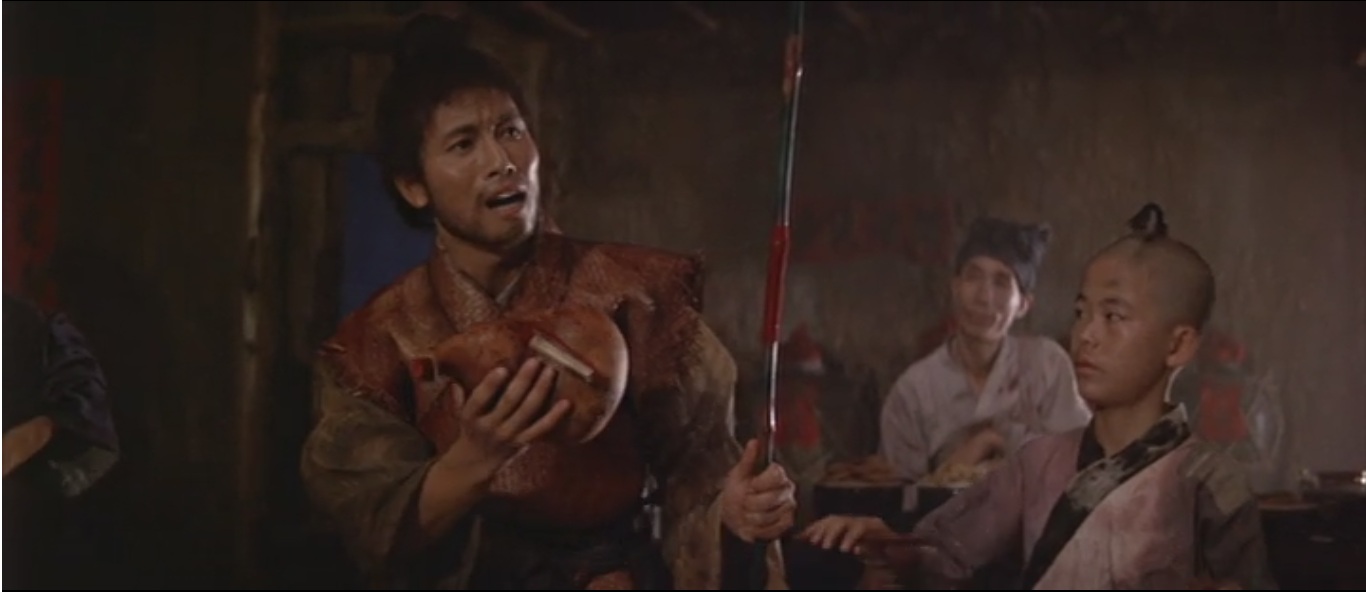
Drunken Knight - Kind of boring
As she slowly recovers from the effects of the poison the narrative focus shifts inexorably to Drunken Knight, who has an infinitely duller backstory of a brother who turned evil and betrayed him. We see less and less of Golden Dawn, and it’s only in the final battle royale that she is fully restored to fitness. We see her fighting with a team of sword wielding woman to protect her rescued brother. Their appearance in the plot is welcome, but unexplained, and it’s incredibly frustrating! I don’t really care about the generic plot of Drunken Knight, I want to know more about Golden Dawn and her squad. Fortunately, while they don’t get the narrative climax, they do get the best action scene in the film, as they systemically take down a huge group of bandits, while Golden Dawn squares off mano a mano with Jade Faced Tiger.
Even Jade Faced Tiger gets bumped down the villainy scale a notch, by the massively less interesting Abbott Liao Kung, Drunken Knight’s long lost brother. We’re told that he is a complete bastard, but he doesn’t really demonstrate this. Disappointingly, the film ends with the least well choreographed and shot fight, with Drunken Knight and his brother fighting each other with magic in a poorly lit garden. I am sure that characters being able to suddenly shoot magic fog out of their hands is a well established aspect of wuxia, but even so it’s not quite as fun as intricate swordplay and hand to hand fighting.
It’s a damn shame that the focus shifts in the latter half of the film. I think it’d be a far more enjoyable experience to keep Golden Swallow as the heroine and focus entirely on her enmity with Jade Faced Dragon. Gender politics in Chinese mythology is not something I am an expert on to say the least, but the way the film was heading in the first half was quite refreshing. It’s rare enough to see a film where a lead female character has agency, huge amounts of ass-kicking skill and buckets of charisma – let alone a 1960s Chinese action film.

If Cheng Pei Pei is looking at you like this, you're probably about lose a limb.
Subscribe to:
Posts (Atom)