Recent Articles
Showing posts with label cheng pei pei. Show all posts
Showing posts with label cheng pei pei. Show all posts
Tuesday, July 22, 2014
Tuesday, July 22, 2014
- 0 Comments

Set in a perpetually overcast Hackney, Lilting is a delicately painted argument that the most fundamental human emotions exist somewhere beyond language. In this case it's grief, loss and depression that provides the fuel for an unlikely, fractious friendship between two people; Richard (Ben Whishaw) and Junn (Pei-pei Cheng). Richard is a....
...hang on a minute....
Pei-pei Cheng? THE Pei-pei Cheng? The Lady of Steel? The Iron Princess? THE QUEEN OF SWORDS?! This Pei-pei Cheng?

Wow! Alright where was I?
Oh yeah. So Richard is the epitome of metropolitan life; he's trendy, fashionable, hangs out in all the right coffee shops and has a beautifully tasteful run-down house in what looks like Cambridge Heath. Junn is an elderly Cambodian immigrant living a depressed life in an old people's home. She speaks very little English, looks isolated and apparently spends her days counting down the hours until the Grim Reaper comes a-knockin'.
Bringing them together is the character of Kai. He's Junn's beloved son, responsible for her being in the UK and obsessed with making sure she's provided for. As the film opens we see them happily making small-talk about the minutia of their lives. Their mutual love is palpable, though there's an undercurrent of unhappiness from the mother at being 'abandoned' in a nursing home. As conversation rambles on a nurse suddenly enters the room and, in a perfectly executed panning shot, we realise that Junn has been talking to herself.
Kai is dead. Hit by a car. Now, left alone, her only regular visitor is Richard, Kai's best friend. But of course he's not his best friend, he's Kai's bereaved partner. Unable to out Kai to his mother even in death, he feels responsible towards her - though she's confused as to why Richard cares so much. Eventually he hires an interpreter that allows them to converse, and the two very gradually form an uneasy bond.
 |
| Kai and Richard |
Lilting is a purposefully slow, desaturated and flatly shot piece of cinema. Khaou clearly understands the psychic numbness that comes with loss, endeavouring to make his cinematic world as muted as possible. Everything from the hideous 1960s wallpaper in the nursing home to the alabaster white skin of Richard and Kai as they lie in bed together combines to create a rather depressing vision of a world where all hope is lost.
The few bright spots in the story come from Alan (Peter Bowles) and Vann (Naomi Christie). Alan and Junn are a rather cute couple in the nursing home, getting on well even though they can't communicate directly with each other. Richard decides the best way to cheer up Junn is to hire an interpretor, Vann, to translate. Bowles gives the role a great deal curmudgeonly charm, making this geriatric romance rather sweet and uplifting in the middle of all this gloom.
As Vann becomes increasingly involved in the drama between Richard and Junn, she translates more and more. The cinematic result of that is quite interesting, breaking up the rhythm of a normal movie conversation. It's a way of clearly delineating reaction from response, the gap necessitated by translation allowing us to focus on the actor's physical and not what they're saying. Both Whishaw and Cheng exploit this dynamic beautifully, the method adding a ton of tension to the fraught final scenes.
 |
| That wallpaper is just awful. |
Lilting is very much an actor's movie - one of ponderous conversations, revelations and gradual character development. Whishaw in particular embodies that stage in a man's life where he realises, once and for all, that he is no longer officially young. In his grief he's shouldered some very mature burdens; and with the death of his partner he has nowhere to direct his newfound desire for responsibility - Junn being the most obvious and worthwhile outlet.
Meanwhile Cheng's Junn bears the burden of constantly lying to herself. You're never quite sure whether she secretly knows her dead son is gay or if she really is naive to the whole deal. I'd like to give the character the benefit of the doubt - her performance is infused with a weird, naked truth that indicates she'd hate to lie to herself. My favourite moments in the film are all her - when she nods in approval as she notices Richard frying bacon with chopsticks, or her sharply felt shock and anger at being denied her son's ashes.
I had no idea Cheng has transitioned so smoothly into straight dramatic roles and though a small part of me was hoping for her to break into an orgy of bloody swordfighting, she fills the screen with the same ironclad inner strength that made her so compelling as a basher of heads and slicer-offer of limbs.
Hong Khaou's style is the cinematic equivalent of a rainy, hungover Sunday afternoon. Lilting is often a bit of a downer, but it's a sensitive movie that has the confidence to proceed at its own pace. I suspect that for some audiences the stately, melancholy drama will translate into straight-up boredom, but I was enthralled from start to finish. It's an unassuming little movie, yet what Khaou has to say about the universal nature of grieving, and how bonds form regardless of cultural or language barriers rings true.
★★★★
Lilting is released August 8th
Tuesday, May 15, 2012
Tuesday, May 15, 2012
- 1 Comment

Original Flyer for Come Drink With Me
It’s always satisfying to place a jigsaw piece in the right place. This nice feeling happens when you’re watching a film and you suddenly realise what that one film was paying homage to, or where a certain style of filming originated from. You feel like your pop culture tapestry has gotten a little more complete.
Come Drink With Me is one of those influential films. I’ve seen the occasional wuxia film, Ang Lee’s Crouching Tiger, Hidden Dragon and Zhang Yimou’sHero and House of Flying Daggers, and it’s clear that this film is a major root of the genre. This was one of the first major martial arts pictures released by the partnership of director King Hu and the Shaw Brothers Studio, and the influence of this and other Shaw Brothers films can still be felt reverberating around the style of modern action. This film in particular has obvious influences on the work of Quentin Tarantino (who bought the rights and was slated to direct a remake of it in 2008), and Kill Bill Vol. 1 directly references a specific scene shot for shot. The wire-fu style of action has its obvious direct Western descendant in the Matrix Trilogy, but also in modern CG assisted superhero brawls, particularly your more acrobatic cinematic heroes like Spider-Man or Black Widow.
Wuxia is a genre of Chinese fiction revolving around the heightened adventures of martial artists. Classical themes of vengeance, justice and fighting evildoers are rife. Characters in wuxia are generally not particularly conflicted. You have the noble hero or heroine fighting against a larger than life villain, usually with a personal connection to the hero and large squad of henchmen whose sole purpose is to get bashed around in fun ways. The action is overtly theatrical. Characters can possess superheroic powers which generally go unremarked upon. People will skip off the surface of lakes, or run up walls as if light as air, and fighting will be balletic and graceful.
Come Drink With Me concerns a gang of powerful and feared bandits who have taken a government official hostage. Set against them are Golden Swallow (Cheng Pei Pei), the sister of the hostage, sent by her powerful father to rescue him, and Drunken Knight (Yueh Hua) initially a jester-like figure who turns out to have a hidden connection to the leader of the gang. For the majority of the film, the primary antagonist is Jade Faced Tiger (Chang Hung-Lit) a ruthless and powerful martial artist and later the boss of the gang, Abbot Liao Kung (Yeung Chi-hing).

Cheng Pei Pei as Golden Swallow
This is Cheng Pei Pei’s breakthrough role, she would later go on to become a wuxia icon known as ‘The Queen of Swords’. It’s easy to see why she so quickly became a star. She has the rare quality that makes it hard to take your eyes from her while on screen. As Golden Swallow she moves with a dangerous, controlled elegance, no doubt a product of her previous training in ballet. Even before she does any martial arts feats she seems to radiate waves of danger. Even her eyebrows look like you’d cut yourself on them. The director exploits this tension to the maximum, teasing out the reactions and whispering from the low-life denizens of the place while Golden Swallow sits controlled and still in the centre of the room. I doubt the films of Sergio Leone were being shown in 1960s China, but there is an undeniably similarity in the slow ratcheting up of tension. The scene has unmistakable echoes in Crouching Tiger, Hidden Dragon where Zhang Ziyi, disguised as a man, tears up a bar. Incidentally, Cheng Pei-Pei appears Crouching Tiger, Hidden Dragon as Jade Fox, her first villainous role in a 35 year career.
Eventually, and after an agonising buildup the bandits in the bar start directly antagonising her. They throw coins, bottles and bar stools at her, and she deflects them with the smallest effort and great skill. She catches a handful of coins on a pair of chopsticks and then hurls them into a wall so hard they stick into it, forming the shape of a man. My first reaction after seeing this probably wouldn’t be to pick a fight with this person, but then I’m not a mook in a kung fu film and I suppose there are rules to this kind of thing.
Cheng Pei Pei is so controlled and unstoppable in this scene I began to get a little worried that she was going to be some stone-faced terminatrix throughout the film. Frankly, I don’t think it’d be too bad to watch an invincible, determined woman gracefully kicking seven shades of crap out of a load of bandits for 90 minutes, but it is nice to have some sense of humanity and vulnerability in your lead.

A stone-faced terminatrix
It is around this time that that we are introduced to Drunken Knight, who is initially portrayed as a foolish drunk wandering into a martial arts fight. Drunken Knight is undeniably charismatic and friendly, a nice contrast to the reserved Golden Swallow. We even get a glimpse of her losing her cool as Drunken Knight annoys and cajoles her while subtly passing on information she’ll need to infiltrate the bandit’s lair.
So, Golden Swallow heads off to the Temple in disguise to go and confront the bandits and hopefully rescue her brother. The bandit leader, Jade Faced Tiger sees right through her disguise and immediately attacks her. He is an excellent villain. I’m not well versed enough in Chinese cinema to know if his strange smooth and pale face has any cultural significance, but on a purely aesthetic level it makes him look otherworldly and sinister. The character seems to enjoy sporting a rictus grin, which coupled with his white complexion makes him reminiscent of DC Comics’ the Joker. He dresses all in flowing white robes, and in a film mostly devoid of eroticism is somehow threatening and alien in his androgyny. He stalks proudly around the place like Bowie’s Thin White Duke, confident and vain, a sharp contrast to his gang of shabbily dressed bandits.

Jade Faced Tiger - a smug git
In these films you need a defining scene of complete villainy so the audience can definitely know that this sinister looking guy is no good. Here it comes when Jade Faced Tiger is sitting with his bandits and senses someone eavesdropping. Reacting instantly he hurls a dart through the paper screen window, hitting a small child square in the eye. The bandits rush outside to see the boy clutching his bloody eye, the dart still poking out of the eyeball. An old monk cradles the boy in his arms pleading for help. Jade Faced Tiger stands watching, a cruel white toothed smile etched on his mask-like face as he informs the monk that his darts are poisoned. The monk pleads for an antidote. Gesturing to one of his men, Jade Faced Tiger tells him to put the boy out of his misery. The bandit plunges a sword into the boys chest, sending an arc of blood into the air. The sinister smile remains. Yep, this guy is definitely evil.
As Golden Swallow and Jade Faced Tiger square off, it quickly becomes apparent that while skilled, our heroine cannot hope to take on the bandit gang alone. Throughout the fight she seems to be being helped by a mysterious man. It turns out to be Drunken Knight, sneaking around the templea and distracting the bandits. Golden Swallow decides to make her escape, but as she clears the temple wall Jade Faced Tiger flicks a poison dart at her.
It is here that the film becomes somewhat less compelling. For the majority of the remaining run-time, our powerful and confident heroine is suffering the effects of poisoning and has to be taken care of by Drunken Knight, who more and more takes on the protagonist role. There is nothing particularly flawed about the performance or the character, but having established Golden Swallow so memorably it’s somewhat depressing to see her unable to stand without being supported by the new hero. Up until this point it was refreshing that she didn’t really need the help of any man to accomplish her mission. Indeed, the fact that the daughter of a powerful politician has been sent to rescue her brother has gone completely unremarked upon by the characters of the film.
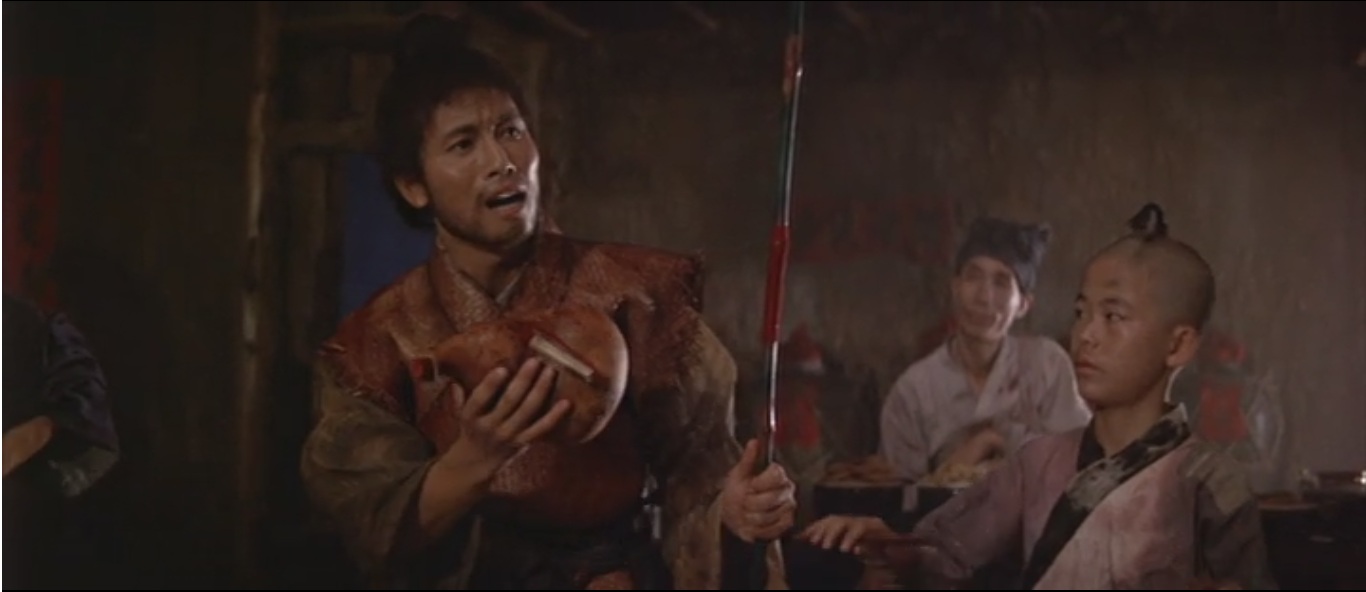
Drunken Knight - Kind of boring
As she slowly recovers from the effects of the poison the narrative focus shifts inexorably to Drunken Knight, who has an infinitely duller backstory of a brother who turned evil and betrayed him. We see less and less of Golden Dawn, and it’s only in the final battle royale that she is fully restored to fitness. We see her fighting with a team of sword wielding woman to protect her rescued brother. Their appearance in the plot is welcome, but unexplained, and it’s incredibly frustrating! I don’t really care about the generic plot of Drunken Knight, I want to know more about Golden Dawn and her squad. Fortunately, while they don’t get the narrative climax, they do get the best action scene in the film, as they systemically take down a huge group of bandits, while Golden Dawn squares off mano a mano with Jade Faced Tiger.
Even Jade Faced Tiger gets bumped down the villainy scale a notch, by the massively less interesting Abbott Liao Kung, Drunken Knight’s long lost brother. We’re told that he is a complete bastard, but he doesn’t really demonstrate this. Disappointingly, the film ends with the least well choreographed and shot fight, with Drunken Knight and his brother fighting each other with magic in a poorly lit garden. I am sure that characters being able to suddenly shoot magic fog out of their hands is a well established aspect of wuxia, but even so it’s not quite as fun as intricate swordplay and hand to hand fighting.
It’s a damn shame that the focus shifts in the latter half of the film. I think it’d be a far more enjoyable experience to keep Golden Swallow as the heroine and focus entirely on her enmity with Jade Faced Dragon. Gender politics in Chinese mythology is not something I am an expert on to say the least, but the way the film was heading in the first half was quite refreshing. It’s rare enough to see a film where a lead female character has agency, huge amounts of ass-kicking skill and buckets of charisma – let alone a 1960s Chinese action film.

If Cheng Pei Pei is looking at you like this, you're probably about lose a limb.
Subscribe to:
Posts (Atom)