Recent Articles
Showing posts with label documentary. Show all posts
Showing posts with label documentary. Show all posts
Thursday, October 13, 2016
Thursday, October 13, 2016
- 0 Comments

"50 years ago a gunshot rang out across the University of Texas campus. Claire Wilson, a pregnant student, was hit in the belly, instantly killing her unborn child. Her fiance, Thomas Eckman turned to her and asked “What’s wrong?” A second shot ensured he would never hear the answer.
For the next hour and a half, death came to the campus. A sniper had taken up position in the central tower, firing indiscriminately at anyone he could get a bead on. By the time he was killed by police he had murdered 11 people and wounded 32.
Reaction at the time was frightened bewilderment. Why would a person take out their frustrations on random strangers in such violent fashion? Little did they know that these shootings were merely the opening act of a continuing trend, one, encompassing names that have become synonymous with tragedy: Columbine, Aurora, Virginia Tech, Sandy Hook and Pulse.
Keith Maitland’s documentary, Tower is a shot by shot recounting of the events of August 1st 1966, telling the tale through the survivor’s experiences. Their memories are interwoven with archive footage of the event and rotoscoped animation that allows us to see what the cameras didn’t capture."
★★★★
Tuesday, November 3, 2015
Tuesday, November 3, 2015
- 0 Comments

Malala Yousafzai is so intensely inspirational that were she fictional you'd have trouble suspending your disbelief. She's like something out of legend; the forthright, passionate schoolgirl standing up to the cruel Taliban and fighting for young girl's rights to an education. That would be impressive in and of itself, but then came the cowardly bullet to the forehead, brain surgery, a miraculous recovery, a best-selling book, global tours, meetings with world leaders and, to crown it all, being awarded the Nobel Peace Prize.
Not too shabby for a 16 year old.
Davis Guggenheim's He Named Me Malala latches onto this epic streak right away. Opening with a pastel-painted Raymond Briggs-esque animated sequence, we hear Malala explain the origins of her name in Pastun legend. We're swept into a battle between retreating Afghani warriors and English cavalry. A lone woman, Malalai climbs to the top of a cliff and yells words of encouragement to the beaten men - they turn around and win an unlikely victory over the English, though not before Malalai is struck by a stray bullet and martyred.
It's a fine opening to a documentary, neatly allegorical to Malala's story. These mythological strokes are contrasted with scenes of casual domesticity: Malala teasing her brothers, playing Snap with her family and studying for her GCSEs. The twin poles fuel Guggenheim's documentary, which not only tells her story but explores how an 'ordinary' girl can change the world.
Malala makes for a compelling subject. She's intelligent, passionate and opinionated yet also very obviously a child. There's a humourous disconnect between watching someone give a passionate, clear-minded speech to the UN one moment, and giggling girlishly over Roger Federer the next. In the one on one interviews she quickly proves a careful operator, careful to make sure that conversation remains on her political campaigns rather than on herself.
This throws up a little friction in the piece: sometimes the most interesting character moments are also the least relevant. There's segments where Guggenheim playfully needles Malala over whether she would ever ask out a boy, drawing out nervous laughter and blushes. It's interesting to see her as a teenager rather than as an exemplar of humanitarianism, but the more we focus on her as an individual, the less we concentrate on her politics and effects of her campaigns.

Malala is an inescapably political figure who has stated her ultimate ambition to be Prime Minister of Pakistan. We only catch snatches of this crucial side to her; for example when she quizzes a caught-off-guard Barack Obama about the legality unmanned drone strikes. Guggenheim doesn't dwell on this (or for that matter, show us Obama's answer), merely using the exchange as further evidence of her bravery. Thus, Guggenheim treats Malala apolitically; displaying no curiosity into the ideology that underpins her passion for reform.
That ideology being socialism:
"I am convinced that socialism is the only answer, and I urge all comrades to struggle to a victorious conclusion. Only this will free us from the chains of bigotry and oppression." - Malala's 2014 message to Pakistan's International Marxist Tendency.
He Named Me Malala instead seeks to claim Malala as a paragon of soft humanism, viewing her activism firmly through the a neoliberal prism. Guggenheim presents a world of stark good and evil, ignoring the geopolitical climate that fuels the quasi-fascist groups that Malala pits herself against. To hear the film tell it, the Taliban, Boko Haram and their ideological brethren are just 'the bad guys', existing in a vacuum and purely to spread fear.
What that adds up to is a feel-good experience for Western liberals: the documentary equivalent of a warm, snuggly blanket to wrap yourself in. Then again, at least it succeeds at doing that.
I think He Called Me Malala, with its dreamy animated interludes, simplistic morality and straightforwardly inspiring narrative, is a perfect film to show in schools, giving children a taste of what standing up for your opinions can achieve and a beginner's guide to oppression.
For adult audiences it's a touch too saccharine, especially when the syrupy string score kicks in at the emotional high-points and (god help us) a dreary Alicia Keys song specially written for the movie begins blaring out. Ultimately, He Named Me Malala is a film that wants you to feel more than think: and as such does an unintentional disservice to its subject.
★★★
He Named Me Malala is on general release from 6th November.
Friday, June 26, 2015
Friday, June 26, 2015
- 0 Comments

In which we observe a talented and charismatic woman gradually descend into alcoholism and mental illness, culminating in her skinny corpse being wheeled into the back of a van. This is the story of Amy Winehouse, as told by Senna director Asif Kapadia. The magnificent Senna (maybe the greatest biographical documentary ever) ended with its subject dying in mangled wreckage. Amy ends in much the same way, surrounded by the final shreds of her talent, dignity and sanity.
It's easy to forget just how quickly and brightly Amy Winehouse burned. The release of Back to Black in 2006 made her an immediate icon, her tattoos, beehive hairdo, Camden-style , confessional lyrics and that voice defining her as something new, propelling her to fame and wealth beyond her wildest dreams. Five short years later she was dead.
Working almost entirely from archive footage, Amy traces the singers teenage musical beginnings, ascent through the music industry and eventual drugged out stupor. It's an incredibly bleak film; every pre-fame image of the young, smiling and vivacious artist tainted by our knowledge of what's to come.
Leaving aside the emotion for a moment, it should be emphasised what an outstanding researcher and editor Kapadia is. God only knows how many hours of footage he must have trawled through to construct this film, piecing together a narrative from thousands of disconnected video clips from many different sources. It impresses upon you how thoroughly a contemporary life can be documented; a mosaic assembled from cameraphones, news reports, television shows and family videos.

Context comes from contemporary interviews with key figures in her life. Cleverly Kapadia doesn't use the bog-standard 'talking heads' style, preferring to overlay the interviews onto relevant footage. This draws up a gentle documentary tension; in the interviews with figures the film treats critically, what they're saying and what we're seeing don't quite add up. The overall effect is that, by the time the credits are rolling (with new footage still playing over them), we feel as if we've genuinely gotten to know Amy Winehouse.
This is, of course, an illusion. How can you truly understand someone through two hours of edited clips? But it's an effective illusion, Kapadia manipulating our perceptions of his subject in order to subtly communicate his message. This proves to be a critique on the exploitation of talent, laying out who 'used' Winehouse and why.
But it's less a process of identifying and condemning 'villains' and more a critique on the processes that allowed them to behave in the way they did. For example her father, Mitch Winehouse, doesn't come out of this looking especially amazing, but he's more stupid than malicious. Another potential villain, her ex-husband Blake Fielder winds up as just another victim - a mirror of Amy Winehouse minus both talent and charisma.
The real villain of the piece soon rears its head; a voracious media fuelled by you and I. There's a epilepsy warning before the film that proves entirely warranted when the paparazzi swing into action, jostling the increasingly confused looking singer in a nightmare strobe world of flashes and screaming. If this is what life is public is like, no wonder so many celebrities go bananas. Kapadia reserves most of his venom for the media, condemning the comedians that made light of her condition, the salacious news reports that wallowed in her misery and the intrusive cameramen that jammed lenses in every private moment.

Paradoxically, Kapadia is quite happy to use that stolen footage in his film. In an affecting moment we see a paranoid-looking Winehouse staring through the slats of her bedroom window, shot through a telephoto lens. It's faintly hypocritical to condemn the tabloids then use their footage, but it's hypocrisy with a point. In watching Amy you feel an extreme empathy with her, as if you're on the same side. Yet, in effect, by delving through a jigsaw puzzle of her private moments you're engaging in precisely the same behaviour that drove her to an early death.
By the time we see her body laying under a blanket you should ask yourself exactly what you're getting out of this. "Aw, what a sad story" sentimentality? Smugness in watching someone successful fail? The vicarious thrill of watching a hedonist burn out? We all try to fit Amy Winehouse's biography into a preordained narrative, scratching away at reality until she's less a human being and more a romanticised archetype.
I can't deny Amy's quality: the music is amazing, the subject is fascinating and Kapadia's technique is second-to-none. But the process of watching the film turns us into vultures, greedily stripping the last chunks of meat off her mouldering carcass. Clearly no lessons have been learned from this whole affair; presumably the next talented and troubled hot young musician that comes along will suffer much the same miserable fate. It's for that reason that I found Amy such a profoundly sad experience.
★★★
Amy is released 3 July 2015
Thursday, March 26, 2015
Thursday, March 26, 2015
- 0 Comments

'Altmanesque' turns out to be a tricky thing to pin down. Throughout Altman, Ron Mann's biographical documentary about the late director, stars of his films pop up to give their two cents on what it means to them. Disappointingly, most of them spout banal platitudes about artistic bravery and idiosyncratic genius. It turns out that 'Altmanesque' is best defined, as Justice Potter Stewart famously defined obscenity in 1964, as "I know it when I see it."
And damn, experiencing an Altman film is like little else in cinema. Even now his loosely assembled (yet rigorously created) narratives and naturalistic dialogue send audiences through loops. You've got to involve yourself in an Altman movie, be able to cycle your empathy between characters even within scenes, let alone within the wider scope of the story. When everything clicks there's not much else that compares, my favourites being Short Cuts, McCabe and Mrs Miller and the astonishing Nashville. These are films that appear grown - like a crystal gradually emerging from saturated solution.
Ron Mann's Altman shows us how he arrived at this style, the ups and downs of his career and his general outlook on life. Made, apparently, with the full involvement of the Altman family, this documentary is a glowing portrayal that borders on hagiography. But then, Robert Altman seems to have been a genuinely pleasant, intelligent and interesting guy. With unfettered access to the Altman archives, Mann has knitted together interviews, lectures, family home videos, news footage and unseen experimental shorts, assembling 'the Altman story'. Narrative duties are split between his widow, Kathryn Altman and, from beyond the grave, Altman himself via archive footage.
A good documentary about cinema should leave the audience hungry for more films. Altman certainly does that; serving up an opening course of tantalising clips of early television work. This footage, from late 50s serials like promising looking helicoptersploitation drama Whirlybirds or Alfred Hitchcock Presents looks as fresh as the day it was shot, remastered in beautiful HD. Even as a young TV director Altman was pushing boundaries pitching an episode of jingoistic war drama Combat! in which a soldier would suffer from crippling shell-shock. After being told in no uncertain terms that the episode wouldn't get made, Altman made it anyway and was summarily sacked (the episode went on to win an Emmy).

Rebellious anecdotes like this pepper the documentary; the timely intervention of producer Daryl Zanuck's young European girlfriends ensuring that the bloody surgery scenes weren't cut from M*A*S*H; Jack Warner booting him off 1967's Countdown for the unconscionable crime of overlapping dialogue; Grace Kelly's horror at seeing Paul Newman struggling through Altman's 1979 sci-fi obscurity Quintet and many more. These make it all too easy to see why Altman is generally referred to as a 'maverick' director.
But there's a dark side to him that's only briefly glimpsed. His sons offhandedly mention that he was so busy working that they rarely saw him - resulting in them learning various film production skills so they could interact. Altman's willingness to throw caution to the wind, while arguably fuelling his best works, also has its downside. Early in his career, after quitting television but before cinematic success, his wife describes how he went to the races with their last $200 and bet it on a 20-1 shot. He won, flying them both to Vegas where he immediately bet the lot on a throw of dice. He won again, but there's a steel in his wife's voice when she explains that if he hadn't the relationship would be over.
Similarly, his more troubled productions - particularly Popeye - are skated over. As we hear of tropical storms destroying sets, an iffy script and subsequent terrible reviews we're desperate to see Altman's reaction to a rare, unalloyed flop. But the film swiftly moves on. If I was feeling charitable I'd assume that the apparently zen-like director let this slide off him like water from a duck's back. Uncharitably you might assume that the Altman family would rather there be as little about his failures as possible.
Altman certainly succeeds in educating the audience on the life of a fascinating director; it's difficult not to leave with a hunger to fill in your personal gaps in his filmography (I really need to see Gosford Park). Occasionally feels this like it could be the bonus disc in an DVD box-set; a smart but efficient documentary with few aesthetic frills and no effort made to deeply understand the politics or philosophy behind the films. Altman is broadly successful in being a history lesson and broad outline of its subjects personality, but it's fixated on the 'how' and 'what', neglecting the juicy 'why'.
★★★
Altman is on limited release from April 3rd.
Wednesday, January 28, 2015
Wednesday, January 28, 2015
- 0 Comments

Who would have thought the sight of a fresh-faced Freddie Prinze Jr could conjure up such nostalgia? There's a lot of him in Beyond Clueless, as well as his teen star cohorts: there's Seann William Scott! Mena Suvari! Matthew Lillard! Seth Green! Jason Biggs! Everyone is so young, hopeful and fancy-free, sure that these days of wine and roses will never end. Oh you sweet summer children, such naïvety...
Beyond Clueless is a docu-collage knitted together from US high school movies, examining their fashions, psychologies and ideological underpinnings. It's worthy of attention: year on year Hollywood cranks out high school movies, always pieced together from the same basic building blocks. You've got your jocks, skaters, nerds, preps and cheerleader cliques. You've got mean gym instructors, awkward transfer students, sexy French teachers, bitchy popular kids and dorky stoners. We troop through school theatre, the big game, debate club, SAT exams and, that all conquering social colossus, the Prom. Having grown up in Britain, I have no first hand experience of US high school, but I've lived thousands of simulations.
In its parade of semi-forgotten faces toothily grinning under regrettable haircuts, Beyond Clueless presents us with a vision of neverending adolescence. As Matthew McConaughey memorably said in Linklater's Dazed & Confused "That's what I love about these high school girls, man. I get older, they stay the same age." The film congeals hundreds of slightly different cinematic high schools into an omnifictional megaschool where Cady Heron can rub shoulders with Peter Parker, Cher can warily eye up Kathryn Merteuil and Rachel Lang can telekinetically tussle with Nancy Downs.

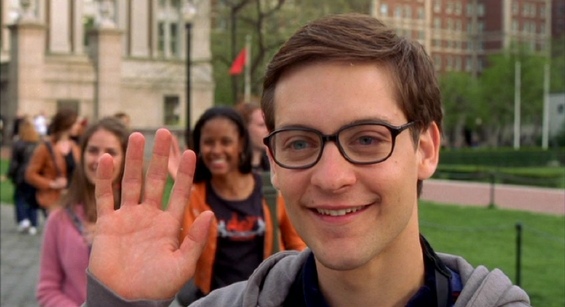

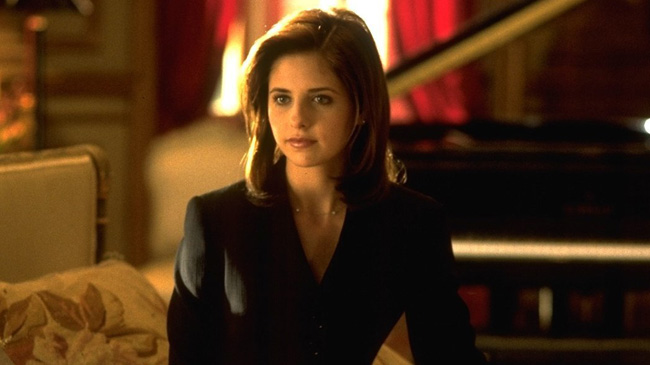
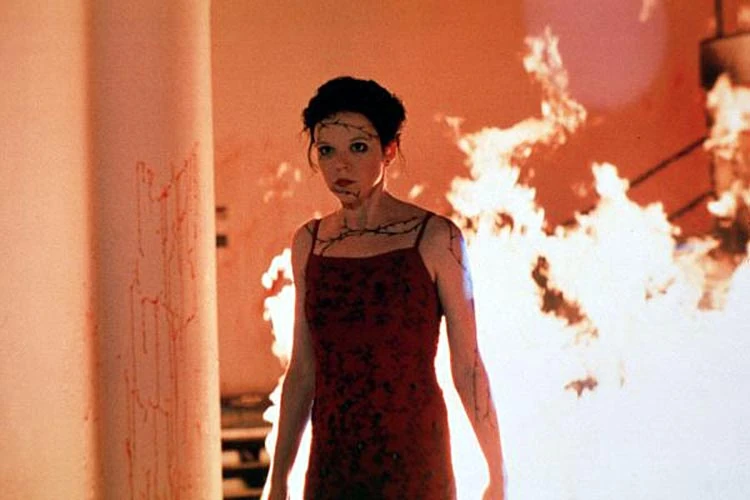


With Fairuza Balk as dispassionate narrator, we're led through the showers, classrooms, gyms and playing fields of hundreds of schools, constantly zeroing in on the common elements. This culture is approached with a rigorous anthropologists eye, giving us examinations of the role of the 'new kid' and the clique system, the consequences and dangers of not fitting in, explosions of violence and frothy oceans of teenage lust.
Though there's hundreds of films here a few are singled out for closer inspection. Watching critical analyses of The Craft, The Rage: Carrie 2, Euro Trip and Idle Hands was like catnip for me. These films are trashy, but Beyond Clueless gives them totemic significance; Rosetta Stones for understanding the teenage psyche (or what old white studio heads imagine the teenage psyche to be).
Charlie Lyne's editing goes a long, long way towards elevating these films to cultural artefects. I wouldn't recommend anyone actually watch the execrable Carrie 2, but slicing out the few genuinely interesting bits and presenting them to us in montage makes it feel worthy of study. This kaleidoscope effect echoes Adam Curtis' style, the images may not logically fit together but they do work subconsciously, fractured moments building up to a meaningful jigsaw. This woozy effect is further underlined by a truly excellent score from Summer Camp, current champs of retro-flavoured, sunkissed synth-indie.

Excellent pacing and scoring allows Lyne to gently ratchet up the pace, culminating in a terrifying litany of violence set to relentless electronic pounding. It's a hell of a sequence, a blizzard of bloody blows and children waving guns at each other. In moments like these, with all extraneous narrative distraction stripped away, Beyond Clueless achieves Herzoggian ecstatic truth. Individual films futilely grasp at that indefinable teenage emotional intensity, capturing brief flashes here and there. Here, in concert, that intensity is realised, and it makes for breathtaking cinema.
That said, there's some slight friction between the critical and aesthetic ambitions. Analyses of, say, puberty in Ginger Snaps, are right on the money but a little obvious. Similarly, a lengthy probe into Euro Trip's latent homoeroticism is cleverly observed, but the argument peters out towards the end.
This criticism applies to the film as a whole, it's strongest when delving into psychology and subtext but lacking when tying it all together into a conclusion. I was reminded of the Žižek Pervert's Guide to... documentaries: both they and Beyond Clueless search for meaning in mainstream cinema, yet while Žižek successfully grounds his analyses in a wider sociopolitical/ideological context, this largely eludes Beyond Clueless.
That aside, this is a brilliant piece of playfully subversive and archly funny analytical cinema that's tuned right into my sensibilities. Where the hell else am I going to see unjustly ignored classics like 2001's Josie and the Pussycats given the attention they richly deserve? But Beyond Clueless's real strength lies on the visual/auditory level: to watch is to step into a pop-inflected hyper-real dream of the past.
If you're even remotely interested in digging beyond the surface of pop culture you'll dig this.
★★★★
Beyond Clueless is on limited release now.
Saturday, September 27, 2014
Saturday, September 27, 2014
- 0 Comments

"In Still the Enemy Within, we witness the last gasp of British working class dignity. This documentary, chronicling the 1984-85 Miner’s Strike, gives us a glimpse into an alien past. This Britain is a country of industry; a place proud of making things. Power lay in the hands of the working class and their trade unions, their economic centrality giving them leverage to fight for decent pay, safe working conditions and secure employment.
In 1972 and 1974 the National Union of Mineworkers staged successful strikes, with the ’74 strike bringing down the Heath Government. This display of power galvanized the trade union movement, every miner buoyed up by the knowledge that their union had their back. Then along came Thatcher. The concept of a worker’s union with the means and ability to affect profiteering was anathema to her free market philosophy, not to mention that the Tory party was consumed with a burning desire to avenge Edward Heath.
The stage was set for a showdown"
★★★★★
Wednesday, September 10, 2014
Wednesday, September 10, 2014
- 0 Comments

My theory was that a documentary that sounded so dull on paper simply had to be gripping on screen. The subject: the Grande Raccordo Anulare or GRA, Rome's equivalent of London's M25 ring-road. I figured that for a film-maker to pack up his equipment and devote a decent chunk of his time to documenting this life, then this must be the most goddamn fascinating urban traffic management project in the world. It really isn't - but that's not the point.
Rosi's Rome is shorn of history; absent are Roman ruins and lofty views of St Peter's Basilica; replacing them are dowdy public housing projects, car parks, half-dead industrial ruins and examples of half-assed architectural modernism. Stumbling around these spaces are an curious crew of society's dregs, centrifugally tossed outwards from the centre of the city.
As a fly on the wall we dispassionately observe the minutia of their lives; a laptop-fixated girl bickers with a bearded old man; women in a decrepit camper van eat mozzarella and discuss their charges for indecent exposure; an old man gets dressed up in a cape for some archaic ceremony; transsexual prostitutes haggle for prices on the pavement; a man chats to his senile mother; skeletal corpses are re-interred and so on. We drift between them as a ghostly, unacknowledged presence - taking in a random couple of minutes of their lives before moving on.

The film is shot on a cheap looking digital camera; I'd guess equipment chosen for portability rather than for cinematic aesthetics. Anyway, Rosi clearly isn't interested in trying to reveal the beauty of these grotty locations; rather to exacerbate their normality. The entire film is shot in perfect digital focus, the effect being a flattening of background, foreground and subject into one image. With an reliance on pre-existing lighting, colours become desaturated and shadows bleed into one another. This all adds up to a film that looks as if it might have been shot on an iPhone.
So what is Rosi trying to achieve here? He's made a purposefully ugly film, stuffed it with a gaggle of disconnected no-hopers who appear to be ticking off the days until they're tossed into the ground. The GRA road, always bustling away in the background, audible if not seen, becomes a symbol of economic activity. A thousand headlights swoop around Rome, creating a ring of light - described in the opening credits as "like Saturn's ring". Yet the people who co-exist with this monumental road are forgotten, living a nomadic, forgotten existence.
This juxtaposition of dynamic economic power and depressive static failure leads us down an irresistibly political path. Sacro GRA is a snapshot of a society teetering on the edge of catastrophe. Rome (and by extension Italy and presumably the whole civilised world) has become rotten, a decomposing edifice sustained only by the memory of past glories.

The views of tiny, strip-lit box-apartments, television sets illuminating stained mattresses recall Orwell's 1984; a society without joy, clinging grimly onto some half-remembered past. There's a visual progression that takes us from these human matchboxes straight to a mausoleum; apartments ebing mirrored with holes for stacked coffins. In creepy footage we see hazmat-suited workers dragging lead coffins from their holes, cutting them open and transferring these dry, papery skeletons to a pit on the outskirts of Rome, unceremoniously dumping them in the shadow of the GRA.
The conclusion of Rosi's argument uses palm weevils as a metaphor for these disparate Romans. The film-maker himself is reflected in one of his subjects; an eccentric scientist/gardener making his way through the palm garden with a microphone and sound recording device. He pokes the mic deep into the palm tree and amplifies the sounds inside, revealing a cacophony of chewing and squeaking - what he describes as "an orgy".
It's a none too subtle metaphor. The GRA becomes the bark of the palm tree, the innards Rome and so the citizens are insects locked into an apocalyptic cycle of consumption, reproduction and death. Not exactly the feel good experience of the year.
While there's more than enough intellectual meat to chew on in Sacra GRA, the actual task of watching the film isn't particularly enjoyable. The combination of deliberately uninspiring visuals and a ponderous pace meant that, while I appreciated the argument Rosi makes, frankly it was a bit difficult to keep my eyes open.

Sacro GRA is firmly experimental cinema, relying entirely on an audience approaching it intellectually rather than for entertainment purposes. It's reductive to describe it as "boring", but hell - it is boring. But this is a purposeful brand of boring - boring with a point. The closest point of comparison I can think of are Godard's 2010 Film Socialisme and Danièle Huillet and Jean-Marie Straub's 1982 Trop tôt, trop tard. Both are similarly boring (and not hugely fun to watch) but in both you sense that careful reasoning has gone into showing an audience certain images, thus imploring you to analyse it as best you can.
Audience mileage for Sacro GRA largely depends on their tolerance for the avant-garde. Though enigmatic and fiercely idiosyncratic it's actually one of the more watchable examples of arty political cinema. That's not a huge compliment and (though I don't want to sound snooty) any mainstream audiences watching this will probably end up baffled and annoyed. It's difficult to assign a star rating to something this, but tellingly, writing about Sacro GRA was a hell of lot more fun than watching it.
Make of that what you will.
Sacro GRA is released in the UK on 7th November
Wednesday, September 3, 2014
Wednesday, September 3, 2014
- 0 Comments

A ferocious Tyrannosaurus Rex bares its jagged teeth on the poster. There's a quote describing it as "awe-inspiring". Perhaps that's why some hapless parent plumped to bring a gaggle of excited five year olds to Dinosaur 13. Unfortunately for her and the children, this is less a thrilling romp through the Mesozoic period and more a dry, analytical documentary about a complex legal battle, with a focus on the minutia of South Dakota land law.
Enjoyment of Dinosaur 13 hinges on two things. If you're interested in the commercial processes behind paleontology you're onto a winner. Similarly so if you like picking through legal logic puzzles. Fortunately I like both, so Dinosaur 13, though a pretty damn dry documentary, held my interest for the full two hours. The five-year olds lasted an hour, with one increasingly dismayed kid politely whispering "Mummy, when are the dinosaurs coming?"
The titular Dinosaur 13 is the most famous dinosaur fossil in the world; Sue. Discovered in the badlands of South Dakota in 1990 Sue is the thirteenth T.rex discovered, and the largest, most articulated and best preserved. A discovery like Sue is every paleontologist's fantasy and through grainy early 90s camcorder we track the excitement, amazement and sheer awe on the faces of those gently excavating her from the desert.
 |
| Peter Larson, Sue Hendrikson and Sue (and a dog). |
Their leader is Peter Larson, fossil-mad since a child and infatuated with his discovery. He and his brother Neal co-founded the Black Hills Institute in 1974, a commercial paleontological company set up to unearth fossils and sell them to museums around the world. He speaks in movingly poetic terms about the thrill of his work, explaining that the light from the stars in the sky left their stars at the same time as the fossilised animal breathed its last, sandwiching him within hundreds of millions of years of history.
With Sue safely out of the ground and the landowner compensated the future was bright. Local spirits were high: children would regularly come to visit Sue and plans were afoot to raise money to construct a local museum to house her - a huge economic boost for this small town. Then, one day the FBI and the National Guard showed up, ordered everyone out of the offices, packed Sue into crates and bundled her into a dimly lit warehouse - her home for the the next four years.
The bulk of the film is devoted to the resulting legal battles between the US Government, Maurice Williams (the owner of the land Sue was found on) and the employees of the Black Hills Institute. Douglas is clearly on the side of Black Hills and the film treats the battle as an inherent perversion of the legal process; a tale replete with vindictive judges, hints of shadowy conspiracies and the overpowering bureaucracy of the US Government.

The mantra repeated throughout the film, whether it be in stock footage or talking heads, is "This the land of the free! How can this happen in America!?" This unified chorus against the depredations of 'big government' exposes the libertarianism embedded deep in Dinosaur 13, something best highlighted when the film uses a clip of Bill O'Reilly to support their case. Boiled to its core, Miller argues for the freedom of private enterprise; that a citizen should own the fruits of their labour and be able to dictate its commercial use.
Short shrift is given to the US Government's position that Sue, having been discovered on land held in trust for the Sioux tribe, legally belongs to them. There's a fascinating ruling midway through proceedings that dinosaur fossils are land. The paleontologists are unified in their indignance that Sue be regarded as "real estate". Ridiculous as that might seem it's a smart bit of legal reasoning: given that the original dinosaur bone has become mineralised over millions of years it is literally composed of 'land'. The crux of this is that in buying Sue, the Black Hill Institute was unknowingly negotiating for the purchase of land from Maurice Williams, land which he was legally unable to sell.
Dinosaur 13 never admits for a moment that its scrappy underdogs could be anything other than in the right - when the law defeats them they fall back on a position of moral superiority. Fortunately for Miller they can claim this ground much more successfully, with a subsequent criminal trial appearing to move into the realms of the genuinely vindictive.
It's a testament to the skills of Miller that, even though I'm opposed to the libertarian philosophy upon which Dinosaur 13 makes its case, I find it easy to sympathise with the people caught up in it. Peter Larson's devotion to Sue is hugely touching; their separation more reminiscent of a tragic love story than scientific endeavour. This passion gives the final shots of him striding purposefully back into the endless desert a great deal of gravitas.
 |
| On display to the public in Chicago. |
But the heart of Dinosaur 13 is Sue. She is heart-wrenchingly beautiful, her enormous bones infused with regal dignity and a subtle sense of loss. When she's ultimately sold to the Field Museum in Chicago for a massive $8.4 million the paleontologists aren't surprised, saying "she's worth so much more". Sue is one of the most magnificent things ever drawn out from beneath the earth, beyond all the politics and law one thing is crystal clear: she was worth fighting for.
★★★
Monday, August 25, 2014
Monday, August 25, 2014
- 0 Comments

The Killers once asked “are we human or are we dancer?” Kenneth Elvebakk's Ballet Boys answers by demonstrating that you can be one or the other – but not both. His documentary, following three Norwegian boys with hopes of being professional ballet dancers, shows the determination, skill and good luck needed to succeed in a cut-throat world that demands perfection.
Our three young Baryshnikovs are Torgier, Syvert and Lukas, all of whom range in talent and motivation. Lukas looks as if he's been genetically bred for dance success, all boy band blue eyes and confident grace. He's Terminator-like in his determination to make it as a ballet dancer, and skilled to the point that he outshines everyone in the film. His superhuman skill is impressive, but makes him a bit unrelatable - the heart of the film lies with Syvert and Torgeir (but mainly Syvert).
In an early scene Syvert bemoans his East Asian ethnicity, explaining that he wishes he was white Norwegian. Right away we recognise that he's nursing an inferiority complex next to the easy-going Torgier and dance commando Lukas. There's a meaty psychological paradox at play in a boy who considers himself innately 'out of place' trying to climb the peaks of physical and mental perfection: transforming his body into a direct tool for artistic expression.

Torgeir is a different kettle of fish, though what kind of fish is anyone's guess. He's the Collins to Lukas and Syvert's Armstrong and Aldrin. Mainly he's an amiable sort of guy, floating around in the background of scenes cracking jokes and stretching. Though we peer into Syvert and Lukas' home lives, Torgeir remains an unknown quantity, a victim, I suspect, of brief run time.
At a mere 72 minutes Elvebakk's film mirrors the bodies of its subjects; lean, pacey and with zero percent fat. On one hand I appreciate brevity in cinema, optimistically treating it as a sign of a confident, concise director. On the other how much justice can a documentary do to his subjects and the art of ballet in such a short amount of time?
Unfortunately this is more the latter than the former. Ballet Boys bears more than a passing resemblance to Steve James' 1994 classic Hoop Dreams. Both follow boys with big ambitions; one set to become professional ballet dancers, the other to compete in the NBA. Both show the emotional and physical toll it takes on the subjects, exacerbated by the weight of ambition and the knowledge that only a tiny minority ever make it. Hoop Dreams follows just two boys, is nearly three hours long and is about as comprehensive a study you could feasibly get of its subject. By comparison Ballet Boys barely skims the surface.
Another flaw is that other than the knowledge that they want to turn professional, Elvebakk never lays out the milestones they need to achieve to do it. We jump haphazardly from auditions to audition with little idea of the stakes. Late in the film we learn, almost as a postscript, that Lukas triumphed over nearly 1200 other applicants to get a place in a top ballet school, a fact that would have immeasurably upped the tension of the preceding scenes.
Also absent is any explanation of why they started dancing in the first place. We meet them in the middle of their training and while some attention is paid to why they want to continue, we've got no idea how they began. Ballet Boys recognises that being a teenage male ballet enthusiast is somewhat peculiar, so knowing what initially attracted these very different boys to this world would add a splodge of character to proceedings.
But the worst consequence of the short run time is that we don't get to see the boys properly dance. Sure, we get a few jauntily edited clips of them doing the odd move to a dubstep beat (presumably intended to show that ballet's hip, cool and with it yeah?) and a few seconds here and there from various contests, but I was craving a couple of unbroken minutes of footage demonstrating what each of these boys can do.

Presumably the potential audience for a ballet documentary must, at minimum, enjoy watching people dance, so why the need to chop up their moves into MTV inflected quick cuts? This robs us of that Billy Elliot moment when we finally understand why they're pushing themselves so hard in pursuit of a distant aesthetic goal.
It's a pity because there's a lot of potential in these boy's stories. I found myself craving more and more information as the film went on; what were their parent's reactions to their child deciding to go pro-dancer? What do their non-ballet friends think of the whole affair? What, exactly do they want to achieve if they do make it? All of this goes answered. What's left is anorexic, as if Elvebakk doesn't think this subject and these boys are going to hold our attention.
The film has its moments – nearly all of them arising from the casual camaraderie between these three remarkable young men. We sense the bond forged between them and they succeed in making us care about their success: we want to see them achieve their dreams. To the film's credit it does go some way to outlining the downsides to ballet; a destroyed body and retirement by the age of 40; the sacrifice of a 'normal' social life in favour of intensive training; the simple risk of a random career ending injury.
These moments of illumination raise Ballet Boys from the humdrum, but it's just too slight to give us any real insight into the weird, high-stakes world of ballet.
★★
Ballet Boys is released September 12th.
Saturday, May 31, 2014
Saturday, May 31, 2014
- 0 Comments

Pulp: A Film About Life, Death and Supermarkets is the best film that could be made about Pulp. The majority of British pop bands were eager to be seen as “one of the lads,” with a pint in one hand and a copy of Loaded magazine in the other. Not Pulp, who wholeheartedly embraced an individualistic style of pervy proletariat, outsider chic. Their lyrics are the stuff of fluttering net curtains in run-down terraced houses, chaotic and confused teenage lust and not only not fitting in, but knowing you’ll never be able to. This documentary, centring on the band’s 2012 farewell concert, grasps everything that Pulp is about. It’s less a straightforward band biography and more a sociological study of the swamp of fears, loves and passions that bubbles away under the industrially cratered landscape of Sheffield.
★★★★★
Pulp, A Film About Life, Death and Supermarkets is released June 6th.
Tuesday, May 6, 2014
Tuesday, May 6, 2014
- 0 Comments

Professional cycling is an ego incubator. Out there, alone for hours on the road, the cyclist's thoughts turn inward. The pain they feel in climbing a hill is cross to bear, their speed entirely their own, every triumph borne solely by them. No wonder they turn into pricks. This documentary explores the life and untimely death of Marco Pantani, a hugely popular and vaguely eccentric professional cyclist feted for winning both the Giro d'Italia and the Tour de France, a feat still unequalled in the sport. He became known as 'The Pirate', becoming a folk hero in Italy. He was on top of the (cycling) world.
Then six years later his cocaine-stuffed corpse was dragged out of a cheap hotel room. From the heights of athletic achievement to drug-fuelled depravity - what the hell happened? Pantani: The Accidental Death of Cyclist tries to go some way to answer this question, linking athletic excellence with addiction, the sweaty cyclist conquering a mountain in the noonday sun a metaphor for deepr internal struggles.
Pantani's story is shown through a combination of stock footage and dramatic re-enactments. By and large it's a pretty seamless combination, the lookalike they've cast as Pantani does a decent of job of standing in where cameras couldn't go. Though technically this is all decent enough, the childhood sequences have more than a whiff of a Dolmio ad, with a smiling Italian grandfather buying a young Pantani his first bicycle under a picturesque Mediterranean sunset.

As he begins to get a reputation as something special on a bicycle, particularly when it comes to climbing hills. This quickly snowballs into a promising career, and soon he's a professional racer - picking up accolade after accolade. Disaster strikes midway through his career when a forgetful cop overlooks a road closure - and while zooming down a mountain he smashes headlong into an oncoming car. Doctors don't know if he'll even walk again - let alone cycle, but after a long period of recuperation he miraculously gets back on his bike and goes on to win big. Textbook triumph over adversity stuff. But this is cycling in the 90s, that's doping territory. After failing a blood test he's disqualified and shamed, sending him spiralling into depression and drugs.
Hang on a minute... A champion cyclist triumphing over medical adversity followed by a doping disgrace? This is awfully familiar stuff... It's impossible not to think of Lance Armstrong watching this, and particular of Alex Gibney's recent The Armstrong Lie, a documentary that covers the same territory beat for beat. I didn't really enjoy The Armstrong Lie, but Pantani definitely suffers from being released in close proximity. This is more cinematic bad luck than anything particularly wrong with the movie, but if you've seen one explanation of what a peloton is, or how performance enhancing drugs work, sitting through it again is a bit tedious.
There are high points within the film. EPO, the drug that caused all this ruckus ups the red blood cell count, allowing more oxygen to be transported to muscles. Having so many red blood cells means that the cyclist's blood runs the risk of "silting up" if their heartrate falls below a certain level, i.e. when sleeping. To counteract this, doping cyclists had to sleep with heartrate monitors on that'd wake them up if they were in danger, after which they'd hop on exercise bikes built into their bedroom and start to pedalling away so as not to die. There's something poetically kinda neat about these quasi-vampiric nocturnal cyclists who've chemically screwed up their bodies up to such a degree that they need to cycle... or die!

But these interesting nuggets of information are few and far between, and as we close in on the fall from grace the documentary shoots for a rather far-fetched defence of Pantani. Essentially they infer that Pantani wasn't really doping, rather he was just too good a cyclist. It's just not interesting to see the same man winning every race, and so the top bods secretly plotted his downfall by faking the results of his blood tests and kicking him out of the sport. This is paranoid conspiracy theory, and from my (admittedly armchair) perspective, if every other damn cyclist was shooting EPO into their bloodstream then in all likelihood Pantani was too.
There's also a suspiciously quick glossing over of his post-racing life, the audience only learning that he was difficult to be around. Aside from people praising his athletic prowess there's a suspicious lack of people who appreciated him as a person. Professional cyclists tend to be arseholes even when sober, so I can only imagine the horror of a miserable coked up self-hating one. As such, the documentary ultimately feels a little like a PR exercise in image rehabilitation; smoothing off the rougher edges, downplaying the scandal and accentuating his victories - turning disgrace into tragedy.
What's left is a portrait of a man who was undoubtedly a very good cyclist, but doesn't appear to have that much more to him. The attempts to define him as a flamboyant man in a buttoned-down sport never quite come off, the lack of any critique of his doping feels a bit cowardly and the conspiracy theory theorising is just far-fetched. Even The Armstrong Lie, though largely dull, had the frisson of Armstrong publicly flagellating himself for the camera.
I suspect these cycling documentaries are tailor-made for those already into the sport, because they offer precious little to those that don't give a toss about bicycle racing. In my book the gold-standard for the sports doc is Senna, which managed to draw me into a discipline and personality I knew next to nothing about. But the difference is that Ayrton Senna was an interesting, charismatic kind of guy and professional cyclists are by design self-obsessed loners. Who wants to spend 90 minutes exploring their inner life? Not me that's for damn sure.
★★
Pantani: The Accidental Death of a Cyclist is on limited release from May 13th.
Subscribe to:
Posts (Atom)