Recent Articles
Showing posts with label four stars. Show all posts
Showing posts with label four stars. Show all posts
Saturday, February 28, 2015
Saturday, February 28, 2015
- 0 Comments

"As I enter this place, I am conscious of the present moment. I am responsible for my own actions. I make my own decisions. Anything I choose to do, I do so freely."
Having to sign a disclaimer like this is a promising omen. The air hangs thick and heavy in damp brickwork of the passages under Waterloo Station, disturbed only by the ominous rumble of overhead trains. What on earth are we to find beyond the sheet metal doors of the 'Cavern' performance space?
For all that I enjoy theatre, I've never been remotely scared by a play. I've laughed, cried and gotten angry - but never been truly frightened. It's not that I'm particularly brave - a suspenseful horror film can give me a bad case of creeps - but the artifice of theatre stops that fight-or-flight instinct kicking in. Even so I've always been on the look-out for that one show that'd scare the pants off me, leaving me a quivering, sobbing wreck of a man. Hellscreen, by Firehouse Creative and double barrel productions, looked like a promising candidate for doing just that. Described as "sensual, exciting and terrifying", the show promised to marry theatrical intensity, cinematic sequences and participatory thrills.

Adapted from a 1918 Japanese horror story by Ryunosake Akutagawa, the show takes the basics and updates them for the modern day. The original story told the tale of 'the greatest artist in the land'. He's commissioned by a patron to create a vision of the Buddhist Hell. To achieve verisimilitude he begins to inflict tortures on his apprentices. Spiralling downwards to depravity, the artist commits a series of atrocities in an attempt to create an true artistic facsimile of hell.
Hellscreen sticks fairly close to this premise, yet updates it to a contemporary setting. The talented artist is reimagined as intense former YBA Frank Holt (Jonny Woo). An enfant terrible, he furiously opposes all forms of cultural triviality, bourgeois quibbling and blind consumerism. As we meet him he's engaged in an unsatisfying series of works in which he paints paintings of celebrities using his own excrement.
But when a mysterious patron (Suzette Llewelyn) offers him unlimited resources to realise his dream of peeling back the carapace of the world to expose the writhing filth beneath he jumps at the chance. His genius idea is to take court transcripts of gruesome crimes and re-enact them with documentary precision; streaming the productions on the internet. Through gore, pain and humiliation he intends to vindicate and spread his nihilistic worldview with the intention of leading society, via misery, towards an aesthetic honesty.
Holt's only bulwark against going completely off the deep end is his daughter Amy (Vanessa Schofield. An intrinsically good person, she finds her father's gradual slide into sadism disturbing. Though she tries to help she's stymied in her efforts by the increasing diabolical patron, who confines her to an offshore artist's workshop to develop her performance skills.
Hellscreen is never less than fascinating, particularly in the subtly provocative staging. Using the traverse style, the space is bookended by two abattoir-like screens of hanging plastic curtains To enter we must push our way through them, take a plastic stool from the stage and decide where we want to place it. Once we're seated the audience faces itself, the narrow room all but forcing us to observe the reactions and body language of our fellow audience members as much as the on-stage action. All of this quietly serves to implicate us in what we're to see; we must choose to force our way into the space through the curtain, choose our own spot to sit and then silently judge one another.
During the performance the audience's involvement becomes more explicit. Throughout, the performers constantly make eye contact with us, ask us questions, sit directly in front of us miming actions or simply give intense performances mere inches away. This all comes to a head in the crime sequences, where the audience is asked to push a button to drop a bomb on a house, or confronted by a torture victim and asked why we're not stepping in.
I enjoy shows that purposefully set out to make the audience uncomfortable; there's a masochistic part of me that enjoys that uncomfortable curl in your gut, the slight guilt and worry that you're not behaving as you should. But what's the purpose of all this provocation?

With Hellscreen's preoccupation with graphic torture, decapitations and immolations, all streamed online to a self-hating public, there's obvious echoes of the execution videos of ISIS. I'm not entirely sure whether the similarities of ISIS' recent high-profile murders are fortuitous coincidences or not, but the shared iconography can't be denied. Thing is, I'm not sure what exactly what's being said about them.
There's a whiff of Charlie Brooker's Black Mirror in the way Hellscreen identifies contemporary trends and takes them to their logical conclusion - presenting us with an outrageous world yet one that's grown organically from our own. But, ultimately, the easily accessible real life horror show of a caged man being burned to death can only trump Hellscreen's fictional imagination.
I can't really criticise the show for being overtaken by reality, how could any playwright foresee the videos periodically emerging from Syria and Iraq? Yet it has, draining some (but not all) of the horror from the final scenes. If the message of Hellscreen is that we should be condemned for our attraction to sadistic violence, then (right though they are) it's a bit of an obvious observation. Similarly, if the show is a more targeted condemnation of those who choose to stream ISIS' videos then it becomes a bit vague - unable to answer whether merely observing an online atrocity implicates us.
This confusion aside, there's a hell of a lot to admire here; from the inherent tension to every facet of Jonny Woo's performance, his papery skin stretched tight over his skull and fists clenched, to the eerily insectile costuming and demeanour of Suzette Llewellyn, to the one bright spot of innocence we find in Vanessa Schofield's singing.
My search for a truly terrifying piece of theatre continues: Hellscreen leaving me ethically uncomfortable rather than cowering in pants-shitting terror. But this is a deeply effective production, one that's constantly finding new ways to toy with the audience and provoke a response from us. In a world of fluffy theatrical trivialities it cuts a distinctive, solitary figure - one well worth checking out.
★★★★
Hellscreen is at the Vault Festival until 8th March. Tickets and details here.
Sunday, February 8, 2015
Sunday, February 8, 2015
- 0 Comments

Jupiter Ascending is about a Russian-American toilet cleaner called Jupiter Jones (Mila Kunis) who's rescued from murderous aliens by half-dog spaceman Caine Wise (Channing Tatum) and subsequently discovers she's the genetic reincarnation of a murdered space-vampire Queen. Also thrown into the mix are royalty detecting bees, an army of flying dinosaur-men, a crapload of gigantic explosions, some killer frocks and some outrageously hammy performances that leave no scenery unchewed.
God only knows who gave the Wachowskis the £175m budget, but they deserve kudos for funding one of the barmiest mainstream science fiction experiences in years. This is the kind of film that casually cuts from kitchen-sink comedy/drama to a destroyed alien world where three weirdoes chat gobbledegook about the end of the world, then cuts back to the real world without so much as blinking. This is the kind of film that you just have to 'go with', trusting that the ludicrous dialogue and nonsensical plot developments are building up to something.
 |
| Also you get to see Tuppence Middleton's butt. |
Well, not to spoil the film, but everything pretty much comes together in the final act. Though the Wachowski's revel in chucking bonkers new ideas onto the screen every five minutes or so, the actual plot isn't so dissimilar from The Matrix. Both here, as there, the accepted layers of reality are peeled away to reveal a horrible truth; that humanity is being exploited for our raw materials.
On its narrative merits, Jupiter Ascending often comes up short. Perhaps a victim of an overzealous studio mandated edit, the plot jumps forward in fits and starts. Characters are introduced with great fanfare then disappear from the plot, the heroine suddenly knows things she shouldn't and the film has at least two unrelated climaxes one after the other. Similarly, Mila Kunis' Jupiter is mostly a bit of a limp rag, forever falling off things and being caught in midair by Channing's hunky dogman, not to mention that she gets riches and fame purely by dint of who she is rather than actually doing anything to earn them.
 |
| Aw yeah. |
This adds up to a undeniably flawed movie, but also a deeply enjoyable, super fun one. By way of an example; there's a scene relatively early in the movie where Jupiter and Caine have temporarily escaped the clutches of the villains and headed to the countryside to seek help from grizzled space veteran Stinger Apini (Sean Bean). For some reason Stinger has filled his house with bees, hives growing from every wall and honey trickling down over the wallpaper. Jupiter reacts to this with understandable fear, brushing them away from her before they sting. But they don't sting.
It's then explained that she's not being stung because bees can instinctively detect royalty and as bees are incapable of lying (news to me!), this means Jupiter must be space royalty. The characters instantly kneel before her, referring to her as "Your Majesty" for the rest of the movie. There's two reasonable audience reactions to a scene like this. The first is "What the fuck is going on? This doesn't make any sense. I don't like it." The second (correct) reaction is "This doesn't make any sense! What the fuck is going on? This is amazing!".
 |
| These bees know the score. |
This freaky dream-logic bubbles under for most of the film, enjoyment largely predicated on audiences just accepting that right now Channing Tatum is breakdance fighting an angry winged Tyrannosaurus man on an exploding refinery in the middle of the planet Jupiter's eye and there's not a damn thing anyone can do about it.
This rebellious, headstrong quality to the script that perfectly tickles away at my sensibilities. So when in the middle of the film, Jupiter Ascending decides it's going to be Terry Gilliam's Brazil for about 10 minutes you just roll with it, giggling along with it as it then produces Terry Gilliam himself to play an sinisterly eccentric intergalactic bureaucrat who proceeds to tattoo the heroine with a cool glowy symbol.
 |
| yes yes yes |
This stuffed-to-the-brim sci-fi maximilism is also realised in the baroque visuals. The spaceships in the film are ornate, gilded and elegant, decorated with gigantic golden statues and glass atriums. Parts of the ships shift and move around the core, the outlines never quite coalescing into something concrete and recognisable. A similar trick is played with the costumes, the most elaborate looking like the kind of thing Lady Gaga would turn down as too impractical. The best way I can summarise this aesthetic is if The Fifth Element and David Lynch's Dune had a lovechild, and that lovechild grew up to become seriously weird teenager.
All of this is extremely my shit, but I've as yet only alluded to the cherry on top of this teetering, sugary, whipped cream bedecked ice cream sundae of a film. This is Eddie Redmayne's Balem Abrasax, main baddie and the silliest thing for lightyears around. Redmayne appears to be channelling David Bowie's evil twin - all pouty lips, high collars and bizarre pronouncements. He does all this in a strangled theatrical mumble, punctuated by angry yelps of passion. He's perfectly attuned to the material, his every appearance sending the audience into giggling fits.
 |
| I love this guy! |
Cards on the table - whatever the Wachowski's are serving up I'll gobble up. Speed Racer, generally regarded as an embarrassing megaflop, is in my book a secret psychedelic masterpiece. Cloud Atlas, a film that confused and alienated it's meagre audience, was for me an imaginatively sincere spiritual quest. And so it is with Jupiter Ascending, a deeply creative, ultra-imaginative and playfully original sci-fi treasure that, let's face it, is probably destined to vanish into ill-regarded obscurity. Ask yourself: do you want cookie-cutter, grey-ass predictable bullshit? No? Then go and see this already!
OOH! OOH! I forgot to mention that when Channing Tatum's dogman fires his space gun it barks at the baddies! :D
★★★★
Jupiter Ascending is out now.
Wednesday, January 28, 2015
Wednesday, January 28, 2015
- 0 Comments

Who would have thought the sight of a fresh-faced Freddie Prinze Jr could conjure up such nostalgia? There's a lot of him in Beyond Clueless, as well as his teen star cohorts: there's Seann William Scott! Mena Suvari! Matthew Lillard! Seth Green! Jason Biggs! Everyone is so young, hopeful and fancy-free, sure that these days of wine and roses will never end. Oh you sweet summer children, such naïvety...
Beyond Clueless is a docu-collage knitted together from US high school movies, examining their fashions, psychologies and ideological underpinnings. It's worthy of attention: year on year Hollywood cranks out high school movies, always pieced together from the same basic building blocks. You've got your jocks, skaters, nerds, preps and cheerleader cliques. You've got mean gym instructors, awkward transfer students, sexy French teachers, bitchy popular kids and dorky stoners. We troop through school theatre, the big game, debate club, SAT exams and, that all conquering social colossus, the Prom. Having grown up in Britain, I have no first hand experience of US high school, but I've lived thousands of simulations.
In its parade of semi-forgotten faces toothily grinning under regrettable haircuts, Beyond Clueless presents us with a vision of neverending adolescence. As Matthew McConaughey memorably said in Linklater's Dazed & Confused "That's what I love about these high school girls, man. I get older, they stay the same age." The film congeals hundreds of slightly different cinematic high schools into an omnifictional megaschool where Cady Heron can rub shoulders with Peter Parker, Cher can warily eye up Kathryn Merteuil and Rachel Lang can telekinetically tussle with Nancy Downs.

With Fairuza Balk as dispassionate narrator, we're led through the showers, classrooms, gyms and playing fields of hundreds of schools, constantly zeroing in on the common elements. This culture is approached with a rigorous anthropologists eye, giving us examinations of the role of the 'new kid' and the clique system, the consequences and dangers of not fitting in, explosions of violence and frothy oceans of teenage lust.
Though there's hundreds of films here a few are singled out for closer inspection. Watching critical analyses of The Craft, The Rage: Carrie 2, Euro Trip and Idle Hands was like catnip for me. These films are trashy, but Beyond Clueless gives them totemic significance; Rosetta Stones for understanding the teenage psyche (or what old white studio heads imagine the teenage psyche to be).
Charlie Lyne's editing goes a long, long way towards elevating these films to cultural artefects. I wouldn't recommend anyone actually watch the execrable Carrie 2, but slicing out the few genuinely interesting bits and presenting them to us in montage makes it feel worthy of study. This kaleidoscope effect echoes Adam Curtis' style, the images may not logically fit together but they do work subconsciously, fractured moments building up to a meaningful jigsaw. This woozy effect is further underlined by a truly excellent score from Summer Camp, current champs of retro-flavoured, sunkissed synth-indie.

Excellent pacing and scoring allows Lyne to gently ratchet up the pace, culminating in a terrifying litany of violence set to relentless electronic pounding. It's a hell of a sequence, a blizzard of bloody blows and children waving guns at each other. In moments like these, with all extraneous narrative distraction stripped away, Beyond Clueless achieves Herzoggian ecstatic truth. Individual films futilely grasp at that indefinable teenage emotional intensity, capturing brief flashes here and there. Here, in concert, that intensity is realised, and it makes for breathtaking cinema.
That said, there's some slight friction between the critical and aesthetic ambitions. Analyses of, say, puberty in Ginger Snaps, are right on the money but a little obvious. Similarly, a lengthy probe into Euro Trip's latent homoeroticism is cleverly observed, but the argument peters out towards the end.
This criticism applies to the film as a whole, it's strongest when delving into psychology and subtext but lacking when tying it all together into a conclusion. I was reminded of the Žižek Pervert's Guide to... documentaries: both they and Beyond Clueless search for meaning in mainstream cinema, yet while Žižek successfully grounds his analyses in a wider sociopolitical/ideological context, this largely eludes Beyond Clueless.
That aside, this is a brilliant piece of playfully subversive and archly funny analytical cinema that's tuned right into my sensibilities. Where the hell else am I going to see unjustly ignored classics like 2001's Josie and the Pussycats given the attention they richly deserve? But Beyond Clueless's real strength lies on the visual/auditory level: to watch is to step into a pop-inflected hyper-real dream of the past.
If you're even remotely interested in digging beyond the surface of pop culture you'll dig this.
★★★★
Beyond Clueless is on limited release now.
Friday, January 9, 2015
Friday, January 9, 2015
- 0 Comments

With the economy in the shitter, the dismemberment of the public sector, the stage-managed collapse of the NHS and the revelation that the Britain military didn't so much fail in Afghanistan and Iraq as serve the countries up to Islamic extremists on a silver platter, it's not surprising that politicians latched onto the centenary of World War One like a drowning man clings to wreckage. "Waitaminute, now that everyone involved is dead and won't object, we can spin it into plasticky feelgood patriotism!"
And so the war, previously generally regarded as a monumental fuck up that gobbled up and shat out a generation, has been slowly rehabilitated into one of Great Britain's 'finest hours'. Shelves are stacked high with flag-waving deifications of 'our boys'; the poppy converted into symbol of military recruitment; and the brainmelting nihilistic horror of the Western Front being used by Sainsburys to sell chocolate.
Something is amiss. Something that Testament of Youth quietly aims to correct, presenting us with a World War I drama that's neither triumphalist nor militaristic. Adapted from the de facto documentation of the effects of the war on civilian populace of Britain, the film gradually draws us through an argument that begins with blind patriotic fervour and eventually settles at hard-won, intellectually grounded pacifism.
Our progress through the film mirrors that of its subject/author, Vera Brittain (Alicia Vikander). We first meet her existing in typical period drama romanticism; a group of model-perfect young, well-off intellectuals basking in a rural lake. The boys, Roland (Kit Harington), Victor (Colin Morgan) and Geoffrey (Jonathan Bailey) jockey amongst each other for her attention, doing the kinds of homoerotic things that young men in these kinds of films tend to. Meanwhile Vera is more focussed on bridling against gender restrictions; upset that her father (Dominic West) won't allow her to attend Oxford and would rather she settle down with a nice husband.
But for the war it wouldn't be too hard to predict where all this is going. When it comes Vera springs into lockstep with the propaganda; desperately trying to convince her father to allow her brother Edward (Taron Egerton) to sign up with the rest of the boys and march off to victory. The phrase "it'll all be over by Christmas" rings a happy echo, and with smiles, kisses and brocades of flowers, most of the male cast cheerily march straight into a meatgrinder.
As the strapping young men of the opening sequence dribble back from the front physically and mentally shattered she begins to reconsider her attitude. Studying at Oxford suddenly seem irrelevant in the face of such carnage, so she signs up as a nurse. Soon she makes her way to the muddy, chaotic field hospitals of the front line, where bits of what were once soldiers are shipped in on bloodstained canvas stretchers. Her duties here are apparently less to save their lives and more to give them brief comfort as they gurgle their last.
This never-ending parade of misery hardens Vera and forms the basis of her rock-solid postwar pacifism. If the film has done its job well then we should be right there alongside her, conscious of the true impact of war, angry at the political manipulations required for its birth and determined to do everything in our power to stop it happening again.
By this metric Testament of Youth largely succeeds. It's surprisingly tricky to make a genuinely pacifist, anti-war movie because, simply, war makes for attractive, seductive cinema. No matter the intended tone, the sight of huge explosions, fevered battles and extreme behaviour under pressure makes for exciting viewing. The upshot is that even purportedly antiwar cinema like Platoon, Apocalypse Now and so on are all too easily repurposed as recruitment campaigns. Sure, what you're watching is a crime against humanity, but boy what an exhilarating crime!

There's maybe two ways around this. One is to either head so far towards disturbing, grand-guignol violence that you alienate (and therefore restrict) your audience; a great example being Come and See: an amazing film, but not one that'll appeal to most people. The other is to focus on something less exciting. This is Testament of Youth's strategy, keeping the front off screen and zeroing in on the effect of machine-gun bullet on human flesh, gas on eyeball and mortar explosion on brain.
As an argument it's smartly constructed. As a film it's on slightly shakier ground. Vikander impresses as Brittain, keeping the core of the character intact as her beliefs shift under her. Kit Harington, an actor whose billing in a film generally makes the heart sink, also surprises by being actually pretty good in this (perhaps it's because he doesn't have a dodgy beard?). The supporting cast, boasting Dominic West, Miranda Richardson and Emily Watson among others, ensures the film maintains a rock-solid level of performance quality.
Visually it's a bit of a slog. The project was apparently first conceived as a BBC TV series, and all too often you get a sniff of these roots. There's a dryness and over-familiarity to the aesthetics, the notion that this is the same old period gear from the BBC's costume department you've seen trotted across countless prestige dramas. Director James Kent throws in the odd adventurous shot, but even though I appreciate the effort they fall a bit flat. In particular there's a visual quote of the famous crane shot from Gone With The Wind that sort of works, but feels a bit self-consciously 'clever'.
Also worthy of criticism is the film's focus on the perils of the middle-class. It was by a huge majority that the working class of Britain were massacred, so there's the odd moment where the troubles of an attractive yet conflicted woman caught in the heart of it don't amount to a hill of beans. But then you're adapting Testament of Youth, and I suppose the book is what it is.
Puncturing the rapidly inflating bubble of patriotic triumphalism building around the Great War is no easy task. You can be criticised for arguing the worth of the war and downright pilloried for raising the point that the average Tommy was perhaps too happily bamboozled into shipping out to shoot other human beings for no clear reason. In showing this process Testament of Youth, clad in the aesthetics and pace of mainstream Downton Abbey-ish period drama, is a quietly (and appropriately) subversive movie.
★★★★
Testament of Youth is released 16th January 2015
★★★★
Testament of Youth is released 16th January 2015
Wednesday, December 17, 2014
Wednesday, December 17, 2014
- 0 Comments

Science fiction that ponders whether an artificial mind is truly conscious is hardly breaking new ground. As far back as 1921 Karel Čapek's play R.U.R. (Rossum's Universal Robots) explored the idea of lifeforms that are almost human, but not quite. Since then they've been a mainstay in all eras of cinema, from Fritz Lang's Metropolis, through The Day The Earth Stood Still, up the modern day via stone cold classics like 2001, Alien, Blade Runner, The Terminator, The Matrix and Her.
So what new angle does Alex Garland bring to this crowded field? Set in an unspecified near future, our protagonist Caleb (Domhnall Gleeson) is a hotshot programmer working for competition crushing search engine BlueBook. He wins a company lottery, his prize a week long visit to the home of the reclusive genius and company CEO Nathan (Oscar Isaac). Nathan lives in isolation with his non-English speaking maid Kyoko (Sonoya Mizuno) in the beautiful Alaskan wilderness. His mostly underground home is ultra high-tech and tastefully decorated, looking like a nuclear bunker as designed by IKEA.
Soon we learn the reason for such isolation. Nathan has made a breakthrough in artificial intelligence, and her name is Ava (Alicia Vikander). Ava is intelligent, beautiful and ultraperceptive, yet also sheltered, childlike and naive. Nathan quickly confesses that the reason for Caleb's visit isn't a holiday, he's to be part of an quasi-Turing test designed to evaluate Ava to conclude whether she's truly conscious. The rest of the film revolves around a series of interviews between Caleb and Eva, as they open up to each other the film gradually reveals more about Ava, Nathan's ulterior motives and Caleb's true role in the experiment.
 |
| Caleb (Domhnall Gleeson) and Nathan (Oscar Isaac) |
I don't want to spoil too much, so I'm going to leave the plot there. Much of Garland's screenplay is concerned with misdirection, sending both Caleb and ourselves down paranoid trains of thought while keeping 'the truth' in plain sight. With a pared down cast of four (one of whom doesn't speak), the claustrophobic and increasingly sinister surroundings and the precise pace at which the film proceeds, the tension gradually ratchets up scene by scene as the truth is slowly unfurled.
On a basic structural level, Ex Machina is a series of philosophical conversations in confined spaces. Consequently, though the film is beautifully shot by Rob Hardy, boasts deeply impressive production design, a great synth score and seamless special effects, it lives and dies on the quality of the actor's performances. All are excellent, though Isaac's vaguely Steve Jobsian tech guru stands out. The programming geek stereotype is completely absent and with his shaved head and masculine beard he looks a bit like Russell Crowe's Noah, the epitome of the dirt-under-the-fingernails mythic paternal figure. Isaac continually finds some fascinating new angle on Nathan, or fresh mood in each scene, both actor and character taking a sadistic pleasure in constantly pulling the rug out from underneath us.
Good as Isaac is, the true star of Ex Machina is Alicia Vikander's Ava. A trained ballerina, Vikander moves with inhuman grace. She's so subtle in this that it's difficult to pin down individual moments; more that every action is millimetre precise, adding up to a queasy combination of sexuality and uncanny valley 'wrongness'. Ava is intentionally designed to express sexuality, but some dark thing twinges in your brain when you realise you're turned on by a creature whose skin is a metallic lattice and whose robot guts you see whirring away in her belly.
 |
| Ava (Alicia Vikander) |
Learning to love (and lust) for this bundle of fibre-optics, carbon fibre and rubber skin is at the heart of Ex Machina, which treats its subject matter as a sober examination of what it will mean to live in a world where beings like Ava exist. Thing is, though this is all very well conveyed, it's not exactly breaking fresh ground. It's been more than thirty years since Blade Runner and though the world has seen a quantum leap in technology, the central questions of Ex Machina are almost identical to what Roy Batty and Rick Deckard violently debated on the rainy roof of the Bradbury Building.
Even the aesthetics are a bit familiar; Caradog James' excellent and underrated The Machine did the beautiful translucent robot girl (who, bizarrely, was also named Ava) thing a year ago, and the cosy pastel and natural materials set design is strongly reminiscent of Her. This isn't to say that there's anything remotely lazy here, just that the visual punch of Ava is slightly dulled if you've seen a robot sci-fi film in the last ten years or so.
Ex Machina finally breaks fresh ground when it eventually reveals itself not as a robot philosophy film, but as feminist science fiction. As we explore Ava's humanity, both audience and characters objectify her. As she is an object, this provides a useful path into a thorny subject. As we learn more about her creator, we come to understand Ava as a sex slave; most notably when Nathan proudly explains the myriad features of her robot vagina. Later developments underline the idea the female body as equipment for men to use, the film gradually becoming less about the ethics of artificial intelligence and more about emancipatory feminist ideology.
That Ex Machina looks for all the world like it's about one thing, yet secretly turns out to be about something completely different feels pleasantly appropriate given the film as a whole. I really hope this finds an audience: it's got some really striking images, a bevy of fascinating performative tics and an absolute humdinger of an ending. That intellectual, firmly adult science fiction films like this can be made gives me the warm fuzzies. I hope it does well. It deserves to.
★★★★
Ex Machina is released 23 January in the UK, 10 April in the US.
Thursday, December 11, 2014
Thursday, December 11, 2014
- 0 Comments

Few things scare the crap out of me like the open ocean. The idea of being stranded in vast watery nothingness, suspended like a mote of dust above bottomless depths freaks me out, and that's even without thinking of the gigantic, voracious monsters that could be (and let's face it probably are) lurking just out of sight, always ready to launch themselves at me in a nightmare kaleidoscope of razor-sharp teeth, sea spray and foaming blood.
All this is why I respect and admire Thor Heyerdahl (Pål Sverre Hagen) while simultaneously thinking that he's utterly insane. A real life boy's own story, the tale of Kon-Tiki is deceptively simple to summarise. An anthropologist wanted to prove that Polynesia (in the middle of the Pacific Ocean) could have been settled from South America. This went against accepted wisdom, primarily as it would require a practically stone age society to be able to travel 5000 miles across open ocean on a wooden raft.
A normal anthropologist might have built their argument on analysing cultural objects, language and hereditary similarities. But Thor was not a normal anthropologist. He made his case by assembling a gaggle of adventurous Scandinavians (including a refrigerator salesman who'd never been to sea) and building a raft out of balsa wood using only materials and methods available to ancient man.
 |
| Pål Sverre Hagen as Thor Heyerdahl |
Naming the raft Kon-Tiki after the Inca sun god, he and his crew abandoned their fates to the whims of nature, hoping that Thor's theory was correct. For 100 days they would float in the ocean, if disaster strikes they face a watery grave. Did I mention that Thor can't swim?
The 'stranded at sea' genre isn't a particularly big cinematic field: there's obvious restrictions on scenery and character, not to mention that technical pains of framing shots on a lifeboat, coupled with shooting on water or out at sea. Nonetheless there's been a number of excellent candidates. The ur-example is Hitchcock's classic (and somewhat unjustly forgotten) The Lifeboat (1944), but modern examples include the terrifying double bill of Open Water (2003) and The Reef (2010), both of which fully exploit the terror of being lost in an uncaring ocean.
But the closest aesthetic and thematic companion to Kon-Tiki is Ang Lee's Life of Pi (2013). Both films combine an awe of the natural world with philosophical tendencies and both share imagery; the soft blue glow of phosphorescence at night, appearances by colossal whale sharks, assaults by hungry great whites and cinematography that highlights the insignificance of humanity in the ocean. The two have so in common that you might assume that Rønning and Sandberg's film is stealing bits from Life of Pi – though this film actually wrapped first.
But where Pi skews towards religious awe, Kon-Tiki has a far more scientific bent. We're never allowed to forget that this adventure is ultimately an experiment; Thor so devoted to proving his theory that it overrides all else. His unshakable confidence to his theories and faith in the scientific method makes the scientist, paradoxically, something of a religious fanatic; best exemplified when he tosses bundles of potentially life-saving wire overboard for spoiling the purity of the wooden raft.
This intense surety makes him endlessly intriguing. As his crew grow increasingly uneasy with the seaworthiness of their raft and their chances of dying at sea, Thor radiates increasingly deranged optimism, his blue eyes radiating a believers gaze that (coupled with his bushy beard and long hair) make him look Christlike.

The pinnacle of the movie in a marvellous night-time sequence in which the camera zooms out from the raft until it's a mere pinprick of light in the vast ocean. We pan up to reveal the curvature of the Earth and the vast Milky Way hanging above it. The shot is held for a moment and then we begin tumbling back towards the ocean, eventually arriving back at the raft.
It's a wonderful shot, loaded with Kubrickian levels of meaning. We already know that the crew of the raft are consciously emulating ancient man. Taking us up to the stars allows us to realise that the film is looking forwards as well, framing Thor's crew (and the travellers they're emulating) as premonitions of future space explorers, entering the vast galactic ocean in search of a cosmic Polynesia.
Kon-Tiki succeeds on many levels. It's a rousing survival adventure packed with tense action sequences and well-executed special effects. It's a moving drama; we want the eminently likeable but obviously flawed hero to succeed. It's a philosophical treatise, going beyond the simple facts to ask big questions about the future of humanity and our innate desire to see what's over the horizon. Scary, smart and inspiring – Kon-Tiki is a triumph.
★★★★
Kon-Tiki is released in the UK on 19 December
Tuesday, December 9, 2014
Tuesday, December 9, 2014
- 0 Comments

In Birdman Michael Keaton, an actor who achieved superstardom by playing a rubber-clad superhero in the early 90s and whose career has since faltered, plays an actor who achieved superstardom by playing a rubber-clad superhero in the early 90s and whose career has since faltered. Yup, it's going to be one of those movies.
Iñárritu's first foray into comedy turns out to be a feature length debate about the worth of creative endeavour. Various questions jostle for attention; the cultural worth of cinema v theatre, the notion of the 'death of the author', what comprises truth in art and the relative value of criticism. It's densely intellectual but not cold; very quickly you sense that Iñárritu's passion for his artistic philosophy.
We first meet Riggan Thomson (Michael Keaton) floating serenely in midair. He sways and bobs as he meditates, coolly observing that his dressing room "smells like balls". He's nestled within a Broadway theatre that's staging Thomson's own adaptation of Raymond Carver's short story What We Talk About When We Talk About Love. This play is Thomson's last throw of the dice, betting his fortune, his reputation and his health on its success. After a career in shallow blockbusters and shitty comedies he craves the artistic respect that only legitimate theatre can apparently provide. Thomson has a lot on his mind; financial, production and performance worries, not to mention the sinister voices in his head.

Thomson thus finds himself as the volatile sun at the centre of a theatrical solar system. Caught in his orbit are Jake (Zach Galifianakis), his best friend and producer of the play; Sam (Emma Stone), his fresh out of rehab daughter; Laura (Andrea Riseborough) his girlfriend and co-star, Lesley (Naomi Watts) a nervy first time Broadway actress; and Mike (Edward Norton), a method-actor prima donna. These characters run like rats around labyrinthine backstage corridors, their egos and neuroses clashing to hilarious effect.
Their interactions are beautifully observed but, refreshingly, Birdman is as much about form as it is about narrative. Save for two brief opening and closing scenes the film is structured to appear as if it's one single shot. The lens glides smoothly through the building as if viewing it from the perspective of a curious ghost. We follow characters around the corridors and onto the stage, swooping around time and space in ways obviously impossible for a physical camera.
You can almost taste the tang of the blood and sweat that's gone into making a movie like this; I'm getting a headache just thinking about the technical logistics and what you're demanding of your cast. Fortunately it pays off gangbusters. Aided by Emmanuel Lubezki (one of the best DPs in the business) this style quickly creates a tense, appropriately theatrical, atmosphere. The performances are shot through with electricity as we subconsciously understand that there can be no second-take, that what we're seeing is somehow realer than typical cinema.
Of course this is an illusion: perversely the naturalistic atmosphere is the result of digitally knitting together a huge number of elements. But importantly it's an illusion that's easy to overlook. Iñárritu's quest for some heightened state of acting truth is reflected in his character's compulsions; nearly all actors striving to inject genuine feeling in their performances. Birdman approaches this primarily through Keaton's Thomson, who frets throughout that he just doesn't have the chops to pull off the role.
With such a rigorous examination of technique the film would come completely unravelled in the presence of a single iffy performance. But everyone is great; so great that there's a decent argument this represents a career best for everyone involved. An obvious highlight is Edward Norton, who transmutes being a massive prick into vulnerability while simultaneously being hilarious. But this is unquestionably Keaton's film. Every one of his distinctive performative tics becomes a method of communicating inner turmoil to us. Much of the story is told on his expressive face, every sling and arrow hurled at him cranking up pressure which is released in increasingly bizarre (and visually fantastical) ways.

The only place the film truly comes unstuck is Iñárritu's bitter fixation on critics as instruments of destruction. He creates a pretty flimsy strawman in a demon badguy critic who promises to destroy Thomson's play purely on the basis that she doesn't like him. She explains that her review is the one thing that decides any New York theatrical success; a dramatic device that feels ripped more from 1930s Broadway musicals like 42nd Street or Footlight Parade than anything relevant to 2014. Her presence gives rise to a drunken tirade in which Keaton's character lets loose his views on critics, views so strongly expressed that I can only assume they're Iñárritu's own.
The whole sequence stinks of sour grapes, of Iñárritu is getting revenge on some critic who's disparaged him. Brad Bird's Ratatouille trod similar ground thematic ground to Birdman and similarly featured a ferocious critic as antagonist. Yet whereas Ratatouille's Anton Ego finds happiness through an artistic rekindling of why he enjoys food so much, Iñárritu's critic ends up having to eat her words in an unlikely front-page article where she's forced to admit that Birdman's hero (and by extension, Iñárritu) is a genius.
Maybe Iñárritu is a genius, but even so there's something nauseatingly vain about creating flimsy characters that exist only to grudgingly praise you. Thankfully Birdman is so performatively and structurally excellent that it's easy to overlook this. There's an embarrassment of cinematic riches tucked away in here; from the spine-tinglingly good moments of magical realism, to the emotional intensity, to the gobsmacking technical accomplishments, right through to the jazz drum solo score.
It's not quite perfect, but it comes painfully close. If you have any interest in cinema, performance and culture in general it's a hands down must see.
★★★★
Birdman is released January 1st.
Tuesday, November 25, 2014
Tuesday, November 25, 2014
- 0 Comments

At first sight, Paddington Bear looks monstrous, his creepy photorealistic fur bringing to mind 2010’s astonishingly misconceived Yogi Bear. You can almost hear the soft, squelching sound as audience’s hearts sink, the sound of teeth gritting as they prepare for yet another sacrilegious plundering of a beloved children’s classic. What nightmares are we going to have to endure? Is Paddington Bear going to have an attitude? Is he going to wear a puffa jacket? Oh god.. he’s going to rap, isn’t he?
This consuming sense of dread isn’t director Paul King’s fault. It’s just that we’ve been burned so many times by overblown, gagless, soulless cinematic abortions that we expect the worst; to look into the eyes of a CG bear is to see a grinning studio exec staring back (probably doing some warped approximation of the hated “Dreamworks face”).
This is a pity, because Paddington is secretly and surprisingly, really pretty wonderful.
★★★★
Friday, November 14, 2014
Friday, November 14, 2014
- 0 Comments
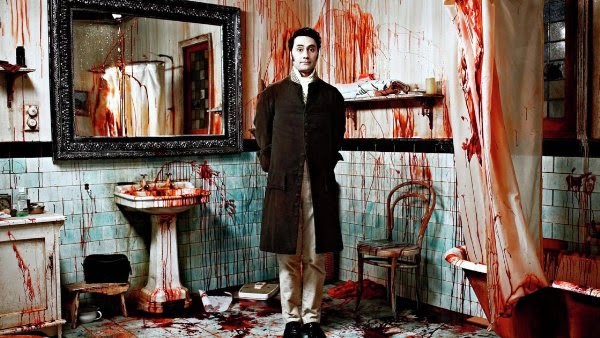
Hands up who's sick of vampires? Over the last decade they've infested pop culture to the point of saturation; every conceivable niche packed with every possible variety of vampire. Sexy, predatory, forever young and usually pretty nattily dressed it's easy to see the attraction: they're the monsters we want to be. After all, what gloomy, black-clad teenager hasn't imagined themselves gaunt, fanged and pale, wrapped snakelike around a church spire and mourning doomy bloodlust romance.
What We Do In The Shadows punctures this aura of mystique, showing us a group of incredibly uncool vampires and demonstrating that despite their supernatural powers they lead hilariously pitiful lives.
The loose conceit is that a documentary film crew wants to make a documentary about vampires living in Wellington, New Zealand. After having taken an sworn oath not to eat the film crew, the four vampires invite them in to document their lives. They are; Vladislav (Jemaine Clement) an 862 year old Vlad the Impaler type; Viago (Taika Watiti) a 379 year old foppish romantic; Deacon (Jonathan Brugh) the 183 year old 'bad boy' of the group and Petyr (Ben Fransham) an 8,000 year old mostly feral monster in the mold of Nosferatu.
Despite their combined age and experience these vampires are, to put it mildly, a bunch of dorks. Their living situation echoes a grubby student house, bickering over who's going to do the dishes and drawing up rotas for who's going to do the hoovering. Though firm friends they're constantly engaged in petty bickering, often throwing quite literal hissy fits at each other.

Their willingness to murder their way through the gullible idiots of Wellington is a a bit worrying, but that aside they're an extremely likeable, funny bunch. Clement and Waititi's master stroke is to realise that someone who's a couple of hundred years old (and can't see themselves in the mirror) is the least likely person to be fashionably 'on trend'. When they go out on the hunt they dress like a designer's nightmare, cluelessly mixing together camouflage gear, 18th century formal dress and ridiculously clashing patterns.
This notion of vampires as the most uncool kids around is the bedrock of most of What We Do In The Shadows' princely selection of gags. I don't want to spoil any of the punchlines, but the film is so damn funny that the audience often hasn't stopped laughing at the last joke before the next one hits. The best of these are the straightforward observations of what everyday life must be like for a vampire. How on earth do you keep your carpets clean when you're puncturing jugular veins? Isn't it difficult to go clubbing when you have to be invited in? If you have a servant who's demanding you keep your promise to turn them into a vampire, who's then going to do your laundry? Why is it hugely preferable that your victims be virgins?
Just as we've gotten settled with the central vampires, the film broadens its horizons to show us the wider supernatural subculture of Wellington. There's a quiet baseline gag throughout the film that New Zealand is where supernatural beings tend to end up; after years of wandering the Earth they filter southwards towards their own kind. So there's a society of slightly dowdy looking zombies, gothic-looking witches and the vampires main rival, the werewolf pack (led by Rhys Darby, Murray from Flight of the Conchords).
The horror/comedy subgenre is a deceptively tricky one to get nail down; for every Shaun of the Dead you'll get many more heaping servings of crap like Vampires Suck. Most of this can be safely chalked up to simple standards of talent; the writers, directors and stars of these cheapo spoofs are bottom of the barrel talent while Jemaine Clement and Taika Watiti have a glittering comedy track record - they're masters of the self-deprecating and the absurd.

Key to getting this mixture just right is choosing when to play something straight. For example, a scene where Viago seduces a victim then attacks, spraying gallons blood all over the living room is straightforwardly funny in a slapstick way. But lurking just underneath the surface is a queasy sensation; though the victim is a throwaway character she's given just enough humanity to make us feel slightly sorry for her.
This quiet humanism comes to a head in the downright hilarious character of Stu (Stuart Rutherford). Stu, a slightly nerdy and withdrawn IT Guy accidentally befriends the vampires, all of whom resolve not to eat him as he's such pleasant company. Stuart Rutherford, actually an IT guy rather than a professional actor, (and who didn't know he was going to play such a large role) is probably the funniest single element in the film, responding to the vampires around him with a confused befuddlement that builds to a head in the 'Dark Masquerade' finale.
What We Do In The Shadows is an unreserved success. It's easily one of the funniest films of the year and in the higher echelons of vampire movies, whether serious or comedic. With a relatively small budget, Clements and Waititi conjure up a fleshed out supernatural underworld that's layered like an onion, full of interesting personalities, endlessly fascinating trivialities, and a plethora of top gags. Seriously, check it out.
★★★★
What We Do In the Shadows is released November 21st
Subscribe to:
Posts (Atom)