Recent Articles
Showing posts with label history. Show all posts
Showing posts with label history. Show all posts
Saturday, November 3, 2018
Saturday, November 3, 2018
- 0 Comments

Reviewed by David James
Rating:

There are no heroes in war, but John Gray's 1978 musical Billy Bishop Goes To War puts a lot of effort into trying to disprove that. Based on the life of Canadian fighter pilot William Bishop (played by Charles Aitken & Oliver Beamish), this is a two-man musical that takes us from his days as "the worst student" in an Officer's Academy, through the Great War and into his old age.
Let's put my cards on the table from the start. I have a deep and abiding dislike of anything that glorifies war, which includes what British hawks have transformed Armistice Day into. Harry Patch, the longest-surviving combat soldier of World War I famously said: "War is organised murder and nothing else”. He died aged 111 in 2009, and now that he's not around to argue back, politicians have seized upon Remembrance Sunday as an opportunity for militaristic nationalist sentiment.
All of which makes this cheery, upbeat tale of a man who murdered 72 people curdle in the mouth. Now, I don't think the producers and creative team behind the show set out to intentionally make a pro-war piece of theatre. After all, the artistic director of the Jermyn Street Theatre, Tom Littler says in the programme:
"When I was asked to do it I said no. I'm as liberal and anti-war as any other theatre director. [But] when I put it on stage I was staggered by how wrong I had been. If you've arrived with anything like my prejudices, I hope you'll be similarly converted."
I wasn't.
The show is basically an uncritical Boy's Own story about a man who began killing people, realised he was good at it and thoroughly enjoyed it. This transformation doesn't go without comment, with Bishop explaining in letters home to his sweetheart that he's surprised by how "bloodthirsty" he's become, excitedly explaining the thrill of hitting someone's fuel line and incinerating them in mid-air, and at one point waxing orgasmic about the prospect of machine-gunning sleeping men in their beds.


There is a moment of self-reflection when he destroys a plane and watches the pilots free-falling to their deaths, but given that he's soon eager to jump back into the fight and continue increasing his kill-streak the sight obviously didn't make that big of an impact on him.
Perhaps - perhaps - I'd have more sympathy for Bishop if he'd been conscripted into service, but he signed up of his own volition, has many opportunities to leave the war and simply doesn't seem to give much of a shit about the reasons for what he's doing. The play concludes with a rousing propaganda speech by the now elderly Bishop as he attempts to recruit future soldiers - which may as well be a paid advertisement for the modern military.
What is there to take away from Billy Bishop Goes To War? That military service is the ticket to admiration and fame? That killing people at the behest of the upper-class is actually kinda cool? That, from a certain perspective, the industrial-scale slaughter of human beings can actually be kinda fun and fulfilling? It just seems a bit tasteless to put on such an ooh-rah piece of pro-Great War propaganda in the week running up the 100th anniversary of Armistice Day.
Compounding all this is Charles Aitken's portrayal of the young Billy Bishop. Aitken quickly proves himself a deeply talented performer with charisma to spare. He's a pleasure to watch, effortlessly swashbuckling, rogueish and handsome - there's something of Rik Mayall's Lord Flashheart in the way he struts about the stage in his fancy leather coat. But, perversely, Aitken being so good only makes the show's pro-war lean that much more pronounced.
And so, intentionally or not, Billy Bishop Goes To War ends up feeling monstrous: a toe-tappin' and smile-inducin' good times romp about a man who just looooved to kill people.
I should say that the Jermyn Street Theatre is also staging Michael Mear's This Evil Thing over the Remembrance period, which is about the misery and injustice inflicted upon conscientious objectors during the Great War. Everything I've heard about that production makes it sound fantastic, and perhaps that's so anti-war that Billy Bishop was chosen as a counterbalance. I wish I'd seen that and not this.
Billy Bishop Goes To War is at the Jermyn Street Theatre until 24 November. Tickets here.
Thursday, June 21, 2018
Thursday, June 21, 2018
- 0 Comments

On 26th August 1768, Captain James Cook departed Plymouth aboard HMS Endeavour with the stated objective of observing the Transit of Venus from Tahiti (thus helping determine Earth's distance from the sun), together with a more confidential mission to search the south Pacific for Terra Australis Incognita - the mysterious unknown southern continent. By the time he returned in July 1771 he had redrawn the globe, charting the eastern coast of Australia and New Zealand and had had first contact with multiple indigenous peoples.
The British Library's James Cook: The Voyages displays a wealth of documents, sketches, and artefacts from this first voyage and two subsequent ones to Antarctic waters and his doomed quest for the fabled North-West passage from the Pacific to the Atlantic.
From the British perspective, these were courageous ventures into a savage land, with Cook's scientific explorations a gateway to the commercial expansion of the Empire. For the indigenous peoples, Cook's boot landing on their shores marks the beginning of their racial, economic and cultural subjugation and exploitation under colonial rule, the consequences of which still reverberate today.
The exhibition leans into this dichotomy, subverting every bit of patriotic swashbuckling with representatives of the cultures explaining how their ancestors dealt with Cook's arrival. Its impossible to conclude whether Cook's voyages were a net good or evil, with perhaps the best summary being a Maori historian who shrugs with resignation: "It happened".


As you travel through the various rooms you find yourself weighing up the morality of Cook. Even if you walk in armed with the knowledge of the consequences of colonialism, it's easy to feel an exhilarating Boy's Own call to adventure when you look at an unfinished map of the world with 'Parts Unknown' in the distant corners. Similarly, when you get into the nitty-gritty logistics of the expedition - the navigational methods, keeping the crew alive, methods of communicating with distant peoples and the sheer distance travelled - you begin to understand the scale of what these men set out to achieve.
The emotional heart of the exhibition is a series of sketches and drawings created on these voyages - their impact amplified by the fact that most of these artists died before returning home. An obvious highlight is Sydney Parkinson's tentative sketch of a 'kangooroo', in which you sense how important the artist knew it was to get the details right to communicate this surreal animal to audiences back in Britain.
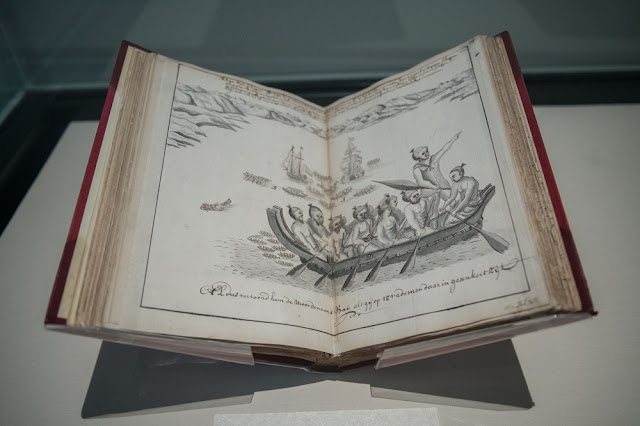

Then there are the careful profiles of the facial tattoos of Maori warriors. First contact was violent and relations were uneasy, but there's a respect baked into the artist's precise lines - as if they recognised a reflection of their own martial discipline in this alien culture.
Dramatic paintings from the second voyage by William Hodges also thrill, particularly a fantastically widescreen 'Cinerama' view of Polynesian war canoes on display. They look like science fiction apparitions, scenes that wouldn't look out of place in Moebius' L'Incal. Later paintings of the ships dwarfed by icebergs in the Atlantic make the ship look as if it has breached a strange unknown dimension, a little wooden husk of civilisation bobbing between uncontrollable cosmic forces.


It's easy to get swept up in this romance, but the careful layering in of the consequences of Cook's actions means we're never in danger of hagiography. By the time we get to his death at the hands of a Hawaiian tribe he appears to have waged a pointless war on, it feels like a fitting end to his story.
But, functioning almost as an extended epilogue, the neighbouring exhibition Windrush: Songs in a Strange Land continues some of the themes of The Voyages. We get a quick recap of British slavery, emancipation and Empire in the Caribbean, the historical forces that brought HMT Empire Windrush to Britain with 800 Jamaican passengers hoping for work. It was neither the first nor the last of these trips, but for some reason, it is this arrival that has lodged firmly in the British consciousness (and is obviously extremely timely right now).
What's on display closes a historical circle: Britain ventures out into the world, exploits and commercialises its resources and peoples, builds an Empire on which the sun never sets, and begins a process of transforming people into mirrors of British values. Of course, cultural cross-pollination was also happening, with Britishness changing to accommodate its new Imperial citizens - beautifully symbolised by the exhibits showing Caribbean culture in Britain.
It's often said we live in the age of identity politics - if that is true then we need to not only understand what our identity is, but the ways in which it has and will continue to evolve. These two exhibitions let us sip at the primordial soup of the modern Britishness: showing not only how we changed the world, but how it changed us. It's a sentiment beautifully summarised in Michel Tuffery's Cookie in the Cook Islands, imagining Captain Cook transformed by his explorations, with Polynesian features and flowers in his hair.

Captain Cook: The Voyages is open until 27 August. Windrush: Songs in a Strange Land is open until October 21st. Details here.
Thanks to Crafted Media for the invitation.
Thursday, April 27, 2017
Thursday, April 27, 2017
- 0 Comments

It's 1943. You're a young woman eager to assist the war effort but bored of desk-based drudgery. You spot an advertisement from the Department for War Transport asking for women "of robust constitution" to work on the canals, hauling tonnes of cargo - steel, food, Spitfire parts, coal, munitions- around the country. Sounds like an adventure, right?
Judging by the fondness with which the women who answered the call recall the experience, it was. But it was also tremendously hard (and often filthy) work: a world of dirty water, poor sanitation, oil, soot and gross green canal slime. On top of that, they had to deal with territorial boat people who'd spent their lives on the canals and were deeply suspicious of these untrained young women arriving on their patch. Their badges had IW (Inland Waterways) emblazoned on them, initials that have given rise to another name - Idle Women.
But judging by the stories that we hear at the London Canal Museum, they were anything but idle. They come courtesy of a double-bill performance by Heather Wastie and Kate Saffin, under the auspices of Alarum Theatre. Both women are steeped in waterway life; Heather having spent many years with her family aboard an ex-working boat and subsequently campaigning to save canals from extinction; Kate having lived on a narrowboat and been telling stories about the waterways for 18 years. A chance meeting on Twitter made them realise that their two short pieces about the Idle Women would make an excellent double-bill.
Which leads us neatly to the London Canal Museum. Despite having spent an awful lot of time on the canal tow path (I've run from Limehouse to Rickmansworth via Bull Bridge and up the Lea Valley) I've only been on a narrowboat once and know very little about what life on the water entails. This made the evening a rapid education in waterway terminology. Evocative terms are bandied about - stemmed up, windlass, snubber, breast-up, and butty - with a glossary on the back of the programme a huge help.


But, fortunately, not knowing much about canals puts me in precisely the same position as the women who signed up to the war effort. Kate Saffin's Isobel's War kicks off the night, an evocative overview of one woman's experiences on the water. Told through the framing device of a daughter discovering her mother's wartime diary, it's a recollection crammed with historical detail and interesting personalities. The backbone is Isobel's growing confidence in her abilities, which quickly expands from the individual out to the rest of the wartime women workers.
Heather Wastie's piece, Idle Women and Judies is more abstract, a collection of poems fused together from phrases from archive recordings, interviews, books, and news media. These pieces vividly, bring to life the sounds, smells, and texture of waterway life. We sense a collective can-do personality from women, who're eager to prove their competence and enjoying proving their mettle in a masculine industry. There's also a charming singalong at the end, with a seriously catchy chorus.
Both women are exceptional storytellers, their performances brimming over with personality and linguistic virtuosity. But the performance is the mortar that's holding the bricks of an extremely interesting history lesson together. Walking into the Canal Museum I was completely clueless about the Idle Women. Two hours later I felt as if I'd absorbed a hell of a lot of information, painting a picture of the domestic wartime victory achieved on the backs of unglamorous hard work and refusal to conform to traditional gender roles.
Kate and Heather are currently touring the waterways of England on their narrowboat Tench (details of their upcoming stops here). It's well worth stopping by, and if you're particularly interested in the domestic front of World War II or women's history it's a no-brainer.
Thursday, October 27, 2016
Thursday, October 27, 2016
- 0 Comments

I consider myself pretty politically engaged. I volunteer on political campaigns. I attend marches. I help out with advocacy groups. I work in law reform. But would I pick up a rifle, head overseas and shoot fascists? In my romantic fantasies I'd like to think so, but in reality I probably don't have the guts. But, in the mid 1930s 2,500 men and women did. These were the men and women who formed the British Battalion of the International Brigades.
They were ordinary people, often with no military experience. Yet they recognised the evils of fascism, left their jobs and families behind and many ended up making the ultimate sacrifice in an attempt to stop Franco in his tracks. Somewhat overshadowed by World War II, the Brigades are an unjustly overlooked part of Britain's history, an inspirational lesson in the common man's willingness to stand up to evil at great personal risk.
Neil Gore's Dare Devil Rides to Jarama follows two such volunteers, speedway champion / dare devil Clem Beckett and milquetoast Pimlico writer Chris Caudwell. Were it not for the war its unlikely that the two would ever have crossed paths, one being a grease-smeared Mancunian and the other an earnest yet nervy London writer. Yet they found common ground in their anger at social injustice and corruption, each sincerely believing in the powerful transformative power of socialism.
Gore begins in the twenties, laying out the early speedway career of Beckett. As he rises through the ranks and achieves a modicum of celebrity he begins to rail against the exploitative treatment of racers. While he and his friends are out risking life and limb, the suits at the top pocket the profits while pushing for faster and more dangerous racing to draw in the crowds. Soon he's a proud member of the Young Communist League, gradually making his way through the party system until he's travelling the world as a sporting emissary of the British Communist Party.

It's just as he's settling down with a new wife and business that the call to arms comes. The mid 30s are dark times in Europe - Hitler, Mussolini and Franco all ascendant and Britain's Oswald Mosley eager to emulate their successes. For Beckett it's a no-brainer to heed the call to defend Spain from fascism and try to turn back the tide.
Caudwell is a different story - a slightly camp, bourgeois sounding intellectual, preferring to bury himself in party organisation and literature rather than engage in direct combat. Yet the argument that bullets are more effective that ink in defending Spain is difficult to refute, and soon the unlikely pair are off to the front, and eventually to the Battle of Jarama - one of the bloodiest conflicts the Brigades ever faced.
Split into two distinct halves, the first is a chirpy music hall biography of Clem Beckett. Played by David Heywood, Beckett is the epitome of the cheeky, cheery Northern lad, always ready with a wink and a smile. He's a dynamic, fun and easy to like character, simultaneously irreverent and sincere. Heywood infuses his every action with energetic life, grinning with happiness as he tackles motorbike stunts while doing his best to live his motto: "forever forward".
Post interval we're in Spain and the tone shifts considerably. Gone are the banjo and music hall trappings, replaced by a poetic seriousness. Clem Beckett's problems have progressed from motorbike accidents to worrying about his malfunctioning machine gun, a lack of ammunition, fighting with untrained and demoralised soldiers and a daredevil dealing with his own fears. Though not devoid of laughs, there's a poignancy and finality to these scenes as the soldiers realise that, despite all their bravery, they're militarily outmatched.
Dare Devil to Jarama often feels like a history lesson. There's a lot of necessary exposition to chew through; whether it's something as expansive as the history of socialism and antifascism in Britain or the politics of the Spanish Civil War; or as particular as the shoddy design and firing techniques of the Chauchat rifle ("the worst machine gun ever"). Working in Gore's favour is that the history is a) really interesting and b) he never once loses sight of his characters.
This makes the dense history navigable: we care about these charismatic characters and their political enthusiasm is infectious. In Beckett's voice, the dusty old anthems of the Young Communist League are infused with new vigour and life. Gore (playing every character other than Beckett) has a neat line in mimicry, excellently delivering the inspirational speeches that drive men like Beckett towards combat. A Peckham theatre in 2016 is a long way from the Spanish Civil War, but we feel like we have a glimmer of how these men might have flt.
Helping out with that is a generous smattering of audience participation. Heywood and Gore are constantly making eye contact with us and gently prodding the fourth wall. We're also provided with Unite branded plastic rattles to wave at key points, allowing us to create the din of the speedway and the enthusiasm of a much bigger crowd. We're also invited to sing along to the songs and, best of all, boo the hell out of Oswald Mosley (if only they'd supplied rotten tomatoes...).
By the time the play ends (to extremely enthusiastic applause) it's more than done its job. Gore has successfully interwoven history and politics, as well as doing justice to Clem Beckett and Chris Caudwell's lives. Dare Devil Rides to Jarama left me feeling inspired and informed, yet also slightly guilty. Would I do there the same if I were in their shoes? Just how many men and women of the International Brigade's calibre are around today?
The only contemporary parallel is extraordinarily depressing - the current people inspired to leave their country and take up arms for their beliefs are would be ISIS soldiers, eager to spread religious fundamentalism, mindless violence and oppression across desperate communities. (Man, maybe things really are just getting shitter and shitter.)
Let's leave that aside for now. Neil Gore's play is a great piece of drama and a worthy tribute to the men and women of the International Brigade. If you have the slightest bit of interest in history and politics it's a fascinating watch.
★★★★
Dare Devil Rides to Jarama is at the Bussey Building until Oct 29th, then on tour. Tickets here.
Photographs by Daniella Beattie
Wednesday, August 3, 2016
Wednesday, August 3, 2016
- 0 Comments

The asphalt of London is but a gateway. Under the streets lie a chaotic warren: from the familiar rumble of the Tube, to sewers, power lines and gas lines. Somewhere within this is nestled more anomalous creations: disused Post Office transit systems, long-buried underground rivers, the 'Pindar' military citadel and the mysterious top-secret 'Q-Whitehall' complex that reportedly begins under Trafalgar Square, spans Whitehall and ends at King Charles Street.
Knowing all this is going on underfoot makes London feel more magical, and that's on top of the 2,000 years of random stuff that we don't even know is there! For example, just a couple of years ago Crossrail excavations turned up a plague pit down the road from my house.
 |
| The shelter in its heyday, 1944 |
And last Sunday, courtesy of a birthday surprise from my very lovely girlfriend, I got a taste of of subterranean London history. The marvellous Hidden London, run by the London Transport Museum has been hosting tours of places the public doesn't usually get to go. Way back in 2012 I went down into the disused Aldwych Tube Station, but now they've expanded to run tours of Down Street Tube Station, the 'lost tunnels' of Euston, London's first skyscraper at 55 Broadway and the Clapham South Deep Level Shelter.
Entry is by an fat pillbox now unobtrusively subsumed into a modern apartment building. Within it lie 180 stairs, spiralling down into a wonder of 1940s engineering and a frozen slice of Blitz era London.
 |
| Areas named for British Naval officers |
From a contemporary vantage point it's difficult to imagine life during the worst months of the Blitz. Just how are you supposed to fall asleep when you know high-explosive bombs are raining down over the city? You might wake up with most of your neighbourhood destroyed, friends and family blown to bits. Hell, you might not wake up at all. The whole city must have been sleep-deprived and pretty goddamn miserable.
Faced with that, and against the wishes of the government, many sought sanctuary in the Tube. It might not be particularly comfy bedding down on a platform, but at least you'll survive. Except you might not. In October 1940 a 1400lb bomb slammed into Balham High Road, penetrating the street surface and exploding underground. Many of those sheltering in Balham Tube station were killed instantly by falling debris. They were the lucky ones. A broken water mains then flooded the station, meaning who survived the debris were drowned in pitch darkness "like rats in a cage".
 |
| The northbound platform at Balham, October 1940 |
Furious protests followed, with demands for deep-level shelters be constructed immediately to prevent disasters like this happening again. The government listened, reversedits policy overnight and ordered the construction of accommodation for 100,000 people in ten shelters: five in north London, five in the south. During construction two shelters were abandoned, one at St Pauls for fear of damaging the cathedral and the other at Oval due to poor ground conditions. The remaining eight opened in 1942, though weren't pressed into full service until the advent of the 'doodlebug' in 1944.
Most have now been sold to private companies, used as archival storage, homes for telecoms equipment or, more recently, hydroponic gardens. Yet the Clapham South shelter, left under the auspices of TfL, remains largely intact, allowing for what feels like a trip back in time.

Essentially the shelter is two long underground tunnels, bisected horizontally to create an upper and lower floor.Triple-tiered bunk beds stretch off into infinity, the guests jammed in with each other like sardines, not exactly the Savoy. It must have been a hell of a weird place to fall asleep, the air filled with a fug of sweat, cigarette smoke and farts, soundtracked by the clickety-clack of passing trains and the muffled thump of bombs far aboveground.
 |
| A blocked off exit to Clapham South station. |
Then again, if the choice is between that and getting blown to smithereens, then I'll take the tunnel. Things weren't all austerity down here, there was a canteen that was 'off-rationing', allowing for as many meat pies and jam tarts as you could afford. Similarly (and deeply emblematic of how living conditions improved in the postwar period) there were chemical toilets which might have been somewhat of a luxury for those forced to trek to an outhouse at night.
 |
| A not particularly comfy looking bed. |
Aside from actually sheltering the community, the shelters also functioned as an effective piece of propaganda. Newsreel was shot showcasing their security and safety; a way to reassure Londoners that they have a safe haven and also to stick two fingers up at the Nazis to show that they can't be beaten no matter what hi-ex horrors they toss over the channel.

But the story of the shelter doesn't conclude with Hitler blowing his brains all over a bunker wall. For about a decade afterwards it was used as temporary accommodation; postwar refugees travelling through London; visitors to the 1951's Festival of Britain; and, most fascinatingly, to house those who arrived on HMS Windrush in order to assist with the reconstruction of bombed out Britain. Eventually, after a damaging fire in the Goodge Street shelter, Clapham was mothballed in the 60s and largely remains so to this day.
 |
| Windrush passengers spending their first few nights deep under London. |
It isn't hard at all to imagine past visitors' reactions to seeing this weird, wonderful and obscure corner of London. The place feels as if it's essentially the same as when war-tired Londoners trooped down to escape the Luftwaffe. I found myself wishing I could spend a night down here, tasting the creosote and plaster tang in the air, and rocked gently to sleep by the rumble of the Northern line meters away.
 |
| Graffiti by bored Belgians. |
Though places are limited on the Hidden London tours, word is the shelter may be opened to the public in the next few years as a Blitz museum. So watch this space. In the meantime, if you're spending a quiet summer's day dozing on Clapham Common be sure imagine the thousands of people who once huddled in safety deep below your head. Who knows, the way things are going we might be thankful that these bomb shelters remain in working order...
Hidden London tour details here.
Sunday, March 6, 2016
Sunday, March 6, 2016
- 0 Comments

London's major art galleries are usually hubs of respectable, hushed appreciation. Visitors travel from around the world to silently gawp at Great Britain's dead luminaries, imperiously peering down the centuries through gilded frames. This most stuffy of stuffy environments gently nudges the viewer to see history as permanent and unchanging: this is the official version of events.
Enter Mel Adam's Lenard Pink. Originating as a YouTube sensation, Pink graduated to the London stage last year. Smartly suited with a smattering of hot pink highlights, a wig that's half Warhol/half Ecclestone and a campness that's not so much performed as it is ingrained in his DNA, he takes audiences on a whistlestop tour through a couple of hundred years of 'secret' history.
Beginning with the Wars of the Roses and ending sometime in the late Georgian period, Pink nimbly skips down the years, illuminating his audience on what was really going on underneath the ermine gowns of the men and women who claimed that God himself installed them as ruler over the British Isles.
What transpires a hugely enjoyable tangle of conspiracy theories. Was Henry VIII really brain-damaged to the point of murderous paranoia? Was Queen Anne actually a secret lesbian? Do the hand positions in the paintings of the Kit-Cat club really indicate their membership of the illuminati? Most shockingly, was one of the most iconic women in British history, Queen Elizabeth I, secretly a man!?
They're outrageous claims and frankly I'm sceptical of most of them. But, crucially, they're fun and Pink's explanations are downright hilarious. There's the old maxim (which comes via Jimmy Stewart) that if you have a choice between dull truth and an entertaining legend, always print the legend. Pink takes that and runs with it: even if his arguments are largely unsubstantiated they provide a perspective that encourages us to query established fact.
Though Pink is irreverent from tip to toe, there's a serious political point to reinterpreting history like this. The past is inherently politicised; each generation using the stories of those that came before to buttress contemporary power structures. This means that alternate views on history; based on economic, class, gender, racial or sexuality; are neatly swept under the rug so as not to confuse bright young GCSE students.

Pink's historical viewpoint is deeply grounded in his own sexuality, his explanations that this King or that Queen were gay not quite authoritative commandments, but more an imploring "what if?". Prejudice has ensured that gay history has been confined to the margins and only whispered of. When so much has been scrubbed from the record, what's the harm in theorising a bit. Though audiences will most likely find some (most?) of Pink's idea far-fetched, they will at least leave us primed to examine the the past through new eyes.
Aside from the theorising, Pink also has a knack for explaining history from unique perspectives. Most enjoyable was his aside as to how miserable life was for Georgian women; their lives a miserable gamut of dressy balls, sexual subjugation and soap made primarily of piss. Pink's language doesn't beat around the bush (and from his descriptions god knows how anyone ever plucked up the courage), but sometimes you've got to be vulgar to explain vulgar things.
The only point where things become a little unstuck is when he questions the provenance of Shakespeare's plays. This particular conspiracy theory has always annoyed me, particularly the part of the argument that claims that Shakespeare's relatively brief schooling wouldn't have granted him the intellect or imagination to devise, say, Hamlet. The theory then states that it's far more likely an esteemed Cambridge alumni like Marlowe would have written such masterpieces. Aside from being a bit tired as far as conspiracy theories go, it's the one point in the tour when the establishment feels reinforced rather than eroded, and is the only real blemish on an otherwise stellar experience.
Aside from that I had a deeply enjoyable and memorable night out. Pink is a fantastic guide through the seamy underbelly of British history, introducing his audiences (and the inevitable gaggle of freeloading hangers-on) to theories so bizarre they might just be true. Highly recommended.
★★★★
Lenard Pink's History Tours take place throughout the year. For more information visit www.facebook.com/lenard.pink or email lenardpink@gmail.com.
Monday, January 18, 2016
Monday, January 18, 2016
- 0 Comments

Was Hitler really all that bad? The answer, of course, is yes. He wasn't just bad either, Hitler was a nightmare of a human being in ways so vast they're difficult to comprehend. That said, when compared to your average reality TV contestant...
Big Brother Blitzkrieg asks a simple, high concept, question: what if Adolf Hitler woke up inside the Big Brother house? So we get a 'pre-fame' struggling artist Hitler (Stephen Chance) attempting suicide, and subsequently finding himself in a alien time and place surrounded by garish weirdos who have no idea who he is.
Said weirdos are; Charlie (Hannah Douglas) a dungaree-clad femmesexual; Lucy (Jenny Johns) a Katie Hopkins clone; M-Cat (Kit Loyd) a gangly wannabe MC; Felix (Neil Summerville) a headache-inducingly OTT queen and; Rachel (Tracey Ann Wood) a homely 'normal' woman who happens to be *gasp* Jewish.

Now, we're not in your Big Brother glory days - we're on Channel 5. This is the dying fart of the format, the contestants all too aware that few are watching and even fewer give a shit. They're desperate not to get cancelled, hyperaware that they can't be boring and eager to latch onto anything that could boost viewing figures.
Enter Adolf Hitler, whose eccentricities, manic temperament and tendency to spark conflict are all the ingredients needed to make him a hit. After his initial confusion, Hitler smoothly ingratiates himself with the moronic housemates, slowly bending them to his will as he scapegoats the Jewish Rachel as a "parasite" and "freeloader".
The first time I heard the conceit I was a little leery that this would be simple Hitlersploitation: revolving entirely around how lol random monkeycheese putting Hitler in this situation would be. But writers Hew Rous Eyre and Max Elton display not only a firm grasp of the dynamics of Big Brother, but also a decent interpretation of the appeal of fascism and exploring the wrinkles of Hitler's personality.
The show is crammed to the rafters with broad comedy moments as 2016 era idiots struggle to process Hitler's behaviour. Though it is essentially a one joke show, it's at least a funny joke and well-delivered. Chance's Hitler is a whipcrack tight scribble of skinny limbs and hilariously cartoonish expressions. In no way is Chance trying to portray a realistic Hitler (to say nothing of the multiple historical inaccuracies) he's more like a manifestation of the popular 2016 image of what Hitler was, or a political cartoon come to horrible life.
Chance makes Hitler so funny that we begin to feel a smidge of sympathy for him being stuck with the Big Brother contestants. For all Hitler's horribleness, at least he's got an ideology - as opposed to the vacuous egotism of everybody else. Particularly humorous is the contrast between the Katie Hopkins-a-like's dogwhistle crypto-fascism against Hitler's straight-up unvarnished fascism.

Funny though all that it is, Elton and Eyre have a sincere political point to make. To contemporary eyes Hitler often appears as a comicbook villain from the distant past, with little relevance or danger to us. Yet this man's ideology entranced a prosperous, educated first world country, converting Germany into a rabidly nationalistic death-machine.
We are not as different from early 1930s Germans as we'd like to think we are, and Big Brother Blitzkrieg exposes us as a society susceptible to fascism's siren song. It's facile to directly compare, David Cameron or Donald Trump to Hitler, yet anyone with an eye for history can identify some Nazi propagandist DNA in their ongoing deification the armed forces, blaming social and economic woes on threatening and amorphous outsiders (Jews/asylum seekers/muslims etc) and flag fluttering nationalism to paper over for deep societal issues.
In the final moments, we see the 2016 Hitler ascendant: having effortlessly demolished the flimsy constructs of identity politics with his poisonously confident authoritarianism. It's a chilling sight, a stark reminder that human nature never really changes, and that a society that doesn't understand history is doomed to repeat it.
With its keen observance of reality TV aesthetics and contestants, coupled with a dynamite central performance, Big Brother Blitzkrieg is a smart, incisive and often brutal gem of a show. Don't be put off thinking that it's all shock value - there's much more going on here.
★★★★
Big Brother Blitzkrieg is at the King's Head Theatre until 30th January 2016. Tickets here.
Thursday, March 26, 2015
Thursday, March 26, 2015
- 0 Comments

A successful historian must play psychoanalyst to their period. Entire societies are gently laid on the couch, their ambitions, paranoias, pride and history intelligently probed in an effort to get at what made them tick. You could look at what they say about themselves, but this strays into the realm of propaganda, neither individual nor civilisation wants to look like a chump.
You can approach this understanding of the past through many prisms, each refracting the past in their own way. Professor Andrew Scull has chosen the processes and understandings of mental illness: the understanding of cause, processes of diagnosis and treatment shedding light into the minds of our ancestors.
This interrogation is the subject of the 2015 Roy Porter lecture, hosted by the wonderful people at the Wellcome Collection. Prof. Scull, a former colleague of Porter, is Distinguished Professor if Sociology and Science Studies at the University of California, San Diego. His new book, Madness in Civilisation: The Cultural History of Insanity has just been released and provides the raw material for this lecture, which zeroes in on the nascent science of mental illness in the 1800s.
 |
| George Cheyne |
Our introduction to this world is the pioneering work of physician George Cheyne. His publication, The English Malady; or, A Treatise of Nervous Diseases of All Kinds, as Spleen, Vapours, Lowness of Spirits, Hypochondriacal and Hysterical Distempers (1733) was a huge influence on popular conceptions of mental illness and depression. That title, with the English laying proud claim to mental disorders, initially feels a touch odd. Why would an proud, patriotic nation hurry to 'own' these conditions?
As a point of comparison, Prof Scull explains the shifting colloquial names for syphilis, which in England, was called 'The French Disease', in France 'The Italian disease', in Italy 'The Neapolitan disease' and so on, with the Turks throwing their hands up and simply calling it 'The Christian disease'. These pejorative names are reflections of nationalistic spite: after all, nobody really wants to be 'the syphilis country'.
 |
| George Durer's Syphilitic Man |
What this reveals is that far from being a negative, 'nervous disorders' were proudly incorporated into the English psyche as a point of patriotic pride. The explanation for why is based around comparing 'primitive' and 'modern' man. The primitive has their mind occupied with acts of survival, a daily life and death struggle for food and shelter. Whereas the modern man, with his refined sensibilities, sharpened mind and rarefied talents, is akin to a precision-tooled piece of machinery - with many more components able to fail. Or, as Cheyne put it:
"those of the liveliest and quickest natural Parts...whose Genius is most keen and penetrating were most prone to such disorders. Fools, weak or stupid Persons, heavy and dull Souls, are seldom troubled with Vapours or Lowness of Spirits." CHEYNE (GEORGE) The Natural Method of cureing the Diseases of the Body, and the Disorders of the Mind depending on the Body.
So, the more Britain succeeded economically, scientifically and culturally, the more 'nervous disorders' we should expect to see - with mental illness an unexpected herald of social success.
This period of history, with luminaries like Isaac Newton, Robert Hooke, Edmund Halley and Christopher Wren et al defining the boundaries of the universe and identifying hitherto unknown invisible forces like electricity, gravity and magnetism must have been an astonishing time to live through. Finally the nuts and bolts of the universe were being revealed, the role of God gradually moving towards to absent caretaker rather than a being that intervenes in the lives of men.
Anything must have seemed possible, an outlook that gave rise to the success of one Franz Mesmer. He invented the concept of 'animal magnetism'; that energetic transference takes place between all objects, animate and inanimate. By manipulating this process he claimed to be able to cure nervous illnesses. Word soon got around, and before long crowds rich and poor were clamouring for a taste of mesmeric therapy.
 |
| A mesmerist using his 'magic finger' to cure a comely woman. |
It was all bunkum of course, Prof Scull inferring that a decent portion of his success came from providing erotic experiences for buttoned down society women. With scandal constantly nipping at his heels, Mesmer hopped between European cities, eventually coming a cropper at the hands of a scientific dream team that included Antoine Lavoisier, Joseph-Ignace Guillotin, Jean Sylvain Bailly, and Benjamin Franklin. They conducted tests, concluding 'biomagnetic fluids' to be a load of cobblers. Mesmer soon vanished into obscurity, the last 15 years of his life large unknown.
Though firmly discredited, his therapies acted as a seed in treated conditions of the mind. Mesmer's animal magnetism therapies evolved into hypnosis therapy (from which we get the word 'mesmerism'). We later learn that Sigmund Freud began his therapeutic career as a hypnotist, the interaction of patient and clinician eventually formalising into psychoanalysis.
It's here that Prof Scull links the behaviour of the past to the present. His examples outline the broad strokes of the 18th century 'personality': nationalism, scientific progress and a belief in progress. Mesmer's popularity inevitably leads the mind toward modern pseudo-scientific therapies, arguably more popular now than they've ever been. Similarly, the ownership of mental disorders feeds into identity politics: in an increasingly homogenous world everyone wants to stand out, with internet self-diagnosis leading to the rise of 'disease/allergy/mental illness as fad'.
What will future historians think of us when they examine these trends? What rationale can be given for masses of people running to alternative therapies when faced with the myriad miracles of modern medicine? Why are increasingly large amounts of people desperate to find 'their' disorder?
Perhaps it's only with the hindsight of history that the answers can really be theorised. Nonetheless, Prof Scull's lecture leads us down fascinating intellectual paths, subtly nudging us towards applying historical analysis to modern trends. It was a real treat watching him speak, I'll have to get hold of his book.
Prof Scull's book, Madness in Civilisation: The Cultural History of Insanity is available here.
Tuesday, April 29, 2014
Tuesday, April 29, 2014
- 0 Comments

Throw Gladiator and Titanic into a blender and Pompeii would trickle out of the nozzle. This film from Paul W.S. Anderson (doomed to be forever known as 'the other Paul Anderson') is a largely moronic slice of pure-grade cheese, boasting a paper-thin romance that'd make Mills & Boon blush, antiseptic action sequences and Emmerichesque destructo-porn only faintly spoiled by the knowledge that this particular disaster actually happened. But it's not all bad!
The volcano disaster movie subgenre has lain dormant for the last 15 years or so, the equally underwhelming 1997 doubleheader of Volcano and Dante's Peak having failed to set box offices ablaze. Bolted onto the disaster flick template are large portions of Gladiator; a young celt Milo (Kit Harington) who hates the Roman Empire making a name for himself in arena combat and subsequently being transported to the big city to prove himself; and Titanic. Colliding with that is Rose's plight from Titanic in the form of Cassia (Emily Browning) a young rich girl who's sick of the trappings of her class falling head over heels for a sexy bit of Celtic rough. This forbidden love would struggle to bloom under normal circumstances, let alone when there's burning lava bombs plummeting from the sky and gigantic tidal waves tearing through the city. But hey, if it worked for James Cameron...
Pompeii ultimately turns out to be a complete load of cheesy bullshit, but that's not necessarily the kiss of death. Cheesy bullshit, ladled out with the right amount of sincerity and gusto, can be just the ticket if you want a lazy, undemanding, dumb sort of cinema experience. And fortunately Anderson, with his track record of the Resident Evil franchise and a smattering of enjoyably dopey B-movies like Mortal Kombat and Death Race, is more than in possession of the directorial skills to make this cheesy bullshit the best cheesy bullshit it can be.
 |
| Kit Harington ain't no Russell Crowe that's for damn sure. |
That's not to say there's not a ton of things wrong with the film. Most obvious is the utterly leaden romance that's supposedly the core of the film. Kit Harington and Emily Browning are pretty dull when they're alone on screen, but together they form a black hole of charisma, with never the remotest glimmer of passion between them. They're not helped by a dog of a script which has some bizarre ideas about how to set up a love story. The weirdest is their first meeting, where Cassia falls for Milo on the basis that he can break a horse's neck with his bare hands (whatever floats your boat I guess...). Beyond that the two barely get a chance to interact at all, meaning the romance never feels remotely moving.
The central romance being a stinker could have killed this film stone dead, but fortunately it's more than rescued by two excellent supporting performances from Kiefer Sutherland and Adewale Akinnuoye-Agbaje. Sutherland, playing the villainous Senator Corvus, pulls out his best Jeremy Irons impression and goes to town with a whirlwind of smug smirks and archly raised eyebrows - if Romans had moustaches you can bet this guy would be twirling his. At times it's like Sutherland is in a scenery chewing contest with the volcano; and honestly, the two come out about equal.
 |
| Sutherland nailing it. |
Similarly ace is Akinnuoye-Agbaje as Atticus, our hero's gladiator buddy. Purely by dint of his natural charisma he's massively more compelling than the bland Harington. Fortunately he gets a decent amount of time on screen, but this would have been a much more successful film with Akinnuoye-Agbaje as the hero. He's also got far more chemistry with Harington than Emily Browning has, the one glimmer of actual sexiness a scene where the two topless gladiators rub each other's wounds down with wine! Going full-bore homoerotic would also have the added bonus of making the erupting volcano a big fat throbbing visual metaphor.
The eruption is the 'money shot' of any volcano movie, and, like every member of the subgenre, a moment that's teased in multiple shots of character's looking suspiciously at dust falling from ceilings or plates clanking on a shelf. When things do geologically kick off it's probably exactly as you imagine - oodles of tiny CG Romans getting squashed by columns, burnt by lava or swept away by raging seas. Watching this entertaining carnage I felt a little curl of guilt in my belly, after all is it right to vicariously enjoy a simulation of other people's deaths - even if they were 2000 years ago?
 |
| Akinnuoye-Agbaje as Atticus. He should be the hero! He's much more fun. |
This gives rise to the one smart bit of film-making in Pompeii. The focus of the big gladiatorial contest is a recreation of the the villain's greatest triumph - the annihilation of the hero's tribe. As we've experienced this from the POV of our hero early in the film we instinctively find this distasteful, frowning at the amphitheatre audience baying for blood. These braying assholes are us - we're both getting our yuks from watching a bowdlerised, sanitised fictional account of historical misery. It's moments like these when you suspect that Paul W.S. Anderson might not be quite as dumb as he's often made out to be.
It's difficult to wholeheartedly recommend Pompeii - enjoyment of it is largely predicated on your tolerance for cheese and by how much enjoyment you get from scenery-chewing camp performances. For me it just about strayed into guilty pleasure; the kind of film best enjoyed curled up under a blanket nursing a severe hangover on a Sunday afternoon, a pot of warm tea and a few packs of chocolate biscuits in front of you.
★★★
Pompeii is on general release 30 April 2014.
Subscribe to:
Posts (Atom)