Recent Articles
Showing posts with label identity politics. Show all posts
Showing posts with label identity politics. Show all posts
Friday, November 16, 2012
Friday, November 16, 2012
- 0 Comments
 |
| They commit LOADS of crimes other than curiosity! Angelina Jolie shoots a flare gun at someone! |
“…angelheaded hipsters burning for the ancient heavenly connection to the starry dynamo in the machinery of night” – Allen Ginsberg’s ‘Howl’ as quoted by Dade Murphy in ‘Hackers’
‘Hackers’ is not a movie with a great reputation. Nowadays it functions mainly as a punchline, an embarrassing relic that demonstrates just how much Hollywood misunderstood the internet in the 90s. It's characters breathlessly gasp about how excited they are by 28.8 baud modems, or that “RISC architecture is going to change everything”. 17 years on from its release it seems impossibly archaic, and in terms of computing power, practically stone age. But while it may be ridiculous in many, many ways, I think it’s more forward thinking than its given credit for.
I went to see it at ‘The Church of London’, a creative agency in Shoreditch which regularly hosts events as well as publishing the magazine ‘Little White Lies’. If their other screenings are anything like what they put on last nigh I’m going to be heading there as often as they have screenings. They’d done up their downstairs bar area in retro cyberpunk style. The tables were swaddled in bin bags, a sickly green light filled the room and a constantly scrolling green and black terminal readout was projected on the wall. The soundtrack? ‘Music for the Jilted Generation’ by the Prodigy. Perfect.
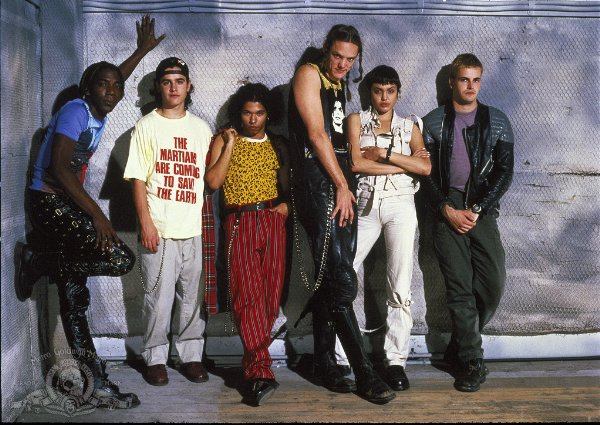 |
| Our heroes. I think they look pretty cool! You may disagree. |
‘Hackers’ tells the story of a group of computer hackers, achingly fashionable and attractive teenage outsiders who seem to rollerblade everywhere. They’re individuals who co-opt computer systems to work for their benefit; hacking television stations to allow them to change programmes at will or breaking into the school network to change which class they’re taking at school. They’re repeatedly defined as living in a more enlightened world than everyone else, of being the ones "with their eyes open", as opposed to the general public who are at one point disparagingly referred to as “cattle”.
Our lead, Dade Murphy (Jonny Lee Miller) is a former child hacking prodigy who crashed “1507 systems” in 1988, including Wall Street. He was arrested, his family fined $45,000 and banned from using computer technology or touch tone phones until his 18th birthday. The film begins with him moving with his mother to New York, a development he seems bizarrely unhappy about. If you’re a bleeding edge cyberpunk hacker why on earth wouldn’t he want to be in New York? On arriving at his new school he becomes involved with a clique of cool, punky outsiders with hacker handles like ‘Acid Burn’, ‘Lord Nikon’, ‘Phantom Phreak’ and ‘Cereal Killer’. They go on to become entangled in a corporate fraud scheme that involves viruses being unleashed onto oil tankers. Meanwhile, a romantic entanglement develops between Dade and Kate Libby (Angelina Jolie). The tanker plot is hardly something to write home about, but the relationship between Dade and Kate is fun to watch develop, mainly because we're watching two great actors enjoying some chemistry at the beginning of their careers.
 |
| These people rollerblade a lot, even when they're in nightclubs. |
I’m of the opinion that in retrospect ‘Hackers’ was a lot more prescient than most people realise. The way the film depicts computer hacking is of course, utterly ridiculous. Our impeccably turned out leads sit, their faces Buddha-like in front of their laptops, data being projected onto their faces from the screen as they swoop around a CG city accessing hidden data files. When we see the crucial data on which the plot turns, it looks like a purple floating cloud with equations and DNA helixes spinning around inside it. It’s a laughably weird way to show a process that is generally rather boring but at least this silliness is fairly visually interesting.
What the film gets right is the notion of self empowerment through digital means. The process of ‘hacking’ in ‘Hackers’ is literally gaining a measure of control over the systems which control the character's lives. In the early 2000s, before the rise of social networking and developed online communities the idea of mass online co-operation to achieve political or social change seemed like a pipe dream, a vision of the future that never came to pass. Before the mid-2000s explosion of user-generated content, the internet seemed to be evolving into a traditional top down media delivery platform. The fabled ‘digital wild west’ of the 90s was steadily vanishing in favour of a rigid corporatism. At the time, this made the freedom that ‘Hackers’ espoused just another failed utopian dream. Who could imagine internet users coming together en masse to attack enormous systems with the intent of effecting real political and social change? So ‘Hackers’ became the butt of jokes, mocked for its naivety. Then something happened which no-one expected: it came true.

I am talking about the rise of ‘Anonymous’. Anonymous is a fascinating organisation, in that in many regards it is not an organisation at all. It’s an amorphous online identity that anyone can adopt for their own ends. There are no leaders per se, no group hierarchy or centralised location that a person opposed them can target. In many respects Anonymous is utterly terrifying, a kind of hive consciousness that is effectively unstoppable and accountable to no-one. You can arrest individual members, but like the Hydra, for every head you chop off a new one grows back. As many have found out, fighting Anonymous is like fighting quicksand, the harder you struggle against it, the deeper you get sucked in.
At the climax of ‘Hackers’ people around the world come together to take down a corporate system, unleashing “their best viruses” which have names like ‘cookie monster’. It’s a pretty silly scene and the audience quite rightly laughed at it last night, but underneath the camp is a remarkably accurate prediction of the future. In the film we see tweed suited men sitting in front of Tower Bridge, Russian gangsters and Japanese cyberpunks all hunched in front of their laptops working as one to bring down a server. The message is that pre digital notions of geography are going to be rendered obsolete. Concepts like nationality, race, religion and gender are inevitably going fall by the wayside as social groupings, to be replaced by ‘purer’ ideological concerns. Or, as the film puts it “hack the planet!”
 |
| Real life computer hackers may not look quite like this. |
If you’re computer literate, you’ll have recognised this scene as a dramatised Distributed Denial of Service (DDOS) attack. In December 2010, the top news story was the gradual release of the Wikileaks diplomatic cables. Wikileaks is dependant on donations to keep going, and was therefore reliant on companies like Visa and Mastercard to process payments to them. Under political pressure to stop Wikileaks, these companies and others stopped all financial transactions and froze Wikileaks accounts. Anonymous responded with ‘Operation Avenge Assange’. Using a program known as the ‘Low Orbit Ion Cannon’, individuals identifying as Anonymous around the world were successful in bringing down these websites using enormous DDOS attacks, bringing the servers to their knees. For a movie that is generally considered insultingly unrealistic, ‘Hackers’ prediction of the rise of groups like Anonymous and how they’d function is dead on.
For all that it gets right, there are a number of things the film feels like its gotten dead wrong Prime among these is the concept that these hackers exist in a more enlightened state than ‘normal’ people. This division is best illustrated by the way the film treats the character of Agent Dick Gill (Wendell Pierce).
 |
| Agent Dick McGill... waitaminute... is that... it is! It's Bunk from the Wire! He wouldn't take any shit from punk ass Hackers. |
Agent Gill is the film’s example of someone who isn’t plugged in, who doesn’t get it. This might not be such a weird idea for a character, except we’re told he’s the head of the CIA’s cybercrime division. Even in the mid 90s, you’d expect him to at least know what a hard drive is. He’s an antagonist, but not a malicious one, being manipulated using his ignorance of technology. In one of the film’s more enjoyable sequences two hackers compete to see how much they can ruin his life. They destroy his credit rating, sign him up for bizarrely kinky personal ads, give him a huge number of traffic violations and finally alter his records to declare him dead. It’s an example of one world preying on another, attacking someone in a way that they can’t possibly understand, the old vs the new.
This dichotomy is present in a lot of scenes, the divide between the digital haves and have nots. In a way that prefigures ‘The Matrix’, computer hacking is shown as a zen-like martial art. We see Kate meditating in the lotus position mentally preparing herself for digital combat. When our hacking prodigy Dade sits at a computer the world around him speeds up as he intently focuses, laserlike, on the code before him. In ‘Hackers’ world, skill with a computer is an inherent trait, and it seems you’re either born 1337 or not (if you didn’t understand that sentence then you’re probably not born 1337).
 |
| 7HE koole57 DOODz 1N 7OWN |
But as time as proved this is a load of cobblers. Being ‘good with a computer’ is no longer an arcane and mysterious skill that can elevate you above the masses. Online technology isn’t some barely understood wizardry anymore, it’s in everyone’s pockets and in every home. It’s telling that in 1995, the idea of remotely accessing a TV network and choosing what you want to watch on TV is the first example they use to demonstrate the awesome power of the hacker. In 2012 even my grandparents are using iPlayer to pick what TV they want to watch. Access to the digital world isn't something for the select few, it's for everyone.
I found myself wondering while watching the film what would have happened to the characters in the years following the film. They seem perfectly placed to ride the first wave of internet entrepreneurship and become dotcom millionaires. The outcasts in this film seamlessly morph into our modern day technocrats, the Shawn Fannings, Jeff Bezos and Sergey Brins of this world. I guess if they wanted control over the system they achieved their goal.
 |
| Oh my. |
Make no mistake, 'Hackers' is a very long way from being a good film. The plot doesn't make a huge deal of sense and frankly, the anti-corporate politics of the film seem a bit hypocritical considering the omnipresent Coca Cola product placement throughout. Equally, it's not quite as bad as its reputation suggests. It's got an undeniably kickin' soundtrack featuring Underworld, Orbital, Leftfield and the Prodigy, two young actors focussed on giving a good debut performance and at least tries to tap into something that no-one else at the time was making films about, even if they misunderstand, misrepresent and shamelessly sex it up.
In ‘Hackers’ they directly quote ‘the Hacker’s Manifesto’:
"This is our world now... the world of the electron and the switch, the beauty of the baud. We make use of a service already existing without paying for what could be dirt-cheap if it wasn't run by profiteering gluttons, and you call us criminals. We explore... and you call us criminals. We seek after knowledge... and you call us criminals. We exist without skin color, without nationality, without religious bias... and you call us criminals. You build atomic bombs, you wage wars, you murder, cheat, and lie to us and try to make us believe it's for our own good, yet we're the criminals.
Yes, I am a criminal. My crime is that of curiosity. My crime is that of judging people by what they say and think, not what they look like. My crime is that of outsmarting you, something that you will never forgive me for.
I am a hacker, and this is my manifesto. You may stop this individual, but you can't stop us all... after all, we're all alike." - The Hacker's ManifestoThat was written in 1986, a quarter of a century ago. I think it, and 'Hackers' still stand up this day, maybe not as an accurate representation of the way things were or what they'd become, but as an illustration of the immense powers of online technology as a force for social change.
Thanks again to 'The Church of London' for the excellent night.
Wednesday, October 31, 2012
Wednesday, October 31, 2012
- 0 Comments

"I would hope that people know at this point that I'm smart enough to know what I'm doing.” – Nicki Minaj
There is no difference between high and low culture, and anyone that says otherwise is a mug. It’s with this philosophy in mind that I approached Nicki Minaj’s Pink Friday: Reloaded show at the O2. I’ve been, if not a fan, then at least an admirer of her since I saw the transcendental video for “Stupid Hoe” earlier in the year. It’s a towering musical and visual achievement, and I realised she was someone to keep a close eye on. So when I was asked if I wanted to go and see her perform at the o2 I jumped at the chance. It’s important to remember when watching a pop concert like this that every little thing on stage has been carefully calculated. A lot of effort and money goes into these things, and every musical and visual clue must to some degree be someone’s decision. It’s a mistake to consider them as unconnected and unsymbolic, especially as in shows like this, there is a clear narrative and philosophical process being enacted in front of us.
Unpicking exactly what and who Nicki Minaj is and what she is trying to do is more complicated than it looks. For example just for starters, Wikipedia lists two birthdays for her. She was born (at some point) in Saint James, Trinidad and Tobago as Onika Tanya Maraj and her family moved to New York when she was five. She had a tumultuous family life; her father drank heavily, took drugs and once tried to kill her mother by setting the house on fire.


So by what process of transfiguration do we get from this inauspicious beginning to the ultra-professional, plasticised pop star that I saw last night? I think this show partially explains how, and outlines the consequences. Becoming a pop star takes a lot out of you, in some cases literally and fatally. Like a freshly caught fish, a person stepping onto the conveyor belt of pop can expect to feel a knife filleting them, spilling their guts out and tossing them away. They can rebuild bodies, making people harder, better, faster, stronger. They're provided with new personalities, new identities, new opinions. Then the unsuspecting popstar is thrown into a chaotic universe where they’re a resource to be strip-mined, exploited by powerful people with an eye to vast profits. Only the strong can survive. The rest burn out spectacularly, going insane and/or dying.

Unlike most people, Maraj had what it takes to pull off this metamorphosis. Her personality type is impregnable and perfectly prepared to the pop star life. Describing her childhood, Minaj says:-
“To get away from (my parents) fighting I would imagine being a new person. ‘Cookie’ was my identity – that stayed with me for a while. I went on to 'Harajuku Barbie,' then 'Nicki Minaj'. Fantasy was my reality."
Prior to her fame she describes a miserable life eking out a wage waitressing in Red Lobster, or working office admin roles. At one point she held a position as an office manager on Wall Street where she describes the intense frustration and resultant aggression she felt, resulting in crippling stress pains. Clearly, Minaj is not cut out to be anybody's wage slave. But she HAS got the motivation, talent and the psychological tools to shed the skin of base humanity and become a fantastic pop star. The show last night explores the consequences of what it means for human being to ascend to the top of the cultural heap.

On stage Minaj is a whirl of contradictions. She stalks around, a gaggle of dancers at her heels alternately spitting out machine gun fast lyrics and fluffy, almost dainty melodies. Her songs, as my friend astutely pointed out, seems to be three or four separate songs mashed into one. You’ll get the fast shouty bit, the light singing and maybe a big drop and a few bars of ultra happy, processed dance. It’s almost like a ‘cut up’ style of music composing. All of this is infused with a take no prisoners attitude, with typical Minaj lyrics frequently asserting her identity and her status as the alpha woman in the room. But every time she asserts that she’s on top, she begs the question, ‘which of you is on top?’ Because there’s not just one Nicki Minaj on stage.
There’s ‘Nicki Minaj’, who seems to be the basic default pop star personality. She sooths the crowd with platitudes “I’m so proud of you!” or “There’s three things I want to tell you: I Love You I Love You I Love You!”. It’s important to remember that although ‘Nicki Minaj’ is the foundation stone of this identity complex that it’s as unreal and calculated as any other the other personae. Within ‘Nicki Minaj’, there are a number of sub-characters too, we see Nicki the Boss, Nicki the Ninja, and Nicki Lewinski, all of which represent different aspects of her past or her personality. The other roles she adopts are Roman Zolanski “a gay lunatic”, Martha Zolanski, Roman’s mother who speaks with a British accent and Harajuku Barbie, but the list goes on, possibly into infinity. She plays with these parapersonalities like she’s shuffling a deck of cards, deciding on ‘who’ she is going to be seemingly at random.


The fact that she can cycle between these identities so fast makes her fantastically suited to life at the cutting edge of popular culture. We’ve all got our own rolodex of personalities, fictionsuits we can don to explore aspects of ourselves or interact more freely with others. To some extent this isn’t a new thing, but internet culture has thrown this jagged, overlapping free-for-all multiple psychology theory into the mainstram. People have a multitude of online identities, posting IDs on forums or fantasy characters in an online roleplaying game – even the ‘Facebook Version’ of the individual has recently gained some currency as a viable separate personality.
It’s this recognition that you need a wardrobe full of masks to cut it in the digital world that Minaj exploits. We can be anything we want or need to be at the drop of a mouseclick. Externalisation and overt theatricality enables Minaj to navigate the high-octane world she inhabits and allows her to become a person-as-corporation, the one-woman brand.
The over-riding visual theme to the show is this conversion of the idea ‘Nicki Minaj’ into a brand or product. The video backdrop allows the scenery to become almost anything, whether it be a projected set, or a psychedelic whirl of colours. Most of the time it shows us a world where ‘Nicki Minaj’ is everything. We see ornate Nicki Minaj branded hotels and department stores full of Minaj branded merchandise. This is as much stage dressing as it is manifesto; a demonstration of the power of her shifting identities. ‘Nicki Minaj’ is adaptable, ‘Nicki Minaj’ is for sale, and ‘Nicki Minaj’ can and does encompass anything.


While us fans have to battle to define our personalities in personal and social terms, Minaj fights for idea space with brands like Coca Cola and Hilton Hotels, taking the fight to the real big boys. Her background projections underline over and over again themes of sublimation of the human being to the brand, the casting aside of the human form/mindset and what it means to personally adopt a shifting and amorphous corporate psychology. If it’s a principle in US law that “corporations are people”, then Minaj asks, why can’t people be corporations?
Later in the show we see a more explicit connection, something that posits her chosen identity within an artistic tradition. In an Andy Warhol-themed backdrop we see shelves and shelves of spinning ‘Nicki Minaj’ branded products. Minaj’ed Warhol paintings flash behind her. The concept of the lifestyle as a part performance, something you live rather than take time off from is exactly relatable to the rootless, globetrotting pop star. By visually aligning herself with a Warholian philosophy the show becomes reflexive; consumerism fuels the Minajplex (herself, her retinue and so on). The identical Minaj branded products rotating away on the shelves behind her reminded me of this famous Andy Warhol quote:
“What's great about this country is America started the tradition where the richest consumers buy essentially the same things as the poorest. You can be watching TV and see Coca-Cola, and you can know that the President drinks Coke, Liz Taylor drinks Coke, and just think, you can drink Coke, too. A Coke is a Coke and no amount of money can get you a better Coke than the one the bum on the corner is drinking. All the Cokes are the same and all the Cokes are good.” - Andy Warhol
But this is a show that takes pains to satirise the culture of consumerism and takes particular pains to subvert the symbolism and imagery that it uses to suck us into its perpetually out of reach dream world. This is explored further soon after in the set, when Minaj takes to the stage riding a giant rubbery inflatable pink car. I think the important question to ask here is why make the car so malleable? It would surely have been easier to just hire a real pink convertible for this segment? As far as I can see, the thinking behind it is to get us to consider her and the car as a reflection of each other. She literally sinks into it at times, giggling and laughing as she plays in and around it. Here the car, the traditional symbol of masculine consumerist desire is rendered soft, feminine and ultimately penetrable. If we’re being led to equate this prop with Minaj herself, what does this tell us about her? My interpretation is that we’re forced to see the car as a subverted image of desire and to view Minaj in the same way.


Nicki Minaj’s public image is consciously doll-like. In her videos, photo shoots and live shows she frequently distorts her body, showing an image of herself with huge, staring eyes, brightly coloured hair, long spindly legs or pumped up collagen lips. This overt sexuality is combined with heavy use of pink, with the disturbing effect being that she is at once sexy and childlike. This conflation is a common advertising tool, but Minaj caricatures it, taking it to the logical conclusion, exposing the ridiculousness at the heart of it.
The final important part of the presentation is also the most thuddingly obvious. The backdrop is replaced by a vast money-minting machine, spewing through dollar notes. Throughout the show, above the stage is an ‘NM’ logo, but here it’s evolved into something more abstract, a corporate brand logo like the Nike swoosh. If all the thematic elements in the show have been relatively subtle so far, this is like a bash on the head for the audience members not playing attention. "Look, this IS Nicki Minaj" is the message. It's the final transformation and the most literal. We've seen the evolution from human to money making machine.

The thing is I can't quite work out if this is genuine corporate idolisation or a way of subverting and satirising the corporate system. Even if it IS a satirisation, the Minajplex is a very real thing, and I've always held that actually doing something that you're satirising defeats the point entirely. I guess the most positive way of looking at this is that we have a girl who's risen from some pretty miserable sounding circumstances to become a person who's the master of their own fate. While it may be an example of making the machine work for you, you're still working a pretty exploitative machine.

The thing is I can't quite work out if this is genuine corporate idolisation or a way of subverting and satirising the corporate system. Even if it IS a satirisation, the Minajplex is a very real thing, and I've always held that actually doing something that you're satirising defeats the point entirely. I guess the most positive way of looking at this is that we have a girl who's risen from some pretty miserable sounding circumstances to become a person who's the master of their own fate. While it may be an example of making the machine work for you, you're still working a pretty exploitative machine.
Nicki Minaj puts on a damn good show, and the only minor criticisms I can make are that maybe the costume changes are a bit long and that I didn't know who the guest stars were. But Nicki Minaj is clearly one of the most dangerously efficient and effective people working in pop music today. Who knows what she's going to do next? Whatever it is, I'll be there.
Thursday, July 5, 2012
Thursday, July 5, 2012
- 0 Comments
 |
| Gaggle |
There comes a time when a person gets sick of watching an endless parade of guys with floppy fringes mopily playing guitars on stage. It was in this spirit that I headed out to see Gaggle at the Village Underground (and, admittedly, also because I know one of the members). Gaggle are a 21 piece all female-choir who dress in outlandish costumes and sing powerful, provocative sloganeering songs. They’ve just released their first album “From the Mouth of the Cave” and seem to be on the up and up. So, to Village Underground in the very beating heart of Shoreditch.
.jpg) |
| AE EA |
First on the bill is AE EA, fronted by ex-Selfish Cunt frontman, Martin Tomlinson and (behind the scenes) Dario Vigorito. AE EA describe themselves as a “Live Music Video Art Performance Group”, and what this translates to tonight is a bizarro piece of confrontational performance art performed by an androgynous, vaguely threatening and loose-limbed artist. Ze stands, wearing the skinniest of skinny outfits, alone on stage, cut up video feeds projected over hir whilst ze sings/screams/speaks to a dissonant noise soundtrack. Doing a piece like this is flirts with cliché so much that it’s like painting a giant bullseye on your chest to invite calls of pretension (incidentally, literally doing this would achieve the much same result).
 |
| I have to admit the guy can pose though. |
A performance like this can succeed in two ways: the first is doing it with unabashed sincerity, if someone gives the audience the impression that they truly believe in what they’re doing it’s difficult to poke too much fun without feeling like an arsehole. The second way is with a nod and a wink, almost saying “I know this is ridiculous, but bear with me here and at worst you’ll be entertained”. This, unfortunately is somewhere in the middle: it veers so close to the cliff of parody that you wonder if we're being made fun of for attempting to genuinely analyse it on its own merits while ignoring what seems like semi-ironic poses and themes. The thing is, I liked this act, but I liked it because it reminded me of 60s performance art pieces, or the brilliant “This is my Rhythmbox” scene from ‘Liquid Sky’, or the ‘Vulva’ scene from Spaced. If the intention was to shock or provoke the audience then it failed (and perhaps artists need to find new ways to shock without using what have become rather tame clichés of sexual ambiguity and loud, dissonant noises), but nonetheless it fit comfortably into the aesthetic of the night and after all all, it wasn’t boring.
 |
| Sylver Tongue |
Next on is Sylver Tongue, fronted by ex-Ash member Charlotte Hatherly. Things look good as she takes to the stage, decked in fur with her partially bleached hair dramatically swept over one side of her face. It’s a post-apocalypse punk look, like a refugee from the set of Mad Max – glamour tinged with a feral, home-made survivalist air. It looks damn cool, and also obviously quite 80s. 1980s synth music has made a bit of a comeback of late, partially I suspect due to the amazing soundtrack to the film ‘Drive’. These expressly artificial synths have just about escaped being considered cheesily retro, and now embody an ice cold emotional detachment. With their kickin’ outfits and synthesisers Sylver Tongue are standing primed for triumph, but unfortunately it doesn’t quite work.
The major problem I have is that this is a very static band. Three of the members are standing behind various keyboards, meaning that by design they have to be rooted to the spot. This sucks a lot of the dynamism out of the performance, and in a relatively small venue like this, if the band are still then it rubs off on the audience very quickly. It’s telling that the most exciting parts of the performance are the rare times when Hatherly steps out from behind her keyboard and picks up her guitar. For brief moments we see something that can almost be described as iconic, a stark rock n roll snapshot of fur, fringe and guitar. Finally there’s a sense of motion and rhythm on stage! All too quickly though she’s back behind the keyboard, arms in, motionless and somewhat rigid. Eventually, this feels a bit standoffish, something that’s exacerbated by the fact that the band rarely acknowledges the audience, not even to let us know the titles of the songs they’re about to play. The ice-queen electrosynth diva image is very effective when played right, but in a fairly intimate venue like this we want something back from the band.
There’s also the annoying situation with the projector at the back of the room. I have no idea who’s in charge of it but it frequently cuts out the visuals and projects the Mac desktop toolbar across Hatherly’s face, which instantly dispels any atmosphere that’s been built up. At one point the projection swings madly and distractingly around – you wish someone would hold it still. But when it does finally settle, it unfortunately illuminates just the top of half of the band’s faces. It seems a bit amateurish: aiming a projector at the right place on a wall and keeping it still is not exactly rocket science.
 |
| More of this please! |
But, despite all of these faults there are moments where everything comes together very nicely. I’m a total sucker for slap bass, and there are some great slap basslines in Sylver Tongue’s songs. When everything is just about working well, and when you get the rare sense that the band are actually having a good time on stage it all works. But throughout I was waiting for the crescendo, the moment where Hatherly would suddenly become the synthesiser goddess she wants to be. It never came. I thought they were going to get there with their last song ‘Peaches’, but again, they fell just slightly short, lacking some essential spark that would push them over the edge. It’s a pity, they’ve got the look and the talent, but something essential that I can’t put my finger on is missing.
 |
| Gaggle |
And now the reason why we’re all here: Gaggle. Gaggle were shimmeringly excellent. Not only were they excellent, but they were excellent in a fresh and unique way. I liked pretty much everything about them. It’s an interesting contrast to the support acts who both seem to have aimed for an already well defined set of aesthetic principles. Whereas their end-game feels sharply defined and well-worn, Gaggle is striking out on a path less travelled. There is a feeling of adventure, of not really knowing what a 21 piece avant-garde all female choir is going to do, of where they’re going to go and how they’re going to do it.
As Gaggle take the stage, there is a buzz of expectation in the room. Things already feel different. The members are dressed in what looks like home-made felt dresses, with strips of brightly coloured cloth pinned to them, they wear turban-like headpieces and they each have a Joker-like glittery blue smile painted onto their face. They take the stage, directed into position by Deborah Coughlin, the conductor, leader and brains behind Gaggle. As the crowd quiets down we hear a faint sharp intake of breath as 21 people breath in deeply, before talking as one. The first time you hear Gaggle talking as one is a deeply weird experience. The uniforms and facepaint all give them a shared visual identity, and this, coupled with the synchronised voices gave me the kind of feeling you get when trapped in a room with a tiger. They seem feral and untameable, the blue face paint suddenly reminiscent of Celtic woad and the dresses of Boudicca. It’s almost overpowering, and having 21 women all aggressively singing in unison at you is initially a bit psychologically intimidating.
 |
| Super-conductive. |
Very quickly I realised that it’s easier to consider ‘Gaggle’ as more of an instrument composed of women rather than a collection of individuals. Standing in front of the stage, with the audience a respectful distance from her, Deborah Coughlin conducts like someone bringing a jumbo jet in to land. With a sweep of her arms she conjures up the weirdest polyphonies from across the stage, multiple voices singing harmonies and counterharmonies, pointing out people to do what seem like impromptu solos. When I had first heard the concept of Gaggle I had assumed wrongly that it was some kind of semi-chaotic collective, but watching them live you quickly understand that there’s a leader with a strong personality and clear vision that’s able to corral this many people into a single identity.
This single ‘Gaggle identity’ is an interesting construction. It creates a deindividuated space, where personal identity is subsumed into that of the group. I don’t like to assume anything about the women who make up Gaggle, but I think it’s fair to say there must be a mix of personalities within the members - some people must be more naturally outgoing than others with a range different political and social philosophies. The ‘Gaggle identity’, whether arrived at by some group consensus or imposed upon them (is there a Gaggle rule book?) ignores all this, fusing its members into one organism. With an imposed identity comes boundaries, but it also creates a performance space that allows the members to act out extroverted behaviour within an acceptable social sphere. It all seems very liberating, and this sense of liberation rubs off on the crowd.
Dissolving your identity into a crowd seems to be somewhat in vogue at the moment, and Gaggle are, consciously or not, riding this wave. There is a direct line though the 'V' masks of Anonymous and the masked faces of the London Riots last summer to the deindividuated yet entirely coherent and focussed anger in many of Gaggle's songs. We live in a society where we're encouraged to nurture the notion of the individual above all else as much as possible. Facebook encourages us to view our life as it's own epic story, profiles on all kinds of sites encourage us to create personalised avatars to set aside me from not-me. In the cult of the individual, anonymity and depersonalisation are the new societal taboos. The themes of destruction of the self, and adding your voice and mind to an impersonal multitude has become one of the few non-violent and genuinely subversive acts of the 21st century, a concept which I see Gaggle as seizing wholeheartedly.
As a large group of people chanting, screaming and singing at once, their music sounds tribal and at times weirdly medieval, like something chanted to scare opponents before a battle, to terrify the inhabitants of a besieged castle. Due to the nature of the band, there’s not a huge amount of room in Gaggle’s songs for complex wordplay, but they excel at sloganeering. It’s a bit hypnotic, and chants like “I hate the power of money, making people rich or poor!” get drilled into your head as if you’re being successfully brainwashed. While the music can initially sound like its degenerating into chaos, the more you hear, the more you realise its very, very tightly controlled. Everyone seems to know what they’re doing all the time, the band is synchronised like a tightly drilled unit. Songs like ‘Army of Birds’ or ‘Gaslight’ occupy their own ‘Gaggle-ised’ genres, ‘Gaslight’ being best described as a show-stopping drum n bass musical number (...I accept that this is not a particularly clear description). Before hearing them you could be justified in suspecting that this band is a concept-led novelty act, where the very idea of a radical 21 piece choir carries them forward rather than the quality of their work. But these are great songs, great songs which stem, if I understand correctly, directly from Deborah Coughlin. I think this is a useful reminder that the group cannot function with everyone pulling in different directions. One of the main reasons it succeeds musically is because there is a specific and unique 'voice' behind their lyrics which has definite ideas it wants to express.
 |
| This is what 21 feminists look like. |
Even if Gaggle didn't explicitly identify as feminists, it's likely they'd be labelled as such purely on the composition of the group. The very fact that this is an all-female collective seems to drive some to fall back on tired cliches. The review of their album in the NME contains this sentence which the author should be embarrassed to have written: "A number of Gaggle will own literature by Germaine Greer. They will have at some point been described as ‘quirky’. They will talk openly about their menstrual cycles with no embarrassment." This is precisely the kind of lazy, dusty old cliche that makes it a bit radical that a band even dares to identify themselves as feminist, a crushingly depressing thought. The Gaggle concept of femininity seems to be refreshingly inclusive, even while taking into account that the costumes make everyone on stage look fairly similar anyway. The aggressive, confrontational stance that the band take in their lyrics and performance is probably going to rile up some people, but frankly these are precisely the people that deserve to have a bee put in their bonnet anyway.
Aside from feminism the band also set out their politics in 'Power of Money', (which they dedicated to current top scumbag Bob Diamond last night). They also set out their opposition to the military-industrial complex in 'Army of Birds', saying in the opening lines "Excuse me Sir, you may not have heard, but I'm not in your army, I'm in an army of birds". There is another fully female choir that has risen to prominence lately which this song seems to be a reaction against; the truly execrable 'Military Wives Choir', who murder music with the same gusto and efficiency with which their husbands and boyfriends murder Afghans. The Military Wives Choir seem in most respects like the antiGaggle, but Gaggle effortlessly demolish them with laser-guided lines like:-
"You should be ashamed of the bomb bomb bomb, blowin' them up like it's fun fun fun."
It's hard for me to pick out anything I don't like about this band really, everyone about them exudes quality. They neatly sidestep the dangers of relying on novelty value, it'd be incredibly disappointing if they'd squandered this unique setup for banal music, but they've followed through on the strength of their premise. It was a damn great gig.
[disclaimer: Please take into account that I know a choir member of Gaggle very well, but I think even if I didn't I think I would like them exactly as much]
Friday, May 18, 2012
Friday, May 18, 2012
- 0 Comments

It’s intimidating to write about a Bergman film. Persona is one of the most analysed films of all time. You begin to wonder what you could possibly say that’s new. Even the act of watching a Bergman film can be a bit daunting. You know that you’re going to be looking at something loaded with symbolism, metaphor and philosophy that’s going to take some serious thinking to properly untangle. Persona is a complicated film with a lot to say, but fortunately, the film is minimalist with a fairly straightforward surface narrative and only two central characters to focus on. That doesn’t make it any less complex, but it does mean that we have a definite set of boundaries to work within.
Persona is about the relationship between two women, Alma (Bibi Andersson) and Elizabet (Liv Ullmann). Elizabet is an actress who has suffered some kind of mental break. She froze one night on stage, and has been catatonic and silent ever since. Alma is the young nurse assigned to care for her. The meat of the film takes place in a secluded seaside cottage where Alma ‘looks after’ Elizabet to aid her recovery. Once in the cottage, Elizabet recovers somewhat from her catatonia, but still does not speak. Alma fills the silence by telling Elizabet all about her life, ambitions, dreams, worries and secrets.
Ingmar Bergman’s films are never anything less than beautiful. I’m not sure how he does it – the film mainly consists of long one-sided conversations where Alma speaks at Elizabet, but every shot has its own peculiar beauty. The positioning of the characters relative to each other in the frame is never anything less than ideal and always accentuates the thematic elements. The locations themselves are, as is typical of what I’ve seen of Bergman’s films, still and tranquil. The seaside environment reminds me of Through a Glass, Darkly (1961), with the rocky shore and huge expanses of still water filling the background of scenes.

Before the central narrative begins, and before even the title card we are presented with a rapidly cut montage of various images. They go by too quickly to clearly pick out what each is, but seem to be footage from old films coupled with distinctly Bergman-esque imagery. There’s a shot of a spider, which, from what I’ve gathered from Bergman’s previous films is a symbol of God, we see this coupled with closeups of nails being driven through Christ’s hands. Bergman’s relationship with Christianity is complex at best, and much of the ‘Silence Trilogy’ (Through a Glass, Darkly, Winter Light (1963) and The Silence (1963) is about the relationship between humanity and a seemingly absent God. These symbols, coupled with shots of cinematic technology and old films seem to add up to a director presenting a summary of what he has achieved so far careerwise. The film is thus positioned as a break from these major themes of the past. The sequence ends with a boy reaching out to a huge indistinct female face which seems to morph between women – a mother figure perhaps. This is held for much longer, and in retrospect, above everything else we have seen in this sequence it is these shots that inform the film we are about to see.

The film simply would not work with lesser actresses, but fortunately we have the amazing performances of both Bibi Andersson and Liv Ullman. With such a tight narrative focus on Alma and Elizabet a misguided performance would ruin the whole film. The audience necessarily identifies more with Alma, as Elizabet is mute. They are wonderful actresses, Alma moves between giddy drunkenness, quiet cruelty, shame, murderous anger and apologetic pleading, but through all of these differing emotions we can still recognise the same personality. Of the two characters, she is the transparent one. Her motivations and frustrations are spelled out relatively explicitly.
 |
| Alma |
Elizabet, on the other hand, is completely opaque. She sits sphinxlike, throughout the film, quietly soaking up everything that the chatty Alma tells us. What we do know about her life comes primarily from letters from her husband, and even then, their relationship is vague and undefined. As the film progresses we do see flickers of emotion from her. She smiles and hums, and at rare points in the film softly speaks. We never find out the reasons why she has retreated into silence, leaving her a mystery to us. There are vague clues in some of her emotional reactions though. She recoils in terror from a news report on the self-immolation of monk Thich Quang Duc and gazes fearfully at a picture of Jewish children held at gunpoint during the Holocaust. Has she become numb to the world as a reaction to its horrors? We can only guess.
 |
| Elizabet |
It is strange that I watch this film straight after Seconds (1966), I feel both cover similar ground, albeit from different perspectives and with varying conclusions. I believe Persona is also concerned with the malleable identity, specifically the boundary between ‘self’ and ‘other’.
The concept of the self seems like it should be fairly straightforward. It’s your personal image, how you define your personality, what you want to present to others. As an internal construction it feels inherently original and unique, but everyone’s self must logically be built from what you have absorbed from your environment. A primary way in which the self emerges and defines itself is through interactions with others.: “I want to be/don’t want to be like him/her”. The boundary between ‘self’ and ‘other’ is generally pretty clearly defined mentally. I think the events of Persona are what happens when this boundary begins to break down. The personality and ‘selfhood’ of Alma begins to become mingled with Elizabet, and the film shows the psychological distress of the destruction of the self.

The circumstances in which this happens are carefully constructed. Both characters are placed far away from civilisation, so the only person to interact with is the other. The fact the Elizabet is mute means that Alma feels a compulsion to fill the silence. She talks and talks and in the process begins to outline her deepest secrets and anxieties. Alma happily says that she feels that this is the first time anyone has ever properly listened to her. In terms of the narrative, Alma has been sent to nurse Elizabet back to health, but the therapist/patient dynamic is reversed here. Alma seems to be inadvertently undergoing a somewhat one-sided psychotherapy.
At Alma’s most open moment, she confesses what seems to be her deepest secret. While sunbathing naked with a friend, they seduced and had an impromptu orgy with two boys. This resulted in Alma having an abortion, which it is plain that she feels intensely conflicted about. She freely admits that this was the best sex she’s ever had in her life, and describes it seemingly proudly graphically. This wanton behaviour does not fit into her perception of who she is, and she cannot square what she has done with what she professes to want out of life (marriage and children/security). As she debates with herself she lies in bed next to the silent Elizabet, who is gently stroking her hair and caressing her.
As time goes on the boundary between the two women becomes blurred. In a dreamlike sequence Elizabet places her long hair over Alma’s head. The high-contrast black and white photography makes Alma’s outline indistinct. It’s hard to tell where she ends and the sunlight begins. The characters are often positioned overlapping in the frame.

It would be a mistake to think that this process is working both ways. Alma becomes vastly more dependant on Elizabet than vice versa. Even though she is the one being cared for, she takes on a kind of maternal air in the relationship as Alma bares her soul.
The closeness can only last so long. Seemingly unable to resist temptation, Alma reads a letter to the doctor that Elizabet gave to her to post. It’s hard to fault her for this really. After giving so much of her internal life up to Elizabet it’s totally understandable to want a window into her head in return. What she finds horrifies her. Elizabet is analysing her, and finds her quite amusing. She even describes Alma’s secret beach tryst. The letter is not written in a bitchy way, and from the tone of it Elizabet clearly has affection for Alma, but it is a betrayal of confidence, and rightfully hurtful.
Alma turns against Elizabet, donning a large pair of sunglasses as if to put up a barrier between the two. She accidentally knocks over a glass outside, breaking it. After clearing up she notices a shard left lying in the path. Elizabet is walking around barefoot. We can sense the internal struggle inside Alma. In the end she decides that Elizabet ‘deserves’ the cut foot, and watches as she steps on it and hurts herself. It’s a coldly sadistic moment, and a worrying sign of Alma’s downward spiral.
 |
| (Also she looks cool as all hell) |
The negative feelings culminate in a row where Alma confronts Elizabet about the letter, angrily saying that she’s breached their trust. As Almamanically tells off Elizabet the row turns physical, ending when Alma reaches for a pan of boiling water. In panic, Elizabet says “be still”! It is one of the few times in the film that she speaks, and jolts Alma from her mania.
Eventually, the two characters seem to become intertwined. In a surreal sequence, Elizabet’s husband visits in the middle of the night, and mistakes Alma for Elizabet. Elizabet guides Alma’s hand to his face. Why does he think Alma is his wife? As Elizabet watches, looking stricken, the two make love.

By the morning all distinctions between them appear to have dissolved. In an astonishing sequence we watch Elizabet’s face as Alma delivers a blistering monologue about how Elizabet loathes herself, considering herself disgusting during her pregnancy, wishing the baby would be still-born and finally hating her son and find him “disgusting”. Elizabet listens. The camera switches angle, and now we see Alma delivering the monologue, we close in on her face. How can she know all this? Is she delivering an accusation or a confession? At the end of the sequence we are shown a terrifying fusion of the two women, neither one nor the other. All personal boundaries have broken down.


Alma panics, shouting,
“I'm not like you. I don't feel like you. I'm not Elisabet Vogler: you are Elisabet Vogler! I'm just here to help you!"
We cut, returning the next morning. Elizabet is now completely catatonic, and Alma has changed into her nurse’s uniform. The divide between them could not be clearer. Alma then gashes her arm and guides Elizabet’s lips to the wound, making her suckle on it. The last boundary between self and other has been breached. Alma then beats Elizabet violently before cradling her and making her repeat one word: “nothing”. She then leaves the cottage alone, the camera turns away and shows the crew and director filming the scene, thus breaking down the final cinematic boundary, between the film and audience.
What does all this talk destruction of boundaries mean? What is Bergman trying to tell us with the film? Is it a warning against giving too much of yourself up to be analysed? In his Silence Trilogy he laid bare his troubled relationship with Christianity. Is Persona a parable about the dangers of exposing too much of your inner being?
Elizabet’s silence creates a dead space that Alma feels compelled to fill, and she pours herself into it, feeding Elizabet in a kind of involuntary vampirism. It is notable that ‘alma’ in latin means ‘soul’, and Elizabet’s job is that of an actress; someone who dons ‘personas’. Are these two sides of Bergman? Does he possess the confused and conflicted desires of Alma, coupled with the desire to exploit those emotional experiences that Elizabeth, the actress must have. Is Bergman someone compelled to create art by cannibalising himself, filling dead space with his own inner fears and troubles while we look passively on in silence?
Like I said, complicated stuff.
This is apparently one of the most debated movies of all time, and apparently “one of [the 20th Century’s] greatest works of art”. I’ve tried to stay away from reading other people’s interpretations of it until I wrote this. So, if you think I’ve ballsed up this analysis, or got everything completely backwards please let me know!
Subscribe to:
Posts (Atom)