Recent Articles
Showing posts with label samuel west. Show all posts
Showing posts with label samuel west. Show all posts
Friday, January 25, 2013
Friday, January 25, 2013
- 0 Comments

‘The
Woman that Wanked off the President’ would have been a better title. ‘Hyde Park on Hudson’ tells you almost
nothing about what’s to come, namely a soft-focus, dreamily serious historical
drama about the woman whose job it was to wank off President Franklin D.
Roosevelt (Bill Murray).
Set in 1939, the film revolves around the visit
of King George VI (Samuel West) and Queen Elizabeth (Olivia Colman) to
Roosevelt’s private residence in upstate New York. Europe is on the brink of war, and the two
have made an unprecedented trip to visit Roosevelt in the hope of form a
relationship between the United Kingdom and the USA as allies against the Axis
powers. This pivotal moment in world
history is told from the perspective of the shy Daisy (Laura Linney), the
Presidents fifth cousin, a member of his staff, and the person whose responsibility is
administering handjobs to the Commander in Chief.
 |
| Bill Murray as FDR |
The film is drenched in summery, pastoral
imagery. It’s languorously paced, with a
soporific, dreamy voiceover from Linney throughout much of the film. It’s almost a bit too obvious to compare it
to ‘The King’s Speech’, but
stylistically and historically it covers some very similar ground, albeit far
less successfully.
The problems of the film all boil down to the
wanking off scene. You can just tell
that director Roger Michell is painfully aware that this element sticks out
like a sore thumb in his highbrow glossy drama, and he does his level best to
camouflage it as best he can. It takes
place in a field full of gently swaying flowers, the sun illuminates it like
something out of a postcard, the camera angles are tasteful and the
performances from Murray and Linney can’t really be faulted. But, for all that, this is an old bloke being
given a hand job in a softly creaking car.
You can only class it up so much.
Bill Murray is the one thing that prevents this
film tipping completely over into creepy territory. He’s a charismatic, loveable and randy FDR,
Murray’s natural ease with people shines through in all his interactions. He may the most powerful man in the world,
but still knows how to have some fun. He
plays the role as charmingly as he can, and with Murray’s considerable talent
this is pretty damn charming.
 |
| Laura Linney as Daisy. |
But even Bill Murray can’t prevent the film
being feeling deeply strange. We are
expected to take it in our stride that a horny FDR is in the habit of randomly
summoning his distant relatives to his private country home, essentially to
audition them for the role of Presidential wanker-offer. The script is at pains to repeatedly
emphasise that Daisy is FDRs fifth
cousin, but as far as I’m concerned as soon as you introduce the word cousin
into the equation there’s a faint and unpleasant whiff of incest to
proceedings.
What makes matters even worse is the creepy way
in which it happens. Daisy is bizarrely
naïve for someone in their late 30s or early 40s. She's weirdly virginal and doesn’t seem to have had any romantic experience, this innocence makes the scenes preceding the
first wanking session really quite creepy.
FDR waves away his police escort, driving off into the woods, Daisy
asking in confusion where they’re going.
When the reach a scenic spot, FDR stares into the middle distance
smoking, and gently guides Daisy’s hand into his lap. She looks shocked and confused, but then gets
on with the task at hand. She doesn’t
really have much of a choice. There has
to be better ways of setting the scene, if you make Bill Murray (Bill Murray!) seem like a creepy sexual
predator then you’re doing something wrong.
 |
| Receiving the Royal Family, George VI (Samuel West) and Olivia Colman (Olivia Colman) |
This bizarre half of the plot takes absolutely
forever to link thematically with the visit of the Royal Family, and then
proceeds to do it in an incredibly confusing way. These segments of the film really do feel
like a bargain basement version of ‘The King’s Speech’. The stiffness and over-mannered nature of the
Royals is emphasised at every turn, with the effect that they seem like
caricatures. Samuel West fails to
capture any of the vulnerability that Colin Firth brought to the role, and
Olivia Colman, generally a brilliant actress, gets to spend the entire film
looking terrified. I know the film is
trying to play up the differences between the aristocracies of the USA and UK but
they seem so confused and lost that they might as well be the Martian Royal
Family.
The two strands of the plot finally link up when
our Royals are served hot dogs at a picnic, an event portrayed as the lynchpin of the entire visit. FDR summons Daisy over to
the table, and as the King shakily proffers his quivering, pink sausage, FDR
tells an awkward Daisy to spread some mustard on it, which takes place in
lascivious close up. Are we to presume
that this hot dog the King is about to suggestively eat is a symbolic of FDR’s
dick? All signs point to yes, but what the hell does this mean?!
 |
| The gang hangs out. |
I am genuinely boggled. Perhaps the handjobs are FDRs way of
relaxing, and he wants the King to relax so he gives him a handjob substitute
in the form of a delicious hotdog? Maybe
this is a symbol of Daisy wanking off George VI behind the scenes unseen by the
audience? Could the suggestive way in
which the King eats the phallic sausage be a point on the unequal power balance
between the UK and USA? It’s frustrating,
there’s something happening here, but I don’t know what it is! Fortunately I don’t much care.
The cherry on top of this muddled and confusing
cake is that the whole film is predicated on the US coming to the United
Kingdom’s aid in World War II. George VI
desperately explains that he’s seen cities bombed during the Spanish Civil
War, and is terrified of the same thing happening to Britain. The film ends in triumph – a ‘special
relationship’ has been forged between our two nations. Everything is going to be fine from now
on! Except the film is set in 1939 and
the USA didn’t enter the war in Europe until 1942. In the meantime Britain's cities got practically bombed flat.
**/*****
Wednesday, December 19, 2012
Wednesday, December 19, 2012
- 0 Comments

The last time I saw Chekhov's 'Uncle Vanya' I screwed up. I'd been sent some tickets to a production in the Camden People's Theatre, and didn't do any research beforehand. I turned up and sat in the centre of the front row, the play started, and everyone began speaking in Russian. I'd inadvertently wandered into a foreign language version of the play. I made it through the thing, doing my best to work out what was going on just from who was crying and who was shouting at whom. That version: 'Uncle Vanya in Languages' was very small-scale, so when I snapped up some tickets to a full, swanky, star-studded production in the West End I was eager to find out exactly what the hell happens.
'Uncle Vanya' has a reputation as one of those plays where 'nothing happens', but this is unfair, this is a play that's got a lot bubbling beneath the surface. We meet a cast of characters struggling to carve themselves a space to live on their own terms in a hostile world. These people are a miserable bunch of losers, trapped in a static, twilight world. But, crucially, they're also recognisable and sympathetic losers.
 |
| Vanya (Ken Stott) and Sonya (Laura Carmichael) |
The setting is the Russian countryside where we find the titular Vanya (Ken Stott), living with the plain Sonya (Laura Carmichael) in a staid, rural existence at a country estate owned by Professor Serebryakov (Paul Freeman). The Professor and his young wife Yelena (Anna Friel) have come to visit, causing much friction between all parties. Everyone is in love with one another, but none of the affection is returned. Vanya lusts after Yelena, Sonya is in love with a young Doctor Astrov (Samuel West) that visits the elderly Professor, Yelena ostensibly faithful, but obviously sexually frustrated and also pining for the doctor.
Basically, it's complicated. All of this simmers under the surface for much of the play, with characters sniping and bitching about each other and making Morrissey-esque monologues that spell out exactly how heaven knows they're miserable now.
This production has an weighty sense of permanence. The sets are huge and wooden, seemingly carved out of one enormous tree. This envelopes the characters in the world; it's like the stage has put down roots. As the production goes on we move between different rooms in the house, all with the same heavy wooden furniture, huge brick ovens and tiny windows that lit in a perpetual sunset. It's a fine bit of stage design, and is wonderfully lit, the characters posing like something out of an old daguerrotype of a bygone age.
 |
| Yelena (Anna Friel) |
The performances range from the brilliant down to, I'm afraid to say, the cringe-worthy. The measure of success here is the ability of the actor to say two things at the same time. Chekhov's characters, especially here, rarely say exactly what they mean. They constantly mask their true feelings and deep passions, bottling things up inside until an eventual eruption.
It's Ken Stott's Vanya who's does this best, showing us a man who is having the worst kind of mid-life crisis. In a time without penis extension sports cars he desperately attempts to assert his masculinity by ineffectually lusting after Yelena. Vanya is a miserable shell of a man, mocking the Professor for producing nothing of worth while frittering away his (apparent) talents and intelligence maintaining the man's estate. Stott constructs a portrait of a man who's realised that he's reached the age where he's officially 'old'. There is no escaping it. He bemoans the opportunities he's passed up, and fears the future heading his way. It's easy to laugh at Stott's Vanya; he's a vain, silly, jumped up little man, but after a certain point we feel a bit guilty laughing at him.

Towards the mid-way point of the play he, besotted and puppy-like, heads out to pick some autumn roses for Yelena, and returns to find her passionately kissing Doctor Astrov. He freezes, his heart breaking and Stott immediately makes us guilty of mocking this poor man earlier in the play. For all his insecurities and unattractive self-pity Vanya is still a man clutching onto some dignity, a man living with a faint flicker of hope in his heart. We watch this flicker being extinguished before our eyes, the character's increasingly melodramatic actions throughout the rest of the play are grounded upon this moment; a wonderful bit of acting.
Anna Friel's Yelena is another great performance. Yelena stands apart from everyone else in the house, placed on a pedestal and exalted. She's admired by most of the male characters more for what she represents than what she is. She's metropolitan, beautiful and probably most importantly, relatively young. Vanya bemoans what he perceives has her 'throwing away her youth' on remaining faithful to the aging professor. Friel's porcelain features are her best weapon, a composed, buttoned up demeanour which is so calculatedly placid that it's obviously artificial. Her faithfulness to the Professor could seem artificial too, but this shines through as actually being genuine, in the way she's obviously a good person trying to do the right thing.
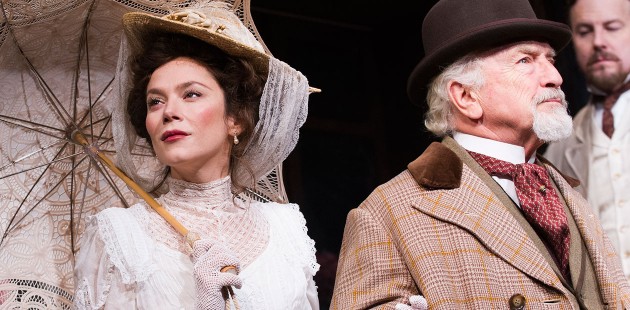 |
| Yelena (Anne Friel) and the Professor (Paul Freeman) |
Most of the rest of the cast is successful to varying degrees. Samuel West's Doctor Astrov has a pleasant dreaminess to him as he talks of conserving forests, and imagining the effects of his work on societies 1,000 years in the future. He's a bit of a fool, throwing himself at Yelena and (wilfully?) misinterpreting her reactions to his advances. His dialogue about the climate change and vegetarianism feels awfully prescient given that this play is about 110 years old.
Unfortunately there is a dodgy cog in this mostly functioning machine, and that's Laura Carmichael's Sonya. Her performance has already taken on semi-legendary status, purely for her being interrupted on opening night by a drunken Sir Peter Hall, founder of the Royal Shakespeare Company and former director of the National Theatre. During Carmichael's closing speech, when she repeatedly says "Life must go on", he responded by shouting "No! Please stop now!".
I disagree with the time and the place in which the criticism was made, but I have to say I find it perfectly accurate. I feel a bit sorry for Carmichael, who is clearly trying very, very hard to do a great job. But it's impossible not to notice that practically every line reading she gives is intoned in the exact same way. She starts out speaking relatively normally, and then by the end of the sentence the pitch of her voice gets higher. It's like everything she says can be read as a question, and it drove me bananas.

Stage and television and film acting require a different set of skills, you can't afford to be as subtle as you can with a camera with a theatre audience and things necessarily must be played a bit bigger. This has translated to Carmichael changing up her facial expression every single second. It's like someone's plugged the muscles of her face into a wall socket! Here eyebrows are maniacally working themselves up and down, her lips moving around, her eyes flaring and narrowing. It's distractingly bizarre.
Sonya is a character lacking in confidence, someone fully aware of their lack of beauty and experiencing cruel pangs of unrequited love. Carmichael isn't really plain, but it's easy to see why you'd think she might be a good choice for the role. She's got a bird-like flighty physicality, and her eyes seem well-suited to wistfully gazing across a room at someone. But for all this, the performance just doesn't add up. The now notorious final speech is a total disaster, something that's supposed to sum up the themes of the play, but here just sounds incredibly insincere and utterly over-rehearsed.
This production is a good one, it's got some of the most intricate and clever staging I've seen recently, and nearly all of the cast acquits themselves well, some magnificently. Chekhov's themes still ring relevant to audiences in the modern day; these are recognisable and comprehensible emotions and actions. You'd have to be a pretty strange human being not to recognise facets of yourself in these characters, they function both as a mirror and as a warning of a future to avoid. It's just a pity about Carmichael's performance. I feel the deepest sympathy for her. Getting heckled on your opening night has got to suck, big time. But it's got to suck even worse when the heckle was completely accurate.
Subscribe to:
Posts (Atom)


