Recent Articles
Showing posts with label science. Show all posts
Showing posts with label science. Show all posts
Thursday, February 28, 2019
Thursday, February 28, 2019
- 0 Comments

Reviewed by David James
Rating:

There is no way in hell I'm going to miss a show called Dinomania. Perhaps understandably, there are few plays about dinosaurs on the London fringe, with cash-strapped theatre companies reluctant to blow their budget on rubber Velociraptor costumes. More's the pity, but as Dinomania proves, there is still room in theatre for palaeontology nerds...
I've been a big admirer of Kandinsky ever since their excellent Still Ill back in 2016 and their talents were only confirmed in last year's Trap Street. Those shows covered psychosomatic illness and post-war housing. Now, as if actively resisting being pigeon-holed, they've created a seriously engaging play about Victorian science and the birth of palaeontology.
I imagine that for most people the names Gideon Mantell, Richard Owen and Georges Cuvier don't mean a huge amount, but they're indelibly burned into my brain thanks to 5-year-old me spending hours poring over various Usborne and Kingfisher books about dinosaurs. These books generally had a section on the discovery and classification of dinosaurs, generally taking time to explain how country doctor Gideon Mantell unearthed one of the first dinosaurs while out walking in the English countryside.
You can imagine what learning something like that does to a five-year-old's imagination. Dinosaurs are not only real and incredibly cool but they are literally hidden under the ground in this country. What on earth is stopping me from going out into the woods and finding the most awesome dinosaur the world has ever seen? All of which led me to me begging for a hammer and chisel for my sixth birthday - which in retrospect must have made for a pretty cheap present.
Anyway, all that's to say that I was extremely geared up to see a show about Gideon Mantell. While the show is broadly biographical, following him from cradle to grave, his life becomes a prism through which we understand Victorian science. The Victorians made enormous leaps in our understanding of the natural world - though these revelations were by no means easily accepted.


And so Kandinsky dramatises the key rifts in Victorian science. This begins with the class divisions between upper-class gentlemen scientists like Owen and Cuvier and middle and working class fossil-hunters like Mantell and Mary Anning (who I was slightly disappointed not to see get a name-check here). This feeds into a more serious rift, with young-earth Christianity and Genesis not having room for extinct prehistoric species and the millions of years required to produce fossils.
One of the most fascinating observations Kandinsky make is to explain how the concept of a creature changing form over time and becoming extinct was anathema to the upper-class Victorian consciousness. The scientists of the day looked to nature to justify the supremacy of their way of life (also a great way of securing patronage) and in Dinomania we hear how the theory that 'a mollusc may become a man' can be viewed as an attack on the rigid class structures.
It's a perspective the show reflects in Mantell's life. The child of shoemakers, he's told by his parents that the Mantells were once a great family and throughout the play we see him struggling to gain gentlemanly respectability. But, much as the Royal Geographical Society resist any 'progressive' ideas about adaptability, they resist his very presence among them and do their best to minimise his role in the discovery and classification of Iguanadon.
Kandinsky stages these arguments with their usual razor-sharp precision. The march of scientific progress and the discarding of incorrect or politically untimely theories is depicted by scientists dispatching each other with a pistol shot to the forehead, religious thought is heralded with hilariously overblown latin chanting and, in the play's best moment, the villain of the piece crumbles as he receives a vision of the future: his hated rival Charles Darwin is venerated and he dies miserable and alone. (Ha-ha! Suck it, Richard Owen).
I was never not going to enjoy a play that sits at the intersection of so many things I'm into, but it takes some serious skills to make a potentially dry subject so gripping. I've read a tonne about these dusty old scientists and in my imagination they are always the rigid, stern-looking men you see in their lithograph portraits (or the photographs of them as corpse-like old guys). Dinomania brings them to lusty, passionate life, blood pumping through their veins and sweat on their faces as they decipher the evidence left in rocks.
I have no idea what subject Kandinsky are going to tackle next but I'll be there day one.
Dinomania is at the New Diorama Theatre until 23 March. Tickets here.
Monday, August 7, 2017
Monday, August 7, 2017
- 0 Comments

Usually when I say a show has got its head shoved up its arse that's a bad thing. Not so with the excellent one woman show Gutted, which chronicles performer Liz Richardson's battle with ulcerative colitis - a condition that seems to involve randomly shitting blood all over the place. I say it's a battle, but it sounds like more of a drawn out war - Liz having spent her life bouncing in and out of hospital wards as her condition flares up, gets better, flares up again and so on.
Eventually she's exhausted all her options for treatment and things are only getting worse. Her doctor proposes radical surgery - removing her bowel and forming a 'pouch' from her small intestine. While this heals she'll have a stoma: her small intestine poking out of her belly and leaking her waste into an ileostomy bag. Theoretically, it's a temporary measure, but a proportion of these 'pouches' fail and there's a chance she could be ileostomy'd for life.
This condition, which apparently affects one in 420 people in the UK, isn't really in the public eye. This primarily because a) it's considered embarrassing and b) it involves a lot of poop. It also tends to affect young people, who are understandably a little squeamish about standing up and being the public face for an undignified bowel condition.
But, quite rightly, Liz Richardson wants to create a forum to publically discuss conditions like this. And so, Gutted presents her story in the most matter-of-fact way possible - explaining candidly what it's like to suffer from this disease, the hurdles she's cleared during treatment and the way people around her have reacted to it. Her delivery is cool, crisp and concise, taking on various personae who've assisted her along the way: leaky pensioners, paranoid teenage girls, bossy nurses and the impeccably named gastroenterologist Doctor Goodhands (and you'd hope so too, given where they're going).
You realise early on that Liz is incredibly difficult to embarrass. After all, she's spent countless hours with doctors probing around in her anus, her family and friends helping with her ileostomy bag, dealing with the anal seepage, and having to be catherised and cleaned by nurses. I imagine that after you've been through all that, standing in front of strangers and giving them a guided tour of your colonoscopy is easy street.
This all makes Gutted is a fantastically educational show. The explanation of how a colectomy and ileal pouch work was particularly fascinating. Liz using herself as anatomical mode, to demonstrate, drawing her colon and small intestine onto her belly and then erasing and redrawing it to show the results of the operation.
Her crystal clear explanation of the stoma and ileostomy bag was similarly neat, conveying the weird body horror of suddenly having a pulsing, oozing extra orifice on your body that kind of looks like a biological USB port. One of my favourite incidental details of the show was that the NHS literature strongly recommending that patients with stomas do not use them for sexual escapades - I would love to know the story behind that.
But behind all this is a genuinely heartwarming tale of how Liz' family and partner came together to support her through all this. Throughout the show audience members read dialogue from her partner Luke and her mother, each of them proving how important it is to have people you can rely on no matter what, and how love can shine through even in the most unpleasant or embarrassing of moments.
The cherry on top is Liz saying "I will never hear a bad word said about the NHS". It left me wondering what it might have cost her if she'd been born in the US, so I googled a bit and learned that she'd be on the hook for $40,000 just for the pouch surgery. Once you add in drug treatments, incidental incurred in hospital visits someone like Liz would be looking at a bill the hundreds of thousands of dollars - and as a further kick in the teeth "people living with inflammatory bowel diseases (IBD) commonly have problems obtaining affordable insurance". The NHS really is something to treasure and fight for.
Liz Richardson has metaphorically and literally seen a lot of shit in her life, but in a Jodorowskyian twist, she's turned that shit into gold. Gutted is a fantastic and important Fringe experience: bold, confident and entirely genuine.
Gutted is at the Pleasance Dome, Edinburgh Aug 8-13. Tickets here.
Friday, May 6, 2016
Friday, May 6, 2016
- 0 Comments

Fetish skulls! Wax guts! Dead kittens! Attending a Morbid Anatomy lecture feels like re-uniting with an old friend. It's been nearly four years since Seize the Day and judging by the fact that this event sold out in a matter of minutes, death appears to be extremely en vogue.
Morbid Anatomy are at the forefront of contemporary death, with Joanna Ebenstein's excellent blog having developed into the Morbid Anatomy Museum in New York City. Their mission statement is "to excavate the intersections of the history of art and medicine, death and culture" and to that end they presented four very different but equally fascinating lectures.
First up was Chiara Ambrosio, who transported us to an obscure cave on the wrong side of the tracks in Naples. This is the Fontanelle cemetery, where the chaotically scattered bones of Neapolitans lie, many dating from the great plagues that periodically decimate the city's poor. Over the years, a cult has arisen around these bones, its devotees constructing miniature 'homes' for skulls and seeking practical and spiritual advice from them in their dreams. This personal hotline to the afterlife threatens the monopoly of the Catholic Church, who declared that the devotees had "degenerated into fetishism" and ordered that the practice end. Which it did. At least the devotees said they'd stopped...
 |
| Skulls in Fontanelle Cemetery |
Secret death cults in obscure Neapolitan caves are (by my standards at least) completely infused with romantic adventure. Accentuating this is Ambrosio's lyrical and poetic analysis of the phenomenon, her lecture accompanied by live musical accompaniment. She created a woozy, dreamlike atmosphere - beginning with the surface geography of the city and subsequently burrowing deeply into the psychology of its inhabitants.
Next was Kate Forde's retrospective on the Wellcome Collection's 2009 exhibition Exquisite Bodies, which showcased wax anatomical models from the 19th century. These 'anatomical venuses' awkwardly straddle dispassionate medical education and quasi-religious eroticism. Forde gave us a whistle-stop tour through the history of wax anatomical models in London; explaining how they were first considered an unambiguous public good but soon fell victim to pearl-clutching Victorian moralists.
 |
| Anatomical Venus by Susini and Ferrini |
Throughout the talk I was mentally filing away things to research in depth later; Dr Kahn's wildly popular anatomy museum in Leicester Square; the delights of the Roca Collection and the classically beautiful, impossibly detailed wonders of Susini and Ferrini. Underneath all this lies a weird dichotomy between the surgery and the freakshow - the wax figures attracting attention as much for their sensuousness as their instructive anatomical detail. I hesitate to plumb the psychological dark spaces that fuel their popularity - what does is say about men who're attracted to a passive feminine body that invites you to strip her down to her womb?
This was swiftly followed by the personable Ross MacFarlane, with Death and Dr Buchan. Dr Buchan was a medical celebrity of the 18th century, feted for his globally popular Domestic medicine, a layperson's guide to treated common maladies. MacFarlane examined the impact of this book through Robert Burns' Death and Doctor Hornbook, in which a man comes across a despondent Death, worried that his services are longer required due to the activities of the titular Doctor. Yet Hornbook isn't some medical wunderkind - his self-taught home treatments are simply killing off far more people than Death ever could.
How much should the public know about medical science? This knowledge used to be the preserve of professionals; who perhaps assumed the general populace was too stupid to understand medicine or (more likely) was afraid that wide dissemination would weaken their businesses. Authors like Buchan broadened access to this knowledge, yet, as Pope famously said, "a little knowledge can be a dangerous thing".
While there are numerous minor problems that people can treat themselves, there's much that probably should stay in the realms of professionals. One only has to look at the rise in internet self-diagnosis/treatment or the alternative medicine industry to see what can happen when people think they know better than a trained professional.
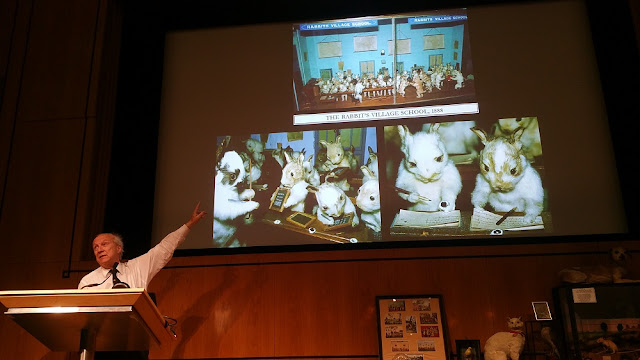
Finally we get to Dr Pat Morris, former Senior Lecturer in Zoology at the University of London and authority on taxidermy. The subject was the taxidermy of Walter Potter, clearly a passion project for Morris. The origin is a visit to his small museum "when I was in short trousers", where he was confronted by his striking anthropomorphic dioramas, the most famous being The Death and Burial of Cock Robin. I can see why he's such a fan - I got to see them (courtesy of Dr Morris) at 2013's The Museum of Everything) and they're just the right cocktail of weird and cool.
With the aid of examples he's brought with him, he gives us a brief biography of Potter. This ties into a wider ruminance on the popularity of taxidermy in Britain. A stuffed bird or family pet would have been an everyday sight in a Victorian household, but postwar squeamishness caused a gradual loss in popularity. Fortunately, taxidermy is on the rise again: chic workshops where you can 'stuff your own mouse' booked up for months in advance.
Dr Morris regards these johnny-come-latelys with a faint sniffiness, pointing out that the same kind of contemporary artwork that's now selling for big bucks was being done by his co-workers ten years ago - to little acclaim. Still, he must be pleased that the Potter works he's saved are being appreciated anew and judging by the crowds that gathered at the front of the lecture hall appreciated quite passionately. I love them: a three dimensional, powerfully physical manifestation of creatures, scenes and personalities long dead.
Once again Morbid Anatomy proves to be very much my kind of event. I look forward to the next thing they have coming up. One day, one glorious day I will visit their New York museum.
 |
| Death and Doctor Hornbook |
How much should the public know about medical science? This knowledge used to be the preserve of professionals; who perhaps assumed the general populace was too stupid to understand medicine or (more likely) was afraid that wide dissemination would weaken their businesses. Authors like Buchan broadened access to this knowledge, yet, as Pope famously said, "a little knowledge can be a dangerous thing".
While there are numerous minor problems that people can treat themselves, there's much that probably should stay in the realms of professionals. One only has to look at the rise in internet self-diagnosis/treatment or the alternative medicine industry to see what can happen when people think they know better than a trained professional.

Finally we get to Dr Pat Morris, former Senior Lecturer in Zoology at the University of London and authority on taxidermy. The subject was the taxidermy of Walter Potter, clearly a passion project for Morris. The origin is a visit to his small museum "when I was in short trousers", where he was confronted by his striking anthropomorphic dioramas, the most famous being The Death and Burial of Cock Robin. I can see why he's such a fan - I got to see them (courtesy of Dr Morris) at 2013's The Museum of Everything) and they're just the right cocktail of weird and cool.
With the aid of examples he's brought with him, he gives us a brief biography of Potter. This ties into a wider ruminance on the popularity of taxidermy in Britain. A stuffed bird or family pet would have been an everyday sight in a Victorian household, but postwar squeamishness caused a gradual loss in popularity. Fortunately, taxidermy is on the rise again: chic workshops where you can 'stuff your own mouse' booked up for months in advance.
 |
| The Death and Burial of Cock Robin |
Once again Morbid Anatomy proves to be very much my kind of event. I look forward to the next thing they have coming up. One day, one glorious day I will visit their New York museum.
Monday, March 30, 2015
Monday, March 30, 2015
- 0 Comments

I love it when art and science climb into bed together. There's something thrilling about the friction of rigorous objectivity of science rubbing up against the subjectivity of art. Over the 2013-14 term I followed the progress of the Central St Martins Art & Science group, which combined the two brilliantly (articles here, here and here). These exhibitions stoked my curiosity, and I hungered for more in the same vein.
I found it at Arebyte Gallery's Wired Up "exploring social, neural and bacterial networks through art and science collaboration". Working as part of the University of Westminster's Broad Vision project, teams of artists and scientists have been devising work centred around the idea of being 'Wired Up'. In 2015 we're all wrapped up in network cabling like a fly in a spiderweb; every person a node in a hundred different networks, which are themselves networked together. It's a dizzying train of thought, one that proves the seed for some fascinating work.
 |
| Internet |
The most initially eye-catching was Internet by Alex Cottrill, Francisco Sajara Vidinha and Mary Woolf. A bamboo model of a telecommunications tower stands in front of a projected map of London. The map has been coloured to show the 'heat' of wireless signals in the capital. As can be expected from a major modern metropolis, this is a blister of angry red activity, only the very edges showing some lull. These shifting colours reveal London as a pressure cooker of electromagnetic activity, watched over by gigantic masts that we've quickly trained ourselves not to notice.
The piece also works on a straightforwardly aesthetic level. The organic bamboo tower works as a counterweight to its steel real-life counterpart and the illumination of the projection against it creates beautiful shadows and patterns. Also, quite simply, the shifting colours of the heatmap pop off the white gallery walls, making for an eye-catching display.
 |
| Living Wires |
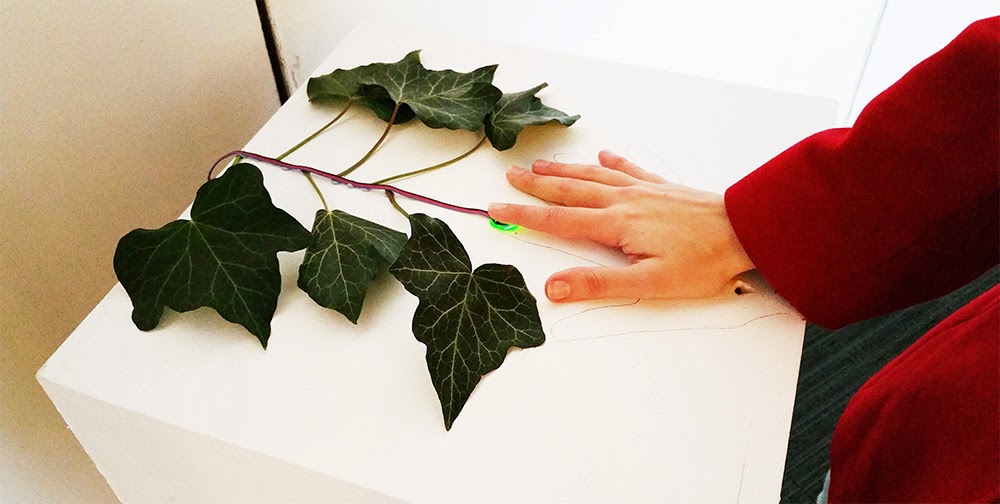
Nestled up against it is a similarly neat piece: Riccardo Branca's Living Wires. The artist explains that he's really working in collaboration with Physarum Polycephalum (a slime mould), to create an interactive exhibition that reacts to your presence. This consists of a box upon which a branch rests, terminating in a heartrate sensor. This is hooked to a projection that displays a closeup of the slime mould, which throbs in time with you. I've always dug slime moulds; they famously display a weirdly alien intelligence - able to puzzle out the optimum routes through mazes and (apparently) escape containers. Pretty impressive for a mould, and this one proves to be an excellent partner for Branca.
In Living Wires, the participant 'makes contact' with this inhuman world, giving us a taste of what it might be like to be part of a distributed plant consciousness. It's a teensy-weensy taste of course, functioning more as thought experiment than simulation, but in terms of provoking ideas it more than succeeds.
 |
| This is the best I could do in low light with my phone. |
These pieces border the edges of a darkened box in the centre of gallery. This is The Room, by Mateusz Gidaszewski, Camila Gaspar, Shin-Young Wiz Choi, and Charlie Dixon. After being blindfolded, you enter a darkened space and are presented with softly glowing jars of liquid. Shake them gently and they glow brighter. Once you have them all glowing, the mirrored walls of the room place you within a spooky constellation of ever-dimming and growing lights, with squirts of peppery scent combining to create a strangely religious atmosphere.
The glowing fluid are cultures of Dinoflagellate (nocticula) and photobacterium phosphoreum. The action of shaking them, which introduces oxygen to the bacteria and makes them glow, proves extremely compelling. There's something magical and primordial about the gentle movements of the glowing liquid, the infinity of the reflected mirrors giving the illusion that we're in the boundless ocean, or perhaps floating through the interstellar void. I could have stayed in there for hours.

Most fun was Sensory Interfaces, by Coral Hermes, Pippa Ischt, Dagamara Rutkowska and Patrycja Wilosz. This comprised three interactive stations that combine our senses (vision/taste, touch/sound, vision/sound) and a fourth that explores the future of our senses. Devised no small amount of humour and imagination, this was straightforwardly fun. A highlight were two boxes, one containing cotton wool and one containing rocks. Place your finger in the former and you get soothing classical music, in the latter you get Slipknot.
It's a clever joke, and this light-hearted sense of exploration continues with the experiment that links taste and vision. Presented with a series of coloured liquids, you're invited to taste them and then sort them by flavour. The twist is that they're not the colours you'd expect them to be; for example, the lemon/lime flavour is dark orange and black cherry is bright yellow. It's curious how our brain fools us with expectations - I could have sworn that the bright yellow liquid was lemon flavoured...
The vision/sound station is slightly less inspired next to the other two, but then these are two senses every human being knows to combine anyway. Finally the future headset, as represented by a faux-VR cardboard headset constructed from a mobile phone gives us a faintly endearing look at the future. There's something indefinably pleasant about this installation, which is geared - Science Museum style - to ensuring participants enjoy themselves while learning.
This is but a taste of what was on offer, though unfortunately this was a two day exhibition so your chance to see it has passed. But I'll be keeping an eye on work of this ilk, science and art perfectly dovetailing into one another to create exciting new hybrids.
Top picture from Dysfunctions by Andrea Fachini and Christopher Verhauwart
Thursday, March 26, 2015
Thursday, March 26, 2015
- 0 Comments

A successful historian must play psychoanalyst to their period. Entire societies are gently laid on the couch, their ambitions, paranoias, pride and history intelligently probed in an effort to get at what made them tick. You could look at what they say about themselves, but this strays into the realm of propaganda, neither individual nor civilisation wants to look like a chump.
You can approach this understanding of the past through many prisms, each refracting the past in their own way. Professor Andrew Scull has chosen the processes and understandings of mental illness: the understanding of cause, processes of diagnosis and treatment shedding light into the minds of our ancestors.
This interrogation is the subject of the 2015 Roy Porter lecture, hosted by the wonderful people at the Wellcome Collection. Prof. Scull, a former colleague of Porter, is Distinguished Professor if Sociology and Science Studies at the University of California, San Diego. His new book, Madness in Civilisation: The Cultural History of Insanity has just been released and provides the raw material for this lecture, which zeroes in on the nascent science of mental illness in the 1800s.
 |
| George Cheyne |
Our introduction to this world is the pioneering work of physician George Cheyne. His publication, The English Malady; or, A Treatise of Nervous Diseases of All Kinds, as Spleen, Vapours, Lowness of Spirits, Hypochondriacal and Hysterical Distempers (1733) was a huge influence on popular conceptions of mental illness and depression. That title, with the English laying proud claim to mental disorders, initially feels a touch odd. Why would an proud, patriotic nation hurry to 'own' these conditions?
As a point of comparison, Prof Scull explains the shifting colloquial names for syphilis, which in England, was called 'The French Disease', in France 'The Italian disease', in Italy 'The Neapolitan disease' and so on, with the Turks throwing their hands up and simply calling it 'The Christian disease'. These pejorative names are reflections of nationalistic spite: after all, nobody really wants to be 'the syphilis country'.
 |
| George Durer's Syphilitic Man |
What this reveals is that far from being a negative, 'nervous disorders' were proudly incorporated into the English psyche as a point of patriotic pride. The explanation for why is based around comparing 'primitive' and 'modern' man. The primitive has their mind occupied with acts of survival, a daily life and death struggle for food and shelter. Whereas the modern man, with his refined sensibilities, sharpened mind and rarefied talents, is akin to a precision-tooled piece of machinery - with many more components able to fail. Or, as Cheyne put it:
"those of the liveliest and quickest natural Parts...whose Genius is most keen and penetrating were most prone to such disorders. Fools, weak or stupid Persons, heavy and dull Souls, are seldom troubled with Vapours or Lowness of Spirits." CHEYNE (GEORGE) The Natural Method of cureing the Diseases of the Body, and the Disorders of the Mind depending on the Body.
So, the more Britain succeeded economically, scientifically and culturally, the more 'nervous disorders' we should expect to see - with mental illness an unexpected herald of social success.
This period of history, with luminaries like Isaac Newton, Robert Hooke, Edmund Halley and Christopher Wren et al defining the boundaries of the universe and identifying hitherto unknown invisible forces like electricity, gravity and magnetism must have been an astonishing time to live through. Finally the nuts and bolts of the universe were being revealed, the role of God gradually moving towards to absent caretaker rather than a being that intervenes in the lives of men.
Anything must have seemed possible, an outlook that gave rise to the success of one Franz Mesmer. He invented the concept of 'animal magnetism'; that energetic transference takes place between all objects, animate and inanimate. By manipulating this process he claimed to be able to cure nervous illnesses. Word soon got around, and before long crowds rich and poor were clamouring for a taste of mesmeric therapy.
 |
| A mesmerist using his 'magic finger' to cure a comely woman. |
It was all bunkum of course, Prof Scull inferring that a decent portion of his success came from providing erotic experiences for buttoned down society women. With scandal constantly nipping at his heels, Mesmer hopped between European cities, eventually coming a cropper at the hands of a scientific dream team that included Antoine Lavoisier, Joseph-Ignace Guillotin, Jean Sylvain Bailly, and Benjamin Franklin. They conducted tests, concluding 'biomagnetic fluids' to be a load of cobblers. Mesmer soon vanished into obscurity, the last 15 years of his life large unknown.
Though firmly discredited, his therapies acted as a seed in treated conditions of the mind. Mesmer's animal magnetism therapies evolved into hypnosis therapy (from which we get the word 'mesmerism'). We later learn that Sigmund Freud began his therapeutic career as a hypnotist, the interaction of patient and clinician eventually formalising into psychoanalysis.
It's here that Prof Scull links the behaviour of the past to the present. His examples outline the broad strokes of the 18th century 'personality': nationalism, scientific progress and a belief in progress. Mesmer's popularity inevitably leads the mind toward modern pseudo-scientific therapies, arguably more popular now than they've ever been. Similarly, the ownership of mental disorders feeds into identity politics: in an increasingly homogenous world everyone wants to stand out, with internet self-diagnosis leading to the rise of 'disease/allergy/mental illness as fad'.
What will future historians think of us when they examine these trends? What rationale can be given for masses of people running to alternative therapies when faced with the myriad miracles of modern medicine? Why are increasingly large amounts of people desperate to find 'their' disorder?
Perhaps it's only with the hindsight of history that the answers can really be theorised. Nonetheless, Prof Scull's lecture leads us down fascinating intellectual paths, subtly nudging us towards applying historical analysis to modern trends. It was a real treat watching him speak, I'll have to get hold of his book.
Prof Scull's book, Madness in Civilisation: The Cultural History of Insanity is available here.
Thursday, December 25, 2014
Thursday, December 25, 2014
- 0 Comments

Will no one rid me of these troublesome biopics?! After suffering through 2014's Jersey Boys, Jimi: All is By My Side, Get On Up, The Butler, The Imitation Game, The Invisible Woman, and Saving Mr Banks I am just about done with watching screenwriters trying to pop a neat thematic bow on top of the sumptuously packaged 'greatest hits' of some notable so and so. So who's on the slate today? Stephen Hawking? Right, fine, whatever. Roll the film.
The Theory of Everything charts Hawking's (Eddie Redmayne)'s relationship with Jane Hawking (Felicity Jones). We begin in 1960s Cambridge, where we first meet the young physicist bouncing down the cobbled streets on a rickety bicycle. With his goofy grin and oversize glasses he looks a little like Austin Powers' academic younger brother. He soon proves to all that he's a genius physicist, and wins the heart and mind of the lovely Jane. Yup, looks like everything's going to work out beautifully for Stephen Hawking.
Then his body decides to eat itself. Stricken with Motor Neurone Disease he's informed that his nervous system is going to shut down and in two years he's going to be dead. Quite reasonably he holes himself up in his room, wraps himself in a blanket and feels exceedingly miserable for himself. But with the fragrant Jane for assistance he finds vast inner reserves of personal strength and decides he won't let this horrible disease stop him from living or completing his life's work. By and large you know the rest of the story; Hawking is a wonderful example of human fortitude to us all blah blah blah.

To be fair to the film there is some genuinely good stuff in here. For a hungry young actor there can be few roles with Oscar-bait written all over them as much as Stephen Hawking. You get to play a witty man overcoming cruel fate, not to mention having to deal with tricky performance limitations: first having to manage subtle facial tics, then being confined to a wheelchair and finally unable to speak or move altogether. Redmayne has clearly done his homework on Motor Neurone disease, effortlessly conveying the slow bodily horror of one portion of your body shutting down after another. In the final scenes he's restricted to just a flicker of his eyes and a curl of his lip, but you can see the echoes of the lively 1960s Hawking in him.
The supporting cast are no slouches either. Felicity Jones has to balance keeping the audience's sympathies while slowly falling out of love with Hawking, which she makes look deceptively easy. This is especially impressive given that Jane Hawking is a curiously underwritten character, especially so given that this is an adaptation of her biography. David Thewlis is also a totally steady pair of hands as Hawking's professor, whose stern demeanour gradually melts into protective paternity as he recognises both Hawking's incredible intelligence and his personal bravery in dealing with his condition.
So why does this film suck? It sucks because it presents Stephen Hawking's greatest achievement as overcoming his disability rather than his work in physics. As far as Anthony McCarten's screenplay is concerned, Hawking may as well be a wizard for all the efforts it makes to understand what he does. There's a moment early in the film that sums it up; Hawking and his classmates are given some 'impossible' equations to solve by Thewlis' professor. Everybody is stunned into silence when it turns out Hawking has managed to 'only' solve 7 out of 8 of them. It's impressed upon us that this is a huge feat but it falls flat as we have no context or explanation why this is impressive. Look! He's solved equations! I mean, we don't know what equations they were but that doesn't matter right? What more proof do you need that he's smart?!
Similarly, when we see the blackboards full of complex formulae they're presented as an achievement in and of themselves, something that's apparently impressive purely because the characters are doing it. As the film develops you slowly realise that there's going to be no real explanation of why Stephen Hawking is such a remarkable man, consequently there's the sense that the film is treating its audience like a big bunch of morons who only want to see a sappy sob-story-of-the-week terminal illness story.

There is some philosophical meat in the film, but it's a tired old debate between Christianity and science, a half-baked exploration of the confluence between high level physics and spirituality. This is tired ground that's been stomped into soupy mud by countless dramatic boots before it. Hawking's science might be beyond intuitive human understanding and perhaps difficult for mainstream audiences to wrap their heads around. But then Hawking himself did it in his bestselling A Brief History of Time (which famously only contains a single equation: E=mc2). Even within cinema, Errol Morris' fantastic documentary A Brief History of Time (1991) conveys Hawking's theories in crystal clarity (with a kickin' rad Philip Glass soundtrack).
The Theory of Everything, in its breathless quest to foreground the tragedy of Hawking's, ends up as emotional pornography. "Oh, this poor man!" we end up thinking, sympathising with him as we greedily guzzle up his suffering. For my money it's not even a great film about MND, certainly not a patch on the excellent but deeply disturbing documentary I Am Breathing, which chronicles the slow death of Neil Pratt from the disease.
Despite Redmayne's excellent performance and the general competence of the filmmaking The Theory of Everything is lobotomised, the grandeur of Hawking's discoveries reduced to fuzzy-wuzzy ponderings about faith. The film casually takes for granted that Hawking's science is too much for audiences. It isn't.
★★
The Theory of Everything is released January 1st.
Sunday, December 21, 2014
Sunday, December 21, 2014
- 0 Comments

You pick up a scalpel and peel back your skin. What lies beneath? Somewhere in that tangle of veins, bones and tissue must be some 'essence of you'. But what if 'you' wasn't really 'you' at all? What if, squirrelled away in your cells was a genetic stowaway? It sounds like some weirdo science fiction thought experiment, but it's real. As an embryo it's possible to merge with a twin in the womb and so carry two loads of genetic material, meaning you can end up with parts of your body that 'belong' to a never-born sibling. You become like the mythical chimera, a creature made up of different organisms.
This mindmelting condition is what Chimera's Jennifer Samuels (Suli Holum) has to contend with. She's a microbiologist and upon discovering her son Brian has a minor congenital heart defect resolves to find out which parent contributed it. Her husband returns a negative and so does she. Curiosity further aroused she probes deeper, eventually discovering her genetic legacy, and worse, realising that this absorbed embryonic sister is the biological mother of her son, making her the aunt of the child she birthed.
Her scientific expertise crashes headlong into a maelstrom of guilt and self doubt, so she bails - abandoning her family and heading for parts unknown. Deborah Stein's Chimera is an attempt to map out this tangled, chaotic psychological terrain, to put intangibilities like the soul, maternity, selfhood on a microscope slide and try to discover their how and why. These are the prickly patches where intellect rubs up against instinct.
First impressions are that Jennifer Samuels is the very model of prim and proper middle-aged femininity. She's got the praying mantis poise you see in WASPish midwestern housewives; demeanour driven by the desire to maintain harmless cheeriness at all costs. But this surface plasticity hides turmoil, both genetic and mental.

Her character is mirrored by the set. At the rear of the stage lies a symmetrical set of sheer white kitchen cabinets. They look dully sterile yet turn out to (literally) conceal hidden depths. Kitchen and woman merge together, the point where Jennifer Samuels is consumed by the waste disposal unit marking when things get really weird.
Concealed beneath these ordinary looking cabinets is a warren of connecting tunnels, allowing Holum to pop up in unexpected places and emerge wearing fascinating new costumes. The sheer white also allows them to be used as a projection backdrop, taking us on psychedelic trips through DNA and outer space. Given the surface austerity of the set these virtuoso sequences allow us to step past merely discussing theories and viscerally experience them
The pinnacle of Chimera's visuals is a spellbinding sequence where Samuels stands behind glass and slowly embraces a projection of herself. Limbs writhe around each other, the boundaries of physical and digital bodies fade and we see two bodies dissolving into one liquefied mass before our very eyes. It's an excellent summation of the conflict at the heart of the play; a body divided, trapped in endless war with oneself.
These are deeply memorable visuals, but Chimera isn't all flash and no substance. Serious thought has gone into the central themes of motherhood, care and nurture. A highlight is an explanation of a cat abandoning the 'runt' of its litter. In Darwinian terms this makes perfect sense; the mother would have have to expend extra effort in keeping this doomed kitten alive at the expense of its siblings. So, hardhearted as it might seem, the runt must be kicked to the kerb. But then you're strolling along and spot a helpless widdle kitty wheezing away. You instinctively rush to help, expending time, emotion and money on trying to save a doomed cat. What logic is there in saving some walking dead animal whose own mother has left it behind?

It's in this example that I most keenly felt the tug-of-war in the heart of Chimera. The veneer of civilisation, represented by the sterile white cabinets, the costumes and the Stepfordian behaviour of it's lead character are an illusion. A major component of this illusion is the idea that, through civilisation, science and technology, you can truly know thyself. Yet the deeper we peer into this tangle of veins, primordial fluids and genetic code the more mixed up we become. This is reflected in the concealed depths of the simple-looking set, domestic bliss sliding into dizzying hallucinogenia.
The only division I didn't think quite worked were the repeated bashes on the fourth wall. We're repeatedly reminded that this is a set, that we're in a theatre and we are watching a performance. The Brechtian distancing effect is keenly observed, particularly in a moment where the stage microphone is peeled away like Holum has discovered some parasite on her body. Though ensuring we keep in mind the fiction/reality duality complements the themes of the play, it sucks away any chance of an emotional connection with the material.
There's big fat ladles of intelligence on stage, but precious little emotional oomph - leaving us with a play that tickles the mind but ignores the heart. Then again, Chimera is at pains to remind us that the heart is simply a bloody muscle endlessly jerking away within our guts, so any squirt of pathos risks hypocrisy. There's much to recommend here; a great performance by Suli Holum, a script quivering with intellectual gristle and stage design that's as high-tech as it is effective (also it gets all this done in 65 minutes, and I appreciate brevity).
But there's a piece of the puzzle missing somewhere, the disquieting questions Chimera asks still unanswered as we troop out. Maybe that's the point.
Monday, December 1, 2014
Monday, December 1, 2014
- 0 Comments

With its dull grey decor and formal atmosphere The Institute of Sexology is the epitome of 'just-the-facts-ma'am' seriousness. This soberness makes for an interesting contrast with the subject matter; galleries of knobs, tits and fannies in various states of erotic arousal, most of them owned by people wrapped up in psycho-sexual knots.
What the Wellcome Collection wants to emphasise is that sexology is a serious-minded, rigorous and important academic discipline. They're absolutely right, but it's difficult to suppress a childish giggle when you're confronted by a Greco-Roman winged boner. It's this tug of war between high-minded academia and puerile sniggering that runs right through this exhibition, the snooty air almost daring you to make some immature joke.
 |
| Masked man in pink tutu, from collection of Richard von Krafft-Ebing (1840-1902). |
Covering just two and a bit rooms, the exhibition spans 150 years of sexological research. We begin with Victorian pioneers who stuck their toes into what they considered perversion, inversion and moral decay. Perhaps the best example of this early work is Richard Freiherr von Krafft-Ebing's textbook Psychopathia Sexualis (a potentially truly great band name). This work, famous for popularising the terms masochism and sadism, is one of the first to catalogue fetishes and the spectrum of eroticism. Krafft-Ebbing feared his work could be used for cheap titillation, so gave it a scientific sounding title and wrote parts in Latin, efforts that are neatly mirrored in this exhibitions efforts to remain respectable and educational.
From here we spiral up through the late Victorian and arrive in 'The Consulting Room', where we see the duelling philosophies of Sigmund Freud and Marie Stopes. There's a simulated version of Freud's desk, populated by his totemic figurines and, my favourite, a bronze porcupine. As far as analogies go I've always enjoyed 'The Porcupine's Dilemma'; to keep warm they must huddle together, but in doing so they risk jabbed by each other's spines - a neat summary of interpersonal relationships. Freud's "the talking cure", involved solving a patient's sexual issues through a comprehensive mapping of their pasts, dreams and mind.
 |
| Marie Stopes birth control clinic in caravan, with nurse, late 1920s. |
This couldn't be further from his contemporary Marie Stopes, who indignantly warned her patients to not “think about your subconscious mind ...as all the filthiness of this psychoanalysis does unspeakable harm.” Stopes is a fascinating character; described as an "feminist, eugenicist and paleobotanist". Her mission in life was to lower birthrate among "undesirables" (i.e. the poor), which is, well, a bit disturbing. But, from the worrying soil of class snobbery grew green shoots of contraception and unprudish sex advice for couples.
It's characters like Stopes that shine through in this exhibition; the idea of a fossil-hunting, feminist, eugenicist fastidiously recording her arousal levels appeals to me on some basic level. Just past Stopes is a similarly magnificent project; a catalogue of all the men that a New York based artist, Carolee Schneemann, slept with over the course of a few years. The men are rated for their skill, masochism, tenderness and the sounds they made when they came. This reducing of something as chaotic, fuzzy and sticky as sex into cold hard data is somehow intrinsically absurd: can you bake love into a pie chart?
 |
| Alfred Kinsey interviewing a woman. |
The pinnacle of this was the exhaustive research undertaken by Dr Alfred Kinsey. After a long period categorising millions of wasps (he eventually concluded that no two are exactly alike) he moved onto sex. You can leaf through Kinsey's questionnaire and quickly understand just how he got thousands upon thousands of people to reveal the most personal details of their sex lives. His method was like the famous example of boiling a frog i.e. to gradually raise the temperature so it cooks alive. One moment a Kinsey interviewee is talking about their first memory of a birthday, the next they're being asked whether they're had a dildo jammed up their arse (and if so what colour, size and make it was).
This compartmentalisation of sexuality into strictly defined categories is fascinating from a scientific point of view, but at some point you've got to ask: where's the love? I had hoped this would come from the exploration into the work of Wilhelm Reich. He's one of my favourite loopy countercultural figures, becoming convinced in the 1940s that he has discovered a cosmic source of energy; orgone. Famously summarised as a mystical sexual energy, Reich built 'orgone accumulators'. Here you get to sit in one.
I'd wanted to sit inside an orgone accumulator for years - particularly after watching the ace film W.R. Mysteries of the Organism. Now the time finally came and, to be honest it was an anticlimax. The accumulator is a foam-covered plywood box lined inside with sheet metal, the design supposedly able to draw down this aetheric energy and concentrate it in my body. Instead it felt much like being sat in a photobooth at a train station. Oh well, maybe this stolid environment isn't a natural place for funky sex magic.
It'd be a lie to say that The Institute of Sexology isn't interesting. It's carefully and rigorously designed to pack as much key information into this small gallery. That said it's a cold and distant exhibition, one that all but demands you surrender your emotions at the door. This absence of playfulness works against the eccentric aspects of characters like Reich, Stopes and Kinsey that populate the display cabinets.
It all adds up to an interesting but not particularly passionate (and certainly not sexy) experience. But I suspect that's exactly what they were shooting for.
The Institute of Sexology is at the Wellcome Collection until 20 September 2015. Free entry.
Subscribe to:
Posts (Atom)