Recent Articles
Showing posts with label Greek mythology. Show all posts
Showing posts with label Greek mythology. Show all posts
Wednesday, March 7, 2018
Wednesday, March 7, 2018
- 0 Comments

Electra reviewed by David James
Rating:

Murder, betrayal and revenge never go out of fashion. These universal themes are what makes plays like Sophocles' Electra, first performed 2,400 years ago, continue to vibrate like a tautly pulled guitar string. Who can't sympathise with rage at a father unjustly killed, children abandoned by their mother and a metastasising cancer at the heart of government?
Dumb Wise Theatre's adaptation, written and directed by John Ward, keeps the poetic meter but updates the language, peppering the lyricism with "fuck you"s and a patchwork of contemporary references. Though the play nominally takes place in the ancient city of Argos, we immediately understand it to be a placeholder for a modern political patchwork that encompasses elements from the Arab Spring, Blairism and a PR conscious media landscape.
Underneath the modern elements, the core of the Electra is what Sophocles wrote: Queen Clytemnestra (Sian Martin) and her lover Aegisthus (Matt Brewer) have murdered the heroic King Agamemnon and assumed the throne. Agamemnon's son and rightful heir Orestes (Dario Coates) was exiled as a child and raised by rebels seeking to place him on the throne and his daughter Electra (Lydia Larson) rages against the injustices of her mother's court, praying for the day when her long-lost brother will return.
All this is played out on a dusty bare-knuckle boxing pit of a stage. It's bordered by a forest of glowing tubes and instruments on which the impressively multi-talented cast play the show's pumping score. As the performers move about they kick up billowing clouds of choking dirt, squeeze fistfuls of dirt and press their faces into it as if trying to commune with the land they're battling over. Underneath the soil is the eroded, abandoned tomb of the murdered King, a constant reminder of the guilt of Aegisthus and Clytemnestra and the fury of Electra and Orestes.


It's great stage design, and the gripping drama played out on it does it justice. Obvious highlights are Sian Martin's villainous Queen, portrayed as a public relations expert as she subtly weaves her personal story into the national narrative. Williams is amazing at showing the microseconds of emotional truth when her cool mask slips, revealing the paranoia bubbling up inside her. Matt Brewer's eloquent politician gradually sliding towards corruption also impresses - not an outright villain but corrupted by power and the decisions he made to seize it.
Best of all is Lydia Larson's Electra, who sets the stage alight. Larson is one of my favourite actors at the moment (brilliant in both Skin A Cat and Brutal Cessation) and knocks it out of the park. There's a lot of Hamlet in her Electra, she does a great line in rebellious seething and viciously worded denunciations of her mother and stepfather. She powers through the play like a guided missile, her arc taking her from angry, to very angry, to incandescently furious, ending up at cracked murderous joy. The only downside is that next to her tour-de-force, Dario Coates' Orestes is a bit anaemic.
The only real flaw is that Aegisthus' villainy is outdated. The era of the shinily suited PR-led centrist politician ended with Cameron's post-Brexit resignation in 2016. It's difficult to equate the id-driven chaos of Trump, the incompetent incoherence of May or the tweed honesty of Corbyn with Aegisthus' character. That the target of the show's fury is yesterday's news slackens its grip, and though there are attempts to keep things relevant for 2018 they don't quite work - for example, I have no idea what statement is trying to be made by having the diabolical scheming authoritarian quoting Jeremy Corbyn's "for the many, not the few" slogan.
Quibbles aside, Electra kicks ass. It's Greek drama firing on all cylinders: exciting, involving and exhilarating - and Lydia Larson gives what I can already tell is going to be one of my favourite performances of the year. Go see it.
Electra is at The Bunker until 24 March. Tickets here.
Friday, February 2, 2018
Friday, February 2, 2018
- 0 Comments

Becoming Shades reviewed by David James
Rating:

The Vaults underneath Waterloo make for a great Hades. The arched ceilings, damp dripping down the walls and trains distantly overhead rumbling overhead do a lot of legwork in Chivaree Circus and Upstage Creative's Becoming Shades - in which the audience becomes lost souls amidst the hellhounds, pomegranate seeds and enigmatic boatmen of the Greek afterlife.
A loose retelling of the myth of Persephone, the show consists of various circus acts performed by an all-female company scattered around Vault Festival's biggest venue. So, we might huddle around a performer doing a piece of interpretative dance, then be hustled over to another part of the room where we take in an acrobatics act and so on. Impressively, this is all musically accompanied by a live duo, Sam West and Becks Johnstone, the latter of which is such a talented vocalist that it feels a bit odd to have your back to her whilst she performs.
The show bills itself as immersive theatre but, like most shows that claim this, it isn't. Instead, it's more of a promenade piece. Though we're poked and prodded by staff who make sure we're not blundering into the fire-eaters, this is an almost entirely passive experience in which we sit down, shut up and watch people do stuff. That the show isn't interactive isn't necessarily a criticism, but "immersive" is quickly becoming a meaningless marketing buzzword and I wish shows would stop diluting the concept.
Becoming Shades also claims to be a "female story of empowerment", which is also a bit debatable. On the face of it, the Persephone myth isn't particularly progressive: a woman abducted and forcibly married, who has little agency of her own within the story. Chivaree Circus zeroes in on the imagery of a busted open pomegranate as a symbol of female sexual power, eventually reincarnating Persephone as a Queenly fertility goddess in full command of her own sexuality (she then twirls around on a flaming yonic hula hoop to really hammer the point home).
That's all well and good, though I'm always sceptical of shows about female empowerment that also feature attractive women in skimpy outfits doing hi-octane pole-dancing routines to dubstep. I get that doing this reclaims misogynist imagery and subverts masturbatory objectification, but y'know, it's still a sexy pole dancing routine.


Stuff like that feeds into a subtle but damaging disconnect between narrative and form. Essentially the show feels like a vehicle for various circus routines around which Greek myth and imagery have been stapled rather than the two properly tesselating. That contributes to an emotional disconnect that makes it difficult to care what's happening.
What's left is an okay circus show. The general atmosphere and dramatic lighting of the venue is effective, but while there's nothing objectively wrong with the acrobatics, there is also nothing that audiences who've seen a couple of circus shows won't have seen before. My barometer for a successful circus performance is when the audience spontaneously gasps and applauds during a piece, so impressed that they cannot help but react. This happens once or twice over the course of the night, but in general things are a bit muted.
Then there's the little gripes. Constantly being asked to sit down, stand up and being herded around the room every couple of minutes quickly gets old. The expectation that you're to wear a surgical mask for the entire show is annoying (most people discard theirs early on). And the wub-wub-wub dubstep effects on the soundtrack are a bit dated in 2018.
Becoming Shades isn't a bad show but it never comes together in a satisfying way; ending up as a collection of disparate elements that awkwardly rub up against one another. At £30 a ticket it's one of the more expensive (possibly the most expensive) show at the Vaults - if I'd have paid that I'd be feeling a little short-changed.
Becoming Shades is at Vault Festival until 18 March. Tickets here.
Then there's the little gripes. Constantly being asked to sit down, stand up and being herded around the room every couple of minutes quickly gets old. The expectation that you're to wear a surgical mask for the entire show is annoying (most people discard theirs early on). And the wub-wub-wub dubstep effects on the soundtrack are a bit dated in 2018.
Becoming Shades isn't a bad show but it never comes together in a satisfying way; ending up as a collection of disparate elements that awkwardly rub up against one another. At £30 a ticket it's one of the more expensive (possibly the most expensive) show at the Vaults - if I'd have paid that I'd be feeling a little short-changed.
Becoming Shades is at Vault Festival until 18 March. Tickets here.
Friday, February 24, 2017
Friday, February 24, 2017
- 0 Comments

The Fate We Bring Ourselves reviewed by David James
Rating:
If there's one golden rule in mythology, it's that you never screw around with the gods. Not only are they immortals who can do whatever the hell they like, but they've got seriously sadistic imaginations. Even worse, the lives of us mortals are dust in the wind compared to their magnificence.
I've been a fan of Greek mythology ever since someone gave me an illustrated book as a child. There's something attractive about the combination of bizarre ancient moral standards, realising what various things are alluding to and the simple pleasures of the soap opera shenanigans that go on in Mount Olympus. But there's a hell of a lot of Greek myths they don't put in children's books: the gory, the sexual or the just plain bonkers.
Enter Ben Haggarty. He's in the upper echelons of performance storytelling: weaving together precise oratory, a striking physical presence and an uncanny knack for improvisation. One of the more magnetic (and slightly intimidating) performers I've seen in a while, the moment Haggarty opens his mouth he has the audience in the palm of his hand. Then, slowly, he closes that palm into a fist, squeezing us, cranking up the tension, etching vivid pictures into our imagination.
Tonight's quartet of stories is particularly vivid. The theme is choice, more specifically the danger of making the wrong choices. We begin with a parable of an ancient blind family. A husband, wife and their mothers live a happy, mutually supportive existence in a community. Their calm is broken by the reverberations of distant war; a lack of men causing the harvests to fail. With the spectre of famine raising its head, the villagers cast out "those without a future".
And so the blind family are left to fend for themselves in the wilderness. It's going to be a story with a bleak ending, until the husband trips over a mysterious bag on the ground. Reaching around inside he finds slick, spherical objects and, for reasons known only to him, pops one in his empty eyesocket. It miraculously grants him sight. He pops another next to it, then sorts out his wife and begins to dish them out to their mothers. But here's the rub: there's eight eyesockets and only seven eyeballs. The man must make a careful choice - whose mother will remain a cyclops?
Now, we're unlikely to ever have to make this exact choice, but life offers plenty of tricky decisions. Sometimes you feel like you're standing at a fork in the road, one way leading towards a happy life of sunshine and roses, the other towards misery and destruction. And you have no way of telling which is which. The three myths that follow are examples of people making the wrong call.

First is the myth of Actaeon and Artemis, in which a hunter happens across the goddess and her nymphs bathing nude in a pool. He decides to silently observe, becoming the first mortal ever to see the goddess' naked beauty. That achievement is scant consolation to Actaeon though, who is turned into a stag by an angry Artemis and subsequently devoured by his own hunting hounds. Next up is the myth of Erysichthon of Thessaly, a King who makes the fateful decides to chop down a grove of trees sacred to Demeter and is cursed with insatiable hunger. Last comes the tangled tale of the (double) birth of Dionysus, which involves killer clowns, Zeus incubating a foetus in his ballsack and a poor young woman being completely vaporised by Zeus' atomic strength ejaculation.
Lessons learned? Think before you act and don't fuck with the gods (and if you see Hera coming down the street be sure to cross the road). Though fantastically delivered, the connective tissue of 'choice' sometimes feels a bit flimsy, but in face of such great storytelling this feels like quibbling.
My favourite bits come when we begin to approach the horrifying or the cruel. The delivery slows down, giving us ample opportunity to anticipate what's to come next. Here, Haggarty is like a boxer shifting his weight backward before unleashing a knockout blow. When he delivers the imagery whacks into you with considerable impact - every syllable of the goriest passages conjuring up hideous mental pictures.
Ben Haggarty is a monumentally effective storyteller: the kind of man who'd be as at home on a Crouch End stage as around a medieval bonfire or a Roman forum. The Crick Crack Club continues to remind me of the power of unadorned storytelling - of letting yourself be lost in a forest of words, giving yourself up to the sheer primeval power of the human imagination.
For more of the Crick Crack Club, see their website.
Friday, December 4, 2015
Friday, December 4, 2015
- 0 Comments
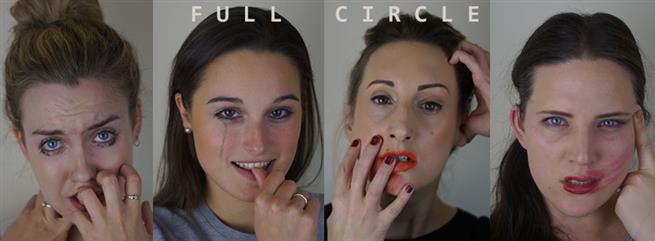
"Hell is other people" rings very true in Madelaine Cunningham's Full Circle. Four A-listers of Greek mythology are trapped together: Medea, Helen of Troy, Clytemnestra and Phaedra. On their slender shoulders lie a litany of crimes that range from brutal murders, paedophilia, false accusations of rape - all the typical brutalities of ancient mythology. Almost all of these women died untimely and violent deaths - some of them by their own hand.
In death they're united for the first time, their colossal egos rubbing up against one another in an battle for dominance. They converse in probing manipulations, trying to get under each other's skin and craving escape from limbo. Their interrogations get to the heart of the various gender archetypes that the characters represent; warped reflections of the daughter, the maiden, the mother, and the wife.
This emotional crucible gives each of them the framework to deal with the enormity of their actions. Each travels through the classical stages of anger, denial etc before arriving at some kind of breakthrough. But can they ever escape the crushing guilt of their self-imposed hell?
Staged beneath a dangling wall of mirrors, lit by sickly bright neon and soundtracked by a combination of thumping dubstep remixes and the wistful voice of Lana Del Ray, Full Circle may be based on classical material, but its style is resolutely modern. Indeed, there's even a tinge of the strip club when you're immersed in coloured light and your bones are tickled by booming bass drops. This combo of ancient Greek morality and modern aesthetics goes a long way towards making these characters' tangled psychologies accessible to a modern audience.
At just over an hour long, Full Circle leaps into the deep end quickly, trusting its audience to keep up with four necessarily complex backstories. Unless you've got a surefire knowledge of Greek mythology, you're going to have difficulty keeping up. I'd consider myself pretty up on this stuff - but though I'm familiar with Helen of Troy and Medea's stories, I'm only mildly familiar with Clytemnestra and only know of Phaedra in passing.
My own ignorance isn't the best basis for criticism, but even though the audience is given a leg-up with cheat-sheet programmes that list each woman's crimes it's easy to get lost in thicket of opinions and accusations that makes up the majority of the play.
Fortunately, a set of uniformly good performances mean that even if you occasionally have trouble following the argument, you remain emotionally engaged. The four actors, Lucy Avison, Madelaine Cunningham, Laura McKee and Sarah Sorenson, each display a clear understanding of what makes each character tick, following emotional threads right up unti the conclusion.
My highlight was Laura McKee's Helen, approaching her as a woman who's made a conscious decision to stop feeling so damn sorry for herself and turn a bit femme fatale. There's a deliciously predatorial quality to her that's surprising considering she's in the company of murderers and liars.
I enjoyed Full Circle; though it didn't knock me for six. Perhaps if I'd done my homework and boned up on the various bloody sagas that fuel the play I'd have been more on board. Still, you can't argue with straight-up, no frills, professional performances like these, or with the obvious enquiring intelligence that lies behind the dialogue.
A bit of a curate's egg, but at least an interesting one.
Friday, June 19, 2015
Friday, June 19, 2015
- 0 Comments

You can't fault Iphigenia for being a bit glum. Her Dad Agamemnon, an A-lister of Greek Mythology, was all set to offer her as a human sacrifice. Escaping by way of divine intervention she now finds herself stuck in Tauris, unhappily working as a Priestess in Diana's temple and being amorously pursued by King Thoas, who she's doing her best to put in the friend-zone.
King Thoas isn't best pleased, threatening to reinstate the old tradition of human sacrifice, and forcing Iphigenia to wield the knife. Things look bad, though a ray of light arrives in the form of Iphiena's long lost brother Orestes and their cousin Pylades. They reveal that everything's gone a bit Jeremy Kyle back home in Mycenae. Agamemnon's wife, Clytemnestra, a bit miffed that he was prepared to murder their daughter, killed her husband. In turn, her children (even more miffed) killed her. Now Orestes is cursed - pursued by the Furies - his only chance to fulfil a challenge of the gods and swipe a statue of Diana from a temple, which is why he's here.
Sounds pretty exciting huh? Well, none of that actually happens in this play. This is Goethe's 1779 adaptation of Euripedes 414BCE play, written with an emphasis on poetic language, emotional intensity and philosophical and moral explorations.
Okay, I've got to get something out of the way. It gives me no great pleasure to say it and it's a criticism that I don't ever like levelling at a piece of theatre. To say it says as much about me as it does about the play, particularly as Goethe is considered a titan of literature. But here we go: Iphigenia in Tauris is boring. Really, really goddamn boring.
I'd never heard of the play before this production, and frankly I can see why. Essentially a series of long-winded, static duologues, the characters go on and on in poetic metre that rapidly approaches incomprehensibility. The language is overwrought, self-indulgent and bulging with self importance. As the characters launch into complex flights of poetic embellishment (full of obscure references to Greek mythology) I felt my eyes glaze over, the dialogue collapsing into a word salad.

It'd take an astonishingly talented creative force to pummel this creaky old thing into anything remotely palatable, and this production just isn't up to the task. Perhaps as if to contrast the florid language, the set and costume design is austere to the point of non-existence. The 'half theatre/half archaeological dig' nature of the Rose resists elaborate stagecraft, but an empty, flatly lit stage decorated only by a white sheet doesn't exactly excite the eye.
Granted, much appreciated efforts are made to exploit the full space. An altar to Diana is set up at the far back of the room, and the characters periodically scamper across the distant earthern floor. This gives rise to one of the few truly successful dramatic moments; the opening in which an ethereal Iphigenia emerges from the shadows and processes towards us, filling the theatre with her atmospheric voice.
I can't really fault the cast too much either, finding myself feeling slightly sorry for them. You can see every dramatic sinew strain as they delve through the soupy dialogue trying to find something - anything - relatable to a modern audience. They're fighting a doomed battle and often, despite their obvious efforts, they end up simply reciting the play. Suzanne Marie as Iphigenia comes out looking best, though even she frequently struggles to locate any glimmer of humanity buried within this mannered poetry.
Maybe if you were a scholar of Greek mythology or a particularly big fan of Goethe you'd enjoy this. Otherwise I wouldn't bother: becoming emotionally involved in Iphigenia in Tauris is next to impossible. Being intellectually involved is a little more achievable, though not without enormous effort. And frankly, it's not worth it.
★★
Iphigenia in Tauris is at the Rose Playhouse until 4th July 2015. Tickets here.
Photos by Lidia Crisafulli
Photos by Lidia Crisafulli
Saturday, May 4, 2013
Saturday, May 4, 2013
- 0 Comments

It's a strange experience watching a film that's 102 years old. Every single person involved in the production is long dead, and so for that matter is everyone that went to see it in the cinema. It's a historical epic that depicts scenes from Odysseus's journey, but by 2013 the film itself has become a relic of a distant past. But, though this film was intended for an audience whose mindset is alien to us, there is still much that's familiar about this adaptation of Homer's Odyssey, which at the time was grandly billed as marking "a new epoch in the history of the motion picture as an actor in education."
Saturday, May 12, 2012
Saturday, May 12, 2012
- 0 Comments


When I received the email reminding me that tonight was the performance of 'Eros and Psyche' at the Swedenborg institute I was a little bemused. I couldn't clearly remember ordering tickets, but it did sound like something I'd do, so I may as well head down there. Frankly, even after visiting a few times I’m still a little bit unsure as to what exactly the Swedenborg Society is all about. Emanuel Swedenborg was an 18th Century Swedish scientist and mystic - but my only real source of information on him is what I’ve read on pamphlets at Swedenborg Hall and on Wikipedia- he comes across as a sort of Swedish analogue to William Blake. Still, while I’m somewhat shaky on what the Swedenborg Society’s guiding philosophy is, I’m glad they’re around. The people working there are always helpful and friendly, and it the place attracts an interesting and surprisingly well dressed crowd. Swedenborg Hall is one of those semi-secret places tucked away behind a shop. The kind of place you occasionally happen upon when going to some obscure performance or talk.
As I took my seat in the front row I still had no idea what kind of performance was in store for me. Encouragingly, what was already on stage looked quite interesting, a range of odd percussion instruments and soft lighting, including what I think were candles in the bottom of paper bags. The thought did cross my mind that one of these might go up in flames during the performance, but these Swedenborgians seem like a sensible bunch so I figured they had this covered. As I waited I read through the programme for the evening – the performance was going to be about 100 minutes, with an interval halfway through. I always feel a slight sense of relief when I see there's an interval, if this turns out to be mind-numbingly dull I can easily slip into the night and be gone with no sharp glances and tuts directed at me.
I needn't have worried. As the lights dimmed and the performance began it didn’t take me long to start enjoying myself. Sally Pomme Clayton is a damn good orator and actress. The performance began with her holding an olive oil fuelled lantern, desperately hoping that the tiny fluttering flame wouldn’t go out and spoil the introduction. It was a nicely humanising touch to what I’d been afraid would be a bit of a cold, conceptual performance, and set the tone for what was to follow. The performance essentially followed two narratives; the myth of Eros and Psyche, which is told within Plato’s ‘Symposium’ by Socrates and a skeleton outline of his philosophy and temperament.
The themes of the evening were the relationship between love and beauty, pretty big things to tackle. The two aspects are personified in the characters of Eros and Psyche; Eros representing love (he is the God of Love after all) and Psyche representing beauty. The basic summary of the story is that Psyche is so beautiful people start worshipping her rather than the Goddess Aphrodite, so she gets all narky and sends her son, Eros, off to torment her as a revenge. (It always amuses me how petty the Greek gods are about stuff like this.) Eros accidentally wounds himself with his own arrow, and surprise surprise falls in love with Psyche. The rest of the story plays out the complications of a God falling in love with a mortal, and how both their families react to this inadvertent pairing. I won't spoil the end, even though you've had about 2000 years to get around to it. The Socrates part of the performance recounted various aspects of his personal life, and his obstinacy which results in him being sentenced to death.
The two narratives were woven together, the story of Eros and Psyche being told by Socrates' teacher, Diotime, Socrates telling it to the group of prominent Greeks at the Symposium, Plato telling Sally Pomme Clayon, and Sally Pomme Clayton telling us. It is a nice chain of oral history and it’s comparatively rare (for me anyway), to be told a epic story by a single person taking on multiple roles with minimal stagecraft. The use of different instruments to represent different voices, for example the voice of Eros was given an unearthly quality by playing a bow on the edge of a cymbal, neatly kept the audience on track, and the use of body language to signify the shifts in status and mood between characters was wonderful. The only part which didn’t really work was a call and response with the audience which apparently demonstrated Socratic dialogue. We were asked questions like “What comes first, love or beauty?” and then expected to answer as one. What resulted was a kind of embarrassed murmur as people weren’t really sure what to say. A particularly bizarre response was when we were asked “What happens when love achieves beauty?” and a woman behind me confidently answered “dissatisfaction”. There’s probably a whole other performance summarised in that one word response.
I was happy to see a warm and compelling look at such large concepts as love and beauty. It is nice to see someone talking intelligently about these highfalutin’ concepts without shrouding them with a veil of irony or cynicism. The next performance by Ms Clayton will be a children’s performance, and as long as Ms Clayton leaves out the violent testicular trauma I find it difficult to imagine how any child could fail to enjoy it. The final performance of her tenancy as resident artist at the Swedenborg Society is in late December. I’m looking forward to it.
Subscribe to:
Posts (Atom)