Recent Articles
Showing posts with label Helen Bang. Show all posts
Showing posts with label Helen Bang. Show all posts
Friday, January 10, 2020
Friday, January 10, 2020
- 0 Comments

Reviewed by David James
Rating: 
Rosalind Blessed's Lullabies for the Lost is a collection of monologues from people living with various mental health issues. There's a skeletal narrative about these characters being trapped together in some kind of monochrome purgatory and having to earn the right to escape it. But this framework is just the cracker on which some extremely miserable cheese is served.
And man oh man, this is some absolutely brutal stuff. From the first monologue on the characters are talking about self-harm, the way their bodies are falling apart, the filth in which they live, the way their minds rebel against them and their sorrow at watching their potential trickle through their fingers like sand through an hourglass. Fat bubbles up through too-deep self-inflicted cuts, throats are slashed with broken wine glasses, vomit smears the walls.
The show hits such high notes of desperation and misery that it wasn't particularly surprising when someone fainted mid-way through and they had to pause the show to check that she was alright. For all I know this person might have had low blood sugar or something, but I assumed that the material was so visceral her brain noped out.
But though it hits those high notes, they're mercifully not sustained. There are laughs amongst the misery as the characters examine the surreal and ridiculous places their condition takes them. For example, an in early monologue about social anxiety and depression, Chris Porter's Larry tries to come up with an excuse why he can't attend a meal. He considers telling them his cat has had a stroke. There's a beat. "... Do cats have strokes?"
These moments of comedy are a double-edged sword. Laughing along with these characters cements our emotional connection with them, which only makes the pits of their despair that much more crushing.


Fringe plays about mental illness aren't exactly uncommon - at any given time there will be various confessional monologues about how miserable the writer's life is going on in a room above London pubs. But Lullabies for the Lost casts its net wider than the playwright's personal experience, showing us that there are many different ways to be in pain, all of which come loaded with their own particular horrors.
You might argue that this play is being sad for sad's sake: like Madame Tussauds' Chamber of Horrors but for mental illness. But there's a mile-wide empathic streak running right through the show, culminating in a video appearance from Hildegard Neil giving us assurance that we should stop being so neurotic and muddled up as "you're just not that important". That's not exactly a traditional pick-me-up, but realizing that no-one gives that much of a shit about what you look like, how successful you are and what you do can be an intensely liberating experience.
All this is delivered by a fantastic (and very well chosen) cast. In a play like this it's silly to pick favourites, but I've been a fan of Helen Bang for ages and she's as great as she usually is here. I also really enjoyed Kate Tydman's Nerys, who nails presenting an outwardly healthy and confident exterior while rotting away behind closed doors. But, perhaps because he gets the most nightmarish monologue of all, Duncan Wilkins' performance is the one that's going to stick in the memory longest.
This all adds up to a not exactly fun night at the theatre, but definitely a worthwhile one. I had actually been suffering from a pretty brutal cold all week and prior to the show was weighing up just staying in bed. But Lullabies for the Lost synced up perfectly with my gloomy, drowsy and stuffed up state of mind. Nothing is sugar-coated here, and the night is all the better for it.
Lullabies for the Lost is at the Old Red Lion Theatre until 31st January. Tickets here.
Images are courtesy of Adam Trigg.
Images are courtesy of Adam Trigg.
Saturday, February 4, 2017
Saturday, February 4, 2017
- 0 Comments

Mark 6:22 - "When the daughter of Herodias came in and danced, she pleased Herod and his dinner guests". From such humble beginnings sprung Oscar Wilde's once notorious Salome. Banned from the London stage until 30 years after its publication, Wilde delivers a potent cocktail of pressure cooker sexuality, stomach-churning decadence and tightly wound symbolism.
The setting is the court of King Herod Antipas (Konstantinos Kavakiotis), son of King Herod the Great (of 'Massacre of the Innocents' fame). Herod senior probably wasn't the greatest provider of paternal love, what with the baby-killing n' all, so perhaps understandably Antipas has never had children of his own. He has, however, married his dead brother's wife Herodias (Helen Bang), who has a daughter from her former marriage, Princess Salome (Denise Moreno).
Salome has fallen in love with hairy-headed John the Baptist (Matthew Wade), but John, known here as Iokanaan, doesn't reciprocate. Enraged, Salome manipulates her powerful stepfather into granting her anything she desires in return for a dance. He obliges, and Salome more than delivers on the promise of the dance, but proceeds to shock her father by demanding Iokanaan's head served up to her on a platter as a reward.
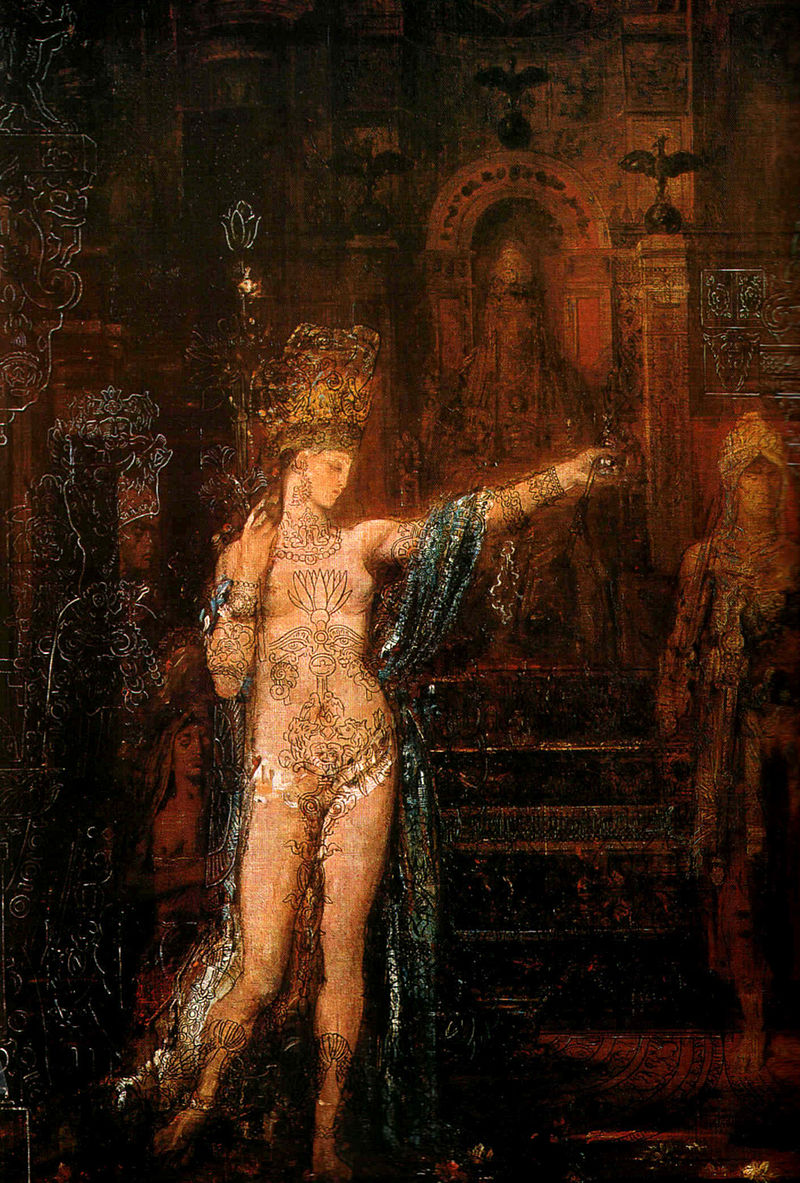
Wilde, attracted to the tale of Salome's tale by the Oriental eroticism of Gustave Moreau's painting of her, found Salome's tale pregnant with dramatic possibilities. He took the bones of the story, originally intended as a straightforward fable about the dangers of female sexuality, and reshaped them into a complex poetic inquiry about lust and power. Here, Salome is primarily considered an object of desire, by both her horny stepdad and his lieutenants. She accepts her and internalises this objectification, reflecting this lust outwards at Iohanaan. When he doesn't respond she has him objectified for her pleasure.
Anastasia Revi's production is set during the 1930s, her international cast making the precise location tricky to pin down. But there's a distinctly fascist tone to proceedings, most obviously in the stench of patriarchy that suffuses the production, but including the coke-fuelled rantings, feverish consumption of luxury and nihilistic loosening of inhibitions among those with power. Herod and Herodias behave as if this might be their last dinner before khaki-clad rebels bust the door down and summarily execute the lot of them.
The cranked up tone and bucketloads of symbolism reminded me of the films of Alejandro Jodorowsky (particularly The Holy Mountain and The Dance of Reality): art that gets under the skin of fascism. This Salome doesn't show us the jackbooted oppression of fascism, but the psychological consequences of keeping so much suppressed - Salome's demand for a mutilated head to pleasure herself with a logical consequence of a lifetime spent immersed in warped fash sexuality.

The recently refurbished Hoxton Hall makes a fine setting for all this. The majority of the show is staged around a large crimson dining table, dotted with bowls of fruit, sickly sweet wine and mounds of coke. The table thrusts into the audience, making us feel less like observers and more like silent onlookers at Herod's big bash. Up on stage there's a gigantic moon on the rear curtain, together with a wrought iron swing for Salome to tantalisingly dangle on. It allows the performers a great deal of mobility, which in turn stuffs Salome with electric energy.
Much of this is through the impressively intense performance of Kavakiotis as Herod. He delivers a deeply operatic (and soon deeply sweaty) performance, gesticulating wildly and charging about the stage with lust in his eyes. Helen Bang (who I admired the hell out of in Edward Bond's Dea) is a perfect foil for Herod, abandoning her dignity and sanity in favour of hedonism. You sense that somewhere deep within is a sane woman trying to get out, but being crushed under the weight of her overbearing husband.
But it's Denise Moreno's Princess Salome that dominates, simultaneously vulnerable and deadly. Dressed as Swan Lake's Odette she has razorblade features, the physicality of a jaguar and eyes that seem to bore right through you. Her climactic 'dance of the seven veils' is erotic, beautiful and terrifying, more than living up to the high billing given in the text. I see a hell of a lot of plays and quickly forget most of them, but Salome's dance is firmly lodged in the old grey matter
This is a fine production of a piece of drama that positively bristles with symbolic meaning. Revi's interpretation is wide enough to allow for a multitude of interpretations while still maintaining an admirable focus. I suspect Wilde would approve.
★★★★
Salome is at Hoxton Hall until 11 February. Tickets and details here.
Friday, May 27, 2016
Friday, May 27, 2016
- 0 Comments
This summary is not available. Please click here to view the post.
Thursday, February 19, 2015
Thursday, February 19, 2015
- 0 Comments

It's unanimously agreed that Bill Shakespeare knew how to put a play together. You don't climb to the top of the English literary canon without a few hits under your belt, and who can argue with crackers like Romeo and Juliet, Macbeth and King Lear? And at the tip-toppermost of the pile the downright delightful Hamlet, a badass revenge thriller with ghosts, stabbings, skeletons, poisonings and multiple counts of regicide. It contains all the ingredients of a seat-of-your-pants grindhouse stunner, only to be let down by a butt-numbing unabridged four hour run time.
English Repertory Theatre obviously recognise that shortcoming, and have gone at Hamlet with pruning shears, taming it into a lean 90 minute thriller that condenses the play down to its fundamentals. Their tagline: "There is no ghost. There is no equivocation. Only revenge." Or, as I prefer to put it: "Less talky talky, more stabby stabby".
Ditching the 'been there, done that' medieval trappings of the traditional staging, director Gavin Davis reimagines Elsinore is an exclusive boarding school. Our action centres around Horatio's (David Alwyn) "modern Danish history" study group, attended by the young Laertes (Alexander Neal), his sister Ophelia (Nina Bright), goody goody Rosencrantz (Charlotte Ellen) and moody eyeliner aficionado Hamlet (Rachel Waring).
Hamlet isn't happy. A letter from his dead Dad explains that Uncle Claudius (Jon House) bumped him off, and to rub salt into the wound he's only gone and married Hamlet's Mum Gertrude (Helen Bang). This injustice will not stand, and a murderous Hamlet sets out on a roaring rampage of revenge. No gut will go unpunctured! No poison undrunk! No blade unbloodied! You might say... DEATH COMES TO ELSINORE!
Reducing Hamlet into a fast-paced, action-packed extravaganza is dramatic blasphemy, but I've always enjoyed shows that go out of their way to tweak stuffy purist's noses. But is it actually any good? Well, in this condensed form a whole bunch goes out of the window: the militaristic background hum beyond the walls of Elsinore is relegated to a history lesson, the travelling players and their play-within-a-play is now a ropey school production courtesy of the four pupils and even poor Guildenstern is subsumed into the expanded role of Rosencrantz.
The most obvious consequence of this reduction of the text is that Waring's Hamlet has no time for procrastination. Given that fannying about and looking for ways to put off avenging his Dad is an enormous part of the traditional Hamlet, this is a pretty big shift in personality. This makes some plot elements a bit confusing. For example, when Hamlet hovers over the praying Claudius it's all too easy to understand Shakespeare's vacillating Prince putting off the deed for fear of sending Claudius to heaven, but somewhat less believable for English Rep's bloody-minded revenge seeker.
Throughout there's the sense that the play has been forcefully crowbarred into too small a space; soliloquys becoming performances to others and characters condensed to slightly confusing effect. The upshot is that were this anyone's first Hamlet they'd be pretty damn confused. As we rocket through the text at breakneck speed we zip through immortal lines, iconic lines and character development, the production feeling in danger of tripping over its own feet.
 |
| Horatio (David Alywn) catches Hamlet (Rachel Waring) and Ophelia (Nina Bright) drinking rum and cokes in a pub. |
It never does, largely thanks to the excellent cast, neat staging and a careful eye for physical theatre. Played in the round, the centre of the aptly named Cockpit becomes a classroom, the set composed of a series of white tables, chairs and a model skeleton with two rapiers perched in its chest. This malleable set is constantly being reconfigured by the cast, becoming variously a classroom, a stage or graveyard. It's most effective moment comes during Claudius' soliliquy. With the tables arranged into one block, a terrified Hamlet hides underneath as Claudius furiously tosses table after table away. The prince scurries into the ever-decreasing hiding spaces, the tension palpable.
There's no weak spots in the cast but my standouts were: Oliver Hume's waffly, puffed up Polonius, appropriately played as man who's not half as intelligent and quick-thinking as he thinks he is; Charlotte Ellen's Rosencrantz, a goody two-shoes who drastically underestimates the seriousness of the situation; and Nina Bright's Ophelia, her believable adolescence making her suicide that much more tragic.
But let's face it, all eyes are on Rachel Waring's Hamlet. Somewhat overshadowed in the 'female Hamlet' stakes by Maxine Peake, the programme quickly reminds us that Waring is the "youngest woman ever to play Hamlet". In practice its her youthful looks rather than her gender that proves more crucial. Waring's Hamlet is more punk-rock-fuck-you than reserved regal dignity. Full of energy, we hear her the lead other characters on a manic backstage chase, muffled yells of "VENGEANCE!" heard from the direction of the bar. Fun as she is to watch, her Hamlet is also layered with faintly disturbing sadism. Rarely have I seen someone take so much pleasure in dispatching Polonius, the obvious glee making the line "I'll lug his guts into the next room" quite disturbing.
The sheer energy of the cast, guided by Gavin Davis' steady direction, make this Hamlet a successful piece of theatre. It's arguable whether this is good Shakespeare; so much is peeled away that we're left with the skeleton of the text, chewy fat and emotional texture discarded in favour of streamlined sinew and muscularity. If this were the only Hamlet in town I'd be disappointed, but among umpteen other adaptations it stands out by virtue of its boldness. Messy, chaotic and hot-blooded, but fun as hell.
★★★★
Hamlet is at the Cockpit Theatre until 15th March. Tickets here.
Subscribe to:
Posts (Atom)