Recent Articles
Showing posts with label Oscar Wilde. Show all posts
Showing posts with label Oscar Wilde. Show all posts
Saturday, February 4, 2017
Saturday, February 4, 2017
- 0 Comments

Mark 6:22 - "When the daughter of Herodias came in and danced, she pleased Herod and his dinner guests". From such humble beginnings sprung Oscar Wilde's once notorious Salome. Banned from the London stage until 30 years after its publication, Wilde delivers a potent cocktail of pressure cooker sexuality, stomach-churning decadence and tightly wound symbolism.
The setting is the court of King Herod Antipas (Konstantinos Kavakiotis), son of King Herod the Great (of 'Massacre of the Innocents' fame). Herod senior probably wasn't the greatest provider of paternal love, what with the baby-killing n' all, so perhaps understandably Antipas has never had children of his own. He has, however, married his dead brother's wife Herodias (Helen Bang), who has a daughter from her former marriage, Princess Salome (Denise Moreno).
Salome has fallen in love with hairy-headed John the Baptist (Matthew Wade), but John, known here as Iokanaan, doesn't reciprocate. Enraged, Salome manipulates her powerful stepfather into granting her anything she desires in return for a dance. He obliges, and Salome more than delivers on the promise of the dance, but proceeds to shock her father by demanding Iokanaan's head served up to her on a platter as a reward.
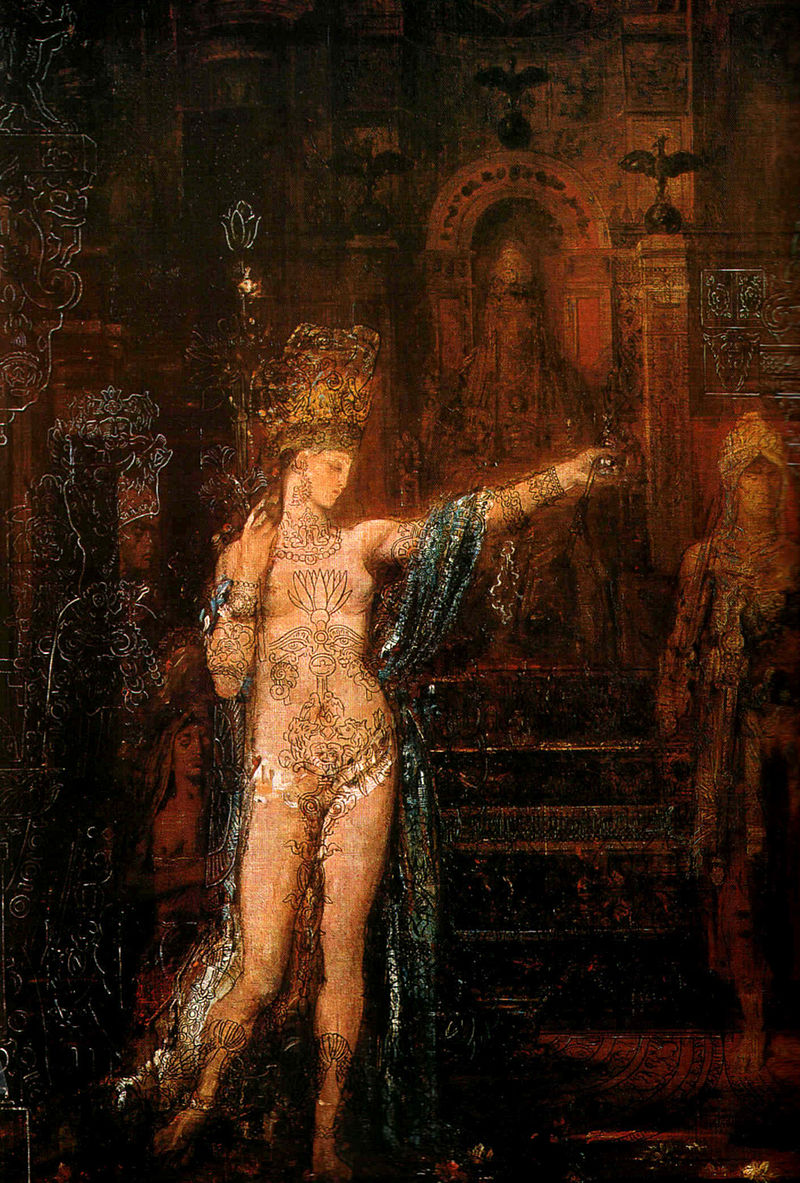
Wilde, attracted to the tale of Salome's tale by the Oriental eroticism of Gustave Moreau's painting of her, found Salome's tale pregnant with dramatic possibilities. He took the bones of the story, originally intended as a straightforward fable about the dangers of female sexuality, and reshaped them into a complex poetic inquiry about lust and power. Here, Salome is primarily considered an object of desire, by both her horny stepdad and his lieutenants. She accepts her and internalises this objectification, reflecting this lust outwards at Iohanaan. When he doesn't respond she has him objectified for her pleasure.
Anastasia Revi's production is set during the 1930s, her international cast making the precise location tricky to pin down. But there's a distinctly fascist tone to proceedings, most obviously in the stench of patriarchy that suffuses the production, but including the coke-fuelled rantings, feverish consumption of luxury and nihilistic loosening of inhibitions among those with power. Herod and Herodias behave as if this might be their last dinner before khaki-clad rebels bust the door down and summarily execute the lot of them.
The cranked up tone and bucketloads of symbolism reminded me of the films of Alejandro Jodorowsky (particularly The Holy Mountain and The Dance of Reality): art that gets under the skin of fascism. This Salome doesn't show us the jackbooted oppression of fascism, but the psychological consequences of keeping so much suppressed - Salome's demand for a mutilated head to pleasure herself with a logical consequence of a lifetime spent immersed in warped fash sexuality.

The recently refurbished Hoxton Hall makes a fine setting for all this. The majority of the show is staged around a large crimson dining table, dotted with bowls of fruit, sickly sweet wine and mounds of coke. The table thrusts into the audience, making us feel less like observers and more like silent onlookers at Herod's big bash. Up on stage there's a gigantic moon on the rear curtain, together with a wrought iron swing for Salome to tantalisingly dangle on. It allows the performers a great deal of mobility, which in turn stuffs Salome with electric energy.
Much of this is through the impressively intense performance of Kavakiotis as Herod. He delivers a deeply operatic (and soon deeply sweaty) performance, gesticulating wildly and charging about the stage with lust in his eyes. Helen Bang (who I admired the hell out of in Edward Bond's Dea) is a perfect foil for Herod, abandoning her dignity and sanity in favour of hedonism. You sense that somewhere deep within is a sane woman trying to get out, but being crushed under the weight of her overbearing husband.
But it's Denise Moreno's Princess Salome that dominates, simultaneously vulnerable and deadly. Dressed as Swan Lake's Odette she has razorblade features, the physicality of a jaguar and eyes that seem to bore right through you. Her climactic 'dance of the seven veils' is erotic, beautiful and terrifying, more than living up to the high billing given in the text. I see a hell of a lot of plays and quickly forget most of them, but Salome's dance is firmly lodged in the old grey matter
This is a fine production of a piece of drama that positively bristles with symbolic meaning. Revi's interpretation is wide enough to allow for a multitude of interpretations while still maintaining an admirable focus. I suspect Wilde would approve.
★★★★
Salome is at Hoxton Hall until 11 February. Tickets and details here.
Thursday, January 21, 2016
Thursday, January 21, 2016
- 0 Comments

Casting Dorian Gray is tricky. The story hinges on his unquestionable beauty, repeatedly described in rapturous terms by the other characters. How do you find someone to live up to that? On top of this, we need to believe that this man is capable of acts of extreme cruelty. I've seen a couple of duff Dorian Grays over the years - most of them stumbling when the casting settled for beauty over talent.
Merlin Holland and John O'Connor at least get it right in Guy Warren-Thomas. He combines an innate purity with growing arrogance and sociopathic tendencies, eventually coalescing into a Dorian that's not just some vicarious avatar for the audience to run through their Victorian playboy indulgences, but someone genuinely worrying.
He's the best thing in the production, my favourite flourish his reaction to hearing that his spurned fiancee Sibyl Vane has killed herself: “So I have murdered Sibyl Vane, murdered her as certainly as if I had cut her little throat with a knife. And the roses are not less lovely for all that. The birds sing just as happily in my garden." It's the first moment in which Dorian realises that his soul is absent. Warren-Thomas plays this beautifully, simultaneously excited and disturbed at how little it's affecting him.
Perhaps it's because I've been watching and listening to a lot of David Bowie (RIP) over the last weeks, but Warren-Thomas' appearance, costumes and general demeanour strongly reminded me of his mid-70s 'Plastic Soul' style. In the mid 70s Bowie was pretty much running on cocaine (weighing just 97lb and sporting a 17in waist), while engaging in omnivorous acts of drug-fuelled predatory sexual degradation with virginal teenagers.

Indeed, in the gel-streaked debauchery sequences Dorian writhes around with Bowie-esque vigour to tripped out music, while coloured gels tossing crazy shadows across his angular features and child bearing lips. He twirls madly, sucking down opium while being caressed by a harem girl and a man in a ridiculous turban who looks like a refugee from pantomime. It's camp but effective - the woozy nightmare opium den accentuated by drug-warped voiceovers that dance on a knife-edge of cheesiness.
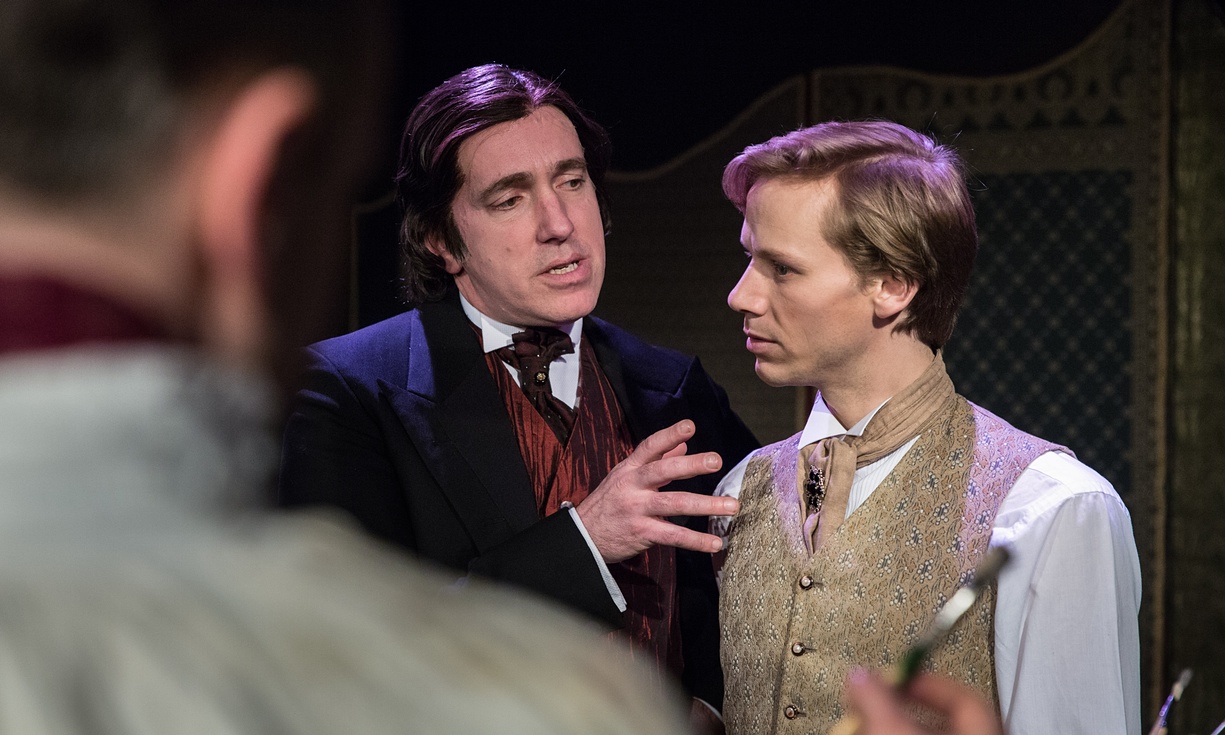
Warren-Thomas' Dorian feels like it's tapping into a wellspring of decadence, updating now quaint Victorian hedonism into self-centred modern fast-living. Indeed, this adaptation accentuates the homoeroticism of the text, promoting subtext to text. Holland (pleasingly (yet irrelevantly) Wilde's only grandchild) does this with the help of the original manuscript, the published version having had the more controversial passages excised.
Facing off against this Dorian is, essentially, Oscar Wilde himself. Henry Wotton has always been a thinly veiled fictionalised Wilde, something this production amps up to maximum. Played by John Gorick, a veteran of playing Oscar Wilde, he looks, behaves and generally is the author trapped in his own story. This doppelganger factor layers on an extra slice of meaning; in the book Wotton eventually realises that Dorian is the logical conclusion of his passion for aesthetics and personal freedom and finding himself disgusted. Here, we see Wilde peering across the 20th century and finding himself alienated..
Though all this is going on under the bonnet, the surface is a neatly executed retelling of a great horror story. With four actors in multiple parts, the company decently recreates a Gothic Victorian sensibility, posing and stuffiness conceals rabid animal desires. As things crank up, Trafalgar Studios' smoke machine gets a decent workout, clouding events in an atmospheric Hammer horror fog.
Unfortunately there's a couple of flaws. It's a consciously minimalist production - a touch too austere given the focus on decadence. Another upshot of this is the often ridiculous contortions the cast must make to navigate between invisible rooms. The characters often walk across the stage, u-turn and walk back along invisible corridors.
Also problematic are comedy peripheral characters that're played a touch too broad. I hope to god these are intentionally funny, because the cast hamming it up like pantomime dames is pretty ridiculous. Though these elements never quite spoil proceedings, they sap away seriousness and distract from the horror elements.
This is a decent translation of a classic work, anchored by John Gorick's Wotton and boasting an effective and occasionally impressive Dorian in Warren-Thomas. While flawed, fans of Wilde won't be disappointed.
★★★
A Picture of Dorian Gray is at Trafalgar Studios until 13 February 2016. Tickets here.
Wednesday, April 8, 2015
Wednesday, April 8, 2015
- 0 Comments

From minute one Dorian Gray is at pains to expose its own artifice. Another Soup pride themselves on their use of 'Brechtian Immersion', drawing us into Wilde's luxuriously amoral fiction while constantly reminding us that we're watching a play. From the moment we enter we're hurried by the cast to find a place to sit, the space dotted with armchairs, comfy seats and steps. I end up sitting practically in the middle of the stage, resulting in the play becoming a minor act of contortion as I crane my neck to follow the cast as they swirl about me.
At a shade under 90 minutes the script takes extreme liberties with the source material, essentially condensing it down to a series of vignettes. So we see the angelic Dorian's (Samuel Woodham) introduction to polite society, during which he's hungrily eyed by the diabolical Lord Henry Wotton (Thomas Judd). With Wotton's clawed hand comfortably resting on his shoulder, Dorian's soul begins to rot. All too soon he's a hardcore aesthete, gazing at a portrait of himself and casually selling his soul on a wish to remain forever young.
As time ticks on Dorian's corruption becomes self-sustaining. In this condensed form the night descends into a whirlwind of fragmented sin. One minute he's callously leading his would-be fiancee towards suicide, the next he's half-hearted seducing and murdering people - flicking a knife between his victim's shoulderblades as casually as he might flick a mote of dust from his suit jacket.
Much of this is conveyed through some rather Sondheim-ish songs. With Felicity Sparks on piano (with violin accompaniment by Isaac Lusher), the jagged, lightly satirical lyrics paint a portrait of an cruel world where words are lethal weapons and reputation is everything. These lyrics are spiky and fun, the entire cast (but especially Judd) taking obvious pleasure in each mannered enunciation and rhyme.
Though it's a happy coincidence, the face that Dorian Gray shares a space with In Your Face Theatre's excellent Trainspotting ends up giving this adaptation a dab more relevance. At first glance, you'd expect the heroin squat marker pen knobs and exhortations to 'Listen to the KLF!' to mildly spoil the audience's immersion. In fact, in an appropriately Brechtian twist, the artifice reminds us that the amorality of Dorian Gray isn't a Victorian aberration, more part of a continuity of cruel decadence that extends to the modern day. In Thomas Judd's opening monologue we're lectured about vice, explaining that for all our modern MDMA and heroin, the Victorians did it first (and better). Both Trainspotting and Dorian Gray take vice's destructive effects as a starting point, each exploring the corruptive influences of solipsism.
Another Soup's adaptation is at pains to emphasise the class differences between Dorian, Wotton and the working class Londoners he exploits. Most moving is the plight of Felicity Kerwin's music hall star Sybil Vane, moving amongst the audience and distributed faded flowers. Entranced by her Prince Charming, she's used up and spat out, dying an ignominious, barely regarded death. Indeed, Dorian leaves a path of destruction in his wake, and who'd suspect a face like his?
Who indeed? Filtered through the beautiful yet sphinxlike face of Samuel Woodham, Dorian appears utterly bored with both virtue and sin, blankly staring at us with dead-eyed unenthusiasm. Given that Wilde's book can easily be enjoyed as a supernatural power fantasy that lets us imagine what we might do if we were given life both eternal and free of consequences, his joylessness is disarming.
I think Another Soup are aiming to deconstruct the idea of Dorian as prototypical Nietzschean ubermensch, connecting his predatory urges to modern day upper class sociopathy. In the high collars, tailed jackets and smug smiles there's visual echoes of the famous Bullingdon Club photos of the current government, both they and Dorian preying on those lower down the social scale and never suffering the consequences. Making Dorian beautiful but genuinely unpleasant, the audience not even allowed the sop of vicarious pleasure in his crimes, distances us from him. The effect that we examine Wilde's story coldly and critically, resisting the urge to be seduced by the beauty and glitz.
Also, this is simply a damn fun way to spend 90 minutes. Rumbling along at whipcrack pace, we're tossed like a pinball between humour, melancholy and sexual kink. My only real criticism is the mystifying decision to have Dorian's portrait remain identical to when we first see it. The characters react to it with horror, as if it's changed beyond recognition - but it's exactly the same. Maybe there's some wider point being made here, but it feels a bit cheap to build up anticipation for no reason. Still, aside from that - good times.
★★★★
Dorian Gray is at the King's Head Theatre until 12 April 2015. Tickets here.
Saturday, August 9, 2014
Saturday, August 9, 2014
- 0 Comments

In C.J. Wilmann's The Picture of John Gray Oscar Wilde is the sun. Shining high in the sky his presence illuminates every corner of this dramatic world. Yet like the sun you can't look at him directly - Oscar Wilde is simply too big a force to be contained on stage. What Wilmann shows us are the planets caught in his orbit, each reflecting individual facets of the great man.
Set in the dying years of the 19th century, we open in the pleasantly scruffy bohemian elegance of The Vale. This is the home of Charles Ricketts and Charles Shannon, two artists lodged within the firmament of Victorian gay culture. The two men appear to able to happily live together as partners as long as they keep their sexuality under wraps, and have cultivated a close-knit social circle formed around a joint love of poetry, art and fine wine.
The first scenes introduce us to their set, all of whom are erudite, well-dressed and with sharply refined tastes. They are; John Gray, a charming would-be poet raised from the sticks; Andre Raffalovich, a very French arch critic and poet gourmand; and Bosie, Lord Alfred Douglas, extroverted and egotistically domineering. As they recite poetry to each other the atmosphere becomes a cocktail of verbal jousting and one-upmanship. We sense that places like The Vale are a sanctuary from a world of where a good reputation is everything, all governed by prudish morality - a place where visitors can drop their masks.
 |
| From L-R: Bosie (Tom Cox), Ricketts (Oliver Allan), Gray (Patrick Walshe McBride), Shannon (Jordan McCurrach) and Raffalovich (Christopher Tester) |
The play gradually zeroes in on the relationship between Gray and Raffalovich, who, despite Gray initially insulting Raffalovich as an "ugly French Jew", quickly fall head over heels in love with one another. It's this relationship that forms the bedrock of the play; which proceeds to sensitively explore same-sex relations through a number of different prisms: how it informs an artist's development, the attraction of Catholicism and what it means to live "the love that dare not speak its name".
Let's get two things out of the way, this is a tremendous bit of playwriting and a marvellous piece of theatre. These are intensely clever characters seeking to one-up each other's displays of verbal gymnastics, so it's to Wilmann's enormous credit that never once does his script come across as trying to impress or worse, a caricature of what the 21st century imagines Wildean wit to be. Lying underneath this blizzard of wordplay is a bedrock of carefully considered historical research and some snatches of carefully considered philosophy and the odd moment of honest-to-god actual profundity.
Particularly striking to me was a moment where John Gray, torn between his love for Raffalovich and his devotion to Catholicism, explains precisely why Christianity appeals to him. He perceives life to be a series of unpredictable changes, and from his perspective he's entirely correct. One minute he's the plain old son of a carpenter, the next he's in a relationship with Oscar Wilde, the next he's in Berlin with a gay lover. With the ground unsteady beneath his feet he can at least rely on Christianity to remain static. No matter whether he attends Mass in London, Rome or Berlin it will always be the same ceremony, no matter when or where he picks up The Bible it will always contain the same commandments and morality.

It's not exactly fashionable for a play to extol the virtues of Christianity, especially when you're exploring gay rights issues. But Wilmann weaves the two together with surprising delicacy, showing us a life of priestly Catholicism as one of the few available Victorian avenues for two men to live together without suspicion of immorality or pressure of marriage. Tossing a pinch of salt into the mix is the observation that a gay man who goes into the church is merely forsaking worship of another man for worship of an omniscient masculine deity.
Similarly interesting is the examination of how being gay in Victorian London influences artistic development. Purely by virtue of their sexuality all the characters are outsiders, rebels against societal norms. Wilmann subtly argues that it's this factor that enables them to produce such beautiful art; the poetry recited, the paintings breathlessly described and even the allusions to Wilde's work. The beauty and demeanour of Gray is referred to as the inspiration for Dorian Gray and, in The Importance of Being Earnest, the characters present different personalities depending on their surroundings, mirroring the division between public and private life. The excellent stage design underlines these themes, the walls featuring a gently homoerotic painting of a man's jaw, pots of white paint dot the se and the floor itself is splashed with suggestively white liquid.
Material this good demands a worthy cast, and this doesn't disappoint. Everybody is excellent in their roles, charging the dialogue with crackling, unrehearsed electricity. With repartee this calculated and verbose there's a risk that it could come across as artificial, yet as we watch them react to each other it's as if we can see the cogs turning in the character's heads as they formulate their laser-precise responses. The structure of the play means that fine though their performances are, Bosie, Ricketts and Shannon remain roughly constant for the entire run-time. Their circumstances change, by and large their personalities do not.

It's Gray and Raffalovich that really go through the wringer, their characters gradually evolving over the course of the evening. Patrick Walshe McBride as Gray has the not inconsiderable task of conveying nervy, faintly shy talent masked by false confidence. There's moments where he purposely stumbles a little over his lines, reminding us that while the others are able to effortlessly dish out razor-keen conversation, he has to struggle to keep up. As his spiritual, moral and emotional journey continues we're magnetically drawn to his struggle - taking the difficult dramatic struggle of making earnest faith attractive and succeeding brilliantly.
But it's Christopher Tester as Raffalovich that was my undisputed highlight. It's difficult for me to pin down precisely what it is that I liked, but there's a core of humanity to the performance that straight up knocked my socks off. Perhaps it's that in the opening scenes he seems invincible, the most verbally dexterous of all, followed by all this being gradually stripped away from him to reveal deep vulnerability and longing. It's a powerhouse of a performance, and if you're going to see it I recommend sitting as close to the front as possible to get the full effect.
As a new play this is a huge success and I feel privileged to have seen it so early on. I can't imagine that it anyone seeing it won't enjoy it, especially not anyone with the remotest interest in Oscar Wilde who, even as an off stage presence influences everything we see. Simply put, this is a wonderful bit of theatre that deserves a wide audience.
The Picture of John Gray is at the Old Red Lion Theatre, Angel until the 30th of August. Tickets available here.
All photographs by Miriam Mahony
Subscribe to:
Posts (Atom)