Recent Articles
Showing posts with label Soho Theatre. Show all posts
Showing posts with label Soho Theatre. Show all posts
Friday, May 17, 2019
Friday, May 17, 2019
- 0 Comments

Reviewed by David James
Rating: 
Quarter past ten at night turns out to be a very good slot for a Soho comedy/cabaret show. The tourists have scuttled back to their hotels, the clubs are yet to kick into gear, and there's enough time to grab a decent dinner and a few laugh-loosening drinks in. All of which works in Witt 'n Camp's favour.
Witt 'n Camp are Charlie Howitt and Holly Campbell, who are the full entertainment package: singing, dancing, telling jokes and performing like old school vaudevillians. They serve up a finely tuned hour of entertainment, consisting of songs that are comedy sketches, comedy sketches that are songs and a lot that resists easy categorisation.
The initial impression you get is "what the fuck is going on"? The show opens with the pair in burly policeman costumes stalking around the stage and fighting one another, then mildly antagonising the audience (sit in the front row at your peril). Things only get stranger from there: the pair morphing into sexually unfulfilled Irish chickens, strangely louche hippies and bitchy opera divas.
But though the scope is wide, their talents are consistently (and occasionally jaw-droppingly) impressive. Their opera divas sing with beautiful precision and skill, managing to convert Nicki Minaj's machine-gun pop masterpiece Super Bass into an opera number. These moments and the other numbers in the same vein are some seriously eye-catching work, perfectly showcasing their vocal and creative talents.


Beyond that, things get head-scratchingly odd. There's a multi-part saga about bored and murderous cannibalistic chickens that's set to lilting folk strings, featuring the laconic pair squatting down to squeeze out eggs. One smashes and, staring at the gooey albumen dripping between her fingers, the chicken says "I don't know how I feel about this". Maybe it's the late hour and maybe it's a mildly soused audience, but you just kinda go with it.
At times Witt 'n Camp reminded me of Jemaine Clement and Bret McKenzie's Flight of the Conchords. Like them, they display an almost infuriatingly natural grasp of melody and lyricism, combined with a refreshing absence of cynicism and a willingness to get silly without any ironic winking at the audience. As such they're extremely easy to like, which makes for an hour that goes down very smoothly.
That said, if there were a bit more connective tissue between the various segments the show could really lift off. It seems a bit ungrateful to complain about 'merely' receiving an entertaining show, but Witt 'n Camp come across as if they're searching for a thesis to bring together these disparate ideas and characters. Then again, perhaps the scrappy and rough around the edges style is what makes the audience instinctively like the pair so much.
Howitt and Campbell are working from a solid bedrock of talent - whatever they turn their hands to will be, at bare minimum, barrels of fun.
Witt 'n Camp is at the Soho Theatre until 18 May. Tickets here.
Friday, January 25, 2019
Friday, January 25, 2019
- 0 Comments

Life as a professional circus performer doesn't sound much fun.
Learning the skills is intense, painful and (I'm guessing) expensive. Relying on your body for your livelihood means that you must constantly train and watch your diet. An injury can permanently scupper your career. The pay is variable and generally not great. Then there's the simple fact that the nature of what you're doing comes with a baked in age limit - and there are always younger, fitter, bendier, injury-free people entering the industry. On top of that, as we learn with No Show, the circus industry treats women really shittily.
So why do people do it? Is that gasp you get from an audience as you spiral gracefully through the air worth all the misery? Creator/director Ellie Dubois and performers Francesca Hyde, Kate McWilliam, Michelle Ross, Camille Toyer and Alice Gilmartin set out to deconstruct the traditional circus show, showing us the psychological and physical pressures behind the sequins and vaseline smiles.
In a way, the audience gets to have their cake and eat it. Not only do we get to see physical feats of strength, balance, flexibility and endurance, but we also learn about what's going on in the performer's mind as they do so.

Early on we get a statement of intent from the show in the form of a Cyr wheel routine from Camille Toyer. I've seen a bunch of these over the years and familiarity with this act has made me a little blase. Much of that was swept away here, as Kate McWilliam gives a running commentary on the potential injuries that can be caused: with the performer risking crushed fingers and toes, broken bones or a fractured skull. Explicitly outlining the physical dangers is a blunt way of cranking up the tension - but it works.
No Show really hits its stride when it gets into the way women are treated within the industry. McWilliam delivers a short speech outlining her career, explaining that while she prefers to do tumbling and gymnastics there is a constant pressure for women to do 'dainty and feminine' routines that emphasise their fragility.
Then you have Alice Gilmartin's repeated efforts to introduce herself to the audience - she generally only gets a few words in before the microphone is snatched from her hands and she's forced into a handstand on the canes. The other women provide a running commentary as she does so: criticising her poise, lack of engagement with the audience, make comments like "she's got her legs open as usual" and generally demean her. You realise that while it's all rictus grins on stage, there's an awful lot of misery going on in rehearsals.
As a show conceived and performed by women, No Show is something of an anomaly in the circus world. Generally, acrobatics and circus shows are mixed sex affairs, with beefy men launching skinny women high into the air. I'd unthinkingly accepted this as just the way things were, but Dubois and the performers gave me a lot to think about.
It strikes me that (in much the same way as other corners of the entertainment industry) your professional career is at the mercy of powerful men with carte blanche to decide the nature of your routine. If that means you're being sent out in a skimpy Barbie-doll costume to grin and twirl before a leering audience, then that's the nature of the game honey, and you'd best get used to it if you know what's good for you.

Learning all this makes the most satisfying moment of the performance one of the most low key: the performers sit on the ground next to one another and silently eat a jam doughnut. It's a funny, dignified and weirdly moving protest, grabbing back a smidge of autonomy in an industry designed to stamp that out.
No Show doesn't provide jaw-dropping stunts you can't see anywhere else, but it has a political dimension that no other circus show even attempts to provide. Check it out.
No Show is at the Soho Theatre until 9th February. Tickets here.
Thursday, November 22, 2018
Thursday, November 22, 2018
- 0 Comments

Escaping a hometown is no mean feat. Like a spaceship trying to escape a planet's gravitational pull you have to build momentum, gradually building up speed in order to break free of its orbit until - in one blissful moment - you're freed from all the petty dramas, bad memories and old beefs - able to leave the past behind and set a course for tomorrow.
Some never make it. You see them on infrequent visits home: sat in the same pubs, in the same barstools, drinking the same pints. Each year a little balder, a little fatter, gradually morphing into their parents. They will die in this place, and their children will repeat the cycle. This is the life trap, and Lisa Carroll's Cuckoo captures it well.
Set in the Dublin suburb of Crumlin, the play follows teenagers Iona (Caitriona Ennis) and Pingu (Elise Heaven), two square pegs in round holes trying their best to escape to a new life in London. Ostracised by their peers for their nonconformity, they're bullied, bored and have visions of a glitzy life in London, where their woes will melt away in a tide of celebrity encounters, over-sized Top Shops and fancy nightclubs.
But their escape won't that easy. Pockets (Colin Campbell) and Trix (Peter Newington) are two young men happy to be big fish in a small pond. They see Iona and Pingu's departure as an implicit criticism, this upsetting of the status quo exposing their small-scale ambitions. And so they plan to tear the pair apart and keep them here.
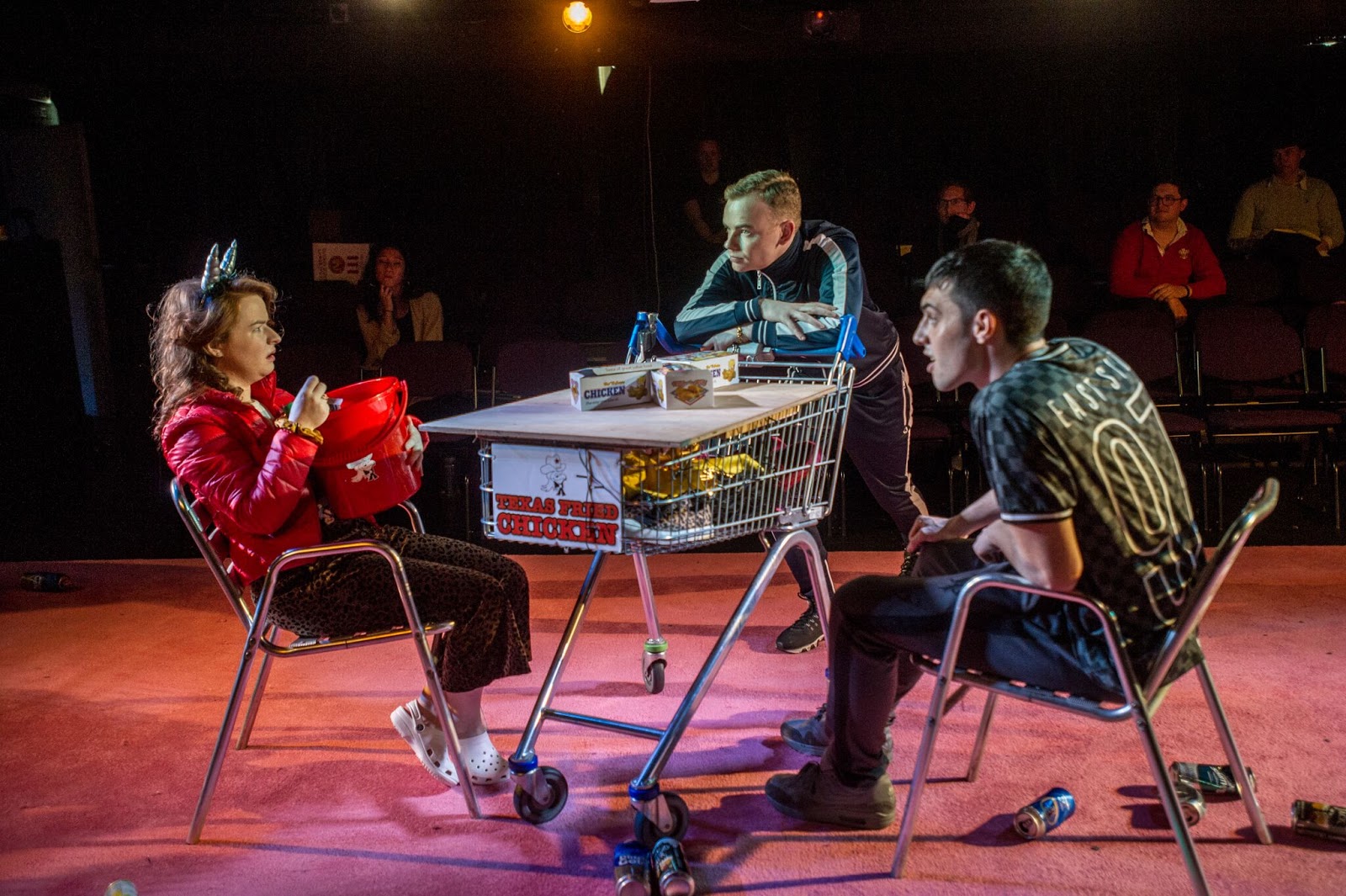
Cuckoo is intelligently staged, written and performed - with Caitriona Evans' Iona a genuinely impressive achievement in acting. Carroll's script seems to have a memorable line on every page and it's written with a punchy, aggressive energy that cuts through flowery bullshit.
And yet... for all it's qualities I simply didn't enjoy watching it. This is a long play - running close to two hours without an interval and I found the experience of watching it incredibly depressing. There is very little light at the end of this tunnel, and after so long of watching yelling, unhappy people drag each other through the mud I was glad for it to end.
One thing I found particularly sad was how Carroll defines her characters' limited dreams. For one, her wildest ambition is to be a background dancer in someone else's music video, for another one of the prime attractions of London is that there's a big Top Shop. These are two examples of many, but Carroll never misses a chance to impress upon us how pathetic and insular her characters are and this relentless misery quickly ground me down.
Naturally, all this leads to a bleak, downer ending in which most of the characters vaguely comprehend that their futures are a barren, joyless wasteland and that they can never truly escape themselves. After that, I blearily stumbled out into the cold November night feeling thoroughly miserable.
This might be exactly what Carroll was after - and if so this is a success. There's a hell of a lot to admire about Cuckoo, but the actual experience of watching it is, quite frankly, an ordeal.
Cuckoo is at the Soho Theatre until 8 December. Tickets here.
Saturday, October 27, 2018
Saturday, October 27, 2018
- 0 Comments

Pickle Jar takes is full of strange similes, so I'm going to describe it as a creamy and relaxing korma with a ghost chilli lurking at the bottom. Or maybe a room full of playful kittens frolicking around a cobra. Ooh, or a bag of pick n' mix with one cyanide capsule thrown in. You get the idea
Written and performed by Maddie Rice, who garnered a whole bunch of praise for playing Phoebe Waller Bridge's role in the Fleabag tour, this is a one-woman play about a young English literature teacher at a girl's school near Guildford. Known only as 'Miss', she's awkward, funny, cute and cares a great deal about her pupils.
Over the course of an hour, Rice conjures a detailed picture of life in the school, meeting her fellow teachers and some of the pupils she teaches. It's honest, straightforward writing that combines with Rice's charisma to conjure up a properly three-dimensional world around her. Though the set is an abstract grey piece of linoleum with some weeds poking through it's very easy to picture a dowdy tea-stained staff room, the woozily loud interior of a shitty club and a packed classroom full of kids.
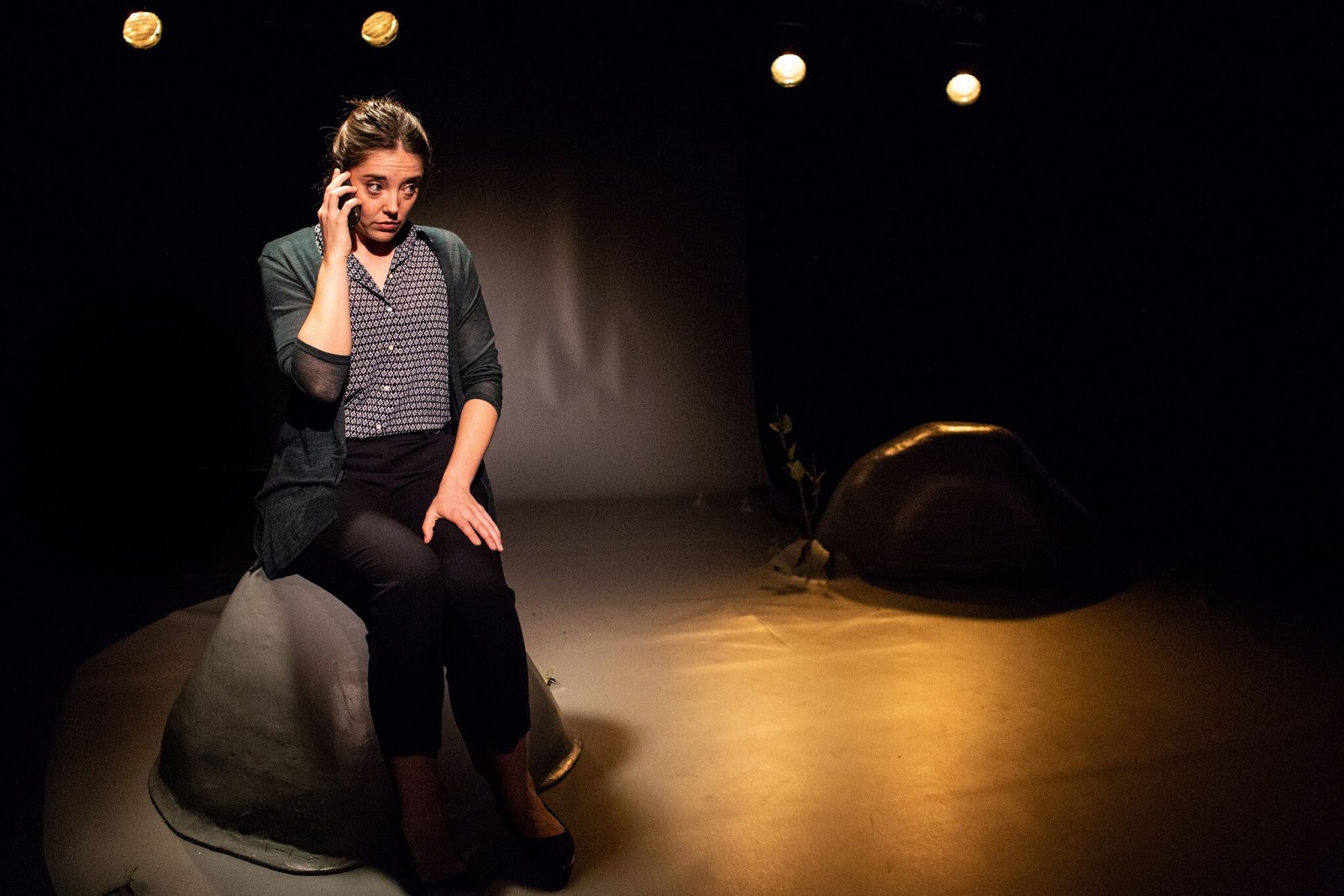
Within this, her characters spring to life. 'Miss' is a self-deprecating but passionate woman who uses her innate awkwardness to empathise with the problems of her teenage pupils. Though her past mostly goes unsaid, her actions within the play and the odd off-hand comment make it easy to imagine her own schooldays. Plus, every supporting character is brought to life in a heightened, caricatured way - with the highlights being the dippy and annoying school counsellor and her fellow teacher/housemate/best friend.
The first thing you realise when watching is just how talented a comedian Rice is. She reminds me a bit of Rachel Bloom in the excellent TV show Crazy Ex-Girlfriend, making us laugh at her while also feeling desperately sorry for her. Rice is so funny that she passes my tried n' tested 'every comedy must make me laugh out loud three times or it sucks' test in about 60 seconds. Perhaps the best litmus test of how much the audience was enjoying it is that one woman got a bad case of the giggles and throughout one of the more serious moments you could hear her feebly suppressing her chuckles in the back row.
The fact that it's so funny makes the sudden tonal shifts to seriousness that much more jarring. Rice sadistically teases the audience with a couple of fakeouts early on in the show, before eventually descending to some pretty dark depths. No good critic would spoil what actually happens in the show, but it's pretty damn moving.
Pickle Jar is a great example of what can be achieved without too much theatrical frippery. This is one woman on stage delivering what an extended monologue, but manages to encompass more reality and humanity than nearly every razzle-dazzle show you'll see on Shaftesbury Avenue. I definitely recommend checking it out.
Pickle Jar is at the Soho Theatre until 10 November. Tickets here.
Thursday, July 5, 2018
Thursday, July 5, 2018
- 0 Comments

Rating: 
In the liner notes of Flesh & Bone, writer, director and actor Elliott Warren instructs that his play should be "performed with bestial fire" and that you should "rattle the house in which you play". It's safe to say that this staging in the Soho Theatre does that, serving up a sinuous, focused and muscular piece of drama that enters with the confidence of a boxer who knows the title belt is his.
Set in the East End, the play is set within an estate under threat of demolition and subsequent redevelopment (no doubt into luxury flats). Residing within are twitchy young waster Terrence (Elliott Warren), his girlfriend Kelly (Olivia Brady), his brother Reiss (Michael Jinks), Kelly's Grandad (Nick T. Frost) and, in the flat downstairs, their dealer Jamal (Alessandro Babalola).

On paper they're broad working class stereotypes: a collection of dodgy, beer-swilling geezers waiting their turn to be disapprovingly paraded around on the Jeremy Kyle Show. But Warren peels back the surface to reveal a series of viscerally three-dimensional internal lives. For example, Reiss is secretly gay, giddily Queening it up in Soho before shrinking back into the closet as the bus home heads eastwards. Dealer Jamal has constructed an impervious tower of 6-foot-tall, ripped masculine intimidation on which to perch, yet it conceals a frustrated, vulnerable man who feels surrounded by stoned zombies.
Their revelations are delivered in stunningly lyrical writing that's half Elizabethan and half contemporary street, the disparate styles mashed up with surreal ease and naturalism. While Warren constantly slides famous lines from Shakespeare into the monologues (the play opens with "What a piece of work is a man.") it doesn't fetishise them. Rather, the quotes feel like the grain of sand inside an oyster around which the pearl forms, the dialogue elegantly and artfully expanding from this bedrock to create something equally brutal and beautiful.
I really can't overstate how fucking incredible this script, bristling with glottal rhythms and aggressively spat bilabial bullets. It looks as fun to perform as it is to watch, each image and concept seamlessly flowing into the next, each character drawn in crystal clarity and each laser-targeted gag landing dead-on.
Faintly miraculously, the show has assembled a cast that's the equal of its script. You can't slide a Rizla between them in terms of quality: but I particularly adored Michael Jinks' conspiratorial delight in recounting a happy Soho evening, Olivia Brady's hilarious Joanna Lumley impression she uses on her phone sex line and Alessandro Babalola's transformations between hard nut dealer and awkward little boy.
The cast is so good that the fact they're performing on an empty stage to a plain black backdrop never really enters into the equation. Thing is, the play occupies this space perfectly: the cast buzzing around the room like electrons around a nucleus, somehow occupying all spaces at once. Their individual moments are punctuated by well composed and executed frozen tableaux, with the best physical moment when a chaotic bar fight transforms into a series of comic-book panels.

I enjoyed every moment of Flesh & Bone, though my favourite seems to summarise everything I liked about it. It comes after Reiss has finally come out of the closet to his brother Terrence, explaining that it's taken so long because he's scared that he'll react with violent disgust. Reiss leaves the stage and Terrence delivers a blisteringly sad monologue in which he reflects on how he's perceived by his family, friends and society:
"What is it about me that my own family cannot unsee? Is it that I'm mindless, thick with heat. That I carry great weight upon my back. That I cannot help but be bad. Praps this pestilent pressure I do pour upon my blood is my only pith. What else might a man like me have? No dreams to be had. How can a man like me be a fucking dad?"
Man it's good. The only downside is that all the plays I'm going to see in the coming weeks will seem that more much pale and flaccid in comparison to this. If you just see one thing in the theatre this summer you've got to make it this!
Flesh & Bone is at the Soho Theatre until 21 August. Tickets here.
Saturday, June 9, 2018
Saturday, June 9, 2018
- 0 Comments

Rating: 
For a person of normal economic means, choosing to live in London is like selecting 'hard mode' in a videogame. Here life is fast, brutal, competitive and overdraft drainingly expensive. Every day brings news stories about fresh nightmares, whether it be skyrocketing crime rates, housing prices beyond the ken of mortal men and women, updates on precisely how poisoned the air is, or the gradual corporatisation of the city and the squeezing out of the general public.
And yet I wouldn't live anywhere else. London is where stuff happens, and that simple fact makes it worth spending your life in a place where you have to constantly fight to keep your head above water or risk being sucked under and spat out into some grey life in a dreary nowheresville.
Marcelo Dos Santos' The End of History is this process, showing us two Londoners finding themselves "face to face on the worst day of their lives". They are Wendy (Sarah Malin), a middle-aged artist turned charity worker who finds herself homeless and Paul (Chris Polick), a confident gay man working in property who spends a morning dealing with some cataclysmically bad news.
They meet inside St Giles-in-the-Field church in Soho, which is a fascinating deep slice of London history. Founded in 1101 and given a mission to care for London's lepers, it has continued to care for the less fortunate ever since. The proceeding 917 years have been busy, with the church functioning as a last stop for those about to executed at Tyburn gallows, the burial site of London's first (of many) plague victims, in the middle of the famous St Giles rookery of the 18th and 19th centuries, and now dwarfed by steel and aluminium skyscrapers, with the nursery-school-cute Google HQ just over the road.
Placing yourself within the continuum of London history is a dizzying experience. If you know where to look you can walk down a pavement constructed by the Romans and even apparently innocuous street furniture can be something that has survived a couple of hundred years of history. Despite this, the city is in constant flux, with new towers sprouting like weeds. The End of History understands that all this can lead to a loneliness, that humanity can seem in very short supply in London.


This particularly London headache is percolated through Wendy and Paul's stories - though they occupy the opposite ends of the social spectrum their symptoms spring from the same psychogeographical condition. Each explains their place within the city, with Wendy a native Londoner whose Mum lived in a new long-demolished house in Soho and feels like she intrinsically belongs here, while Paul is proud of his decision to 'choose' London and hurl himself into its style and speed.
After just over an hour in their company we know them pretty well. Though they don't directly interact until the final scenes, we understand them as representing two very different tribes of Londoners: the haves and the have-nots. As they're fleshed out through monologues, songs and fourth-wall bustin' asides their complexities become apparent and the social labels we've put on them dissolve. By the time the curtain falls there's a sense of London community that's formed between the characters, the audience and the creative team, the play having nailed down a particular urban ennui that binds us together.
All that is done through multiple lyrical and performative flourishes that mean there's never a dull moment. I particularly liked how the songs weren't showy vocal displays, the occasional off-note making them seem that much more honest ( all boosted by the church's great acoustics). Dos Santos also effectively switches gears between comedy and tragedy, sometimes within the same line.
Malin and Polick are similarly great, balancing their character's attractive and ugly features effectively. A decent amount of the action takes place very close to the audience - I got lucky and during a pivotal moment in the climax the pair were pretty much sat next to me, the closeness of their performances really cranking up the complexity. Perhaps the only fly I can pick at in this ointment is that Malin's Wendy continually complains about her middle-aged spread - given Malin looks fit and healthy it doesn't quite jibe.
But hey, that's a really teeny fly and that's a hell of a lot of top-class ointment. The End of History feels like a play tailored to my sensibilities - combining an intelligent analysis of urban living, understanding life in London in a historical context and smart and imaginative staging. This is my kinda theatre.
The End of History is at St Giles-in-the-Fields until 23rd June. Tickets here.
Friday, June 19, 2015
Friday, June 19, 2015
- 0 Comments

Food is a fantastic dramatic metaphor. The best food and the best art both get under your skin, both bear the fingerprints of its creator and both communicate complex emotions without words. Not to mention the sheer visual dynamism of preparation and presentation, or simply describing it in strings of luscious, saliva-inducing adjectives. Sabrina Mahfouz's Chef uses food as a reflection of its subject's soul: no matter how much shit is heaped on an individual they are still capable of wonderful things.
Chef comes pre-garlanded with praise, nabbing the Fringe Fest Award at the 2014 Edinburgh Festival. It's a scanty 50 minute monologue, presented with minimal stagecraft and little theatrical frippery. There's a sense that the dead wood of theatre has been pared away - allowing us untrammelled access to an interesting person: almost theatre as confessional rather than narrative.
Said interesting person is 'Chef' (Jade Anouka). Going in we know that she was a haute-cuisine head chef and is now a convicted inmate running a prison kitchen. Salacious questions immediately pop to mind - what could have precipitated such a fall from grace? How could someone used to expressing themselves through food work in such a restrictive environment? What on earth did this woman even do?
All these answers are revealed in a chronologically jumbled story that gives us insights into family, victimhood, self expression, guilt, denial and joy. It'd be remiss of me to spoil the revelations in Chef, but I can say that by the time we're applauding we've seen a three-dimensional portrait of a genuine human being, one obviously informed by personal experience.
There's a ragged honesty to Mahfouz's writing style. Her broad technique here is to build to an emotional peak (recounting some grim act of abuse) then undercut that with subversive humour. In less capable hands these opposite forces would undermine one another, spoiling the mood. Yet Mafouz deploys comedy and tragedy with precision timing, playing us like a fiddle.

Aside from these clever rhythms, there's some straight-up beautiful descriptive writing on display. My favourite was a description of an uneaten Chinese takeaway: "noodles gloomily looking through foggy containers / at a scene of all too common domestic distress / chunks of sweet and sour chicken solidifying / under the soundwaves of unextraordinary anger". The text is studded with these wonderful turns of phrase, viscerally constructed, full of satisfying alliteration and harmonic phrasing.
This is all beautifully played by Jade Anouka. The confined upstairs room of the Soho Theatre allows a performer to engage with their audience, something that Anouka instinctively grasps. Throughout she makes eye contact with her audience, peppering us with rhetorical questions and the occasional accusatory glance. The effect is that, as we swerve towards darker themes, we're right there with her - almost implicated in her situation. Similarly, shifts in body language, from confident gesticulations to an inverted stillness, go a long way in accentuating the rhythms of the text.
Throughout we keep returning to food; Chef breathlessly describing a perfect peach, coconut tofu curry or hibiscus sorbet. It sounds delicious, the enthusiasm of the performance and the knowledge in the writing conveying an infectious passion. What I took away is that there are some incorruptible passions in life, and food is one of them. The misery inflicted upon the character cannot damp her enthusiasm and pride in her art; though her life is a shambles her soul remains intact.
I've always held that brevity doesn't indicate a lack of depth. In just 50 minutes this manages to pack in more sincerity, truth and humanity than some pieces manage in a couple of hours. I've always enjoyed seeing monologues performed, and this marks one of the best I've seen this year. It's a complex, troubling piece of work that doesn't offer up any easy answers. It's also warm-hearted, funny and approachable. A definite win all round.
★★★★
Chef is at the Soho Theatre until 4th July. Tickets here.
Friday, March 20, 2015
Friday, March 20, 2015
- 0 Comments

Before moving to the big city I grew up in a farmhouse in Wales. This makes Hiraeth, about a girl who grew up on a farmhouse in Wales before moving to the big city, very easy to empathise with. The show tells the life-so-far of writer and star Buddug James Jones and though the wrinkles of our stories differ, she unearths a barrow-load of half-forgotten nostalgia. This easy familiarity is hardly rare; like a powerful magnet London winkles out the adventurous and creative from small towns all over Britain, the city ever-bulging with those for whom small town life is bondage.
With James Jones playing herself, Max Mackintosh takes up the role of the entire supporting cast. Displaying remarkably chameleonic talents he cycles between a paranoid Welsh farmer's family, the wise Mamgi, immature teenagers, cocky Portuguese lotharios and, eventually, a fictionalised version of himself. He's quick to remind us that he's a trained actor and, as promised, functions as the bedrock of the show - a secure foothold for James Jones to work with.
Beginning in the small town of Newcastle Emlyn, we're given a quick overview of the who, what and why of Buddug. She's the greenest branch on a sturdy family tree composed entirely of farmers.She explains how each of her forebears were notable, one of whom is remembered solely for once growing a cucumber in the shape of Abraham Lincoln. The scope expands to the present, dragging us to a cosily provincial Welsh farmer's social, where cider and black is downed and sprayed and politely limited mayhem ensues.
When Buddug's boyfriend tips over a portaloo with a poor woman inside, coupled with her meeting a globetrotting musician, something awakes inside her. She announces her intentions to "go to London", a prospect greeted with confusion and fear by the provincial locals (and some of the provincial wildlife). Soon she's off down the M4, her parents escorting her to university in London. Here she desperately searches for genuine human contact amidst the surging, unfriendly crowds.
There's a lot to admire here, most of it arising from the loveable, charismatic lead. Constantly assuring us that she's not an actor "but I'll do my best" she makes what could easily be indulgent subject matter into something that's equally interesting, funny and surprisingly meaningful. A decent wodge of the play is spent hammering home the maxim that there's two types of people in the world, rocks (dependable, secure sorts) and rivers (who move 'like electricity' and flow free). Despite lip service being paid to the need for the 'rocks', Hiraeth's sympathies lie firmly with the 'rivers' of this world. It's her 'river' nature that separates Buddug from her family and Welsh friends, a bravery and ability to adapt to shifting circumstances that leads her inexorably towards the gleaming spires of London.
It's also nice to see Welshness and the language on the London stage. Unsurprisingly you don't tend to hear Welsh too often in London, so there's a simply homely novelty of watching people speaking and singing it in the heart of Soho. I don't want to give the impression that this show is exclusively 'for' Welsh speakers (it's all instantly translated), or even primarily aimed at Welsh people, but the sound of the language is like pulling a much loved old jumper on and being hit with a whiff of intense nostalgia for something you didn't even realise you missed.
 |
| Buddug James Jones |
This fed into my favourite bit, a song entitled 'Cool Cymru' where Welsh nationalists attempt to convince Buddug to remain in country by extolling its virtues. Buddug, in full Welsh national costume, delivers a vaguely threatening argument for isolationalism. Given that I associate this outfit primarily with schoolgirls on St David's Day it's odd to see someone looking so intimidating in it.
Enjoyable and personable as all this is, there are a couple of things that don't really work. A repeated gag of the lighting tech yelling at the cast to "get on with the show!" falls flat. Increasingly these fourth-wall busting techniques work as a shield against criticism. After all, if the cast and crew aren't taking things seriously why should we? It's a reflexive, modern snarkiness that very slightly tarnishes the sincerity that's fuelling the show.
Slightly more befuddling is the repeated mild-mannered (in-character) racism against gypsies. I didn't know what on earth to make of this and judging by the confused silence, neither did the audience. I certainly don't think anyone in Hiraeth is racist against gypsies, so I guess this is some West Wales reference that befuddles when you get east of Carmarthen. Whatever it is it didn't work.
Minor quibbles aside, Hiraeth is attractively warm and, most importantly, funny. Buddug James Jones understands that inside everyone's head they consider themselves the star of their own movie. With that in mind she's taken the clay of her life and baked it into a fine piece of theatre. While the beats of her life might feel familiar to many (and to me in particular), her individual story has never been told before, and it, while not mind-blowing, is a more than pleasant way to spend an hour.
★★★
Friday, October 10, 2014
Friday, October 10, 2014
- 0 Comments

When you leave Going Straight, you'll be wearing a pretty princess tiara, you'll be worn out from dished out handjobs and a little sore at being simultaneously penetrated in every orifice at once. You'll also have ritually chanted the name Jeremy Clarkson over and over to a dad jeans n' crap jacketed cult leader. So in many ways it's a typical Soho night out.
Guilt and Shame are Rob Cawsey and Gabe Bisset-Smith and Going Straight is an intense and fast-paced sketch show about sexuality. The bedrock of the act is that one of them is gay (Rob) and the other straight (Gabe - appropriately, also the straight man), here they tackle the bull by the horns, slamming straight attitudes to homosexuality on the slab and, with a sinister grin, whipping out a scalpel and performing a full autopsy.
Entering the room you're first greeted by the puffy-faced bovinity of Jeremy Clarkson, standing radiant and Christlike in the clouds. Oh how I hate this man, and what's worse, I know that he gets a kick out of me hating him, the bastard. The sight sent a shiver up in my spine, as did a nearby sign reading "The Church of Clarkstianity". The church's most recent (and indeed, only) convert is Gabe. Unsure in his masculinity he's dived headfirst into a sticky-beery pit of petrol and bad haircuts, tailoring his life to Clarkson's commandments: hatred for anything abnormal, wallowing in intense misogyny, casual racism and wheyyyyy banter lads lads lads!
Meanwhile Rob, despondent about the lack of romance in his life, has decided that being gay might not be his cup of tea after all. Wouldn't it be nice to give women a shake, just to mix things up a bit? This dovetails nicely with Gabe's Clarksonian fanaticism and Rob becoming Gabe's test subject in an experiment to deprogramme his homosexuality.
This conversion therapy is the basis the sketches of the show; all bristling with humour and sharply observed gender politics. We see Gabe taking the Clarkson view of masculinity to it's logical conclusion, soon degenerating into a violent, unhinged monster. In a marvellous "man's guide to pub etiquette" Rob tries to order a drink in a pub and chat to the landlord. He's stymied at every turn; "Beer? Rhymes with QUEER!" "Guinness?! Rhymes with PENIS!". It's not long before they're downing pints of neat vodka, discussing the least gay sport that can agree on (paraplegic men's fishing) and hurling infinite pint glasses at the wall.

The moment that sums up this absurdist tone best is Gabe arguing that it's gay for a man to touch a penis, even his own. Following this to the letter, he stands proudly atop a chair and pisses himself. At moments like these there's a beautiful glint of insanity in Gabe's eyes, his crazed expression both freaking us out and making him weirdly sympathetic.
Key to any of this working is Rob and Gabe's essential likeability. Taking on the persona of a rabid homophobe in front of a crowd of pissed up, late night denizens of Soho has the potential to go very wrong very fast. There's a few moments where they're skating on some pretty thin ice: during a sketch where Rob is trying his best to chat up a lady, Gabe advises him to tell the most racist joke he knows. "H-how many black men does it take to change a light bulb?" stutters Rob. The audience collectively holds its breath. I won't spoil the punchline, but needless to say they pull back from the brink.
That said there's more than a few walkouts throughout the show, which is less a reflection of its quality and more a reflection on them. Charitably I suppose they might have trains to catch, uncharitably I reckon they're conservatively-minded prudes for whom the sight of lasciviously beaned up, badly wigged, blissed out buggery is a step too far, at least on a work night.
Underneath the lashings of bodily fluids and parade of hard cocks lies a sincere message about sexuality. Trying to crowbar your identity to fit into predefined roles - let alone ones defined by Jeremy fucking Clarkson - is going to end in tears. "Be yourself" might be kind of a corny moral, but that doesn't mean it's not an accurate one.

The back and forth between Rob and Gabe is consistently hilarious throughout; the mood in the room relaxed and friendly (especially as the crowd had presumably had more than a few drinks by the 22:15 start) and everybody is eager to join in with participatory cheering and the odd synchronised dance routine. I had a whale of a time and laughed my socks off. Then again, if you're a tight-arsed-Daily-Mail-reading-UKIP-voting-chortle-at-racist-gags-on-Top-Gear-sort-of-type this show probably represents everything you hate in the world. But bollocks to you, you don't deserve to have this much fun.
'Guilt & Shame: Going Straight' is at the Soho Theatre, Thu 9 Oct - Sat 11 Oct & Thu 16 Oct - Sat 18 Oct, 10.15pm - £10.
Thursday, September 11, 2014
Thursday, September 11, 2014
- 0 Comments

It's a horrible feeling to realise you're going to hate something five minutes in. Your stomach clenches into a pressured ball as you glance furtively at the exit to the theatre, suddenly envious of every other human being on the planet on the other side. Wingman might have been tailor-made to rub me up the wrong way; a spiral of crap baby jokes and gloopily sentimental observations on life and family with all the social insight of a Hallmark card.
Wingman is the brainchild of Richard Marsh, playing what I hope is a heavily fictionalised version of himself: a paranoid emotional leech that can't see beyond the end of his own nose. The theme of the show is self-flagellation, a litany of Marsh bemoaning his personal worthlessness, his neurotic tendencies and his innate pettiness.
The show begins with cancer humour (oh joy). In rhyming couplets we hear how Marsh's mother has developed a tumour called "The Bastard". She dies soon afterwards, spending the rest of the play as ashes in a pink plastic tube. Then Len, Marsh's estranged Dad, shows up. Played by Jerome Wright in the mode of an eccentric relative from a mid-90s sitcom, he's all outrageous comments and extroversion. Marsh is incandescent with fury at his father for abandoning the family, exacerbated by his father's nerve in turning up at her deathbed and subsequent funeral. The two characters quickly fall into traditional comedy roles with Marsh as straight man to his Dad.
The repair of their relationship comprises the meat of Wingman, a healing process seen through the prism of an unplanned pregnancy. Marsh has gotten Brigitte, one of his co-workers pregnant. She subsequently gives birth to a son, and gradually grandfather, son grandson and Brigitte form an ersatz family unit and everyone skips away happy. This is primarily delivered as a semi-rhyming monologue from Marsh, somewhere between a poetry and stand-up comedy. It's remarkably similar in form to Andrew Maddock's The Me Plays (currently playing at The Old Red Lion), though the stage presence of his father gives the show a little more leeway to dabble in comedy sketches.

Fundamental to Wingman is the conceit that Richard Marsh is a terrible person. This is all too easy to believe; he's petulant, self-centred and genuinely unpleasant company for much of the play. Though we hear at length about how his father abandoned him, the Len we meet is a jocular, upbeat and sincere man who doesn't deserve the hatred heaped upon him by Marsh. The apparent intention is that Marsh's anger will slip away as he gains a new understanding of life.
Theoretically this allows for the arsehole we meet at the beginning to end the play as a well-rounded individual happy with his new responsibilities. But this is fatally undermined by the dramatic structure - namely that every other character exists purely as a vehicle for Marsh's personal development. Brigitte spends the entire play played by Marsh as a bad Welsh caricature (seemingly the product of a Gavin & Stacey marathon) and Len the baby is relegated to the status of crap joke machine. His father is more of a character in his own right, but even so every single action he makes is designed to further Marsh's awakening as a rounded human being.
It's a dramatic oxymoron to create a play where an analogue of yourself is the only important thing, then try to sell us on a moral message that living for others is the decent thing to do. This, coupled with excessively schmaltzy family drama sentimentality means Wingman quickly curdles in the mouth.
I could have forgiven a lot of that if Wingman was jam-packed with great gags. I smiled a grand total of twice, both at Jerome Wright's physical performance. Fatally, the show didn't wring a single genuine laugh from me (and the rest of the audience weren't exactly rolling in the aisles). Marsh's humour lies in the dully safe no-man's land of comedy occupied by the likes of Michael McIntyre and Alan Carr, gags revolving around the hilarity of men trying changing nappies and the like. This is comedy swaddled in cotton wool, the prickly edges of life filed away in an attempt to please everyone, the end result so bland it pleases no-one.
As the play ended I quickly exited the theatre, a queasy feeling burbling away in my stomach. I guess what Marsh is trying to do is create a universal story with something for everyone, but this isn't life as I recognise it. This is homogenised drama: a morass of cliches, false sentimentality and all-too-easy answers - ultimately and irrevocably dishonest theatre.
While The Me Plays, covering similar ground to far superior effect, plays in The Old Red Lion you'd be a fool to plump for Wingman.
Wingman is at the Soho Theatre until 20th September. Tickets available here.
Subscribe to:
Posts (Atom)


