Recent Articles
Showing posts with label anatomy. Show all posts
Showing posts with label anatomy. Show all posts
Friday, September 26, 2014
Friday, September 26, 2014
- 0 Comments

Exploded toads, monkey foetuses and disembowelled mice; the ingredients for a great evening! I love getting invited to places like the Royal College of Pathologists, where the walls teem with portraits of sternly bearded Victorians and the building simply reeks of centuries of accumulated knowledge. The occasion was the launch of the One Health, One Art medical art exhibition, showcasing paintings by Geoffrey Harrison (who I've previously written about) and John Gales (who I haven't).
Medical art is one of my favourite art niches. The intersection between objective, analytical science and subjective artistic interpretation gives rise to some fascinating frictions and unpredictable common grounds. This exhibition showcases precision with most of the images approaching photorealism, with a dual function as art and as an educational illustration. One tempting response to these exactingly drafted pictures is to wonder why they don't just use a photograph? One Health, One Art answers this by underlining the importance of artist as conduit, the works subtly layering in beauty, meaning and truth.
One of the most eyecatching pieces is Harrison's RVC Monkey Foetus. Shrouded in its amniotic sac, the foetus floats like a star in an inky black void. The delicate colouring renders the skin translucent, the patches of light blue and pink suggesting veins and muscles concealed just below the surface. At first glance you assume this is a human foetus, but as you spot the tail and prehensile toes your perception gradually changes. This internal shift underlines the false distinction between 'man' and 'animal', forcing the viewer to re-evaluate their ingrained response.
 |
| RVC Monkey Foetus |
If you'd have happened across this foetus floating in preservative in a pot you'd have gotten a taste of this process, but the tenderness and care that's gone into this rendering adds an element of love. The artist cares about his subject, and that care radiates out to us, the effect being an emotional involvement that you just wouldn't get from a photograph.
 |
| Anatomical land mark descriptors of the Mouse |
Crucial to this air of calmness is the lack of blood. I imagine opening up a mouse for dissection is a fiddly, messy, frustrating affair, so in this illustration we see reality sans chaos, a world of crystal clear draftsmanship and delicate pastel shades, all of which adds up to a weird beauty that you might not expect to find inside a dead rodent.
 |
| Top of the Stream |
I love the continuity of colour between these elements, the brown of the seal's flipper gradually blending into the grey rocks, the impact a quiet and respectful outlining of the link between organism and environment. Soon we begin to examine this scene with a forensic eye, sorting bone from rock like we're reconstructing a crime scene. This is a pretty grim landscape, but it's saved from being too morose by presence of a jaunty looking Pipet, a gentle nudge to the ribs that life carries on, even in a graveyard.
 |
| RVC Anatomy Dogs |
Meet Viper and Bonnie, gainfully employed as 'anatomy dogs' by the Royal Veterinary College. Living in kennels attached to the school, their job to trot out to lectures and act as living models for students. Most greyhounds don't meet pleasant ends; when they can't race their employment and their lives tend to terminate simultaneously. Fortunately the fat-free anatomy of a greyhound and their innate docile nature make them perfect teaching aids, and based on this painting, they look like happy dogs.
This painting is a ray of sunlight that pierces the morbid atmosphere of the room. It's pleasant, but as you can probably tell by now, I don't mind a bit of morbidity; as far as I'm concerned the processes of death, deformity and decomposition have as much potential for beauty as any glowing sunset or tasty bowl of fruit. What these artists do is go beyond simple representation to achieve a Herzoggian 'ecstatic truth', elevating their subjects with their imaginations, their gentle stylisations and their imagination.
If you're out and about in the West End pop down to the Royal College of Pathologists and check it out. If you like this stuff there's much much more to see. I didn't even explain the squashed toads!
Open weekdays by appointment until 30th October 2014. Royal College of Pathologists, 2 Carlton House Terrace, London, SW1Y 5AF.
Thursday, October 24, 2013
Thursday, October 24, 2013
- 0 Comments
 |
| The skull of John Bellingham, unofficial mascot of St Barts |
But, as we learned last night, these centuries of accumulated knowledge came close to being lost forever, not during World War II, not during some 1930s modernist push but in the mid-2000s. Tonight's talks told us the history of this wonderful museum, and a brief exploration of the stories behind some of the more interesting pots.
Paola Domizio is Professor of Pathology Education at Queen Mary's and head honcho at the Barts Pathology Museum. She's been working in this space for years and as she speaks you sense her deeply held affection for the museum. Her talk gives us a whistle-stop tour through the history of the collection, from its 18th century origins right through to the modern day.
The genesis is the 1726 provision for a "Repository for Anatomical and Chirurgical Specimens", the first of which was a collection of bladder stones donated by Dr John Freke. As medicine began morphing into the evidence-based practice we know today, prominent doctors began keeping specimens of their most striking cases. These personal collections became a point of pride, the top medical minds competing against each other for who'd have the most comprehensive and unique catalogue.
The men that amassed these collections made huge leaps forward in medical knowledge, a prime example being Percivall Potts using the pickled scrotums of dead child chimney sweeps to correctly conclude that soot is a carcinogen. The pots that make up the bulk of the collection were amassed at around this time, medical students having free access to physical examples of the effects common Victorian diseases like syphilis and TB have on the internal anatomy of a person.
 |
| Barts Pathology Museum in its Victorian heyday. |
The building the collection now sits was opened in 1879 and from then until the 1930s the building was a hive of activity, a crucial resource for any budding doctor. The building just about survived the Blitz (though it came very close to being bombed to bits), though post war activity gradually declined. Still, the collection was maintained, well-frequented and lovingly curated up until the mid 90s.
Then everything changed. In 1999, following investigations by bereaved mothers, it was discovered that Alder Hey Children's Hospital had been removing and preserving body parts without consent. Understandably people were both horrified and furious. It's one thing to donate human tissue and take some small solace that your loss is medicine's gain, it's quite another to bury your child and then discover his heart is sitting in a plastic, formalin-filled container on a shelf somewhere. The knock on effect was a public backlash against pathological collections. Almost overnight their image morphed from educational resource to crude Victorian freakshow. Pathological museums were closed up and down the country, and the hardwood floors of medical schools echoed with the sound of shattering pots.
Paola explains that it's a miracle that this collection didn't get destroyed, though the museum was left to collapse into damp and destruction. The space was used as a rubbish dump for building equipment; rain falling through the walls, pots freely leaking fixative fluids onto the floor. When you're sitting within the room it's almost difficult to imagine this pleasant, tidy space descending into chaos - yet the scars are remain in cracks along the walls, the plaster having torn itself apart in obscene bulges.
After heading to the very brink of ruin the museum began a slow, tortuous process of salvage and reconstruction. The Human Tissues act 2004 codified exactly how human specimens could be kept and displayed, the rules perhaps a touch strict but at least clear. Slowly, with intense effort things began to get back in order. A prime mover in this rescue was Carla Valentine, who personally re-pots the specimens and takes responsibility for raising the museum's profile.
 |
| Carla Valentine (pic by Stylist Magazine) |
Carla spoke next, beginning with a Bible quote:
"I will attach tendons to you and make flesh come upon you and cover you with skin; I will put breath in you, and you will come to life." - Ezekiel 37:6
This passage from Ezekiel is referring to God, a role that in Barts Pathology Museum is currently filled by Carla. In tending to the specimens she has an intimate, loving relationship with them: if Carla is putting a severed hand into a new pot, this could be first time this hand will have been held in hundreds of years. I admit that it's not very scientific to start thinking of the specimens like this - objectively they are 'merely' chunks of old meat - yet I think it's important to think of them as the surviving parts of real people with passions just like mine.
Carla's talk goes some way to 'putting breath' into the specimens, fitting them into a medical and sociological context and allowing us to consider the lives behind them. Percivall Potts' child chimney sweeps come up again, young boys forced naked into nightmare black flues, suffocating in claustrophobic, sooty misery. Even by Victorian standards it seems cruel, Potts remarking that:
"the fate of these people seems singularly hard; in their infancy, they are most frequently treated with great brutality, and almost starved with cold and hunger; they are thrust up narrow, and sometimes hot chimnies, where they are bruised, burned and almost suffocated; and when they get to puberty, become peculiary liable to a noisome, painful and fatal disease."
 |
| Scrotal cancer on a chimney sweep. |
 |
| A transorbital lobotomy. |
Similarly barbaric is the procedure of lobotomy, particularly the transorbital lobotomy pioneered by Walter Freeman. Using medical tools that bore a suspicious resemblance to ice-picks (largely because they were ice-picks) he'd bend your head back, jam a needle through your eyesocket and then diddle it about inside your brain, producing unpredictable neurological damage with resultant loss of motor skills, personality transformation and memory loss. Don't worry it's perfectly safe - he practised on a load of grapefruits in his kitchen.
Freeman had no formal surgical training whatsoever, yet over four decades until the mid 1970s performed over 3,400 lobotomies, charging as little as $25 a time and performing the procedure in people's homes and in hotel rooms. He even (and I swear I'm not making this up) had a "lobotomobile" for performing the operation on the road. In examining his work a queasy trend emerges; the procedure apparently being applied to teenagers regarded as headstrong and difficult.
 |
| Rosemary Kennedy pre lobotomy |
Undoubtedly the most notorious lobotomy was performed on Rosemary Kennedy, sister to John and Robert Kennedy. She was scorned as a party-loving ditz whose lack of academic achievements was reflecting badly upon the illustrious family. So Joe Kennedy called up Freeman, who sedated Rose (who hadn't been told what was going to happen) and made her recite the Lord's Prayer. While she did so he beat her brain like he was making an omelette, working out when to stop by how slurred and incoherent she became. After the procedure Rose, who an hour before had been a relatively normal, fun-living young woman, spent the rest of her life incontinent, staring blankly at walls with the mental capacity of a two year old.
It's stories like these that bring the pots of Barts to life, the specimens crucial not only for education, but also as historical documentation of medical practice. It's quietly astonishing that we can stare at the immaculately preserved anatomy of a person who died over 200 years ago, the veins, muscle and bone looking as though it'd take but a slight nudge to start pumping blood through them. Stories like the scrotal cancer of the sweeps, or the visibly scrambled brains of those who underwent lobotomy become tangible when you have the physical evidence floating gently in front of you.
 |
| Barts Pathology Museum today. |
In terms of an educational aid the worth of this collection is clear as day. As Paola says, "you wouldn't let a car mechanic qualify who had never touched a real engine part". Specimens like these ground theory in reality, showing people directly what a spine infected with tuberculosis looks like, or the way a tumour gradually invades an organ.
Most of all, disposing of a collection like this would be a betrayal of those that gave up their bodies to create it. These pots are our shared history just as much as national treasures like the Crown Jewels or Nelson's Column - with the bonus that we can still learn much from them. I desperately hope that Barts Pathology Museum keeps being funded, and that Paola and Carla can carry on the sterling work they're doing. Who knows, perhaps one sunny autumn evening in 2208 some future space-Londoners will be staring at a piece of me floating happily in a jar. It might not be the sexiest kind of immortality, but it's at least a kind of immortality.
I highly recommend visiting. The museum is closed to the general public, but there are frequent events listed here.
Thanks to Paola, Carla and everyone else at Barts Pathology Museum for a fantastic night.
Saturday, August 31, 2013
Saturday, August 31, 2013
- 2 Comments
 |
| My Heart is a Strange Cabin (2008) - Eleanor Crook |
Eleanor Crook brings the dead to life. She's a great fit for Barts Pathology Museum: a cathedral of science literally full to the rafters with formaldehyde reliquaries, the organs and bones of the long dead floating in pickled serenity. A sculptor, she works primarily in wax, the human anatomy, both in rude health and various states of distress and dismemberment. By way of an example, her companion throughout the lecture was an incomplete wax sculpture of a disfigured soldier. Half his face a mangled mess, the other handsome, soft and androgynous, one intact eye mournfully staring off into the middle distance.
Monday, August 19, 2013
Monday, August 19, 2013
- 0 Comments

Barts Pathology Museum is one of those mysterious London places that I've always wanted to visit. I love the Hunterian Museum on Lincoln's Inn Fields - I can't imagine myself ever getting sick of peering at strange things floating in preservative. There's always a tension in these museums between education and entertainment, you can simultaneously learn a great deal about human anatomy and also gawp in open-mouthed freakshow horror at deformed skeletons. Unfortunately there's no photos of specimens in this blog post (due to the pesky Human Tissue Act 2004), just art, but if you want a taste of what's on display visit the excellent Museum blog.
Monday, October 15, 2012
Monday, October 15, 2012
- 1 Comment

What is the worth of the skin you live in? It’s strange to think of your body as a source of raw materials, a purely physical commodity with a price tag attached – a commodity which sinister people may seek to acquire by fair means of foul. This new exhibition at the Museum of London explores this territory, examining the history of dissection and anatomical study in London, and the wider argument of donating our bodies to medical science.
The exhibition begins by showing us a selection of attention-grabbing objects that aptly summarise much of what we’re about to see. To some degree, this exhibition underlines certain contrasts and similarities inherent to the history of anatomy. The crossroads between art, science and religion is aptly showcased in the dramatic sight of sculptor Thomas Bank, and artists Benjamin West and Richard Crossway’s crucified man. In order to show an anatomically correct vision of Christ’s crucifixion, the men procured a body of an executed man, skinned him and nailed the body to a cross. What we see here is a plaster cast of this tortured corpse. It’s spookily lit, and the knowledge of its provenance gives it a strange, pained aura. We’re shown a skeleton dug up at the Royal London Hospital contrasted with a modern computer simulation of human anatomy. The skeleton looks brutally dismembered; the top of the skull sawed open to get at the brain – a cruel and barbarous sight compared to the neat, antiseptic CG imagery directly above it. This contrast between the messy, bloody past and the sterile, surgical present forms much of the basis for the layout of this exhibition as a whole.
 |
| Plaster cast of the crucified James Legg |
We begin in gloomily lit dark rooms, all earth colours and deep cherry reds. The rooms are painted black and spotlights pick out each exhibit in a pool of sickly light. As we progress through the exhibition, the colour palette gradually moves towards white, and the lighting gets brighter. It’s a neat and subtle way of showing how things have changed, and smartly (literally too) conveys growing enlightenment. I appreciate attention to detail like this and the strong design continuity throughout the exhibition – I was particularly impressed by the wallpaper in one room which features diagrams of organs, something you might not even notice unless you look closely.
The layout of the rooms also gently invokes the surgical content of the exhibition. In one room, mirrors hang above tables displaying the exhibits, placing us in the role of the medical students who’d be dissecting and examining them. Putting us in this position gently encourages us identify with the viewpoint of the person wielding the scalpel.
 |
| Dissection Table |
At various points in the exhibition red rubber strips are hung from the ceiling. These serve two symbolic purposes; firstly they invoke the antiseptic and surgical bringing to mind an entry into a controlled and scientific environment, the second is that they force attendees to push against them to progress through to the next area. In this sense, we are probing and pushing against these red surfaces in much the same way as an anatomist might slice through human tissue. Again, all of this is very subtle stuff, but it’s an excellent way to keep people emotionally as well as intellectually engaged with the exhibition.
One of the major focuses points here is grave robbing. Grave robbers were known as ‘resurrection men’, or ‘Burkers’ (after the infamous Burke and Hare). Medical schools in London needed cadavers to dissect, and their primary legitimate source was the bodies of executed criminals. But, despite London’s vast criminal underworld and a multitude of executions, there still wasn't a steady source of bodies. Spotting a gap in the market, less-than-salubrious characters realised that fresh bodies were worth their weight in gold to the right people. London is dotted with cemeteries, and in the dead of night the resurrection men would sneak in, unearth the freshly buried cadaver and spirit them away to a dissection hall.
But this wasn’t enough for some. Armed with the knowledge that the fresher the body the bigger the bounty some took this grisly business to the only logical endpoint: murder. The resurrection men part of this exhibition focuses on one specific case, the Italian Boy murder. Three men, James May, Thomas Williams and John Bishop conspired to get a young boy drunk and drugged on laudanum. When he was incapacitated they tied a rope to his feet, and drowned him by lowering him headfirst into a well. The three toted his body around the various schools of anatomy, trying to get a good price, but the scientists became suspicious of the extreme freshness of the body and alerted the police. The men were arrested and eventually executed – their bodies ironically being dispatched for dissection to the very schools of anatomy they tried to deceive.
 |
| Tattooed skin of John Bishop |
The exhibition presents various artefacts from this case for us to consider, among them contemporary news articles, sketches of the men and most gruesomely, their actual tattooed skin. Explaining the story is a well produced video narrated by Ray Winstone (or someone doing a great impression of him). In the wider context of grave robbing, we see an example of an iron coffin, sealed to prevent people breaking in and a collection of popular accounts from fiction of the time. It’s very interesting stuff, the tone of this area feels like a higher-brow version of something you’d see at London Dungeon.
 |
| Man trap used to deter those who would disturb the dead. |
As we move through the exhibition, we begin learning about the enactment of the Anatomy Act of 1832. This aimed to provide anatomy schools and scientists with constant supply of fresh bodies, legislating that every unclaimed body will be donated to medical science. This would have two intended effects; it would allow for medical research to progress much more quickly and would end the demand for illicit graverobbed corpses.
The exhibition allows us to ‘sit in’ on a debate of this Act. In a large circular space we see a video of recitations of the passionate debates in Parliament. The ‘Yes’ camp makes an excellent case in favour of improved medical research, but the ‘No’ camp makes some excellent arguments as well. I hadn’t considered before that if the candidates for dissection were unclaimed bodies, then they are far more likely to be those of the poor and desperate than the upper class. One of ‘No’ debaters makes an excellent point that in order to avoid any hypocrisy, those supporting the Act should pledge their own bodies for dissection upon their death. Below this video, lying silently in the middle of the room is a skeleton showing the blade and saw marks of dissection. It’s an effective symbol of the worth of the poor in C19 society, relegated to the role of onlookers as those in power argued over their fate.
 |
| Dissected skull. |
The potential exploitation of the vulnerable is a particular focus of this exhibition. It’s easy to look back and scoff at those who were so terrified of their bodies being dispatched for dissection, but throughout the exhibition we see cartoons of ghoulish anatomists laughing as they slice open peaceful looking bodies. Judging from the descriptions of some prominent surgeons and anatomists, ‘ghoulish’ doesn’t appear to have been too far from the truth. One of them, John Scott Harrison is painted in frightening terms, being described not only as being brusque and unfriendly, but as someone with “no sympathy for humanity”. And this was from the man’s obituary!
When looking at the anatomical teaching aids here it’s not too difficult to imagine them being viewed with horror and disgust by the general Victorian public. There are a selection of sickeningly realistic sliced open wax heads, their eyes glazed and their tongues lolling from the exposed jaw. There’s a prepared full anatomical treatment of a young boy of two or three that seems to prefigure Gunter von Hagen’s Bodyworlds, the flayed body posed as if screaming to the heavens in pain. This juncture between medical learning and grand guignol is perhaps unavoidable, but nonetheless these items somehow seem to lean maybe a little far to the sensationalist freakshow aesthetic than they need to.
 |
| Hand powered skull saw. |
The final room of the exhibition shows a film that shows the wide variation in cultural and religious viewpoints in regards to organ donation, or leaving your body to science. Many people hold opinions that they seem to accept as illogical, but still seem passionate about them. You hear people saying things like;
“I’m happy to donate my organs, but not my eyes – I’ll need them won’t I?”
It doesn’t make any sense, but somehow I can understand where these people are coming from. It’s a mistake to view a topic like this purely through a prism of cold logic. While it's an unassailable truth that the more bodies and organs available to medicine and science, the faster technology will progress, the better trained medical students will be and fewer people will die while waiting for a compatible transplant organ. But even with viewed with a modern enlightened, humanist mindset, the boundaries and composition of your body feel instinctively sacrosanct.
The film also made me realise that cultural and religious practices also disproportionately affect the amount of transplantable organs for various ethnic groups. Religious commandments that bodies must be burned as soon as possible after death make perfect logical sense in a pre-industrial society, where the prevention of disease is hugely important, but in modern society it means that certain ethnic groups are vastly under-represented on the organ register.
 |
| Section of stomach prepared by Edward Jenner. |
As you leave the exhibition, you’re confronted with one final exhibit – one that’s maybe the most eye-opening of them all: yourself. Two huge mirrors show you from the front and back as you approach. Ordinarily your reflection wouldn’t be a shocking sight, but after time spent in the company of human specimens, of seeing and hearing tales of scalpels slicing through tissue and bone and of imagining your organs being extracted and recycled into healthy individuals, it’s a sobering sight. It’s easy to subconsciously fool yourself into thinking you’re going to live forever, that death is something that happens to other people, but what the exhibition does here is bring the debate home with a thump. This is going to happen to you, either unexpectedly or not, so make a decision.
This exhibition easily achieves its aims, and has clearly been put together with close attention to detail and thematic unity. My only minor quibble is that I wish the curators had explicitly taken a side on the organ donation debate. It’s blindingly obvious where their sympathies lie, and in this sense it’s laudable that they devote time to showcasing arguments against organ donation. We spend time in the final rooms going over both sides of the benefits of an ‘opt-in/opt-out’ policy on organ donation, and the argument is clearly stacked in favour of opt out (meaning that unless you explicitly objected, all bodies would be automatically harvested of transplantable organs). The exhibition taken as a whole presents a powerfully convincing argument that organ donation is both ethical and logical. Imagine if at the end of the exhibition visitors had the opportunity to sign up to the organ donation register? This would literally be an exhibition that saves lives!
 |
| Memento mori - death is never far away. |
There’s probably a tangled web of laws and moral reasons why the museum can’t do that, and I guess people don’t go to museums to sign their bodies away to medical science. Even so, it’d be nice to at least have some information as to how to go about doing this (which incidentally you can do here, and will take you just a few minutes of your time and is something you should really really do RIGHT now because hey, you could get hit by a bus today and that liver could mean the difference between life and death for someone).
‘Doctors, Dissection and Resurrection Men’ is an exhibition that’s entertaining without being sensationalistic, powerfully presented without feeling preachy and hugely informative without the feeling that you’re being overwhelmed with data. I’d highly recommend it.
‘Doctors, Dissection and Resurrection Men’ is at the Museum of London (10am-6pm daily (last adm 5.30pm), £9, £7 concs, over-12s) until April 14th, 2013. Many thanks to the Guardian for inviting me to the advance preview.
Monday, July 30, 2012
Monday, July 30, 2012
- 0 Comments

Very soon a momentous event in sporting history is about to take place. At the London Olympics, double amputee Oscar Pistorius will compete in the able-bodied 400m and 4x400m relay races. If he wins these events, something will change forever in athletics - a man relying on an external prosthesis, his 'blades', will have beaten the able-bodied athletes on a world stage. The notion of a physically augmented athlete being the most efficient and quickest contender will take firm hold, inevitably raising a number of ethical arguments about the relationship between the human body and technology.
 |
| Oscar Pistorius competing with able-bodied athletes. |
It all sounds like cutting edge scientific debate - a conversation that previously would have been relegated to science fiction - but the Wellcome Collection's new 'Superhuman' exhibition outlines the long history of how men and women have replaced or extended their bodies capabilities and senses, as well trying to explore where we may be heading.
The first exhibit we encounter in the exhibition is a small statue of Icarus dating from ancient Greece. This is not exactly a cheery start to the exhibition, but it does seem appropriate. The notion of a millennia old story about the dangers of relying too much on technology shows us that these are issues that humanity has grappled with in some form or another for millennia.
 |
| Icarus - 1st-3rd century CE, bronze |
One of the things that the exhibition is keen for us to understand is that human augmentation and prosthesis can take many forms. It's not all robot limbs and glowing red eyes - even something as innocuous as a pair of spectacles or a watch can be considered an augmentation. In the first display case we see items as disparate as a pair of Vivienne Westwood shoes, an iPhone and a blister pack of Viagra. We take many items like this for granted, but in a very real sense they can respectively be considered as augmenting beauty, memory and sexuality - three pretty essential components for humanity.
 |
| Viagra (sildenafil citrate) |
Near this is another demonstration of a socially acceptable form of human modification - plastic surgery. In 'Cut Through the Line' a short film by Venezuelan artist Regina José Galindo, we see the artist standing naked (link NWS), with a plastic surgeon drawing marker pen lines across her body to show the changes he would make to her body. The loops and lines he draws across her look beautiful and faintly primal - as if she's being prepared for sacrifice. It's only when you remember that these lines of ink are guides for the scalpel to cut along that you understand the true import. The impact of the film, and the message it sends are quite clear. Galindo clearly has nothing wrong with her physically, yet to judgmental eyes there will always be a nip or a tuck somewhere that'll somehow bring her closer to an imagined universal standard of beauty. Her passivity as she stands naked with bystanders surrounding her, some filming her seems to both show her as a submissive canvas on which the plastic surgeon artist can realise his vision, while also showing her as an individual who is comfortable with her body as it is, and has no qualms about standing naked in front of people. This video outlines a compelling argument against the race for enhancement- would humanity be better off as a race of conventionally beautiful, technologically enhanced superpeople? If you can afford to recreate yourself like this, then where does individuality lie? And what about the people who're left behind?
 |
| Pair of artificial legs for a child (red shoes), Roehampton, 1966 |
The next section of the exhibition that caught my attention was a display about the prosthetics developed in the 1960s to help victims of the Thalidomide tragedy. Pregnant women who'd taken a drug to prevent morning sickness found that their children were born with underdeveloped limbs, and well-meaning experts on prosthesis stepped in to offer their assistance on giving the children a 'normal' life. Displayed at the exhibition are a collection of these prostheses. Decoupled from their owners they look faintly disturbing, limbs constructed of leather, gas-cylinders powering movement with shoes incongruously placed on the feet. What this display highlights is that prostheses like these seem to be more for the benefit of everyone who has to interact with the person using them, rather than to help them. The people creating them doubtless had the best of motives, but the victims of the Thalidomide tragedy seemed to find it far easier to learn to cope with their limitations of their own limbs rather than learn to use these somewhat clumsy replacements. There is an interesting contrast between a video of a child delicately and neatly eating lunch in school using his foot to hold a spon, and of someone in a prosthetic 'suit' awkwardly trying to control arms constructed of hooks and springs. Manipulating one of these devices is described as like "being in a dream, where you can manipulate things, but can't feel them".
My perspective on this seems to be that doctors were in too much of a hurry to 'normalise' these children. The de facto position seems to have been that the conventional human body shape was what should be aimed for above all else. Their mistake was assuming that if a person looks normal, then the assumption must be that they feel normal - a position that conveniently allows able-bodied people to avoid dealing with the disabled person's condition. If someone can learn to utilise their bodies effectively in a way that works for them, irregardless of whether it might appear a little weird to onlookers, then that is something that should be aimed for.
 |
| Thomas Hicks, Marathon Olympic Champion and his supporters at the marathon, St Louis Olympic Games, 1904 |
The next arena we examine is the world of sports. There are two areas to focus on - athletes using drugs to enhance performance, and physical aids. I was amazed to learn that in the early C20th, athletes would use strychnine to improve performance during marathons. The athlete, Thomas Hicks won the 1904 Olympic marathon after taking two doses of strychnine and brandy to ward off exhaustion. Not surprisingly, he collapsed and nearly died after crossing the finish line. A slightly more recent, and more disturbing example is the death of Tom Simpson in 1967. He was competing in the Tour de France on a bakingly hot day, and race rules at the time restricted athletes to about two litres of water per day. On a steep mountain climb he began weaving across the road before collapsing. While a medical team attempted to save his life he urged them to let him continue the race, shouting "Go on! Go on!". Three tubes of amphetamines were later found in his pocket - the drugs prevented Simpson from knowing he was dehydrated: he didn't realise he was dying.
The last minutes of Tom Simpson
Thankfully, deaths like Tom Simpson's are now extremely rare due to advances in anti-doping detection and an awareness of the dangers of doping. Yet athletes still seek to enhance their bodies with banned substances. One exhibit in this section is a fake penis called a 'Whizzinator' that allows athletes to fake urine tests. In a 2012 study by Leeds Metropolitan University it was discovered that athlete's attitudes towards banned substances was generally negative, although many of them understand the temptation. Athletes believe that 37% of their fellow athletes would use a drug if it was undetectable and guaranteed winning - 9% believe that their fellow athletes would use the drug even it led to guaranteed death within 5 years!
This intense desire to win lies at the heart of all professional athletes - arguably they wouldn't be professionals if they didn't have that burning desire for victory within them. It's easy to understand how they can come to rely on the crutch of a banned substance - especially in circumstances where a coach or instructor is advising the use something as safe, morally acceptable or undetectable.
 |
| Pair of blue and yellow Nike waffle trainers, Nike 1977 |
The other, more uplifting side to human augmentation in athletics is physical prosthesis. This ranges from something as simple as running shoes. On display at the exhibition is an early C20th running shoe - it's a fearsome and uncomfortable looking thing made of hard leather and with a flat sole. Apparently athletes used to soak their feet in brine to toughen themselves up to wear it! So it was somewhat of a revolution when Bill Bowerman, coach of track sports at the University of Oregon developed a 'honeycomb' sole and new running shoe design - many of these innovations are still in evidence in running shoe design to this day.
The displays within the exhibitions are in rough chronological order, and as we get to the final rooms we begin to consider the future of human enhancement. There are a variety of theories, ranging from wearable computers, to internal organic implants, to gene therapy and even more science fiction applications of nanotechnology to the human body. One thing that is agreed is the future of humanity almost certainly lies with further augmentation of our bodies and senses.
There are two short films on display here that more than adequately demonstrate the dangers of this. The first tells us a fictional story of an injured US Marine who wins a contest to turn him into a superhero through prosthesis. The film takes the form of his video diary over a number of months - and we see his progression from a handsome and well-adjusted person to a monstrous and disorientated Frankenstein. Initially he starts out happy, enjoying the look of his new 'blade' legs, but as more and more is subtracted from him he begins to lose his humanity. There is one distressing sequence where his arm has been amputated and replaced with a prosthetic "that'll let me punch through walls", but as impressive as this might be, "it isn't so good at the small stuff" like fine motor manipulations. By the end, after he's had radical brain surgery and his eyes replaced by bleeding mechanics there is almost no trace of the excited and charming man at the start of the documentary - he's been replaced by a scarred and disorientated machine.
The other is a 'documentary' about the fictional condition Metalosis Meligna. The report shows us how people's metal implants have begun to take over their body. It's an extremely effective bit of body horror - reminding me of Shin'ya Tsukamoto's Tetsuo: the Iron Man (1989), with pieces of metal invading and taking over people's bodies. While Tetsuo treats this as surreal and frantic, this takes an almost perversely sober look at the 'metalosis' of sufferer's bodies. It's a nice allegory for our relationship with technology, and the dangers of immersion and reliance upon it.
 |
| 'Metalosis Meligna' Floris Kaayk, 2006 |
The final piece of the exhibition is an autonomous wheelchair 'Psalms'. This piece was created by Donald Rodney, a sufferer of sickle-cell anaemia. He was too ill to attend his gallery openings, and a wheelchair was designed to take his place. The piece incorporates a neural network, and it wanders through the exhibition negotiating paths around us using various sensors affixed to it. Rodney died in 1998, and yet his wheelchair still roams the exhibition without him: a prosthesis making a lonely journey without its owner. This none too subtly points towards a possible future for humanity - that we will dissolve into or be replaced by what we have created to aid ourselves.
There is a theory popularised by futurists like Ray Kurzweil known as the 'singularity'. Here is the basic outline of how it may come about:
"Let an ultraintelligent machine be defined as a machine that can far surpass all the intellectual activities of any man however clever. Since the design of machines is one of these intellectual activities, an ultraintelligent machine could design even better machines; there would then unquestionably be an ‘intelligence explosion,’ and the intelligence of man would be left far behind. Thus the first ultraintelligent machine is the last invention that man need ever make." - I.J. Good - 1965
This is sound thinking, but adherents commonly posit the singularity as a quasi-religious enlightenment of the human race. That it'll be a jump towards post-humanism, the end to all of our woes, that we will soon after become immortal, godlike digital intelligences. Thinking like this is one of my major issues with the notion of augmentation as inherently a good thing for the future of humanity. It seems that something like this would inevitably widen the gap between the haves and have nots - sure some people may jump forward, but at the expense of those left behind.
If a person is likely to experience a vast increase in awareness and intelligence due to an application of technology they are far more likely to be an extremely affluent person than, say a subsistence farmer in a Third World country. The gap between life at the lowest end of the poverty scale is wide enough already, and it is worrying to think of a world where the rich can afford to make themselves physically and mentally superior to us. How will these superhumans consider their interactions with us? The wealthy will have perfect photographic memories, be able to survive without sleep or run for miles - can we expect to be able to compete against them with our clumsy and imprecise organic brains and easily worn out and tiring bodies?
These are issues that we are beginning to have to face in the current day. Elderly people who are not connected to the internet risk losing out on essential interactions with their families - separated from them by an intimidating digital wall. As time progresses, we will find ourselves in their position, faced with a society plugged into each other in ways we might not be able to comprehend, or more likely, won't be able to afford.
There is a good argument that while there may be an initial stratification of society it will eventually even out. Look at mobile phones - once a trademark of wealthy financiers in the 1980s, and now a worldwide technology hugely popular and useful in African countries. The spread of the internet, possibly humanity's first global prosthesis is another way in which technology that was once the preserve of the wealthy eventually becomes accessible to all. I consider there be to be obvious silver linings to this cloud, but for a while it may be a pretty dark and forbidding cloud as we race to catch up with those who can afford to make themselves 'superhuman'.
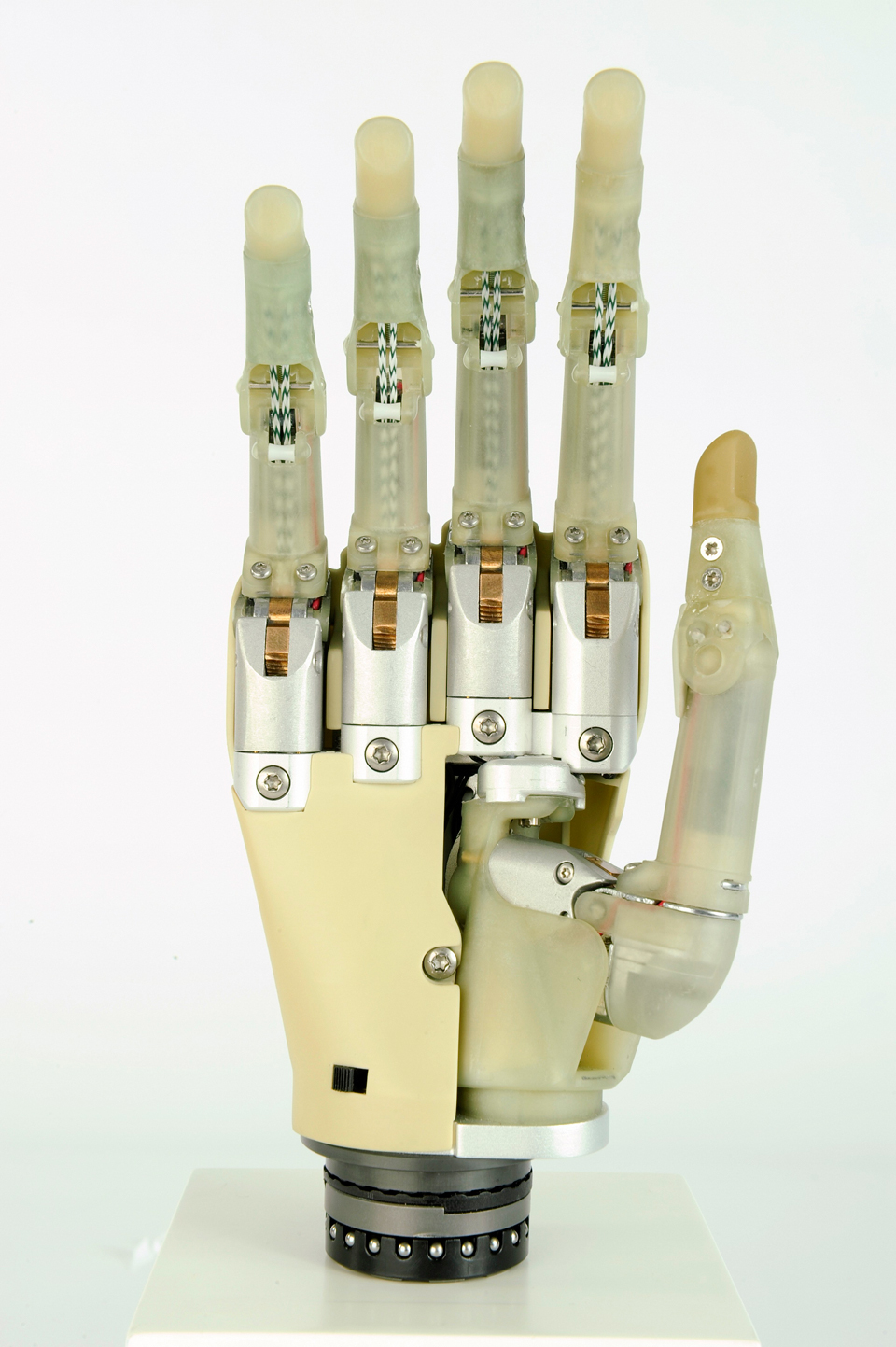 |
| 'i-Limb ultra prosthetic hand', Touch Bionics |
This is a typically excellent, and highly thought provoking exhibition from the Wellcome Collection - a place which really should be more popular among London attractions. It's well laid out, gives us just the right amount of information and most importantly lets us come to our own conclusions about what we see. There is a wry sense of humour to some aspects of the exhibition, and some interestingly provocative choices in what to exhibit. I particularly liked the way that the information cards were pinned to the wall in a stretched, slightly surgical manner. My only criticism is that this is an exhibition that relies very heavily on video and the volume of them varies enormously. There are some that are so quietthat it is very hard to make out what is being said, while conversely a few are so loud that you can hear them across the entire exhibition. But in a summer where people are pushing their bodies to the limits of athleticism in the Olympics and Paralympics it's very timely and any visitors to this should find themselves watching some events in a different light. Highly recommended - and anyone attending should be sure to see the rest of the Wellcome Collections fascinating galleries.
If anyone visited this and wants to add their thoughts I'd be very interested to hear them, post in the comments below!
'Superhuman' is at the Wellcome Collection from the 19th of July until the 16th of October 2012.
Subscribe to:
Posts (Atom)


