Recent Articles
Showing posts with label australia. Show all posts
Showing posts with label australia. Show all posts
Thursday, June 21, 2018
Thursday, June 21, 2018
- 0 Comments

On 26th August 1768, Captain James Cook departed Plymouth aboard HMS Endeavour with the stated objective of observing the Transit of Venus from Tahiti (thus helping determine Earth's distance from the sun), together with a more confidential mission to search the south Pacific for Terra Australis Incognita - the mysterious unknown southern continent. By the time he returned in July 1771 he had redrawn the globe, charting the eastern coast of Australia and New Zealand and had had first contact with multiple indigenous peoples.
The British Library's James Cook: The Voyages displays a wealth of documents, sketches, and artefacts from this first voyage and two subsequent ones to Antarctic waters and his doomed quest for the fabled North-West passage from the Pacific to the Atlantic.
The British Library's James Cook: The Voyages displays a wealth of documents, sketches, and artefacts from this first voyage and two subsequent ones to Antarctic waters and his doomed quest for the fabled North-West passage from the Pacific to the Atlantic.
From the British perspective, these were courageous ventures into a savage land, with Cook's scientific explorations a gateway to the commercial expansion of the Empire. For the indigenous peoples, Cook's boot landing on their shores marks the beginning of their racial, economic and cultural subjugation and exploitation under colonial rule, the consequences of which still reverberate today.
The exhibition leans into this dichotomy, subverting every bit of patriotic swashbuckling with representatives of the cultures explaining how their ancestors dealt with Cook's arrival. Its impossible to conclude whether Cook's voyages were a net good or evil, with perhaps the best summary being a Maori historian who shrugs with resignation: "It happened".


As you travel through the various rooms you find yourself weighing up the morality of Cook. Even if you walk in armed with the knowledge of the consequences of colonialism, it's easy to feel an exhilarating Boy's Own call to adventure when you look at an unfinished map of the world with 'Parts Unknown' in the distant corners. Similarly, when you get into the nitty-gritty logistics of the expedition - the navigational methods, keeping the crew alive, methods of communicating with distant peoples and the sheer distance travelled - you begin to understand the scale of what these men set out to achieve.
The emotional heart of the exhibition is a series of sketches and drawings created on these voyages - their impact amplified by the fact that most of these artists died before returning home. An obvious highlight is Sydney Parkinson's tentative sketch of a 'kangooroo', in which you sense how important the artist knew it was to get the details right to communicate this surreal animal to audiences back in Britain.
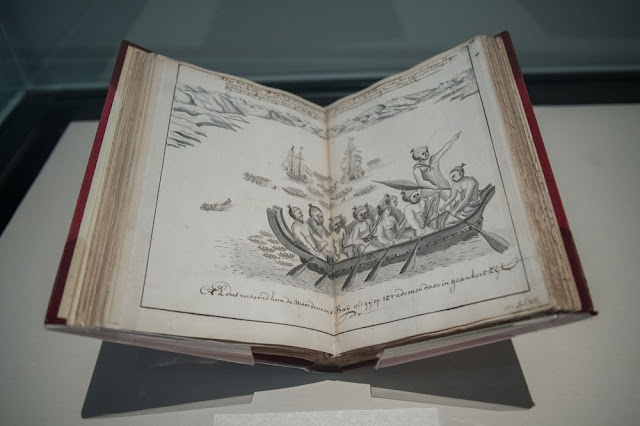

Then there are the careful profiles of the facial tattoos of Maori warriors. First contact was violent and relations were uneasy, but there's a respect baked into the artist's precise lines - as if they recognised a reflection of their own martial discipline in this alien culture.
Dramatic paintings from the second voyage by William Hodges also thrill, particularly a fantastically widescreen 'Cinerama' view of Polynesian war canoes on display. They look like science fiction apparitions, scenes that wouldn't look out of place in Moebius' L'Incal. Later paintings of the ships dwarfed by icebergs in the Atlantic make the ship look as if it has breached a strange unknown dimension, a little wooden husk of civilisation bobbing between uncontrollable cosmic forces.


It's easy to get swept up in this romance, but the careful layering in of the consequences of Cook's actions means we're never in danger of hagiography. By the time we get to his death at the hands of a Hawaiian tribe he appears to have waged a pointless war on, it feels like a fitting end to his story.
But, functioning almost as an extended epilogue, the neighbouring exhibition Windrush: Songs in a Strange Land continues some of the themes of The Voyages. We get a quick recap of British slavery, emancipation and Empire in the Caribbean, the historical forces that brought HMT Empire Windrush to Britain with 800 Jamaican passengers hoping for work. It was neither the first nor the last of these trips, but for some reason, it is this arrival that has lodged firmly in the British consciousness (and is obviously extremely timely right now).
What's on display closes a historical circle: Britain ventures out into the world, exploits and commercialises its resources and peoples, builds an Empire on which the sun never sets, and begins a process of transforming people into mirrors of British values. Of course, cultural cross-pollination was also happening, with Britishness changing to accommodate its new Imperial citizens - beautifully symbolised by the exhibits showing Caribbean culture in Britain.
It's often said we live in the age of identity politics - if that is true then we need to not only understand what our identity is, but the ways in which it has and will continue to evolve. These two exhibitions let us sip at the primordial soup of the modern Britishness: showing not only how we changed the world, but how it changed us. It's a sentiment beautifully summarised in Michel Tuffery's Cookie in the Cook Islands, imagining Captain Cook transformed by his explorations, with Polynesian features and flowers in his hair.

Captain Cook: The Voyages is open until 27 August. Windrush: Songs in a Strange Land is open until October 21st. Details here.
Thanks to Crafted Media for the invitation.
Thanks to Crafted Media for the invitation.
Sunday, October 12, 2014
Sunday, October 12, 2014
- 0 Comments

"David Gulpilil is the undisputed King of Aboriginal actors. Since his debut in Nicholas Roeg’s unforgettable Walkabout, followed a couple of years later by his stunning performance in Peter Weir’s The Last Wave, Gulpilil has been the cinematic face of Aborigines for the last 45 years or so. Yet until he collaborated with Rolf de Heer in 2007′s award winning Ten Canoes, he was often stuck playing supporting roles to white leads. Only a sucker would disparage Jenny Agutter or Richard Chamberlain, but it’s Gulpilil that provides the heart of their respective films, his characters representing mysterious, unknowable spirituality.
In Charlie’s Country, his second collaboration with de Heer, this mystery begins to peel away. Traditionally films about Aboriginal beliefs involve a white Australian becoming inadvertently initiated into a world they can’t comprehend, often with tragic results. Here, we see Australia from a firmly Aboriginal perspective; a litany of discrimination, dehumanization and cultural obliteration. This inverts the process, with the film showing us a proud Aboriginal man fighting off the cultural and social infection of white European society."
★★★★
Tuesday, October 29, 2013
Tuesday, October 29, 2013
- 0 Comments

As mini-genres go, 'going bonkers in the Australian outback' is fruitful cinematic territory. Peter Weir is top dog here, the back-to-back Picnic at Hanging Rock and The Last Wave invoking a disturbing Aboriginal mysticism underlying Australian society. These films, along with the brilliant Walkabout paint the outback as a place detached from the modern world, where time, identity and geography grow soft and malleable. It's difficult to argue that these films romanticise the outback, yet there's definitely a sense of wonder. Not so in Ted Kotcheff's Wake in Fright, a film that embraces nihilistic chaos, rejecting an Aboriginal mysticism and replacing it with violence, blood, puke and a festering lake of shitty beer.
This is the story of John Grant (Gary Bond), a schoolteacher working in a dead-end dustbowl called Tiboonda. He's thoroughly miserable: he misses his girlfriend and the relative cosmopolitanism of Sydney and wishes he could get out of Australia altogether. When the summer holidays arrive he happily leaves Tiboonda to get back to civilisation. First though, he must spend a night in Bundanyabba (known as "The Yabba"), before getting his connecting flight to Sydney.
The Yabba is a wretched hive of scum and villainy. The men of this town are in a constant state of drunken back-slapping, yelling masculinity, glugging down beer like their lives depend on it. The Hogarthian bar scenes showcase a teeming, pulsating mass of humanity; crowded, filthy and chaotic. Floating softly in the air is a a faint aura of repressed homoeroticism as the men stickily wrestle with each other, desperate to avoid even the faintest suspicion of femininity. This ties into a mean misogynistic streak, this is a town for men's men, the few women we encounter hardened into impassivity by a lifetime of pinches and aggressive flirting.
Our hero is a hoity toity type, looking down at the men of the Yabba like he's peering through the bars of an ape enclosure. He tolerates everyone's gregarious friendship with a condescending bourgeois politeness. Yet as he gets more and more soused on beer he gets sucked in, losing all his money on a coin-flipping game, trapping himself in the Yabba and finding himself sucked ever deeper into this quicksand town.
 |
| It's also crammed with great shots. |
On first viewing I was struck by the intense sense of foreboding throughout the first act of the film. I assumed the town must be hiding some Twilight Zone dark secret, something definitely connected to their colossal, neverending appetite for beer. The way they force it into Grant's hands throughout the film, cajoling him and pressuring him to down his drink and have another led me to think that there was some science fiction mind control agent in it - something mystery serum responsible for eroding his personal identity and turning him into one of the leering lads of the Yabba.
There's no science fiction in Wake in Fright, yet I was absolutely right about the effects of the beer. This mind control agent had all the effects I assumed; plain, simple everyday alcohol. I've always thought that alcohol helps reveal people's true selves; if you're an arsehole when you're drunk you're probably an arsehole all the time, just now you don't have the inhibitions to stop yourself acting that way. The beer in Wake in Fright dissolves the veneer of educated civilisation around Grant, exposing him (and perhaps all men) as barely repressed savages.
During the first act, Wake in Fright leads you to side with Grant as he curls his lip at the town's lack of refinement and reacts with detached amusement at the behaviour around him. This sympathy is what makes the film so terrifying. Though Grant eventually reveals himself as a monster, it's a stomach-churningly familiar monster. We find ourselves standing in his shoes, wondering how we'd fare on this diabolical, booze-fuelled merry-go-round. Ultimately that's the central terror of Wake in Fright: being wrenched from cosy, cultured city life, forced into a nihilistic, violent death spiral and enjoying it.
 |
| This movie has put me off beer for a while. |
During the first act, Wake in Fright leads you to side with Grant as he curls his lip at the town's lack of refinement and reacts with detached amusement at the behaviour around him. This sympathy is what makes the film so terrifying. Though Grant eventually reveals himself as a monster, it's a stomach-churningly familiar monster. We find ourselves standing in his shoes, wondering how we'd fare on this diabolical, booze-fuelled merry-go-round. Ultimately that's the central terror of Wake in Fright: being wrenched from cosy, cultured city life, forced into a nihilistic, violent death spiral and enjoying it.
The guide that lures him into the underworld is 'Doc' Tydon (John Pleasance). Like Grant he's an educated man, yet where Grant sees himself as above the muc of the Yabba, Tydon rolls around in it as happy as a pig in shit. This is a place where is alcoholism goes unremarked, where nobody cares if he lives in a dilapidated, filthy shack on the borders of town. If the Yabba itself is hell, then Tydon's shack is the dankest depths - you can almost feel the stink radiating off the screen. In Pleasance's unhinged, charismatic and nakedly honest performance the film shows us the limits of masochistic debasement.

In the film's most disturbing sequence we join Grant, Tydon and two other men on a midnight kangaroo hunt. We see kangaroo after kangaroo getting blown away; bloody puffs of tissue flying out into the night, strong legs twitching their last in the dust. Later, we see the men hunting them with knives, slitting their throats and frenziedly stabbing them. These are real kangaroos, and this is real footage of them being shot. The sequence feels like it's stretching off into infinity, a neverending nightmare bloodbath .
Here, Kotcheff's outback becomes an antithesis of Weir and Roeg's, enormous and chaotic yet completely devoid of any mystical veil. Whereas the latter two's reaction to the vast open spaces was a kind of religious awe, Kotcheff sees a river of gore, screaming and gunshots - a declaration of utter nihilism that links the outback and masculinity as vicious and cruel. Somewhere that life isn't just cheap, it's worthless. It's a depressing vision, but a tangibly honest one. No wonder Nick Cave describes it as the best film about Australia.
So it's no surprise that the Australian Board of Tourism didn't come knocking at Kotcheff's door. After bombing on its domestic release and stealthily slipping into a few US cinemas in castrated form the film promptly sank into obscurity, becoming a notorious 'lost film'. Decades later Australian producer Anthony Buckley tracked it down, finding it in a bin in Pittsburgh a week away from incineration. Thank god he found it, though Wake in Fright is skin-crawlingly unpleasant from start to finish it's also a powerful and ruthless dissection of masculinity - peeling off the scab of respectability and drawing out great gobs of infectious, bloody pus.

In the film's most disturbing sequence we join Grant, Tydon and two other men on a midnight kangaroo hunt. We see kangaroo after kangaroo getting blown away; bloody puffs of tissue flying out into the night, strong legs twitching their last in the dust. Later, we see the men hunting them with knives, slitting their throats and frenziedly stabbing them. These are real kangaroos, and this is real footage of them being shot. The sequence feels like it's stretching off into infinity, a neverending nightmare bloodbath .
Here, Kotcheff's outback becomes an antithesis of Weir and Roeg's, enormous and chaotic yet completely devoid of any mystical veil. Whereas the latter two's reaction to the vast open spaces was a kind of religious awe, Kotcheff sees a river of gore, screaming and gunshots - a declaration of utter nihilism that links the outback and masculinity as vicious and cruel. Somewhere that life isn't just cheap, it's worthless. It's a depressing vision, but a tangibly honest one. No wonder Nick Cave describes it as the best film about Australia.
So it's no surprise that the Australian Board of Tourism didn't come knocking at Kotcheff's door. After bombing on its domestic release and stealthily slipping into a few US cinemas in castrated form the film promptly sank into obscurity, becoming a notorious 'lost film'. Decades later Australian producer Anthony Buckley tracked it down, finding it in a bin in Pittsburgh a week away from incineration. Thank god he found it, though Wake in Fright is skin-crawlingly unpleasant from start to finish it's also a powerful and ruthless dissection of masculinity - peeling off the scab of respectability and drawing out great gobs of infectious, bloody pus.
Wednesday, June 19, 2013
Wednesday, June 19, 2013
- 0 Comments

Cultures colliding can lead to wonderful things, a fusion that combines the best of both worlds. Unfortunately, as history tells us, these clashes tend to lead to destruction. Power imbalances are exploited, the enormous weight of one colonising culture begins a conscious erasure of what it's landed on. This global cultural desecration was carried out with gusto for most of the last century, ethnic cultures systemically being converted to a Western model: languages forgotten, traditions abandoned, rituals blown away like dust in the wind; a thousand years of culture destroyed in favour of Christianity and capitalism.
Subscribe to:
Posts (Atom)