Recent Articles
Showing posts with label death. Show all posts
Showing posts with label death. Show all posts
Wednesday, May 22, 2019
Wednesday, May 22, 2019
- 0 Comments


If I had realised in advance what User Not Found was about I probably wouldn't have gone. The show, written by Chris Goode and performed by Terry O'Donovan, ponders what how we should handle the digital footprint of a dead loved one - something I have recent and painful experience of. But here we are and I guess I'm going to have to take the bull by the horns.
Both set in and staged in a modern cafe, we meet Terry sipping his peppermint tea and observing the world around him. He ascribes identities to the other patrons, idly fantasising about their miniature dramas. Early on, we learn that Terry's ex-boyfriend Luka has died, an event which propels the next 90 minutes of drama. But there's a wrinkle, prior to his death Luka named Terry as his 'digital executor'. This means that a company called Fidelis is now asking him to sort through years of social media posts to decide what to keep and what to delete.
It's a very relevant topic, amplified in effectiveness by Daphna Attias' excellent direction and her team of audio/video artists and technicians. The audience shares tables in the cafe and hears the production through a set of wireless headphones. These play the live audio of O'Donovan's performance but also mix in various other multimedia elements (music, sound effects and so on).
In addition, everyone is given a smartphone at the beginning of the show. This displays what Terry is seeing on his phone, as well as showing us abstract video sequences that the monologue refers to. On top of that, each table has a networked lamp and under-lighting allowing the technicians to dramatically light the space.
For User Not Found to work, all of these systems have to work in concert with one another. If one fails they may as well all have failed. Given that a decent rule of thumb in theatre is not to overcomplicate things, it's a minor miracle that this play functions so smoothly and is a testament to the blood, sweat and tears (and money) poured into it by everyone at production company Dante or Die.

The result is worth the effort. Having a smartphone in your hands and watching it navigate itself through social media feeds is a disconcerting experience, and shows us the world through its character's eyes in a way that other shows can't conceive. A less ambitious company might have simply projected this onto the rear of a stage, but cradling an individual device in your hands builds a connection to the contents that's viscerally real.
Maybe a touch too real for me - but I guess this makes me a particularly well-placed critic to judge this show. I thought the way it dealt with picking through the digital detritus of a dead partner was painfully accurate. Figuring out what to do with a person's online presence after they've died isn't something that previous generations have had to deal with, but as the years tick by the amount of data generated by an individual over the course of their lives will grow exponentially. So what's the right thing to do? Do you consider what their wishes might have been, decide on the naked truth or simply mould the person who their friends and family wanted them to be?
Perhaps sometime soon there'll be an accepted way to approach this conundrum, but right now we're groping in the dark. This curation of a person's life is not easy: pruning away the stuff that should remain private and promoting elements in order to create an idealised reality that (after a hundred small choices) can suddenly seem quite artificial. This process is an emotional minefield that the show captures perfectly.
It also understands the less-considered online aspects of a person: with the show showing data on fitness, banking and other apps that aren't necessarily broadcast to the world. Data like this can be a kind of ticking timebomb - just the other day I turned on an old Xbox to find a personalised 3D avatar of my dead partner smiling and waving back at me. Fun times...
I left the show feeling really goddamned miserable, but I guess that's testament to how well it reflected my own experiences back at me. Intelligent and emotionally resonant theatre like this is the kind of stuff that makes seeing all the less-great stuff worthwhile. Huge credit to Terry O'Donovan for cramming so much into his personable yet scarred performance, and everyone at Dante or Die should be proud of themselves for what they've accomplished here.
User Not Found is at The CoffeeWorks Project until June 2nd. Tickets here.
Friday, May 20, 2016
Friday, May 20, 2016
- 0 Comments

"This has been a shit week. I died." Life is so unfair. One minute you're a happy-go-lucky young woman in a loving relationship with a young daughter, the next you're a freezing lump of decomposing meat trapped in a soggy limbo. That is Alice (Tamia Kari), newly dead, and This Is Living.
Fortunately 'life' isn't completely lonely six feet under. She's visited by her husband Michael (Michael Socha), a decent yet vulnerable man riddled with equal parts grief and guilt, facing up to the prospect of raising their daughter alone. Over the course of the play the two pick their way through their past and future to decide what Michael does next and Alice... well who knows what lies beyond the veil?
Cleverly, playwright Liam Borrett (also directing) never defines precisely what form his afterlife takes. Alice could be anything from a literal ghost, the dream/nightmare of a mourning partner or simply his conscience eating away at him as he contemplates suicide. Whatever she is, it ain't sunshine and roses.
Borrett and designer Sarah Beaton stage the play on a large raised oblong, upon which a thick black tarp is fixed. Water puddles on wrinkled service, creating pools that ebb and flow as the characters move about the stage. It's immediately striking: the water both evoking tears and implying a cold fluidity of motion that fits in perfectly with these wanderings between life and death.
On a purely practical level, full credit to everyone involved for making this wet production work. Splashing about in tepid water for two hours can't be much fun for the actors, and I can just imagine the nonplussed reaction of a lighting designer being informed that they have to place underlighting mere inches from a puddle. But the water really pays off; Tamia Kari appears to be gently rotting the wetter she gets; it accentuates the atmosphere of misery and grief; and the physical moments are that much more visceral when accompanied by arcs of glittering spray.


On top of that, Jackie Shemesh is responsible for one of the most intelligent lighting designs I've seen in a good while. When the play switches gear from afterlife to flashback, the lighting shifts appropriately, seesawing the play between a warm summer's glow and shivering midnight. Most impressive is a moment when the couple stand facing one another. Michael stands with a spotlight that casts a clear silhouette against the back wall, while Alice (despite being lit) casts no shadow at all. It's subtle, striking and spooky in all the best ways.
All that's impressive enough - though these delights would amount to nothing without two sturdy performances at the centre. Kari and Socha more than provide, constantly underlining their characters' normality in the face of the play's surreal supernatural elements. Who can't fall in love with a character who - upon awakening as a magically animated corpse in a gloomy nightmare world - exclaims "Oh god... have I been on the Blue Nun again?"
Both are more than easy to like, and it's obvious they like each other. Kari and Socha's first flirts and romantic encounters have a ring of truth about them, as well as the way they gradually opening up to one another as their lives intertwine. They're also both very funny, and given the grim themes that This Is Living grapples with, some belly laughs are sorely needed to prevent us getting dragged down in the doldrums.
My only real criticism is that the play ends, then it doesn't. No, seriously - the story reaches a satisfying emotional and thematic climax, the lights go out and everyone wholeheartedly applauds what we've seen. Then the lights come back up and we sit through a confusing and entirely unnecessary epilogue. This vestigial scene is narratively extraneous, not to mention that it's aesthetically tone deaf. The play gets its proper round of applause soon after, but this final scene is so obviously surplus to requirements that I can't imagine it'll stay beyond the first couple of nights.
Aside from that, this is great stuff. Borrett, Kari, Socha and Beaton take the audience somewhere that feels theatrically unique - a place of damp, blurred and fuzzy gloom so slick and slippery that its slide between your fingers as you grip it. While some plays flit in and out of memory as passing diversions - This Is Living, with its powerful visuals and emotive storytelling, will stay.
★★★★
This is Living is at Trafalgar Studios until 11 June. Tickets here.
Friday, May 6, 2016
Friday, May 6, 2016
- 0 Comments

Fetish skulls! Wax guts! Dead kittens! Attending a Morbid Anatomy lecture feels like re-uniting with an old friend. It's been nearly four years since Seize the Day and judging by the fact that this event sold out in a matter of minutes, death appears to be extremely en vogue.
Morbid Anatomy are at the forefront of contemporary death, with Joanna Ebenstein's excellent blog having developed into the Morbid Anatomy Museum in New York City. Their mission statement is "to excavate the intersections of the history of art and medicine, death and culture" and to that end they presented four very different but equally fascinating lectures.
First up was Chiara Ambrosio, who transported us to an obscure cave on the wrong side of the tracks in Naples. This is the Fontanelle cemetery, where the chaotically scattered bones of Neapolitans lie, many dating from the great plagues that periodically decimate the city's poor. Over the years, a cult has arisen around these bones, its devotees constructing miniature 'homes' for skulls and seeking practical and spiritual advice from them in their dreams. This personal hotline to the afterlife threatens the monopoly of the Catholic Church, who declared that the devotees had "degenerated into fetishism" and ordered that the practice end. Which it did. At least the devotees said they'd stopped...
 |
| Skulls in Fontanelle Cemetery |
Secret death cults in obscure Neapolitan caves are (by my standards at least) completely infused with romantic adventure. Accentuating this is Ambrosio's lyrical and poetic analysis of the phenomenon, her lecture accompanied by live musical accompaniment. She created a woozy, dreamlike atmosphere - beginning with the surface geography of the city and subsequently burrowing deeply into the psychology of its inhabitants.
Next was Kate Forde's retrospective on the Wellcome Collection's 2009 exhibition Exquisite Bodies, which showcased wax anatomical models from the 19th century. These 'anatomical venuses' awkwardly straddle dispassionate medical education and quasi-religious eroticism. Forde gave us a whistle-stop tour through the history of wax anatomical models in London; explaining how they were first considered an unambiguous public good but soon fell victim to pearl-clutching Victorian moralists.
 |
| Anatomical Venus by Susini and Ferrini |
Throughout the talk I was mentally filing away things to research in depth later; Dr Kahn's wildly popular anatomy museum in Leicester Square; the delights of the Roca Collection and the classically beautiful, impossibly detailed wonders of Susini and Ferrini. Underneath all this lies a weird dichotomy between the surgery and the freakshow - the wax figures attracting attention as much for their sensuousness as their instructive anatomical detail. I hesitate to plumb the psychological dark spaces that fuel their popularity - what does is say about men who're attracted to a passive feminine body that invites you to strip her down to her womb?
This was swiftly followed by the personable Ross MacFarlane, with Death and Dr Buchan. Dr Buchan was a medical celebrity of the 18th century, feted for his globally popular Domestic medicine, a layperson's guide to treated common maladies. MacFarlane examined the impact of this book through Robert Burns' Death and Doctor Hornbook, in which a man comes across a despondent Death, worried that his services are longer required due to the activities of the titular Doctor. Yet Hornbook isn't some medical wunderkind - his self-taught home treatments are simply killing off far more people than Death ever could.
How much should the public know about medical science? This knowledge used to be the preserve of professionals; who perhaps assumed the general populace was too stupid to understand medicine or (more likely) was afraid that wide dissemination would weaken their businesses. Authors like Buchan broadened access to this knowledge, yet, as Pope famously said, "a little knowledge can be a dangerous thing".
While there are numerous minor problems that people can treat themselves, there's much that probably should stay in the realms of professionals. One only has to look at the rise in internet self-diagnosis/treatment or the alternative medicine industry to see what can happen when people think they know better than a trained professional.
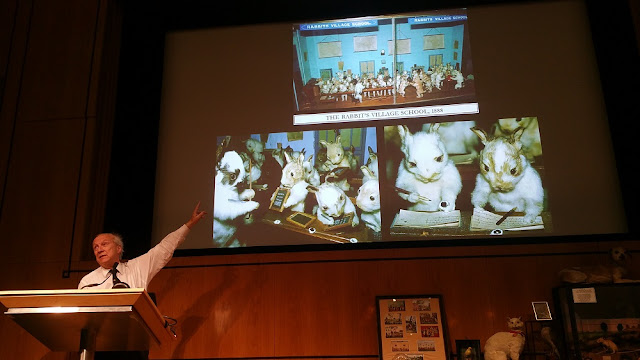
Finally we get to Dr Pat Morris, former Senior Lecturer in Zoology at the University of London and authority on taxidermy. The subject was the taxidermy of Walter Potter, clearly a passion project for Morris. The origin is a visit to his small museum "when I was in short trousers", where he was confronted by his striking anthropomorphic dioramas, the most famous being The Death and Burial of Cock Robin. I can see why he's such a fan - I got to see them (courtesy of Dr Morris) at 2013's The Museum of Everything) and they're just the right cocktail of weird and cool.
With the aid of examples he's brought with him, he gives us a brief biography of Potter. This ties into a wider ruminance on the popularity of taxidermy in Britain. A stuffed bird or family pet would have been an everyday sight in a Victorian household, but postwar squeamishness caused a gradual loss in popularity. Fortunately, taxidermy is on the rise again: chic workshops where you can 'stuff your own mouse' booked up for months in advance.
Dr Morris regards these johnny-come-latelys with a faint sniffiness, pointing out that the same kind of contemporary artwork that's now selling for big bucks was being done by his co-workers ten years ago - to little acclaim. Still, he must be pleased that the Potter works he's saved are being appreciated anew and judging by the crowds that gathered at the front of the lecture hall appreciated quite passionately. I love them: a three dimensional, powerfully physical manifestation of creatures, scenes and personalities long dead.
Once again Morbid Anatomy proves to be very much my kind of event. I look forward to the next thing they have coming up. One day, one glorious day I will visit their New York museum.
 |
| Death and Doctor Hornbook |
How much should the public know about medical science? This knowledge used to be the preserve of professionals; who perhaps assumed the general populace was too stupid to understand medicine or (more likely) was afraid that wide dissemination would weaken their businesses. Authors like Buchan broadened access to this knowledge, yet, as Pope famously said, "a little knowledge can be a dangerous thing".
While there are numerous minor problems that people can treat themselves, there's much that probably should stay in the realms of professionals. One only has to look at the rise in internet self-diagnosis/treatment or the alternative medicine industry to see what can happen when people think they know better than a trained professional.

Finally we get to Dr Pat Morris, former Senior Lecturer in Zoology at the University of London and authority on taxidermy. The subject was the taxidermy of Walter Potter, clearly a passion project for Morris. The origin is a visit to his small museum "when I was in short trousers", where he was confronted by his striking anthropomorphic dioramas, the most famous being The Death and Burial of Cock Robin. I can see why he's such a fan - I got to see them (courtesy of Dr Morris) at 2013's The Museum of Everything) and they're just the right cocktail of weird and cool.
With the aid of examples he's brought with him, he gives us a brief biography of Potter. This ties into a wider ruminance on the popularity of taxidermy in Britain. A stuffed bird or family pet would have been an everyday sight in a Victorian household, but postwar squeamishness caused a gradual loss in popularity. Fortunately, taxidermy is on the rise again: chic workshops where you can 'stuff your own mouse' booked up for months in advance.
 |
| The Death and Burial of Cock Robin |
Once again Morbid Anatomy proves to be very much my kind of event. I look forward to the next thing they have coming up. One day, one glorious day I will visit their New York museum.
Wednesday, August 12, 2015
Wednesday, August 12, 2015
- 0 Comments

Last night I looked a woman in the eyes and told her she was going to die. She looked right back at me and told me the same. It was disconcerting: you compartmentalise mortality and death deep down inside - sure, at that at some day you're going to die, but dwelling on it isn't particularly healthy. But My World Has Exploded A Little Bit thumps death down on an autopsy table and spills its guts, picking through bereavement, loss and grief.
The tone varies from sentimental miserablism to blunt honesty with stop offs on the way at anger and joy. This is the brainchild of Bella Heesom, who previously impressed in last September's The Woman in the Moon. Beginning as a practical guide to bereavement, she gradually switches gears and ends up at painful self-appraisal. Throughout she's assisted by Esh Alladi, who plays a piano accompaniment and provides comic relief.
The underlying narrative chronicles two deaths. The first is a daughter struggling to cope with her father's fatal illness. Having been diagnosed with an aggressively malignant brain tumour things are gradually winding down, and the daughter explains the stages by which you cope with care, planning and emotional reinforcement. Next up her mother dies, and we repeat the stages, now shot through with a faint anger and guilt.
First impressions are worrying. The prose used to describe the daughter's reactions is syrupy and laden with clunking similes. This, in combination with a manipulative 'okay, cry now' piano score left me primed for a sickly dose of grief porn. Fortunately, the show quickly demonstrates a nimble self-awareness that allows the tone to vary wildly while maintaining a narrative and thematic throughline. Contrasting emotions clash up against one another: moments of deeply felt misery pricked by a comic flourish or upbeat bit of narration.
This gives My World Has Exploded A Little Bit a powerful core, especially as we quickly realise that the 'case studies' we're exploring are obviously derived from Heesom's own experience. Ordinarily I'm deeply suspicious of performers using their shows as a form of therapy. This brand of drama tends towards the narcissistic, treating the audience as distractions along for the ride on someone's personal growth. But though the show is obviously therapeutic for Heesom, it's also a worthwhile piece of drama in its own right.
This is almost entirely down to Heesom's performance - it hits like a freight train. To devise a piece of theatre around your parent's deaths is either bold or foolish - transforming moments of intense pain into something to entertain a bunch of anonymous strangers. But Heesom gradually peels back all the layers of artifice, arriving at a white hot ball of confusion, anger and self-loathing, which explodes in a climax that's spinetingling in its raw honesty.
That said, there's a few flies in the ointment. Esh Alladi grates as the comic relief, his performance a man-childish set of ingratiating grins and clownish waves. I get that for this to work you've got to have a little sugar mixed in with the salt, but his mugging quickly becomes an annoying distraction. He's not exactly helped by the task of tunelessly thumping a keyboard to mark scene changes. I don't know if it's a volume issue, or something to do with the mixing desk, but the sound ran through me like nails down a blackboard.
This aside, My World Has Exploded A Little Bit is an undeniably powerful piece of theatre. Death is an incredibly weightier subjects to tackle, but Heesom approaches it with a perceptive, clear-eyed intelligence. All around me audience members were sniffling and dabbing their eyes - their reaction not caused by sentimental manipulation, but by hard-earned, keenly felt pathos.
Not exactly a cheery night out, but nonetheless an extremely rewarding one.
★★★★
My World Has Exploded A Little Bit is at Tristan Bates Theatre until 15 August. Tickets here.
Monday, November 19, 2012
Monday, November 19, 2012
- 0 Comments

When it comes to museums I’m a bit of a luddite. I’d rather wander through a room full of dusty Victorian display cases rather than a multimedia, touch-screen, swipe card extravaganza. A lot of my favourite museums showcase private collections put together a long time ago, the result of someone's life spent collecting whatever interested them. I repeatedly come back to brilliant places like the Wellcome Collection in Euston, or Sir John Soane’s House in Lincoln’s Inn Fields. I love looking at some strange object and trying to figure out what it’s for, or what was going through the mind of the person that made it. So when I heard about ‘The Museum of Curiosity’ I was naturally excited. The description I'd read promised to recreate this experience of wandering through these curiosity cabinets, and to showcase some damn weird things in a nice space.
 |
| Eyeball Tray |
The first thing you’re confronted with upon entering is a large taxidermied ostrich dating from 1785. It sits in an L-shaped display case, the head poking up into a special compartment as if the case was bodged together when whoever was making it realised it was too small. Ostriches are inherently ridiculous creatures and here even in death it is a figure of fun. Sometimes the silliest animals find a measure of regal dignity when stuffed, their stillness and glassy stare a challenge to whoever’s looking at them. Not here though, the way it’s displayed underlines the grotesque extension of its skinny neck and the relative tininess of its head.
This ostrich is definitely dead. Dead for nearly a quarter of a millennium in fact. But it’s at home here because this exhibition is a mausoleum, a lot of the art here is composed of various bits of dead things mashed up into each other.
 |
| "The Hunt" (detail), Tessa Farmer |
Perhaps the best examples of this creepily morbid aesthetic are the work of Giles Walker and Tessa Farmer, who each have a number of exhibits on display. Walker shows off a number of pixie-sized bodies with bird skull heads frozen in emotional, dramatic poses. It's comic and disturbing all at once. Farmer creates impossibly detailed and fragile pieces composed of fairy like insects delicately and gracefully posed. I last saw her work at the Bedlam exhibition in the Old Vic Tunnels, and while the scale here is smaller the effect isn't lessened. The tiny posed insect bodies seem impossibly fragile, the mind boggles as to the care and delicacy taken in putting these dioramas together. Even gently exhaling causes them to sway and spin on their micro-filament wires.
 |
| "Born to Be Wild", Giles Walker |
The death theme continues with various bits of bric a brac placed around the room. A hippopotamus skull sits on a shelf, there’s a carved walrus’ penis bone, petrified cobras frozen in a mirrored duel, a desiccated mummified cat and skeletons of all shapes, sizes and species, including a rather pitiful human one, awkwardly stuffed into an ill fitting wooden cabinet.
The name of the game throughout appears to be recontextualisation. Here creation begins with examining what an existing object or organic remain means, and then figuring out how to distort that meaning for your own ends. Perhaps the purest example of this are the ‘intertwangleized’ paintings of Butch Anthony. He takes antique portraits of people lost to the mists of time and paints his own cartoony designs over the top of them. There’s a part of me that instinctively recoils when I see an historical artefact being irreversibly altered, a revulsion at the bare-faced cheek of an artist who assertively declares that something old is worthless, rudely crosses out the name of the original artist and only has use as a canvas for their own work. But then this feeling of revulsion gives way to wondering whether something simply being ‘old’ automatically makes it more worthwhile. And after all, who’d really give a toss about these paintings if Butch Anthony hadn’t drawn on them?
 |
| "Intertwangleized Woman", Butch Anthony |
There are a number of other pieces here that subvert the meaning of their raw materials, notably two enormous wall sculptures constructed from hundreds (maybe thousands) of crucifixes and other religious paraphernalia. Taken individually these objects could be small and intensely personal mementoes but en masse they impress upon you how much of this stuff is mass-produced. You imagine assembly lines pumping out tin messiah after tin messiah in a never ending stream, the process making a mockery of individual faith and a ‘personal’ Jesus. Here too is the stench of death. Perhaps it’s the lingering after effects of the lecture on morbid anatomy I went to a fortnight ago, but I see the crucifix as a representation of sadistic torture and death rather than as showing holy and noble suffering.
Even the more original pieces are still constructed out of pre-made furniture, but remain no less impressive. One of my favourite things here was Swoon's 'Dream Reliquary', a towering mountain of old cabinets, encrusted with what looks like calcified bone growing in and out of them. On top is a large classical head, staring straight ahead blankly. You're encouraged to open the drawers, each one is stuffed with dreams submitted to the artist. Some are banal, some are fantastically weird. It's a very nice concept executed perfectly, the act of opening the drawers and interacting with the piece made me feel some kind of sense of psychic exploration.
 |
| "Madonna and Child (14 yrs), Giles Walker |
15 Bateman Street is a lovely space and it's a pleasure to explore. There’s art stuffed into every nook and cranny and the more you explore, the more you’ll get out of the experience. The only thing I'm struggling with is what all this transformative art signifies as a whole. Much of what I've seen here is all about taking junk from the past and forcing a new meaning onto it. Is this a safe way out for art; a reliance on accreted cultural meaning rather than creating anything new of your own?
Admittedly, the exhibition functions brilliantly as a cabinet of curiosities, a mountain of what the gallerist Mike Snelle describes as “weird shit”. If filling a space with weird shit is the target that Black Rat have set for themselves then they've more than achieved it. Even so, by the time I walked out of the door I began to wonder whether just being creepy, kooky and altogether ooky is a substantial enough message.
But that aside, I had a great time poking about the place, and nearly everything here is interesting as hell. It’s beautifully lit, atmospheric and extremely delicately detailed. If you’re walking down Oxford Street feeling blown out on Marmite sponsored commercial Christmas cheer and need bit of mental retuning you should definitely pop along and take a walk on the weird side.
The Museum of Curiosity is open now until Christmas, with late openings on Thursday nights.
Friday, June 22, 2012
Friday, June 22, 2012
- 0 Comments

To say that interesting theatre only happens above Islington pubs or in West End basements is a mistake. There are lots of interesting things going on all over London, and getting out Zone 1 once in a while is nice for a change of pace. But even with this thought running through my head, it was with a dark sense of foreboding that I stepped off the train at West Croydon Overground station. I am familiar with Croydon, and have formed the opinion that it is a featureless, depressing wasteland of the soul. As I staggered down the wind tunnel of Wellesley Road, corporate concrete monoliths towering over me I began to feel that sucking sense of hope being drained out of your soul that seems to accompany a visit to Croydon. I reached the theatre – Fairfield Halls, a monument to some deranged sense of 1960s functionality, a place that should have been torn down long ago and the earth salted. ‘This play had better be damn good’, I thought.
‘Born in the Gardens’ is a Peter Nichols play that premiered and is set in 1979, it’s about a family coming together for the funeral of their father. The mother, Maud (Katherine Senior) lives in a decaying mock-Tudor house with one of her sons, the somewhat isolated Maurice (Edward Ferrow). The two other siblings soon arrive for the party, Maurice’s twin sister Queenie (Rachel Howells) and their younger brother, Hedley (Jonathan Parish) a Labour MP. The plot revolves around Queenie and Hedley trying to get their mother to move into a duplex in London, and to get rid of the somewhat decrepit house she lives in Bristol.

First impressions of the play were not good. We open with someone dressed as bumbling old lady, it feels immediately sort of Little Britainy – the humour seems to be largely based around comically misunderstood words (‘michael wave’ for microwave for example) and on talking back to the television. It seems almost impossibly old-fashioned. The staging is overly naturalistic, the character’s dialogue is generally aimed at the audience rather than at each other and even though there are apparently jokes being told, no-one in the audience seems to be laughing. A slow tingle of horror begins to grow in my chest, have I come all the way to Croydon to see a bad play? The programme informs me that this production has arrived here by way of the Budleigh Salterton Public Hall, suddenly all signs are pointing to disaster.
But I bear with it, and try and work out what they’re getting at. 1979 seems like a pretty depressing year in British history, beginning with the winter of discontent, with rubbish piled up in the streets and parks, and corpses going unburied, and by the time the events of the play are taking place, the Labour government has lost a vote of no confidence and a new Conservative government led by Margaret Thatcher has taken power. It is a time of change, although not necessarily a positive and happy sort of change. The events of the play seem to hint at the social misery going on in the wider world around the characters. Ledley, the Labour MP is treated as a figure of fun for his socially crusading philosophy. I suppose in 1979 views like this would be considered ripe for mockery. The daughter, Queenie, is living in a beach house inMalibu writing acidic but hollow magazine articles, and Maurice seems to be locked into a spiral of masturbatory isolation and talking to his beloved cat.
It slowly becomes apparent that while on the surface the play is a harmless, toothless, neutered kind of comedy, deep within its chest beats a misanthropic and twisted heart. The characters are stock comedy archetypes, but these are archetypes just one step before their neuroses collapse in on themselves.

It is interesting to see how they play the ‘hilarious’ dottiness of the mother Maud. She is constantly seeing ‘mites’ on everything. This is frequently a punchline and it seems like they want the audience to think ‘this old woman is so whacky!’ Characters spend time angrily debating their existence, but it is clear to us at least that they do not exist. Maud finds them everywhere, in her shoes, in her bag, in the car, on the serviettes – they’re even eating her hair. Her children don’t seem to find this behaviour particularly disturbing, they see her delusion as a kind of leverage to get her to move out of the house and into a modern duplex. When we in the audience think about it for a moment, the humour begins to recede. It’s pretty apparent that no matter where Maud ends up, either in the Victorian house or the duplex she will continue to see ‘the mites’ on everything. How long before she sees them under her skin? And then what?
This is not some wilfully dark interpretation of mine: the play demonstrates a specific awareness of delusional clinical psychology. It takes pains to use the expression folie a deux, and then to explain what exactly this entails. It actively wants us to consider this comedic character’s quite disturbing mental illness taken to its logical end.
This sense of things going very wrong just waiting in the wings hangs over the whole play. While the events on stage are fairly comedic and inconsequential, there are pitch-black hints of the most terrifying activity in the character’s pasts and future. For example, throughout the first act of the play, the dead father, Victor’s coffin lies in the front room. Queenie, his ‘favourite’ says that she came over to see his ashes scattered for a sense of closure. "Closure for what he did to me that night…".
Wait… what?!
For a moment the spectre of childhood sexual abuse hangs over the play, and then it vanishes, uncommented on by both audience and cast alike. You find yourself wondering if you’d imagined it.
Another instance of this fleeting sense of underlying horror comes during a vaguely incestuous scene between the two twins. In this instance I can’t tell whether it was something in the script, or maybe a bit of miscommunication between the actors and the audience, but a murmur of shock travelled through the audience. Later on there is frequently disturbing sexual activity alluded to, and it seems to throw contrast to the light and harmless ‘humorous ‘dialogue on stage. Once you’ve glimpsed this darkness it seems to pervade even the lightest of scenes. The ruined late 70s furniture and technology seems to take on a sinister air, and the constantly mentioned decay of the house seems to mirror their mental states. The fact that the ‘jokes’ the characters make are falling flat does not seem embarrassing to anyone – only the bitterest and most cynical can laugh at these poor bastards.
I find it interesting that this play was in a contemporary setting when it was premiered. It works so well as a period piece that it is difficult to imagine it ever being regarded as modern, even in 1979. Nostalgia for the past is a pretty easy crutch for a play to rely on, and it is to the credit of the production company Creative Cow that they do not try to portray 1979 as a fond memory. It is explicitly a dank, depressing and tasteless era. Characters are casually racist in a reflexive and unexamined way, their listing of the nationalities of the business owners in their town sounds disturbingly like the kind of bile you’d hear foaming from the mouth of a BNP member. It all seems suffocating. Even the drinks seem warped and off-putting, characters frequently enjoy an absolutely vile sounding “bullshot” cocktail which apparently consists of beef bouillon and vodka (I had assumed that something so revolting must be made up, but no, apparently it’s a real cocktail).

I hesitate to say I enjoyed this play. It was unfunny, at times crushingly dull and the more you think about it, the more depressing the events of the play become. But maybe this is all the point? All of the performances are great, and the production values are extremely professional, but they seem in service of a sinister agenda, one designed to instil a sense of creeping horror and unease in the audience. It is a profoundly nihilistic experience: the final scene of the play is much the same as the first, suggesting an unending ouroboros of misery, pain and death. God only knows what the audience in Budleigh Salterton made of it.
As I stumbled out into the Croydon night it seemed like the crushingly oppressive world of the play was following me. I picked my way past pools of steaming vomit outside a chain nightclub, past people groaning (in pleasure or pain?) on benches on the high street, past strange inhuman howls coming from a back alley and eventually onto the train home. As it pulled out of the station the words of Johnny Rotten popped into my head: "There is no future in England's dreaming."
I have once again vowed never to return to Croydon. This time I’m determined to keep my word.
Subscribe to:
Posts (Atom)