Recent Articles
Showing posts with label the O2. Show all posts
Showing posts with label the O2. Show all posts
Thursday, November 15, 2012
Thursday, November 15, 2012
- 0 Comments

I've got a soft spot for 'found footage' films. 'The Blair Witch Project' traumatised me in
1999 and 'Cloverfield' had me gripping the edge of my seat in 2009. These types of films get a lot of stick,
frequently being accused of a lazy way to make a film (to be fair, this is sometimes justified).
I love it, turning the characters into cameraman doesn't feel like
laziness to me, it's an opportunity. By
seeing the world through their eyes (or at least through their cameras) we can
literally see the world how they do.
It allows the audience to take root inside the character, letting us
experience the world of the film much more viscerally.
This direct, personal experience is crucial here. 'End of Watch' is a film about LAPD beat cops
in South Central. I've never had any
experience with the LAPD, but through popular culture I've built up an image,
rightly or wrongly, of them as corrupt, racist, violent
thugs. We spend the film in the company
of two cops, Mike Zavala (Michael Pena) and Brian Taylor (Jake Gyllenhaal). Taylor is taking a film class and has decided
to film everything about his job as a cop.
This is really more of a framing device, and we soon forget the
actual physical constraints of filming like this as we explore the world and
the different characters in it.
'End of Watch' exploits our expectations of what a modern audience expects
in a film about the police. As the film
beings we're expecting to see these cops go off the rails, to expose themselves
as corrupt and self-serving, to be loose cannons who break the rules but get
the job done. I'd seen the trailer a
week or so ago, and it seemed to be selling us on a story of two rogue cops
whose selfishness gets them in over their heads with the mob. This isn't what the film is about at all, and
it's almost jarring when you realise that these characters are genuinely good,
smart people who for the most part treat the people they come into contact with respect and
good humour.
 |
| Mike Zavala (Michael Pena) and Brian Taylor (Jake Gyllenhaal( |
Outside the cinema, I'm not particularly enamoured with the behaviour of
the police. I read a steady trickle of
news from the US that has cops doing things like tasering 10 year olds, punching cyclists, shooting people by mistake, viciously beating handcuffed men and generally being extremely unpleasant people. In
the opening scenes of this film I thought all these negative qualities were
about to be confirmed. At the beginning
of the film we see our characters engaged in a car chase which ends with them
gunning down the perps. Back at the station we see them laughing and joking in
the locker room. They act blase about
killing, even when they're reminded that this is homicide even if allowed under
the law, and we sense they've enjoyed the adrenaline rush. This behaviour, coupled with the fact Zavala
and Taylor look and behave like bonehead bro types meant that I didn't exactly
start out the film with a huge deal of sympathy for them.
Very quickly however, they reveal that they're quite a bit deeper than most
cinematic policemen. A large portion of
the film is them driving around on patrol in South Central LA chatting away to
each other. These conversations reveal
that these are two intelligent men with a surprisingly nuanced and humanistic
view of the world. Taylor, for example,
is desperately trying to find an intelligent woman to have a long-term
relationship with. After a string of
short flings, he's less interested with getting them into the bedroom than
being able to have a decent conversation with them. Zavala on the other hand is married with a
child on the way and seemingly deeply in love with his wife. He talks proudly about the strength of their
relationship and how important he considers the bond of marriage to be.
When we finally get to meet their partners, Gabby (Natalie Martinez and
Janet (Anne Kendrick), we get to see a softer and more likeable side to
them. Their interactions are sweet and
touchingly emotionally honest, both men consider the women their better halves
and take their advice and opinions seriously.
 |
| Brian Taylor and Janet (Anna Kendrick) |
These two characters are further developed by the ways in which they react
to the situations they find themselves in, or by what they're confronted with
in the line of duty. When they find
abused children they seem genuinely shaken up by the experience. Their fury at the perpetrators of this abuse
feels genuine, and you can sense them straining against the limits of their
moral code. At various points in the
film they're confronted by scenes of extreme violence, and refreshingly for a
Hollywood film the characters are clearly physically nauseated by it,
realistically retching and gagging.
Both Pena and Gyllenhaal are absolutely excellent
in this film. The relationship between
the two policemen is the backbone of the film and both men are so relaxed and
comfortable in each other's company here that it's almost inconceivable that
the two men aren't friends in real life.
Martinez and Kendrick compliment these performances with their own
excellent work, and although they don't have nearly as much screen time both
women quickly and effectively define themselves as intelligent and kind.
As someone viewing this film from the other side of the world, South
Central LA is portrayed here as a violent urban warzone. We see the police kitting up at the start of
the film, and as they pack shotguns, pistols and pepper spray into their police
cruiser they look more like soldiers heading off to war than cops. The enemy are Mexican drug cartels, gangs
notorious for their extreme violence and voracious expansion of territory.
 |
| He's really a very sensitive man. Seriously. |
When I think of gangs in South Central LA I imagine of drive by shootings
between the Crips and the Bloods, two gangs squaring off against each other for
territory. But as the film tells it,
their glory days seem to be over. They've
been trumped in organisation, wealth and sheer viciousness by these Mexican
Drug Cartel. The cartel members are
overtly vile people, physically and
sexually threatening to everyone around them.
They exist in a twilight, lit dramatically even though the film is
ostensibly 'reality'. In terms of
morality they seem utterly straightforwardly evil (their leader is in fact
called 'Big Evil'), almost to a cartoonish level).
With all these heavily tattooed, perpetually angry and incredibly sweary gang members, 'End of Watch' runs the
risk of promoting some very unfortunate stereotypes. David Ayer doesn't shy away from tackling racial issues, an emotive subject which to the film's credit it sensibly and skilfully navigates. The flipside to the demonisation of the cartels is the character of Zavala, through whom we get a view of a far healthier and more positive latino
community. The importance of family
bonds is repeatedly emphasised here, with Zavala's family held up as an
exemplary example of a mutually supportive family network. If our characters can be said to have a goal
outside of enforcing the law, living in warm and loving domesticity is it.
Ayer consciously sets up this point of comparison: the film cuts from a
sinister night time drug fuelled party with pounding bass music to a well lit,
friendly and happy community hall where Zavala's sister's quinceañera is taking
place.
 |
| Also a very nice person. I think here he's about to smash some guy in the snotbox. |
The considered, nuanced performances and the intelligent direction and
writing all form the foundation of an incredibly effective film. This means that when the action kicks off
it's almost unbearably tense. The film has
gone to such lengths to establish a feeling of realism that every gunshot feels
impossibly threatening. The sound during
these scenes is outstanding, with some of the loudest, most unpleasant sounding
gunfire I've heard in a film. The film
exploits this, making the cartel's gunfire tinny and trebly, while the cops'
guns make a slightly more pleasant bassy booming sound. More than in most action films, the guns feel
dangerous, every bullet potentially a killer.
I do think that the film goes slightly too far in deifying the
police force. There are a few scenes
where the film loses it's way a little bit and tips over into what feels like
blatant propaganda. In particular
there's a lengthy monologue by a side character about how his partner took a
bullet for him that's unbearably glurgy. By and large the film avoids these pitfalls,
though in one light that probably means it's successful propaganda. I suspect that this hero worship of the
police, whose methods and behaviour are never criticised, is a consequence of
their co-operation with the production of the film. The production detail is incredible here, and
it feels authentic from start to finish.
 |
| Los Angeles looks like a total dump in this film. |
Despite these serious misgivings, the kind of which should generally kill a
film stone dead for me, I couldn't help but find 'End of Watch' an utterly
gripping experience. The
characterisation is dead on, you can't help but like these two men and hope for
the best for them. This attachment we
develop to them, and the emotions we invest in their relationship transforms
the action scenes into tense, unpredictable and terrifying nightmares. But then on the other hand this is a great PR coup for the LAPD and it'd be perfectly reasonably to argue that this film is merely a two hour long recruitment ad. Ultimately I'm torn between being politically suspicious of it but absolutely loving it as a piece of cinema. It's definitely worth seeing, if only for a glimpse into a world where policemen can be smart, kind and conscientious individuals.
Wednesday, October 31, 2012
Wednesday, October 31, 2012
- 0 Comments

"I would hope that people know at this point that I'm smart enough to know what I'm doing.” – Nicki Minaj
There is no difference between high and low culture, and anyone that says otherwise is a mug. It’s with this philosophy in mind that I approached Nicki Minaj’s Pink Friday: Reloaded show at the O2. I’ve been, if not a fan, then at least an admirer of her since I saw the transcendental video for “Stupid Hoe” earlier in the year. It’s a towering musical and visual achievement, and I realised she was someone to keep a close eye on. So when I was asked if I wanted to go and see her perform at the o2 I jumped at the chance. It’s important to remember when watching a pop concert like this that every little thing on stage has been carefully calculated. A lot of effort and money goes into these things, and every musical and visual clue must to some degree be someone’s decision. It’s a mistake to consider them as unconnected and unsymbolic, especially as in shows like this, there is a clear narrative and philosophical process being enacted in front of us.
Unpicking exactly what and who Nicki Minaj is and what she is trying to do is more complicated than it looks. For example just for starters, Wikipedia lists two birthdays for her. She was born (at some point) in Saint James, Trinidad and Tobago as Onika Tanya Maraj and her family moved to New York when she was five. She had a tumultuous family life; her father drank heavily, took drugs and once tried to kill her mother by setting the house on fire.


So by what process of transfiguration do we get from this inauspicious beginning to the ultra-professional, plasticised pop star that I saw last night? I think this show partially explains how, and outlines the consequences. Becoming a pop star takes a lot out of you, in some cases literally and fatally. Like a freshly caught fish, a person stepping onto the conveyor belt of pop can expect to feel a knife filleting them, spilling their guts out and tossing them away. They can rebuild bodies, making people harder, better, faster, stronger. They're provided with new personalities, new identities, new opinions. Then the unsuspecting popstar is thrown into a chaotic universe where they’re a resource to be strip-mined, exploited by powerful people with an eye to vast profits. Only the strong can survive. The rest burn out spectacularly, going insane and/or dying.

Unlike most people, Maraj had what it takes to pull off this metamorphosis. Her personality type is impregnable and perfectly prepared to the pop star life. Describing her childhood, Minaj says:-
“To get away from (my parents) fighting I would imagine being a new person. ‘Cookie’ was my identity – that stayed with me for a while. I went on to 'Harajuku Barbie,' then 'Nicki Minaj'. Fantasy was my reality."
Prior to her fame she describes a miserable life eking out a wage waitressing in Red Lobster, or working office admin roles. At one point she held a position as an office manager on Wall Street where she describes the intense frustration and resultant aggression she felt, resulting in crippling stress pains. Clearly, Minaj is not cut out to be anybody's wage slave. But she HAS got the motivation, talent and the psychological tools to shed the skin of base humanity and become a fantastic pop star. The show last night explores the consequences of what it means for human being to ascend to the top of the cultural heap.

On stage Minaj is a whirl of contradictions. She stalks around, a gaggle of dancers at her heels alternately spitting out machine gun fast lyrics and fluffy, almost dainty melodies. Her songs, as my friend astutely pointed out, seems to be three or four separate songs mashed into one. You’ll get the fast shouty bit, the light singing and maybe a big drop and a few bars of ultra happy, processed dance. It’s almost like a ‘cut up’ style of music composing. All of this is infused with a take no prisoners attitude, with typical Minaj lyrics frequently asserting her identity and her status as the alpha woman in the room. But every time she asserts that she’s on top, she begs the question, ‘which of you is on top?’ Because there’s not just one Nicki Minaj on stage.
There’s ‘Nicki Minaj’, who seems to be the basic default pop star personality. She sooths the crowd with platitudes “I’m so proud of you!” or “There’s three things I want to tell you: I Love You I Love You I Love You!”. It’s important to remember that although ‘Nicki Minaj’ is the foundation stone of this identity complex that it’s as unreal and calculated as any other the other personae. Within ‘Nicki Minaj’, there are a number of sub-characters too, we see Nicki the Boss, Nicki the Ninja, and Nicki Lewinski, all of which represent different aspects of her past or her personality. The other roles she adopts are Roman Zolanski “a gay lunatic”, Martha Zolanski, Roman’s mother who speaks with a British accent and Harajuku Barbie, but the list goes on, possibly into infinity. She plays with these parapersonalities like she’s shuffling a deck of cards, deciding on ‘who’ she is going to be seemingly at random.


The fact that she can cycle between these identities so fast makes her fantastically suited to life at the cutting edge of popular culture. We’ve all got our own rolodex of personalities, fictionsuits we can don to explore aspects of ourselves or interact more freely with others. To some extent this isn’t a new thing, but internet culture has thrown this jagged, overlapping free-for-all multiple psychology theory into the mainstram. People have a multitude of online identities, posting IDs on forums or fantasy characters in an online roleplaying game – even the ‘Facebook Version’ of the individual has recently gained some currency as a viable separate personality.
It’s this recognition that you need a wardrobe full of masks to cut it in the digital world that Minaj exploits. We can be anything we want or need to be at the drop of a mouseclick. Externalisation and overt theatricality enables Minaj to navigate the high-octane world she inhabits and allows her to become a person-as-corporation, the one-woman brand.
The over-riding visual theme to the show is this conversion of the idea ‘Nicki Minaj’ into a brand or product. The video backdrop allows the scenery to become almost anything, whether it be a projected set, or a psychedelic whirl of colours. Most of the time it shows us a world where ‘Nicki Minaj’ is everything. We see ornate Nicki Minaj branded hotels and department stores full of Minaj branded merchandise. This is as much stage dressing as it is manifesto; a demonstration of the power of her shifting identities. ‘Nicki Minaj’ is adaptable, ‘Nicki Minaj’ is for sale, and ‘Nicki Minaj’ can and does encompass anything.


While us fans have to battle to define our personalities in personal and social terms, Minaj fights for idea space with brands like Coca Cola and Hilton Hotels, taking the fight to the real big boys. Her background projections underline over and over again themes of sublimation of the human being to the brand, the casting aside of the human form/mindset and what it means to personally adopt a shifting and amorphous corporate psychology. If it’s a principle in US law that “corporations are people”, then Minaj asks, why can’t people be corporations?
Later in the show we see a more explicit connection, something that posits her chosen identity within an artistic tradition. In an Andy Warhol-themed backdrop we see shelves and shelves of spinning ‘Nicki Minaj’ branded products. Minaj’ed Warhol paintings flash behind her. The concept of the lifestyle as a part performance, something you live rather than take time off from is exactly relatable to the rootless, globetrotting pop star. By visually aligning herself with a Warholian philosophy the show becomes reflexive; consumerism fuels the Minajplex (herself, her retinue and so on). The identical Minaj branded products rotating away on the shelves behind her reminded me of this famous Andy Warhol quote:
“What's great about this country is America started the tradition where the richest consumers buy essentially the same things as the poorest. You can be watching TV and see Coca-Cola, and you can know that the President drinks Coke, Liz Taylor drinks Coke, and just think, you can drink Coke, too. A Coke is a Coke and no amount of money can get you a better Coke than the one the bum on the corner is drinking. All the Cokes are the same and all the Cokes are good.” - Andy Warhol
But this is a show that takes pains to satirise the culture of consumerism and takes particular pains to subvert the symbolism and imagery that it uses to suck us into its perpetually out of reach dream world. This is explored further soon after in the set, when Minaj takes to the stage riding a giant rubbery inflatable pink car. I think the important question to ask here is why make the car so malleable? It would surely have been easier to just hire a real pink convertible for this segment? As far as I can see, the thinking behind it is to get us to consider her and the car as a reflection of each other. She literally sinks into it at times, giggling and laughing as she plays in and around it. Here the car, the traditional symbol of masculine consumerist desire is rendered soft, feminine and ultimately penetrable. If we’re being led to equate this prop with Minaj herself, what does this tell us about her? My interpretation is that we’re forced to see the car as a subverted image of desire and to view Minaj in the same way.


Nicki Minaj’s public image is consciously doll-like. In her videos, photo shoots and live shows she frequently distorts her body, showing an image of herself with huge, staring eyes, brightly coloured hair, long spindly legs or pumped up collagen lips. This overt sexuality is combined with heavy use of pink, with the disturbing effect being that she is at once sexy and childlike. This conflation is a common advertising tool, but Minaj caricatures it, taking it to the logical conclusion, exposing the ridiculousness at the heart of it.
The final important part of the presentation is also the most thuddingly obvious. The backdrop is replaced by a vast money-minting machine, spewing through dollar notes. Throughout the show, above the stage is an ‘NM’ logo, but here it’s evolved into something more abstract, a corporate brand logo like the Nike swoosh. If all the thematic elements in the show have been relatively subtle so far, this is like a bash on the head for the audience members not playing attention. "Look, this IS Nicki Minaj" is the message. It's the final transformation and the most literal. We've seen the evolution from human to money making machine.

The thing is I can't quite work out if this is genuine corporate idolisation or a way of subverting and satirising the corporate system. Even if it IS a satirisation, the Minajplex is a very real thing, and I've always held that actually doing something that you're satirising defeats the point entirely. I guess the most positive way of looking at this is that we have a girl who's risen from some pretty miserable sounding circumstances to become a person who's the master of their own fate. While it may be an example of making the machine work for you, you're still working a pretty exploitative machine.

The thing is I can't quite work out if this is genuine corporate idolisation or a way of subverting and satirising the corporate system. Even if it IS a satirisation, the Minajplex is a very real thing, and I've always held that actually doing something that you're satirising defeats the point entirely. I guess the most positive way of looking at this is that we have a girl who's risen from some pretty miserable sounding circumstances to become a person who's the master of their own fate. While it may be an example of making the machine work for you, you're still working a pretty exploitative machine.
Nicki Minaj puts on a damn good show, and the only minor criticisms I can make are that maybe the costume changes are a bit long and that I didn't know who the guest stars were. But Nicki Minaj is clearly one of the most dangerously efficient and effective people working in pop music today. Who knows what she's going to do next? Whatever it is, I'll be there.
Friday, June 1, 2012
Friday, June 1, 2012
- 2 Comments
Axl Rose is a raving egomaniac with absolute contempt for his audience. He pudgily stalks the stage with an unearned swagger, a man artistically bereft, trading on songs written 25 years ago. He’s a dinosaur, a fossilised relic from a tasteless and self-centred era. He’s the epitome of every creeping, self-loathing emotion in mankind. Greed, solipsism, vanity, anti-intellectualism, he embodies all this and more. When humanity stares into the abyss, it is Axl Rose that stares right back at us.
.jpg) |
| The abyss. |
Having said that , I have to admit the guy certainly can put on a show.
I’ve never been a fan of Guns n Roses. I was more of a Nirvana fan, a band that set themselves in opposition to the kind of overly theatric cheesy cock rock that Guns n Roses provide. They seemed moronic, music for meatheads, the kind of rock that appeals to people who don’t really like music that much. I’ve softened on them over the years (and also stopped taking my music taste so seriously), and I’ve recognised they have redeeming qualities. There is a place for rocket-fuelled streamlined songs about sex and violence, and I’ve grown to if not admire, then at least respect their primordial ‘don’t give a fuck’ attitude.
There are certain expectations that go with a Guns n Roses show. The first, and most important is that they’re going to be incredibly late. Getting annoyed at this seems a bit like getting annoyed that the tide comes in and out. As the crowd booed and hissed as the minutes ticked by, I couldn’t help but wonder what they’d expected. It seems pretty easy to combat Axl’s lateness anyway, just turn up late yourself. I arrived just after 10 (doors opened at half six), and was only waiting for about half an hour or so. He banishes the bad vibes in the crowd pretty handily though, launching straight into ‘Welcome to the Jungle’.
The show is loud, bombastic and very bright. There’s nothing particularly unique about the set up: the stage is covered lots of ramps and balconies for Axl to roam around on and strike cliché ‘rock star’ poses. Every surface seems covered in video screens which seem to alternate between vaguely trippy graphics and permed 80s models smiling at the camera. I suppose they know their audience.
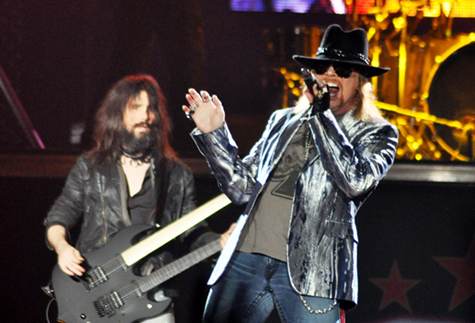 |
| Two necks makes a guitar twice as good, right? |
For all their lateness, and Axl’s prima-donna nature, you certainly get your money’s worth when it comes to length. The show runs for two and a half hours or so, running through their hits; ‘Welcome to the Jungle’, ‘Sweet Child O’ Mine’, ‘November Rain’, ‘Night Train’ and ‘Paradise City’, as well as squeezing in some famous covers like ‘Another Brick in the Wall Part II’, ‘Live and Let Die’ and ‘Knockin’ on Heaven’s Door’. I don’t really know much of their discography (I only really know ‘Appetite for Destruction’) I was a bit concerned that they’d be playing lots of songs I hadn't heard of, but even the ones I didn’t know were enjoyable enough. You have to hand it to Axl for giving it all vocally – it’s an impressive feat to get through such a long set and with difficult songs like this.
The music is all bravado and promotes a kind of hedonistic ‘kill or be killed’ masculinity. It’s pretty unreconstructed stuff, stuffed with complicated guitar virtuosity and powerful riffs. Axl’s singing voice is an impressive thing to behold throughout, sounding much the same as it did in the late 80s. There always seems to be room for a guitar solo, during which Axl pops off stage, and apparently huffs oxygen to keep going. This isn’t the original Guns n Roses though, rancorous legal divides mean that past members like Slash (who is largely responsible for their biggest hits) refuse to even be in the same room as Axl. But the current band acquit themselves well – they never seem anything less than professional and entirely competent. In fact they’re so professional that it can seem a little clinical at times. I imagine Axl runs a pretty tight ship improvisation-wise, and there isn’t really any sense of spontaneity to the performances. It’s not that it’s over-choreographed, just that Axl is always the centre of attention. It all revolves around him but then he’s the reason we’re there, so it’s hard to complain.
Unfortunately, at least where I was sitting, the crowd seemed somewhat comatose. Perhaps the wait between arriving and the band taking to the stage had finished them off? It’s a strange contrast to have pyrotechnic guitar solos onstage and someone gently dozing away next to you. I was up on Level 4 of the 02, so I guess these might not have been the most passionate members of the audience. As the night dragged on, the audience began to thin, tempted perhaps by the last Jubilee line tube home. I half considered leaving myself, being stranded in North Greenwich at 2am doesn’t sound like much fun at all, no matter how good the show is.
 |
| Imagine a boot stamping on a human face... forever. |
This incarnation of Guns n Roses is a hell of a spectacle. The thing is, they have to put on a big show. Their last album, ‘Chinese Democracy’ infamously took 15 years to be released, and then to middling reviews. It’s pretty clear that Axl Rose, bereft of Slash, is not going to be writing any new smash hits anytime soon. This is a genre of music whose day in the sun has passed, and what Axl has left is the name ‘Guns n Roses’, and a catalogue of nostalgically remembered hits from 20-odd years ago.
Guns n Roses have a lot working against them; the entire rest of the band acrimoniously quitting; a lack of any interesting new material and a lead singer who keeps audiences waiting for hours upon end – so it’s a little surprising that they still pack out stadiums. Tours like this are all Axl has left, and when the years take their toll, and his ego and gut continues to expand will the audiences keep coming back? I’d like to think so. It’s nice to have a little pocket of reality where leather, bandanas and guitar solos still rule the roost.
As for Axl himself, I’ve developed a strange affection for him, or at least, what he represents. I wouldn’t ever want to interact directly with the guy, but he is the quintessential pampered Spinal Tap-esque rock star. Do we really want to live in a world where big-headed rock stars can’t make ridiculous demands of their audience and strut around in ridiculous outfits while fireworks explode behind them? Yes, Axl Rose is unquestionably an egomaniacal prick. But frankly, I wouldn’t have it any other way.
Subscribe to:
Posts (Atom)