Recent Articles
Showing posts with label world war 2. Show all posts
Showing posts with label world war 2. Show all posts
Friday, March 15, 2019
Friday, March 15, 2019
- 0 Comments

Rating:

Just under a year ago I reviewed Parabolic Theatre's For King and Country, which tasked the audience with repelling a Nazi invasion of England in 1940. I loved it. Proper immersive theatre is surprisingly hard to find, with many shows billing themselves as immersive despite being nothing of the sort. But Parabolic do it right, trusting the audience to move the narrative along and nudging us towards developments that feel organic.
So when I was invited along to the sequel, For King and Country: 1944, I leapt at the chance. Whereas the previous show asked us to play a fictional government under threat of invasion, 1944 drops us into a United Kingdom now firmly under the Nazi jackboot. Operation Sealion was a success, Winston Churchill has been executed, the British Army is now under Nazi command and Oswald Mosley seems pleased as punch.
But all is not lost. It is June 6th, 1944 and on the east Irish coast there's an Allied liberation force formed of American and Commonwealth troops. They're preparing to invade Britain and drive the fascists out - but they're going to need support from Resistance fighters remaining in London if they're going to succeed. And that's where you come in.
Correctly taking the view that if it's broken don't fix it, 1944 is structurally very similar to its predecessor. The audience is divided into different departments which need to co-operate with one another to achieve shared goals, our decisions are evaluated and consequences decided off-stage and we must react and cope with events taking place around the country.
If this all sounds a bit intimidating, it is. At least to begin with. Though the audience is trusted to link pieces of information, draw conclusions from them and execute a plan, the cast is always ready to help and, if you're going seriously off-piste, will subtly point you back in the right direction.
I spent my time in the Intelligence Department, which consisted of poring over documents in order to direct the other departments towards military and espionage aims. Whoever at Parabolic is in charge of producing all this paperwork deserves some kind of award - it's all utterly convincing, full of world-building detail and has a trail of breadcrumbs scattered through it that rewards lateral thinking.


Based on these documents our team successfully sniffed out secret Nazi weapons programmes, made calls impersonating Nazi commanders so as to confuse the chain of command, and forged documents to get our spies and assassins where they needed to be. Now, you might not think forging documents would be particularly exciting - but it's surprisingly rewarding to figure out ways to replicate every last detail of a document with what you have to hand.
I don't want to explain too much more of what happens for fear of spoiling the surprise, but much like its prequel, I had a great time putting myself into another world and puzzling my way through a situation completely removed from my everyday life. Huge credit to the cast (Christopher Styles, Edward Andrews, Zoe Flint, Tom Black, Ed Cartwright, Beth Whitaker and Owen Kingston), who are some of the most quick-witted and natural improvisers I've seen in years.
So how does 1944 compare to 1940? Both are excellent shows, but I think the original remains the one to see. I think this boils down to 1944 feeling less dynamic: you are essentially a third party in the conflict between the Nazis and Allied Forces, which makes you feel slightly less involved in what's happening than if you were, say, commanding the invading forces yourself. Similarly, while the objectives and surprising developments are fun, there's nothing quite on the same level as the revelations you learn in 1940.
Plus - and this is in no way a criticism of the company or the show - at the performance I attended there were a couple of Hooray Henry city boys who got drunk, sniggered and whispered through the serious moments, and had to be told not to take selfies in the middle of the show. To the audience's credit, there were attendees who took the whole thing seriously, but it's a reminder that any show that relies so much on the audience can easily be spoiled by a couple of bad eggs.
If you've already seen and loved 1940, this is a no-brainer. The way Parabolic Theatre develop the story and construct a scarily believable world is way beyond what other immersive companies are trying to achieve. That said, it doesn't quite hit the heights of what came before, but it's still an easy recommendation.
For King and Country: 1940 and 1944 are playing on alternate nights (and as a weekend double-bill) at Colab Factory until April 28th. Tickets here.
Wednesday, April 25, 2018
Wednesday, April 25, 2018
- 0 Comments


'Immersive' is one of the great marketing buzzwords in contemporary theatre. Spurred on by the wild success of shows like PunchDrunk's The Drowned Man, it seems like every other show now bills itself as an immersive experience. Most of them simply aren't - they're either promenade pieces in which the audience watches a play staged over multiple rooms or just 'yer bog standard sit-down-and-shut-up play sandwiched between two thin bookends of interactivity.
So it's insanely refreshing that Parabolic Theatre and writer/director Owen Kingston's For King And Country is not just genuinely immersive, but that it takes full advantage of what immersive theatre can achieve.
The year is 1940, King Edward VIII sits on the throne alongside his wife, Wallis Simpson and Britain is in nervous turmoil. Nazi forces have seized the French Navy, crossed the Channel, landed on the south coast of England and are advancing towards London. The audience become the British Government's 'designated survivors' - a group of MPs and their families ordered to remain in an underground bunker and tasked with commanding of the war effort should the unthinkable happen to the sitting cabinet.

The unthinkable happens a couple of minutes after we take our seats and, under the guidance of a group of civil servants and military representatives, we form a new government and begin to formulate strategies against unfolding events. This consists of ordering the British forces around the south of England, keeping morale steady through inspiring and informative speeches and engaging in diplomacy with both the enemy and potential allies.

The unthinkable happens a couple of minutes after we take our seats and, under the guidance of a group of civil servants and military representatives, we form a new government and begin to formulate strategies against unfolding events. This consists of ordering the British forces around the south of England, keeping morale steady through inspiring and informative speeches and engaging in diplomacy with both the enemy and potential allies.
As MPs and Ministers we're expected to vote on issues like deploying chemical weapons, whether to execute Nazi prisoners accused of atrocities and whether to evacuate civilians from the cities, to name a few. These big decisions, and the actions we take in various ministries, have consequences - and we must rapidly adapt to these changing circumstances and try our best to keep wartime Britain in one piece and repel the Nazi invaders.
On paper it's a bit Mark Corrigan. Playing out an alt-history wargame and pretending to be old-timey generals and politicians doesn't exactly sound like the sexiest night in London - not to mention that the spitfires/blitz spirit/Winston Churchill/"Keep Calm And Carry On" (etc) iconography was mined to death over the Brexit campaign. There's a convincing argument that Britain needs to stop wallowing in a past that's all but faded from living memory and get a true picture of our geopolitical importance in 2018.
But For King And Country doesn't just fetishise the past, it uses it as a vehicle to examine very contemporary issues. For example, we instinctively and rightly condemn the use of chemical weapons in Syria, but you see the issue from a different angle when you're asked if you'd use them to prevent our country falling under Nazi rule. Everyone believes politicians should strive for honesty and transparency, but would the populace really be happier if they discovered British bombers had accidentally destroyed Canterbury Cathedral rather than the Luftwaffe?


Very quickly you start thinking of the people you are governing as resources to be utilised and problems to be solved, with high-falutin' ethical stances quickly sacrificed on the altar of the 'greater good'. If you can start to go mad with power after 15 minutes in a Borough basement, the mind boggles at what must be going on in the heads of politicians with real sway over people's lives. Realisations like these demonstrate the power of immersive theatre: we're not being lectured about the perils of power and the fog of war, we experience and understand it.
That the show achieves this so successfully is testament to the theatrical skill and intelligence with which its constructed. The cast (Christopher Styles, Edward Andrews, Zoe Flint, Peter Dewhurst, Tom Black, Michael Thomas, Lauren Reed and Owen Kingston) are the most flexible improvisers I've seen in a long time and are also possessed of a encyclopaedic knowledge of the time period. There is apparently nothing they can deal with without breaking character - their sincerity and skill subtly encouraging the audience to take the show seriously.
It all adds up an incredibly fun, thought-provoking and exciting night of theatre. One of the perils of truly immersive theatre is that the show is only ever as good as the audience that night, but I suspect For King And Country's careful construction will avoid that pitfall and encourage every audience member to be the best participant they can be.
In the murky sea of half-assed quasi-immersive experiences dotted around London, the sheer quality of For King And Country stands out a mile. It's the best thing I've seen this year so far - I can't recommend it highly enough.
Pictures by Owen Kingston
Wednesday, August 3, 2016
Wednesday, August 3, 2016
- 0 Comments

The asphalt of London is but a gateway. Under the streets lie a chaotic warren: from the familiar rumble of the Tube, to sewers, power lines and gas lines. Somewhere within this is nestled more anomalous creations: disused Post Office transit systems, long-buried underground rivers, the 'Pindar' military citadel and the mysterious top-secret 'Q-Whitehall' complex that reportedly begins under Trafalgar Square, spans Whitehall and ends at King Charles Street.
Knowing all this is going on underfoot makes London feel more magical, and that's on top of the 2,000 years of random stuff that we don't even know is there! For example, just a couple of years ago Crossrail excavations turned up a plague pit down the road from my house.
 |
| The shelter in its heyday, 1944 |
And last Sunday, courtesy of a birthday surprise from my very lovely girlfriend, I got a taste of of subterranean London history. The marvellous Hidden London, run by the London Transport Museum has been hosting tours of places the public doesn't usually get to go. Way back in 2012 I went down into the disused Aldwych Tube Station, but now they've expanded to run tours of Down Street Tube Station, the 'lost tunnels' of Euston, London's first skyscraper at 55 Broadway and the Clapham South Deep Level Shelter.
Entry is by an fat pillbox now unobtrusively subsumed into a modern apartment building. Within it lie 180 stairs, spiralling down into a wonder of 1940s engineering and a frozen slice of Blitz era London.
 |
| Areas named for British Naval officers |
From a contemporary vantage point it's difficult to imagine life during the worst months of the Blitz. Just how are you supposed to fall asleep when you know high-explosive bombs are raining down over the city? You might wake up with most of your neighbourhood destroyed, friends and family blown to bits. Hell, you might not wake up at all. The whole city must have been sleep-deprived and pretty goddamn miserable.
Faced with that, and against the wishes of the government, many sought sanctuary in the Tube. It might not be particularly comfy bedding down on a platform, but at least you'll survive. Except you might not. In October 1940 a 1400lb bomb slammed into Balham High Road, penetrating the street surface and exploding underground. Many of those sheltering in Balham Tube station were killed instantly by falling debris. They were the lucky ones. A broken water mains then flooded the station, meaning who survived the debris were drowned in pitch darkness "like rats in a cage".
 |
| The northbound platform at Balham, October 1940 |
Furious protests followed, with demands for deep-level shelters be constructed immediately to prevent disasters like this happening again. The government listened, reversedits policy overnight and ordered the construction of accommodation for 100,000 people in ten shelters: five in north London, five in the south. During construction two shelters were abandoned, one at St Pauls for fear of damaging the cathedral and the other at Oval due to poor ground conditions. The remaining eight opened in 1942, though weren't pressed into full service until the advent of the 'doodlebug' in 1944.
Most have now been sold to private companies, used as archival storage, homes for telecoms equipment or, more recently, hydroponic gardens. Yet the Clapham South shelter, left under the auspices of TfL, remains largely intact, allowing for what feels like a trip back in time.

Essentially the shelter is two long underground tunnels, bisected horizontally to create an upper and lower floor.Triple-tiered bunk beds stretch off into infinity, the guests jammed in with each other like sardines, not exactly the Savoy. It must have been a hell of a weird place to fall asleep, the air filled with a fug of sweat, cigarette smoke and farts, soundtracked by the clickety-clack of passing trains and the muffled thump of bombs far aboveground.
 |
| A blocked off exit to Clapham South station. |
Then again, if the choice is between that and getting blown to smithereens, then I'll take the tunnel. Things weren't all austerity down here, there was a canteen that was 'off-rationing', allowing for as many meat pies and jam tarts as you could afford. Similarly (and deeply emblematic of how living conditions improved in the postwar period) there were chemical toilets which might have been somewhat of a luxury for those forced to trek to an outhouse at night.
 |
| A not particularly comfy looking bed. |
Aside from actually sheltering the community, the shelters also functioned as an effective piece of propaganda. Newsreel was shot showcasing their security and safety; a way to reassure Londoners that they have a safe haven and also to stick two fingers up at the Nazis to show that they can't be beaten no matter what hi-ex horrors they toss over the channel.

But the story of the shelter doesn't conclude with Hitler blowing his brains all over a bunker wall. For about a decade afterwards it was used as temporary accommodation; postwar refugees travelling through London; visitors to the 1951's Festival of Britain; and, most fascinatingly, to house those who arrived on HMS Windrush in order to assist with the reconstruction of bombed out Britain. Eventually, after a damaging fire in the Goodge Street shelter, Clapham was mothballed in the 60s and largely remains so to this day.
 |
| Windrush passengers spending their first few nights deep under London. |
It isn't hard at all to imagine past visitors' reactions to seeing this weird, wonderful and obscure corner of London. The place feels as if it's essentially the same as when war-tired Londoners trooped down to escape the Luftwaffe. I found myself wishing I could spend a night down here, tasting the creosote and plaster tang in the air, and rocked gently to sleep by the rumble of the Northern line meters away.
 |
| Graffiti by bored Belgians. |
Though places are limited on the Hidden London tours, word is the shelter may be opened to the public in the next few years as a Blitz museum. So watch this space. In the meantime, if you're spending a quiet summer's day dozing on Clapham Common be sure imagine the thousands of people who once huddled in safety deep below your head. Who knows, the way things are going we might be thankful that these bomb shelters remain in working order...
Hidden London tour details here.
Wednesday, October 22, 2014
Wednesday, October 22, 2014
- 0 Comments

I should hate a film where a rough n' tumble gang of American soldiers mow down a faceless horde of baddies. But Fury's baddies are Nazis - fuck those guys. Nazis stand alongside zombies and killer robots as the guilt-free massacre of choice; you can have your hero mow down near-infinite numbers of them in casual bloodlust and still maintain audience sympathy. David Ayer's Fury tests this theory to breaking point, the film wading hip deep through tattered, bloody SS uniforms and bullet-punctured Swastikas.
The titular Fury is a beaten-up, battle-scarred Sherman tank full of beaten-up, battle-scarred men: Sergeant 'Wardaddy' (Brad Pitt), Bible (Shia LaBeouf), Gordo (Michael Peña), and Coon-Ass (Jon Bernthal). Set in April 1945, the film shows us the final Allied push into Germany. Victory is all but assured at this point, but pockets of desperate Nazi resistance remain. So the 2nd Armored Division is tasked with liberating town after town in anticipation of delivering the final blow on the streets of Berlin.
It's grimly miserable work, the remaining Nazi soldiers either suicidal fanatics or child conscripts, the civilians cowed into submission after years of war and the countryside ruinous and muddy. Our window into this world is Private Norman Ellison (Logan Lerman), a US Army typist who through an administrative error has been assigned duty inside Fury. Norman's boyish face looks positively virginal next to the existing crew, who look made out of worn-out shoe leather. They mock his naivety, hate his innate pacifism and resent his inexperience endangering them. So Wardaddy decides to bust this kid's cherry, the film chronicling the transformation of Norman, typist into Machine, bloodsoaked warrior.

In Fury, Ayer elevates war to religious calling. The soldiers, cocooned within the safety of their tank are painted as crusaders, devoted to enacting violence upon their enemies. Spiritual ecstasy is achieved via blasting high caliber rounds through Nazi flesh, the hitherto numbed characters springing to energised life and yelling "DIE YOU NAZI FUCKS!!!". Within this cloistered order, the tank is cathedral, Wardaddy is high priest with 'Bible' as his gunner. The innocent Norman is an initiate to this order, only truly accepted once he's been baptised in blood and rechristened 'Machine'.
It's perhaps not surprising then that one of the closing images is of the tank at the dead centre of a cruciform surrounded by hundreds of blown-apart Nazi corpses. The image of a war machine on the cross, sacrificed to absolve us of our sins is a pretty damn heavy symbol to throw our way - but what the hell does it mean?
Ayer, a former military man himself, is exploring the distinctions between the 'Golden Generation' that came through the depression and fought World War II and the modern first world - and finding us lacking. It's notable that Norman, the audience viewpoint, is a mild-mannered typist with no experience of real hardship. He is us; sat behind our computers tapping away online, tasting war through videogames and action movies.

Fury venerates the Golden Generation, placing them within an amped-up nightmare war that even actual surviving veterans point out is a bit too intense. Fury's argument is that when push comes to shove we need to relinquish kindness and transform ourselves into brutal executioners, reaching deep within ourselves to unlock our killer instinct.
With Brad Pitt as a character that takes inordinate pleasure from killing Nazis, comparisons have inevitably been made to Tarantino's Inglourious Basterds. A more worthwhile point of comparison is Basterds' film-within-a-film, Stolz der Nation, a faux-Nazi propaganda film where a heroic sniper makes a last stand against hordes of faceless Allied troops. In Basterds, this film satirises the audience's bloodlust for dead Nazis - and it structurally, visually and tonally echoes Fury.
So where does that leave Fury? A Christological propaganda film that deifies soldiers and killing and encourages us to emulate them? That's not good! Also a little worrying is Ayer's technical excellence; the battle scenes are an overwhelming experience with pinpoint perfect editing, sound design and score. It batters down your critical faculties, emotionally involving you in sadistic satisfaction at launching volleys of bullets into warm Nazi flesh.
The simple fact that we're vicariously enjoying massacring fascists soothes a little bit - after all if anyone's got it coming it's these bastards. But a film taking this much salacious pleasure in mass murder, no matter who the enemy, slips into military pornography. I'm not sure what to make of Fury. I enjoyed the hell out of it, but the more I think about it, the more that enjoyment freaks me out.
★★★★
Fury is released today.
Thanks to Vargo of Cinema Discusso for the religious observations
Thanks to Vargo of Cinema Discusso for the religious observations
Thursday, October 9, 2014
Thursday, October 9, 2014
- 0 Comments

If you're looking for an actor who can believably play a superhuman genius, Benedict Cumberbatch is your man. Since Sherlock Cumberbatch has displayed his mastery of a) talking very fast, b) being a charismatic prick and c) layering in a streak of humanising vulnerability. So who else do you call when you're casting Alan Turing, a genius prick with a vulnerable steak?
The Imitation Game opens with Turing's arrest in 1951 for indecency. This public outing was the beginning of a sad spiral of events that concluded with his suicide in 1954. Within the striplit police interrogation room Turing's skin takes on a deathly white pallor, as if his ghost talking to us from beyond the grave. "Pay attention", he sternly says, "or you're going to miss things."
Flashback ten years. Britain is at war with Germany and things are not looking good. With the aid of the famously 'unbreakable' Enigma encryption device the Nazis are able to coordinate surprise attacks across the Atlantic, sending tonnes of crucial food aid to the ocean floor. Britain is starving, bloody from being pummelled by the Luftwaffe and growing increasingly desperate - "we are losing this war". But at Bletchley Park a team of expert cryptanalysts is being formed, their ultimate goal to crack the Enigma code.

Turing, a man who "loves solving puzzles" is drawn to Bletchley like a moth to a flame, presenting himself to the commanding officer and straightforwardly telling him that his mathematical theories are the only realistic chance of beating Enigma. The rest of the film chronicles his time at Bletchley; his rocky relationship with his fellow cryptanalysts; his neuroses about his homosexuality; guilt at the growing pile of wartime dead and his fast friendship with the only person he considers smarter than himself, Joan Clarke (Keira Knightley).
For the most part this is riveting stuff. The plot rumbles along at a decent pace, historical details are keenly observed and Tyldum throws in a smattering of clever visual direction (tank treads match cut to spinning computer parts, torpedoes match cut to cigarettes being stubbed out). Importantly, the film goes to great lengths to give the audience the illusion that they're as smart as these characters. Cryptography, high level statistical analysis and mechanical computing isn't the most relatable (or cinematic) subject around, but The Imitation Game is smart enough to know how to communicate what's going on.
Most of the time this works. Using the ability to solve crossword puzzles as a mark of intelligence gives us a window into logical problem solving and the script is packed to the rafters with similes that more than outline how huge an endeavour cracking Enigma is. That said there are moments when things are dumbed down a touch too much, a late 'eureka!' moment must be on the first page of Codebreaking for Dummies. It's a delicate balancing act; if we're too far behind Turing's team we can't follow the action, if we're too far ahead they lose their mystique.
Slightly more egregious flaws lie in the film nakedly shooting for awards season success. This has Oscar contender written all over it - for the most part deservedly so. But there are moments where Alexander Desplat's overbearing score swells with strings and someone says something really damn corny like "sometimes it is the people who no-one imagines anything of, who do the things no-one can imagine". In a film full of largely naturalistic dialogue, crap like this stands out a mile - dialogue that feels written to be slotted into the trailer (as indeed it is). The nadir is the utterly moronic text that closes the film; "scientists called these devices Turing Machines." (dramatic pause) "We call them 'computers'". Well duh.

The Imitation Game's desire for mass market acceptance only truly trips up the film by mandating a rather cowardly depiction of sexuality. Turing's gayness thrums along behind Cumberbatch's performance throughout, but only comes to the foreground in the final act. Unfortunately while the film pays lip service to gay rights it doesn't have the balls to actually show Turing's sexuality. The character, by and large, ends up in a conventional love story with Keira Knightley's character with every act of gay affection taking place firmly off screen.
I strongly suspect this omission is made with one eye on the box office; the producers either fearing that audiences won't relate to an actively gay hero or, more pragmatically (and depressingly), knowing showing Turing even kissing another man will earn the film an automatic R certificate from the MPAA, with the resultant reduction in its potential audience.
It's a shame that The Imitation Game often feels like it's had its rough edges sanded away, as there's a barrel load of great stuff here. Cumberbatch, though essentially playing a spin on his Sherlock character, is fantastic as Turing and Knightley is comfortably his equal as a genius mathematician. The supporting cast is similarly impressive, particularly Matthew Goode as a suave codebreaker and Mark Strong as a weirdly droll spymaster.
It's more than worth seeing, and works beautifully as uplifting, tense and exciting entertainment. But you can't ever shake the impression that these events have been strained through an extremely efficient studio machine designed to filter out every bit of grit and risk. This means that despite the obvious effort and hard work that's gone into The Imitation Game it feels a mite insubstantial.
★★★
The Imitation Game is released 14th November 2014.
Thursday, May 1, 2014
Thursday, May 1, 2014
- 0 Comments

Hayao Miyazaki sits at the pinnacle of animation; his only equals Walt Disney and John Lasseter. His 30 year filmography, from Nausicaä of the Valley of the Wind to The Wind Rises, is beloved by children and adults across the whole world. Miyazaki poured his inspiration, his sweat and his passions into his cinema, never putting a foot wrong through his long, lauded career. And now it's coming to an end. Last year he announced that The Wind Rises was to be his final feature length film, followed by a relaxing, well-earned retirement.
It's appropriate then that The Wind Rises summarises Miyazaki's twin obsessions; aviation and morality. This is a highly fictionalised biopic of Jiro Horikoshi, man who designed fighter planes for Japan during World War II - the crux of the film the internal conflict of a talented, passionate genius whose masterpieces tear his world apart. We follow Horikoshi from his childhood daydreams of flight, through his education and finally his professional career working for Mitsubishi as war looms menacingly over the horizon. Save for the occasional dream sequences this is much more grounded than Miyazaki's usual fare, a straightforward, sober and emotional story so deeply felt that it feels like a true passion project.
From his first films, Miyazaki has always adored flight. Practically every film he makes has an exhilarating flight scene; highlights being Nausicaä piloting her Mehve, Satsuki and Mei being carried across the night sky in My Neighbor Totoro, Kiki riding her broomstick, the hero of Porco Rosso diving into aerial combat and Chihiro riding on Haku's back through the clouds in Spirited Away. Miyazaki sees the notion of flight as freedom, or his words, "a liberation from gravity". When his characters rise above the clouds they literally see the bigger picture, the action of viewing their world from on high exposing opposing sides as part of a larger whole.
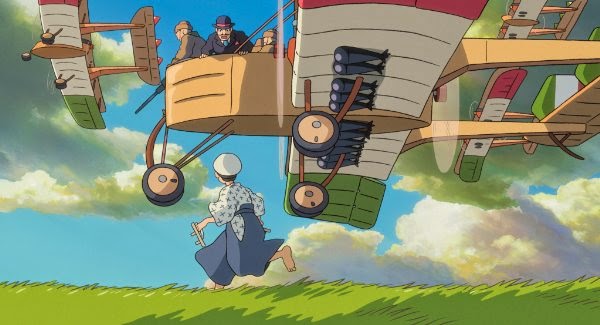
This goes hand in hand with his deeply held humanist morality. In contrast to the starkly manichean world of Disney with its clearly defined boundaries between good and evil, Miyazaki's movies never feature a true villain. There may be an antagonist, but care is taken to give them sympathetic motivations for their actions. My favourite example being Eboshi in Princess Mononoke, she's cutting down a forest in order to expand her industrial town which seems like classic environmental villainy. The twist is that Eboshi is a straightforwardly feminist defender of social outcasts, providing a refuge for former prostitutes and lepers. In Miyazaki's movies, just as in reality, good and evil are never as clear cut as they might seem.
These preoccupations reach their ultimate synthesis in the character of Jiro Horikoshi. We have to square his innate nobility, passion and quiet heroism with the fact that he's furthering the aggressive military ambitions of authoritarian imperialism. Even with the full knowledge of the misery his creations will wreak upon the world, we can't help but want him to succeed in creating beautiful flying machines - to realise his dreams even with their terrible cost.
As we progress through his life, we encounter portents of the oncoming war. A stunning sequence shows us Horikoshi navigating the Kanto Earthquake of 1923, which with its shockwaves tearing down buildings, enormous fires and earth-shaking booms is an eerie premonition of the later destruction of Hiroshima and Nagasaki. On a research trip to Nazi Germany we watch the secret police chase a man down, watching the shadows of a beating around an alley - a mysterious man (voiced the English dub by none other than Werner Herzog!) speaks darkly of inevitable, oncoming annihilation.
It's difficult not to read Jiro Horikoshi as a mirror of Miyazaki himself. Both men are expert draftsmen that transform pencil on paper into reality, both are torn between their professional careers and their personal lives, and most obviously, both dream of flying. These parallels raise an obvious question: how on earth are Horikoshi's planes and Miyazaki's animations connected? After all, one visits death and destruction upon the world, the other brings joy to millions.
The disquieting answer reveals a depressed, introspective Miyazaki - a man at the pinnacle of his profession, yet introspective, full of regrets and apparently a bit depressed. Knowing a little about Miyazaki's personal life, his estrangement from his son Goro and the amount of time he's devoted to his art at the cost of a family life helps appreciate the movie -a master film-maker questioning whether all these technical and artistic achievements were worth sacrificing his relationships for.
 |
| Here you have an artist puking blood onto a canvas. Draw your own conclusions. |
To that end, The Wind Rises sits apart from the rest of Miyazaki's filmography, hitting a sober, contemplative tone that makes it difficult to recommend for younger audiences. It's essentially a low-key, intimate arthouse film, yet produced to the highest possible standards of traditional animation - a unique combination in cinema. It's beautiful from top to bottom; art design, organic sound work and considered philosophy crystallising into a film that's as precision engineered as Horikoshi's fighter planes.
It'd have been easy for Miyazaki's final film to have been a triumphant victory lap, for the master to roll out one last optimistic fairytale. For him to give us this muted, introspective, rather depressing slice of self-criticism speaks volumes as to his honesty and intelligence. The Wind Rises is a Rosetta Stone for understanding the man behind the magic, and so the perfect capstone to a glittering career.
★★★★
The Wind Rises is on general release from May 9th
Tuesday, February 11, 2014
Tuesday, February 11, 2014
- 0 Comments

As we glide through the clouds the voice of Death assures us that we're all going to die and there's not a damn thing we can do about it. It's a pretty harsh way to open a sentimental film about a young girl, yet his words ring truer the longer the film goes on. The Book Thief is a film about the power of stories; the internal narratives we forge for ourselves, the realities imposed upon us by authority and the liberating power of the written word. However, as Neil Gaiman correctly identified: "the real problem with stories [is that] if you keep them going long enough, they always end in death.”
Adapted from the novel by Markus Zusak, The Book Thief charts World War II of a young German girl called Liesel (Sophie Nélisse). It's 1938 and her younger brother is dead, her mother is 'disappeared' Communist - with nowhere else to go she's placed with a non-descript German couple, Hans (Geoffrey Rush) and Rosa (Emily Watson). After a frosty beginning the three form a close-knit family unit, growing together as Europe tears itself apart.
As the years tick by Liesel gets an abridged version of the domestic German experience during the war; witnessing book burnings, her schoolmates becoming indoctrinated into Nazism, Jews having their shops ransacked and bundled into cars and the men in her life gradually being conscripted into the Nazi war machine. The most notable development is the arrival of Max (Ben Schnetzer), the Jewish son of an old war buddy of her adoptive father. The family hide him in their cellar and soon he and Liesel form a strong friendship, Liesel reading to Max from banned books she's appropriated from book burnings and private libraries and Max gently encouraging Liesel to express herself creatively through her writing.

For much of The Book Thief the war seems a distant concern. It's something you hear reports of in the newspaper, but the propagandist stories give little real insight into what's going on in the outside world. This puts Liesel's picturesque town in a bubble, a close-knit community where Nazism is an alien invader rather than something that's naturally sprung up within the community.
Pervical's film softly paints a picture that comes close to absolving the average German citizen of responsibility for the rise of Nazism. The majority of the townspeople we meet in this movie are kind, intelligent and understanding, most of them apparently secretly opposed to Adolf Hitler but intimidated into stepping into line and subsequently into uniform. The only 'true believers' we meet are obvious villains, cartoon pastiches of cruel bullies. While the Nazis obviously were cruel bullies The Book Thief presents us with an reductively Manichean world. In this film Nazi indoctrination becomes something that happens to other people, as opposed to the reality that racist, xenophobic, totalitarian fascism is something that, given the right conditions, can take deep root inside every human being.
Fortunately what the film lacks in narrative subtlety it more than makes up in careful visual storytelling. From the opening shot of clouds we quickly swoop down to following a train travelling through a snowy white field, white steam billowing from the smoke-stack. All too often these characters are surrounded by pure white snow, piled in heaps on the ground and gently fluttering down from the sky around them. This snow is the psychic echo of the pillars of ashes emanating from the ovens of Dachau that, unbeknownst to these townspeople (and certainly to the young Liesel), are burning not so far away. With the snatching of Jews from their shops, and later ragged, emaciated concentration camp victims marching down the street, they sense that something is deeply wrong but lack the information to articulate it - this unfocussed yet keenly felt guilt drifting in their streets, clogging their gutters and freezing their rivers.
Much like young Liesel, the film has it's heart in the right place yet occasionally struggles to articulate itself. From Death's opening lines we're know we're building to a morbid conclusion yet we get there by a frustratingly circuitous route: the film is never dull exactly but it comes perilously close. This largely a structural symptom, there's a few different mini-plots going on at once, and as these end there's pauses in the action where nothing much of interest is happening.
 |
| Geoffrey Rush is one of a very small group of actors who can retain our sympathy while dressed in a Nazi uniform. |
Preventing this stop-start narrative technique from torpedoing the film are the excellent performances throughout, with particular praise due to Geoffrey Rush's ultra-paternal Max - a rock of warm humanity within the nightmare of fascism. Emily Watson also impresses as the gradually thawing Rosa, effortlessly morphing from evil stepmother to nobly pragmatist. Roger Allam is a decently ambiguous Death (though his intonation distractingly recalls The Stanley Parable). But it's Sophie Nélisse that deserves the real plaudits, believably portraying the lead character over multiple years - somehow physically embodying every single stage of adolescence.
The only real problem with the performances is that there's the disappointing decision to have our leads speaking English with wobbly German accents rather than just speaking German. Annoyingly they decide to pepper the dialogue with the odd German word ('Ja' and 'Nein' instead of 'Yes' and 'No etc), as if they're scared we'll forget this is taking place in Nazi Germany (the omnipresent Swastikas kind of give it away...). Even more bizarrely they're not consistent about it, so some characters speaking in subtitles and some don't. This isn't so much of a problem when you're properly engaged in what's on screen but it definitely undercuts more than few dramatic moments.
Nobody is going to argue that the central message of the importance of books and how they teach you to viewing the world through a poetic questioning lens isn't a vital one, yet in my opinion it's a touch too vague, too fluffily humanistic to act as a true riposte to the horrors of Adolf Hitler. That said, the muffled sniffles from the audience as the credits roll is testament to the film at least succeeding on a emotional level.
★★★
The Book Thief is on general release from February 26th
Monday, January 27, 2014
Monday, January 27, 2014
- 0 Comments

In 1961 Hannah Arendt attended the trial of Adolf Eichmann in Jerusalem and coined the phrase "the banality of evil". That straightforward, iconic phrase quickly came to define one of the most publicised trials of the 20th century, perfectly encapsulating the frustrations of having an architect of one of the most horrific acts in human history on trial, and finding him to be 'just' a boring, run-of-the-mill bureaucrat. This film chronicles the impact of this trial on Arendt and the wider Jewish diaspora, following her as she travels to Israel to observe the trial, followed by her articles in the New Yorker and her controversial book Eichmann in Jerusalem, whose publication kicked up one hell of a stink.
Though Hannah Arendt keeps its focus on events surrounding the Eichmann trial, it also attempts to give us at least a cursory biography of its subject. She led a fascinating life, born to German Jews in Hanover, and going on to study philosophy under Martin Heidegger. As a student she entered into a passionate and complex romantic relationship with Heidegger, one severely tested by his support for the Nazi Party and her Jewish ancestry. As the Nazis tightened their grip on German institutions the life of a German-Jewish political theorist became ever more dangerous and she was forced to flee Germany for Paris in 1933.
In 1940 the Vichy Regime began to deport Jews to Nazi concentration camps. Arendt was arrested and interned as an "enemy alien". Again she was forced to flee, this time crossing the Atlantic to New York where she worked on behalf of Jewish organisations to aid those stranded in Europe. By the time we meet her in this film Arendt is a respected author, thinker and professor at the New School in New York, with a major work The Origins of Totalitarianism under her belt.

Barbara Sukowa plays her as confident and forthright, a woman possessed by the courage of her convictions and more than able to defend her views. She occupies a rarefied New York intellectual ocean, within which she is regarded as something of a big fish. Sukowa neatly captures the cloud of intimidation that accompanies people who are not only remarkable thinkers, but are all too aware of their own exceptionality. This stern, rigorous, chain-smoking exterior softens when she's alone with her beloved husband, but in all other regards the defences are up, the film making much of her stony face, behind which you can practically see the cogs and gears of her impressive mind whirring.
It's of course entirely appropriate that Hannah Arendt should be a cerebral film, and there's a refreshing lack of melodrama, the core premise being the publication of a political work, then subsequently defending it. As concepts go it's not immediately thrilling; after all, showing someone lying around smoking cigarettes and thinking really hard isn't exactly dynamic cinema. But rather than try to jazz things up, Von Trotta embraces a kind of no-frills aesthetic; working with a digitally restrained, desaturated colour palette and the absolute bare minimum of directorial frippery. This avoidance of any hint of studio glamour means the style of the film becomes a reflection of its subject, though that also means its a bit detached.
It's telling that the scenes where you get hints of genuine passion are the lectures/monologues by Arendt (which I assume are verbatim quotes). This reveals the film's true intention: not to entertain but to teach. There are moments when the film almost becomes a documentary, particularly during the Eichmann trial sequence where archive footage is cross-cut with a recreation. Particularly effective is the decision to only use footage of the real Eichmann rather than hire a lookalike. We can't help but stare into his face as he blithely argues that he was "just following orders". We try our best to somehow spot the monster within, but in the end we must throw up our hands and admit that there's nothing here except Arendt's "banal" man - a tactic that cleverly nudges us towards looking through Arendt's eyes.

Clever though this is it results in a smidge of intellectual myopia. As controversy builds concerning Arendt's arguments, we're told that numerous rebuttals to her are being published, but we never see them. This is a film that relies on a certain intelligence in its audience, so when we're confronted by the antagonists - represented as a gaggle of cartoon critics replete with snooty insults - it stands out as weirdly simplistic. It's totally reasonable for a film to take a certain viewpoint but it displays a curious lack of confidence to deprive us of even considering the opposing view.
It's refreshing to see a film that aims for the head rather than the heart; a film that understands that you don't need to dumb anything down and that simply being interesting and intelligent is more than enough to sustain our attention. The production design, score and performances are all quietly evocative without being overbearing, and Sukowa manages to make a restrained, frosty and intimidating woman heroic and charismatic at best, and deserving of respect at minimum. But the best praise I can give to Hannah Arendt is that it acts as a springboard to further learning, giving us a compelling and accurate overview of the life and work of a fascinating political theorist and academic.
★★★
'Hannah Arendt' is released on DVD today.
Subscribe to:
Posts (Atom)