Recent Articles
Showing posts with label animation. Show all posts
Showing posts with label animation. Show all posts
Thursday, October 20, 2016
Thursday, October 20, 2016
- 0 Comments

"Psychonauts, the Forgotten Children is a weird, brutal and lyrical Spanish animated film (with no connection to the Double Fine game of the same name) that feels like the mutant lovechild of Hayao Miyazaki and John Kricfalusi. Alberto Vazquez, adapting his own graphic novel with co-director Pedro Rivero, spins us a tale of cute child animals desperate to escape their nightmare island.
Any suspicions that this is for children vanish pretty quickly in the opening narration, which explains how Cute Animal Island industrialized itself and subsequently suffered a catastrophic nuclear meltdown. In an apocalypse scene reminiscent of Barefoot Gen, the mice workers are scorched into ashen skeletons by a wall of radioactive fire."
★★★
Tuesday, June 24, 2014
Tuesday, June 24, 2014
- 0 Comments

In
2010 DreamWorks Animation was primarily known for their onslaught of
pop-culture referencing, celebrity-voiced kids films populated by
cute animals that all make
the same face. Compared to the lyricism and beauty of
Pixar's output, Dreamworks Animation was looking increasingly cynical and
commercially driven. Then How
to Train Your Dragon came
out. The marketing made it look like just another identikit CG kid's
flick, but soon people began to sit up and take notice: this was an
animated film with a soul; a story about enacting social change told
with a Miyazaki-esque fixation on the joy of flight and mysteries of
nature.

After
a slow start the film quickly benefited from excellent word of mouth
and now, after a few straight-to-DVD shorts, videogames and a TV
series, the franchise returns to the big screen with How To
Train Your Dragon 2. The big question: can DreamWorks
Animation catch lightning in a bottle twice?
Set
five years after the events of the original, we rejoin Hiccup and his
dragon, Toothless to find them older, wiser and more focussed. The
town of Berk, having gotten over its antagonistic relationship with
dragons, now lives in a state of happy symbiosis with them. Hiccup is now the de facto hero of the town, and his father Stoick eagerly
anticipates him taking the reins and becoming Chief.
 |
| Sample dialogue: "YEEEARRGGGGHHH!!!!" |
Hiccup
has other ideas. Driven by wanderlust he speeds through the
clouds on top of Toothless, excitedly mapping out new islands and
devising new gadgets. By chance he
runs into a group of dragon trappers working for a warlord named
Drago. Drago is a half feral nutjob with a penchant for terrifying
screaming and skill for enslaving dragons. He's out to bring the
world under his heel, and only Hiccup and the town of Berk have the
knowledge of dragons to stop him in his tracks.
Bubbling
under all this is a debate about the merits of persuading people to
change their minds through peaceful rather than violent means. This thematically continues the last movie, Hiccup once again being an agent of
change in a sea of people patiently explaining that "some
things just can't be changed". But, whereas his
position was validated by the union of dragon and Viking before, the
waters are muddied by Drago, whose hellbent mania resists reasoned
debate. Unfortunately the film never satisfyingly resolves the
ethical problem it sets itself, somewhat half-heartedly concluding
that maybe some people's minds really can't be
changed.
 |
| Valka is awesome. |
This
colours the film with a tinge of pessimism. As the characters have aged so the world has become a bit more serious, replete with large scale battle
sequences and imagery of torture and death. This ain't exactly Lars
von Trier, but there's a growing sense of the burden of responsibilities and
the shucking off of youthful idealism.
But
where the film stumbles thematically, it more than picks up the slack
visually and aurally. The cinematography is stunning, though what else do you expect with Roger Deakins on board? His technique in animation is to treat the virtual camera as if it were real, which gives the action weight and authenticity. The flight sequences are still as
thrilling as they were in the original; the film making excellent use
of 3D as it sends audiences spinning through the clouds and over
oceans on Toothless' back. Capturing this exhilaration is
the key to making these films work; our enjoyment is mirrored in
Hiccup's face - we wholly understand his passions, love and fears.
Technologically
things have been bumped along a bit too in the last five years. The
2010 film was no slouch, but improvements in facial animation are
obvious. These characters, particularly our hero, act.
I don't know if they use motion capture or not, but there's a
realistic, almost naturalistic way to the way their tiny unconscious
tics play across the character's faces.
 |
| I wish I had a pet dragon. |
Most
impressive animation-wise is Valka, a new character who's spent the
last 15 years living with dragons. She moves as if dancing, both otherworldly and mysterious. All of my favourite
moments in the film revolve around her character, and among a stable
of broadly drawn comedic stereotypes she shines through as something
genuinely fascinating. Being voiced by Cate Blanchett helps,
but it's the way she moves around a room that gives you goosebumps - feral, wild and loving all at once.
Her
scenes are buoyed up by John Powell's playfully epic Celtic score. My
highlight is the music played when Valka and Hiccup fly together, the
characters moving between a bustling flock of dragons. Their
mutual happiness is infectious and for a moment all the drama drops
away and we're left with the simple pleasures of two people
discovering a mutual bond. The only minus point is the early
inclusion of the rather out of place pop song Where No One
Goes, whose processed vocals sit at odds with the folkish,
medieval spirit of the rest of the score.
How
to Train Your Dragon 2 is not as good as the original.
There's the occasional overlong lull in momentum; the film
doesn't quite have the confidence to be wholly sincere, peppering
otherwise touching scenes with gags; the thematic stuff is a bit
disappointing and the thrill of discovering a new world has begun to
evaporate. But despite all that, this is still a very good movie, and
though it doesn't hit the heights of How to Train Your
Dragon, it's definitely a worthy followup.
★★★
How to Train Your Dragon 2 is released July 11th
Thursday, May 1, 2014
Thursday, May 1, 2014
- 0 Comments

Hayao Miyazaki sits at the pinnacle of animation; his only equals Walt Disney and John Lasseter. His 30 year filmography, from Nausicaä of the Valley of the Wind to The Wind Rises, is beloved by children and adults across the whole world. Miyazaki poured his inspiration, his sweat and his passions into his cinema, never putting a foot wrong through his long, lauded career. And now it's coming to an end. Last year he announced that The Wind Rises was to be his final feature length film, followed by a relaxing, well-earned retirement.
It's appropriate then that The Wind Rises summarises Miyazaki's twin obsessions; aviation and morality. This is a highly fictionalised biopic of Jiro Horikoshi, man who designed fighter planes for Japan during World War II - the crux of the film the internal conflict of a talented, passionate genius whose masterpieces tear his world apart. We follow Horikoshi from his childhood daydreams of flight, through his education and finally his professional career working for Mitsubishi as war looms menacingly over the horizon. Save for the occasional dream sequences this is much more grounded than Miyazaki's usual fare, a straightforward, sober and emotional story so deeply felt that it feels like a true passion project.
From his first films, Miyazaki has always adored flight. Practically every film he makes has an exhilarating flight scene; highlights being Nausicaä piloting her Mehve, Satsuki and Mei being carried across the night sky in My Neighbor Totoro, Kiki riding her broomstick, the hero of Porco Rosso diving into aerial combat and Chihiro riding on Haku's back through the clouds in Spirited Away. Miyazaki sees the notion of flight as freedom, or his words, "a liberation from gravity". When his characters rise above the clouds they literally see the bigger picture, the action of viewing their world from on high exposing opposing sides as part of a larger whole.
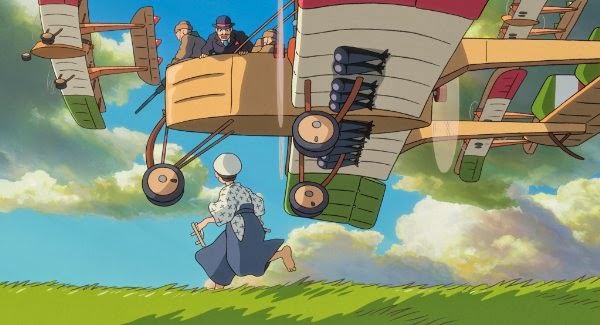
This goes hand in hand with his deeply held humanist morality. In contrast to the starkly manichean world of Disney with its clearly defined boundaries between good and evil, Miyazaki's movies never feature a true villain. There may be an antagonist, but care is taken to give them sympathetic motivations for their actions. My favourite example being Eboshi in Princess Mononoke, she's cutting down a forest in order to expand her industrial town which seems like classic environmental villainy. The twist is that Eboshi is a straightforwardly feminist defender of social outcasts, providing a refuge for former prostitutes and lepers. In Miyazaki's movies, just as in reality, good and evil are never as clear cut as they might seem.
These preoccupations reach their ultimate synthesis in the character of Jiro Horikoshi. We have to square his innate nobility, passion and quiet heroism with the fact that he's furthering the aggressive military ambitions of authoritarian imperialism. Even with the full knowledge of the misery his creations will wreak upon the world, we can't help but want him to succeed in creating beautiful flying machines - to realise his dreams even with their terrible cost.
As we progress through his life, we encounter portents of the oncoming war. A stunning sequence shows us Horikoshi navigating the Kanto Earthquake of 1923, which with its shockwaves tearing down buildings, enormous fires and earth-shaking booms is an eerie premonition of the later destruction of Hiroshima and Nagasaki. On a research trip to Nazi Germany we watch the secret police chase a man down, watching the shadows of a beating around an alley - a mysterious man (voiced the English dub by none other than Werner Herzog!) speaks darkly of inevitable, oncoming annihilation.
It's difficult not to read Jiro Horikoshi as a mirror of Miyazaki himself. Both men are expert draftsmen that transform pencil on paper into reality, both are torn between their professional careers and their personal lives, and most obviously, both dream of flying. These parallels raise an obvious question: how on earth are Horikoshi's planes and Miyazaki's animations connected? After all, one visits death and destruction upon the world, the other brings joy to millions.
The disquieting answer reveals a depressed, introspective Miyazaki - a man at the pinnacle of his profession, yet introspective, full of regrets and apparently a bit depressed. Knowing a little about Miyazaki's personal life, his estrangement from his son Goro and the amount of time he's devoted to his art at the cost of a family life helps appreciate the movie -a master film-maker questioning whether all these technical and artistic achievements were worth sacrificing his relationships for.
 |
| Here you have an artist puking blood onto a canvas. Draw your own conclusions. |
To that end, The Wind Rises sits apart from the rest of Miyazaki's filmography, hitting a sober, contemplative tone that makes it difficult to recommend for younger audiences. It's essentially a low-key, intimate arthouse film, yet produced to the highest possible standards of traditional animation - a unique combination in cinema. It's beautiful from top to bottom; art design, organic sound work and considered philosophy crystallising into a film that's as precision engineered as Horikoshi's fighter planes.
It'd have been easy for Miyazaki's final film to have been a triumphant victory lap, for the master to roll out one last optimistic fairytale. For him to give us this muted, introspective, rather depressing slice of self-criticism speaks volumes as to his honesty and intelligence. The Wind Rises is a Rosetta Stone for understanding the man behind the magic, and so the perfect capstone to a glittering career.
★★★★
The Wind Rises is on general release from May 9th
Sunday, May 12, 2013
Sunday, May 12, 2013
- 0 Comments

How do you judge the success of a children's film? I saw it with a cinema full of kids who laughed (though not uproariously) at the jokes, shut up for the emotional parts and I didn't see any particularly miserable children on the way out. There's certainly a convincing argument to be made that if a film aimed at children succeeds in entertaining them then it's a success. So what separates, say, Finding Nemo and Shark Tale? What's the quality that makes Kung-Fu Panda so much fun to watch and Bee Movie so dire? To young children the difference is intangible, but even so, deep down they must sense the difference in quality. Why else would films like Wall-E be so beloved and Robots (by the same director as Epic) be so forgotten?
Sunday, April 7, 2013
Sunday, April 7, 2013
- 0 Comments

The Adventures of Prince Achmed is the oldest surviving animated feature film. But to modern eyes it looks stylishly avant-garde, an piece of animation that by its very nature was experimental, yet one that's aged fantastically. The director, Lotte Reiniger, became fascinated with the art of silhouette animation as a child, building puppet theatres to entertain her family and friends. Her childhood passion developed as she grew up, becoming enchanted with the work of Georges Méliès, leading to her attending lectures by early film-makers who rhapsodised of the infinite possibilities of film and animation. Her passion stoked, she ran off to join the Theatre of Max Reinhardt, and began creating elaborate title cards for film production companies throughout Germany.
Subscribe to:
Posts (Atom)