Recent Articles
Showing posts with label Drayton Arms Theatre. Show all posts
Showing posts with label Drayton Arms Theatre. Show all posts
Friday, June 21, 2019
Friday, June 21, 2019
- 0 Comments


It's true you know. About the diamonds anyway. Atmospheric data for Jupiter indicates that lightning storms in the Jovian atmosphere turn methane into soot. Said soot hardens into lumps of graphite which in turn become diamonds that endlessly rain into the liquid sea of the planet's hot core.
What that has to do with the story of a woman dealing with her sex worker past beats me, but it's certainly a striking title. Written by Eleanor Ross and directed by Anastasia Bruce-Jones, It Rains Diamonds on Jupiter tells the story of Olivia (Rosanna Suppa). We meet Olivia as a 20-year-old student who has decided to make some extra money by working as what's billed as an 'escort', but is actually just plain old sex work. Her clients seem happy enough, her boss Bill (Jacob Melling) takes his cut and she gets paid.
The meat of the story takes place a few years later, with Olivia now established as a journalist. Despite her efforts to maintain a low profile she ends up working on television news. Bill spots her, and suddenly her past threatens to ruin the present. Can her career, relationships and sense of self survive the intense stigma that society places on sex workers?
It's a good question, and Ross (and everyone involved with this production) has clearly spent a long time thinking and arguing about it. Throughout the play we see various perspectives on sex work: ranging from a self-professed feminist accusing Liv of betraying women by confirming men's misogynistic fantasies, through to sex work being a way for women to achieve financial independence. There's also a strong sense of class consciousness in the piece, with the script at pains to contrast Olivia's financial needs in comparison with her privileged colleagues (who can afford to take unpaid internships and so on).
What our heroine Olivia thinks is somewhat murkier. Her battle isn't about whether what she did was right, but dealing with intense fear and paranoia of how everyone will perceive her if they knew the truth about her past. While there is a growing movement to destigmatise sex work (impressively staged in the Bunker Theatre's recent Fuck You Pay Me), activists face a long uphill climb. Even in our theoretically liberated times, former and active sex workers are widely considered desperate, immoral and innately unclean, and that's unlikely to change anytime soon.
Suppa does a great job of filtering all this through Olivia: an honest, personable character who gradually unravels as she struggles to reconcile her present with her past. There are a lot of perceptively written and performed passages in which she teeters on the edge of a panic attack, her terror at being exposed visceral and touching.
Though Suppa knocks it out of the park, the play is studded with smaller performances worthy of note. Duncan Hess' older client is an obvious highlight, rambling on and clearly nervous at what's expected of him. Jacob Melling's Bill is also interestingly complex, putting up an aggressive front to conceal an obvious shame burning at his core.
But for all these positives, It Rains Diamonds On Jupiter really feels like it needs a few more drafts. While I have no idea as to the play's production, it feels as if it arose from some intense group discussions about what sex work means, with the eventual narrative stretching to accommodate many points of view. This results in a loss of focus that muddies what's trying to be communicated.
It means that, particularly in the back half, there are narrative strands that simply don't go anywhere. Theoretically, the drama is powered by Olivia being blackmailed by Bill, though this quietly fizzles out as he apparently just decides to... stop? Similarly, there are extraneous (though still well written) scenes in which Olivia encounters a fellow sex worker, a bizarre non-sequitur involving a man whose wife is in labour and an ending that doesn't resolve anything. All of the above scenes tell us something about Liv, though Suppa's performance is good enough that she could be trusted to tell us them through her acting skill alone rather than didactic writing.
This might be why a play billed in advance as 1 hr 15 mins long actually comes closer to 1hr 45mins. A pair of sharpened editing scissors and a 'kill your darlings' approach would work wonders here - if some of the more meandering elements were snipped away this would be a powerful and memorable hour of theatre.
The moment-to-moment writing is great, I have nothing but nice things to say about Suppa's central performance and the playwright clearly has her priorities in the right places. It's so close to being great, but some storytelling discipline would go a long, long way here.
It Rains Diamonds on Jupiter is at the Drayton Arms Theatre until 22nd June. Tickets here.
Tuesday, October 9, 2018
Tuesday, October 9, 2018
- 0 Comments
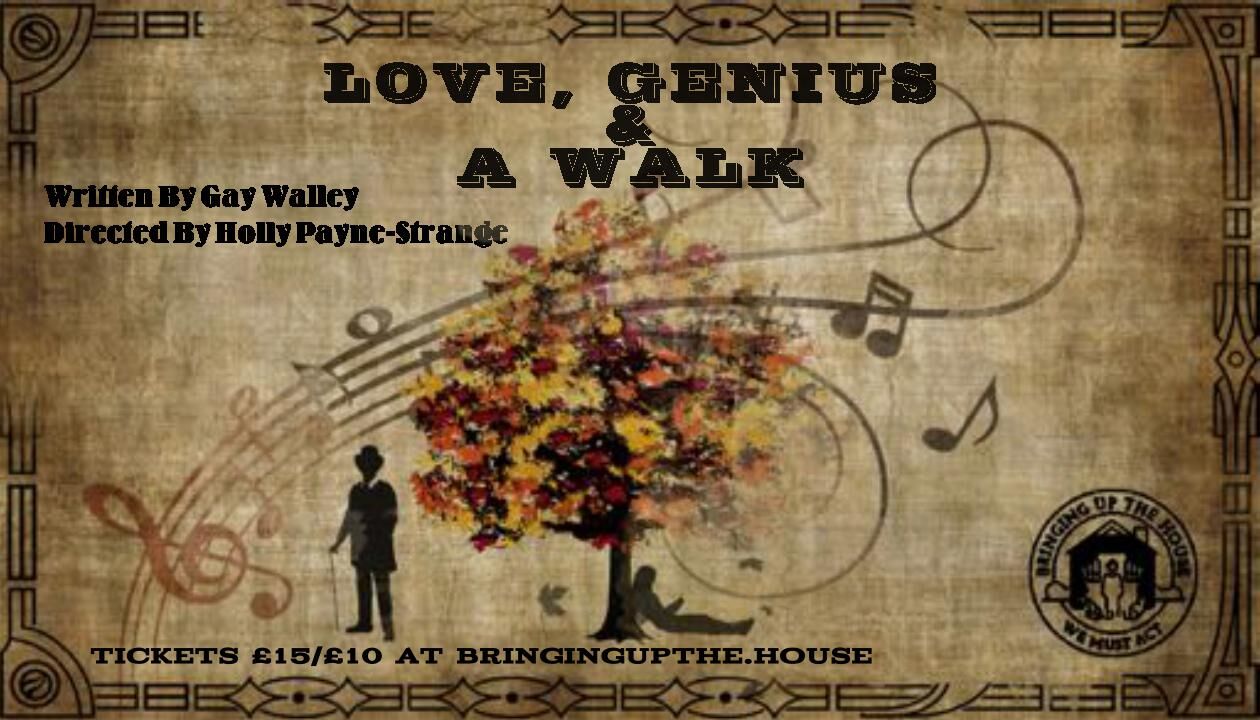

On the 26th of August 1910 in Leiden, Sigmund Freud and Gustav Mahler met for four hours. Love, Genius and a Walk imagines what they might have said. For classical music buffs, their chat is a tantalising opportunity to get under Mahler's skin in the year before he died. We know he was having marital problems relating to his young wife Alma, we know he was working hard on his (never completed) Symphony No. 10, and we know that afterwards, he was quite a different man.
This conversation is at the core of Gay Walley's play and comprises much of the final act. The rest of the play tries to get under the skin of Gustav's marriage with Alma, which includes a passionate affair with Walter Gropius (who would go on to found the hugely influential Bauhaus school).
All that is bookended by the marital problems of a contemporary couple in New York. He's a Wall Street risk manager / she's an unsuccessful but well-regarded author who is currently researching Mahler.
Writing a play about geniuses is never easy (for obvious reasons), and Love, Genius and a Walk struggles to convince. The act of Mahler's composition - which to me seems like one of his core elements - is reduced to him hunched over a desk occasionally. A little more egregiously we're constantly told but not shown how great his music is. There are frequent scenes in which it's breathlessly communicated how he plumbs the depths of human emotion, but we only actually get to hear a very short excerpt as the play finishes.
Freud doesn't fare much better - feeling like an aphorism-machine rather than a three-dimensional character. It's a bit weird when the Freud in Bill and Ted's Excellent Adventure is a more believable version of the man, but heyo.
Despite all that, Lloyd Morris and Brendan Wyer are decent enough actors and the conversation the play centres on works well enough. Their moments together are easily the best bits of the play. If the play had 'just' dramatised their conversation that might have been enough.
And then there are the scenes set in the modern day. Hot tip playwrights: if you want me to care about your characters' woes do not make them two of the most egregiously awful arseholes you can conjure. Now, Benjamin Murray's Steve being a prick is fine, sure he fails at being wryly unpleasant and lands at just-plain-unpleasant, but at least he's supposed to be awful. Helen Cunningham's 'The Writer' however - boy fuckin' howdy...
What theatre really doesn't need right now is privileged white women ennui-ing all over their fancy Manhattan apartments about how they're torn between their arsehole husband and some floppy-haired drip. Maybe its Cunningham's affected *yawn* seen it all before line delivery, maybe it's the way she and her husband casually shit all over what they consider 'low' culture, maybe it's just because for all their her supposed intelligence and culture she clearly has nothing to say about the world...
Let's just say it's difficult to care about characters' problems when you're imagining them blindfolded, stood against a concrete wall and being offered a last cigarette.
While the core idea of imagining what Mahler and Freud discussed is fine, I simply didn't enjoy Love, Genius & A Walk. It's over-long, pretty damn boring and, as a singer-who-now-shall-not-be-named once wailed: "it says nothing to me about my life." I suspect it won't say much to you either.
Love, Genius & A Walk was at the Drayton Arms Theatre on 7-8 October 2018.
Wednesday, September 23, 2015
Wednesday, September 23, 2015
- 0 Comments

Eugene Ionesco's The Lesson is a tremendous feat of writing. A key piece in the postwar 'Theatre of the Absurd', it's about a Professor giving an extended lesson to a bright-eyed young pupil. Other than the occasional intervention of the Professor's maid the entire play consists of this lecture, which grows increasingly bizarre. Covering arithmetic and philology, the Professor's tangled explanations and theorising quickly becomes a thicket of brain-numbing non-sequiturs and ludicrous pronouncements - all presented with rock-sold authoritarian confidence.
It's an excellent choice for a fringe production: reliant on dialogue rather than whizz-bangery and with malleable enough edges to allow for creative production design. First impressions are excellent, this is a visually striking set made a bedraggled carpet with test-tubes of dry paint suspended from the ceiling. Fishing line demarcates the boundaries of the stage, causing little silvery lines to flit in and out of view as the air moves around the room. Staged in the round, the set feels a bit like a boxing ring - entirely appropriate given the adversarial nature of the play. Designers Audrey Guo, Frances Jialu Chen and Tan Hua should be proud of themselves.
Similar levels of quality are found in Kelly Blaze's squeakily vulnerable pupil. Brimming over with eager nervous energy, she manipulates the audience with Shirley Temple cuteness layered with subtly dark strands. Her initial interactions with the Professor feel like Red Riding Hood meeting the wolf: innocence versus predatory hunger. As the play progresses the character becomes increasingly uncomfortable - suffering a painful toothache that eventually envelopes her body. In straightforward performative terms, Blaze sells the hell out this - running through 30ish minutes of agonised wriggling with ease.
All of the above is ace and would ordinarily comprise the bedrock of an excellent piece of fringe theatre. Sadly this is not to be, as this production of The Lesson is entirely ruined by one element: Toby Osmond's Professor.
First thing's first: he kept forgetting his lines. Now I'll give a tiny bit of leeway on this, the Professor role in The Lesson has the vast majority of the dialogue to the point where the play is essentially one long monologue. On top of that, it's a Byzantine, repetitive monologue that constantly loops around itself. Then again, Osmond is a professional, trained actor and learning complex parts is, y'know, his job.
Anyway, I can forgive the occasional memory misfire - it happens to the best - but seven or eight in one performance? Not helping at all is that rather than working around the problem and improvising until he picks up the thread (which Ionescu's style of dialogue gives you scope to do) he pauses, breaks character and tetchily shouts "Line?" at the stage manager. This is an intense piece of drama made of subtle rhythms and mounting tension - all spoiled by these constant gaffes.
But even when he remembers his lines Osmond is terrible. Wooden as all hell, he recites rather than performs the role, not sounding remotely convinced of anything he's saying. This is the key to the Professor's character - delivering stentorian gobbledegook as if it's the most obvious thing in the world, and it's utterly bungled.
There's also zero tonal progression to his performance. The dramatic curve of the play is such that, at least in the first few interactions between Professor and pupil, this could be a vaguely naturalistic bit of teaching. Ideally, as the drama ramps up and the pupil's grows ever more distressed, the Professor role should dovetail with it - growing monstrous as she shrinks in fear. Osmond doesn't do this, from minute one locking into a single tone, style of delivery and set of mannerisms that he maintains without change for the duration. It's a sad indictment of a performance when the closest an actor comes to communicating character development is taking his shirt off.
This production feels designed to impress. The creative team are all recent graduates from China now working in London and it's clear that no small amount of their blood and sweat have been poured into The Lesson. Similarly, the performances of Kelly Blaze and Roslyn Hill's (even in a minor role) are easily to the standard of the London stage. Toby Osmond's isn't: he's not only unprepared but unable to perform this role to a satisfactory degree and singlehandedly ruins what would otherwise have been a decent show.
★★
The Lesson is at the Drayton Arms Theatre until the 26th of September. Tickets here.
Friday, May 29, 2015
Friday, May 29, 2015
- 0 Comments

No-one can deny that they've crammed an awful lot of talent into the top floor of the Drayton Arms Pub. The Theory of Relativity, a loosely constructed chamber musical by Neil Bartram, works as a beautiful showcase of what these impressive young talents can put together. It's always a pleasant sensation to spot familiar performers on stage, even more so when they're generally among the stand-outs of their various productions.
Structurally, The Theory of Relativity is a series of vignettes centred around the, interconnected lives of a group of college-age Americans - their fears, passions, histories, ambitions and desires. For example, a woman sings out a bad relationship, a man experiences melancholy at life at home moving on whilst he's at college, a nervous physics major prepares for a date, someone deals with their cat allergies and so on.
But.... *deep breath*.
This is gloopy, sentimental, mawkish-as-all-hell BULLSHIT! Listening to college kids moaning about their parents getting divorced, worrying that their parents want them to be an electrician or simply yammering out syrupy, Hallmark card level rubbish about how much we all need each other jams on my annoyance button like few others. It's not just that it's painfully North American in that moronically sincere starry-eyed 'aw gee we're all super wonderful, folks' kinda way, it's that these are the epitome of 'white people problems'.
Worse, it's swaddled in layers of pseudoscientific claptrap in which, say, Newton's laws of motion, or Einstein's theories used as metaphors for human relationships. I reserve an especially acrid place in my heart for this kind of thing, literary devices that are as cliched as they are unimaginative. Now, I'm not some stone-hearted cynic - I don't mind the occasional dab of sentimentality - but this is about as fun as being forced to smoke a whole pack of cigarettes.
*and exhale*
Having said that, I can't pick any holes in this particular production. These are performers so talented that it's a tiny bit awe-inspiring to spend an hour or so in the same space as them. In concert, they project an incredible confidence and charisma, looking like nothing less than the future shock troops of the West End. They carry themselves with the subtly unconscious ease you see in people who are not only naturally gifted, but have the discipline to elevate their talent through countless hours of practise and toil.
I was pleased to see Joshua LeClair, who impressed as Arpad in She Loves Me back in February. Sure, the metaphor for sexuality at the centre of Apples and Oranges is, to put it mildly, torturous - but he performs the hell out of it, crowbarring every nugget of emotion and personality he can.
I also got a tiny little thrill when I realised Natasha Karp was in this, who stood out a mile at the recent You Won't Succeed On Broadway If You Don't Have Any Jews revue. She was the best thing there and one of the best things here, mixing up a rat-a-tat vocal style with believably frazzled physicality in Cake and, in The End of the Line, one of the more palatable (by which I mean crueller) songs, affects a quick and effective physical transformation alongside Ina Marie Smith.
As a demonstration of talent, The Theory of Relativity is hard to find fault with. The jaunty, upbeat book covers a wide range of styles - from Sondheim-esque word salads right through to hyper-emotional torch songs. This gives every performer space to excel, making for a truly egalitarian show where all are on equal footing. It's just a damn shame that the tone of the show is so pukemakingly cheerful - with just a sprinkling more poison and a little pinch of malevolence I'd have found it much more palatable.
★★★
The Theory of Relativity is at the Drayton Arms Theatre until 13th June. Tickets here.
Sunday, September 8, 2013
Sunday, September 8, 2013
- 0 Comments

Ah Othello: epitome of nobility, driven to the depths of misery by evil manipulation. Described by eminent Shakespearian scholar A.C. Bradley as "the most romantic of all Shakespeare's heroes" and "the greatest poet of them all". As his beloved wife Desdemona perishes beneath his hand, we feel the most intense sympathy: here is a good man whose true love has been twisted, shoved unjustly towards murder. Why - he's hardly guilty at all!
That's the traditional reading. But what Othello Syndrome argues is that Othello's nobility is an illusion, that we labour under a wantonly blind reading of his actions - his romance actually disturbing, violent and controlling. Here, Othello's manipulation by Iago is not a monstrous perversion of Othello's good nature, but a light tap that knocks down a house of cards; exposing this oh-so-admirable nobility as a symptom of internalised misogyny, pent-up violence and a sociopathic possessiveness.
Subscribe to:
Posts (Atom)


